Category: Ethereum news

  • Vitalik Buterin Warns Crypto Price Growth Is a Double-Edged Sword

    Vitalik Buterin Warns Crypto Price Growth Is a Double-Edged Sword

    Vitalik Buterin, founder of Ethereum, described crypto price growth as an “ultimate double edged sword” during a December 5, 2025 interview on the Green Pill podcast. He explained that while rising prices have helped fund innovation and attract attention to blockchain technology, they can also risk shifting focus away from the original purpose of decentralized systems.

    Vitalik Buterin at Green Pill podcast

    Buterin outlined three major directions that shaped the crypto ecosystem from the beginning. The first is censorship resistance, which allows users excluded from traditional banking systems to access alternative financial tools. This principle, he noted, remains central to blockchain’s value proposition.

    Institutional Design and Long-Term Stability in Crypto Systems

    The second direction involves the “number go up” culture, which supports development but can weaken long-term priorities if speculation dominates. The third focuses on institutional design, ensuring decentralized systems can sustain themselves without eventually becoming centralized structures similar to traditional financial institutions.

    Disclaimer

    This content is for informational purposes only and does not constitute financial, investment, or legal advice. Cryptocurrency trading involves risk and may result in financial loss.

  • Aave Records $5.4 Billion ETH Outflows After rsETH Exploit Triggers Liquidity Concerns

    Aave Records $5.4 Billion ETH Outflows After rsETH Exploit Triggers Liquidity Concerns

    Decentralized lending protocol Aave has experienced more than $5.4 billion in Ether outflows following a security incident tied to rsETH, raising fresh concerns about liquidity risks across decentralized finance markets.

    Data shared by Lookonchain indicates that the issue began after an exploit involving Kelp DAO allowed an attacker to deposit rsETH and drain ETH liquidity from the lending pool. The incident reportedly left Aave with a portion of bad debt, intensifying fears among large holders.

    Whale Withdrawals Accelerate After rsETH Exploit

    The exploit triggered a wave of withdrawals from major investors, often referred to as whales, as confidence in the platform temporarily weakened. Among the largest withdrawals was by crypto entrepreneur Justin Sun, who removed 65,584 ETH, valued at approximately $154 million, from the protocol.

    Blockchain data shows that this mass withdrawal trend contributed significantly to the overall outflow total, marking one of the largest single-day liquidity movements recorded on the platform in recent months.

    ETH Utilization Rate Reaches 100% Amid Liquidity Pressure

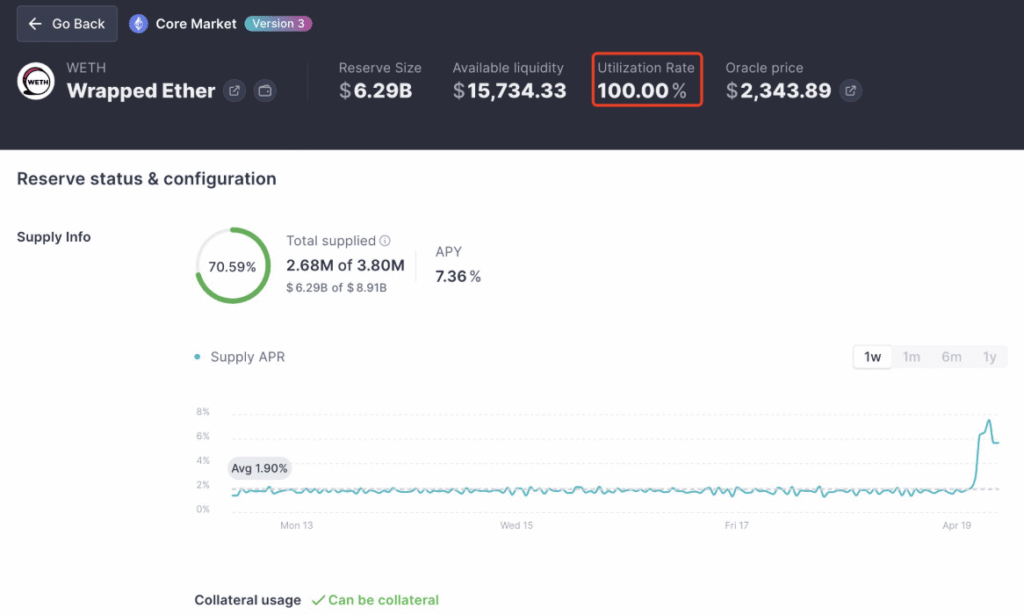
    As withdrawals intensified, Aave’s ETH utilization rate climbed to 100%, indicating that nearly all available Ether within lending pools had been borrowed or withdrawn. Such conditions can increase borrowing costs and heighten the risk of liquidity shortages if inflows do not recover.

    Market observers note that the situation highlights ongoing risks associated with liquid restaking tokens and interconnected DeFi protocols, particularly during periods of market stress and security-related uncertainty.

    Disclaimer

    This content is for informational purposes only and does not constitute financial, investment, or legal advice. Cryptocurrency trading involves risk and may result in financial loss.

  • Ethereum Co-Founder Warns of AI Centralization Risks and Predicts Machine-Driven Crypto Economy

    Ethereum Co-Founder Warns of AI Centralization Risks and Predicts Machine-Driven Crypto Economy

    AI and Blockchain Convergence Driving Future Digital Economy

    Ethereum co-founder Joseph Lubin has warned that artificial intelligence and blockchain technology are rapidly merging, creating the foundation for a machine-driven global economy. He explained that autonomous and semi-autonomous digital agents will increasingly transact, coordinate and verify activities across decentralized networks, using blockchain systems as their financial infrastructure.

    Lubin noted that these advanced interfaces could allow users to interact with complex crypto platforms through simple instructions rather than technical processes. In this model, artificial intelligence acts as a bridge between users and blockchain protocols, simplifying operations such as payments, asset transfers and financial management.

    However, he cautioned that risks could grow if artificial intelligence systems remain concentrated in the hands of a few major technology companies. According to him, decentralized cryptographic networks will play a crucial role in maintaining transparency and ensuring that systems can independently verify transactions without centralized authority.

    MetaMask Development and Growth of Tokenization

    Lubin also highlighted the ongoing transformation of MetaMask into a user-controlled financial platform that functions like a personal banking system. He described it as evolving toward a “personal money operating system,” capable of managing digital assets and interacting with decentralized services through automated tools.

    He added that stablecoins are acting as an early step toward broader adoption of decentralized financial systems, although many still depend on centralized issuers. Tokenization of traditional assets is expected to expand as financial institutions increasingly adopt blockchain technology.

    Quantum Computing Risks Considered Manageable

    Addressing concerns about quantum computing, Lubin described the technology as a long-term challenge rather than an immediate threat. He said developers have been preparing protective upgrades for years, suggesting that future improvements will be integrated into Ethereum’s natural evolution as the ecosystem continues to expand.

    Disclaimer

    This content is for informational purposes only and does not constitute financial, investment, or legal advice. Cryptocurrency trading involves risk and may result in financial loss.

  • Ethereum NFT Platform Foundation Shuts Down After Failed Blackdove Acquisition

    Ethereum NFT Platform Foundation Shuts Down After Failed Blackdove Acquisition

    One of the prominent marketplaces from the 2021 NFT boom, Foundation, has announced it will shut down operations after a planned acquisition by digital art distribution firm Blackdove collapsed.

    Founder and CEO Kayvon Tehranian confirmed the closure in a statement posted on X, explaining that the intended sale was meant to keep the platform running under new ownership. He said that outcome was no longer possible and that the company lacked the resources to relaunch the marketplace independently. Foundation later noted the site would temporarily return to allow users to delist NFTs before permanent closure.

    Launched in early 2021 during the peak of NFT adoption, Foundation facilitated more than $230 million in primary NFT sales. The platform hosted digital works from artists including Jen Stark, James Jean and Reuben Wu. It also featured work by whistleblower Edward Snowden, whose NFT titled “Stay Free” sold for about 2,200 Ether, valued near $5 million in 2021.

    The shutdown highlights the ongoing contraction across NFT markets as liquidity declines and fewer independent platforms remain viable. Several platforms have recently exited the space, including Nifty Gateway and Rodeo, while MakersPlace closed last year and X2Y2 pivoted away from NFT trading.

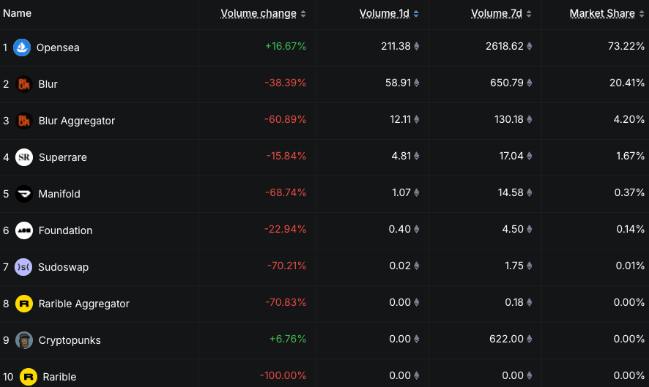
    Despite the downturn, OpenSea remains dominant, accounting for more than 73% of sector activity, with competition from rivals such as Blur. Some industry leaders, including Yat Siu of Animoca Brands, believe the NFT sector could eventually recover and reach new highs.

    Top 10 NFT marketplaces by volume.: DefiLlama
    Disclaimer

    This content is for informational purposes only and does not constitute financial, investment, or legal advice. Cryptocurrency trading involves risk and may result in financial loss.

  • Ethereum Researcher Josh Stark Departs Ethereum Foundation After Five Years

    Ethereum Researcher Josh Stark Departs Ethereum Foundation After Five Years

    Leadership Exit Marks Most High-Profile Change Since 2025 Restructuring

    Key researcher Josh Stark has announced his departure from the Ethereum Foundation after five years, marking one of the most notable exits since the organization’s leadership overhaul in 2025. Stark, who served as a researcher and project manager, confirmed the decision in a public statement but did not provide a specific reason for leaving.

    He said he has no immediate professional plans and intends to take personal time to focus on family and friends. Reflecting on his time within the ecosystem, Stark noted that many early doubts surrounded whether Ethereum could successfully launch decentralized finance or transition to Proof of Stake, milestones that were eventually achieved despite skepticism.

    Stark was also one of four individuals listed under management in the Foundation’s organizational structure, with most staff reporting through that leadership layer. His departure follows the resignation of contributor Trent Van Epps, who stepped down a week earlier.

    Ongoing Organizational Changes Continue After 2025 Shakeup

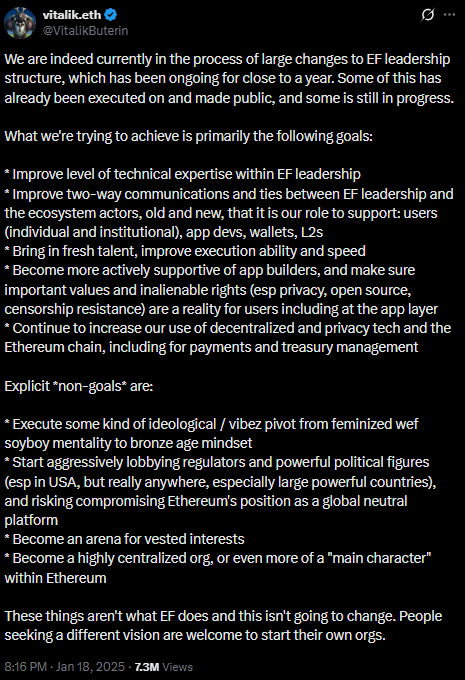
    The latest leadership changes follow sweeping reforms introduced in January 2025 by Ethereum co-founder Vitalik Buterin in response to community concerns about the ecosystem’s long-term direction. The restructuring focused on bringing in fresh talent, increasing decentralization, and improving transaction throughput and speed.

    In March 2025, the Foundation appointed Hsiao-Wei Wang and Tomasz Stańczak as co-directors. Stańczak later stepped down in February 2026, while Wang continues to serve on the management board, according to the Foundation’s latest organizational chart.

    Disclaimer

    This content is for informational purposes only and does not constitute financial, investment, or legal advice. Cryptocurrency trading involves risk and may result in financial loss.

  • Bitcoin Bulls Target $125,000 as Negative Funding Rates Signal Short Squeeze Potential

    Bitcoin Bulls Target $125,000 as Negative Funding Rates Signal Short Squeeze Potential

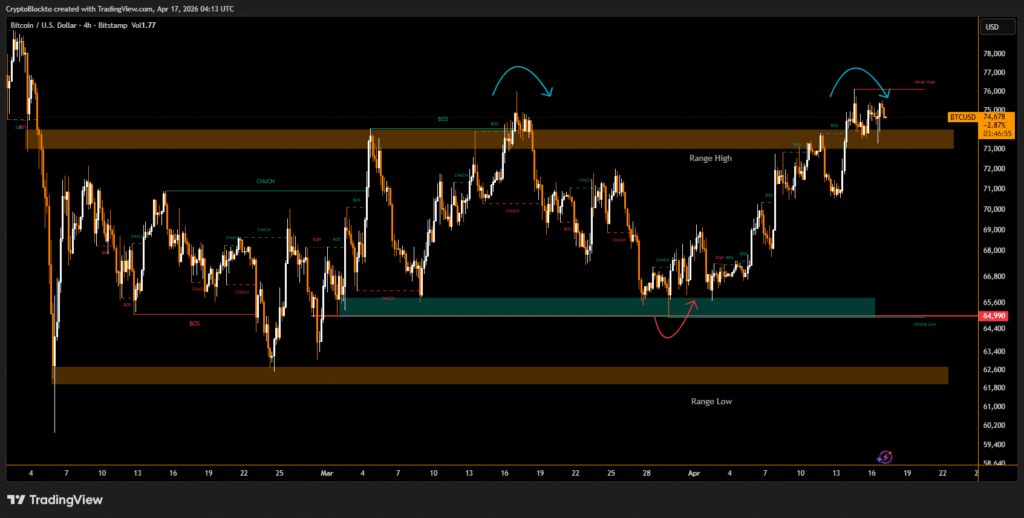
    Bitcoin hovered around $74,600 in Friday’s Asian session, slipping 0.4% over 24 hours but maintaining a 3.5% weekly gain following a strong 10-day rally in global equities. Investor sentiment improved ahead of the upcoming U.S.–Iran ceasefire deadline, which has helped ease geopolitical risk concerns.

    $BTC 4h price chart

    Global benchmarks such as the MSCI All Country World Index and the S&P 500 recently reached record highs before modest declines. Meanwhile, Brent crude fell 1.2% to $98.20 after Donald Trump said prospects for a permanent Iran ceasefire were “looking very good,” claiming Tehran would abandon nuclear ambitions and reopen the Strait of Hormuz, though Iran has not confirmed this. Separately, Benjamin Netanyahu confirmed a 10-day ceasefire between Israel and Lebanon, contributing to reduced war-related market premiums.

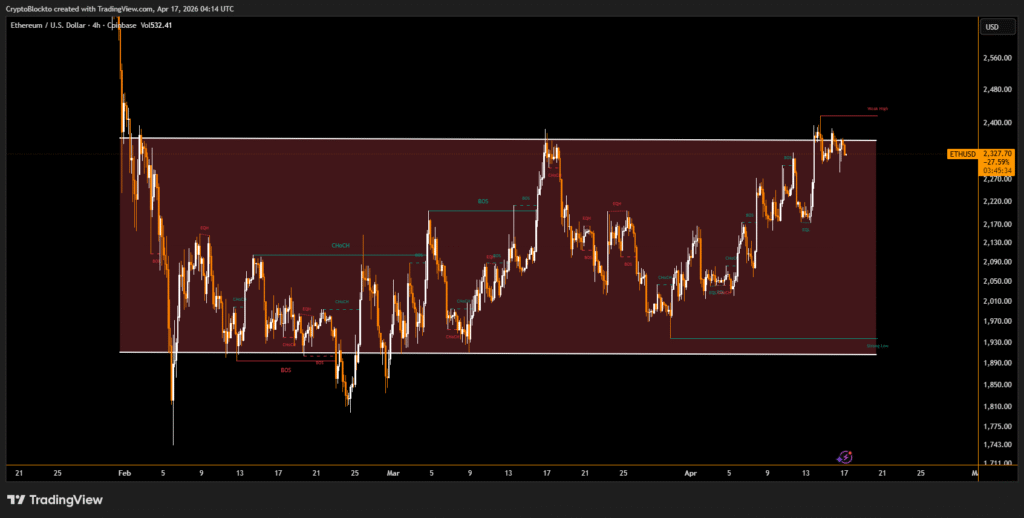
    Among major cryptocurrencies, Ether declined 1.4% to $2,327 but held a 6% weekly gain, while XRP traded near $1.43 with a 6.4% rise.

    $ETH 4h price chart

    Analysts Highlight Short Positioning and On-Chain Risk Signals

    However, on-chain analyst CryptoVizArt pointed to bitcoin’s True Market Mean, which suggests many active holders remain underwater. Historically, similar conditions aligned with major downturns, including 2018–2019 and 2022–2023 declines. Analysts note that any squeeze-driven rally may still face selling pressure, with market direction depending largely on whether the U.S.–Iran ceasefire is extended.

    Disclaimer

    This content is for informational purposes only and does not constitute financial, investment, or legal advice. Cryptocurrency trading involves risk and may result in financial loss.
  • Tom Lee Says ‘Mini Crypto Winter’ Is Ending, Predicts Ether Could Reach $60,000

    Tom Lee Says ‘Mini Crypto Winter’ Is Ending, Predicts Ether Could Reach $60,000

    Tom Lee said the recent cryptocurrency slowdown represents only a “mini crypto winter” that may already be ending, suggesting renewed momentum for the digital asset market. Speaking at the Paris Blockchain Week 2026, Lee projected that Ether (ETH) could climb above $60,000, with a potential fair-value estimate near $62,000 over the next several years.

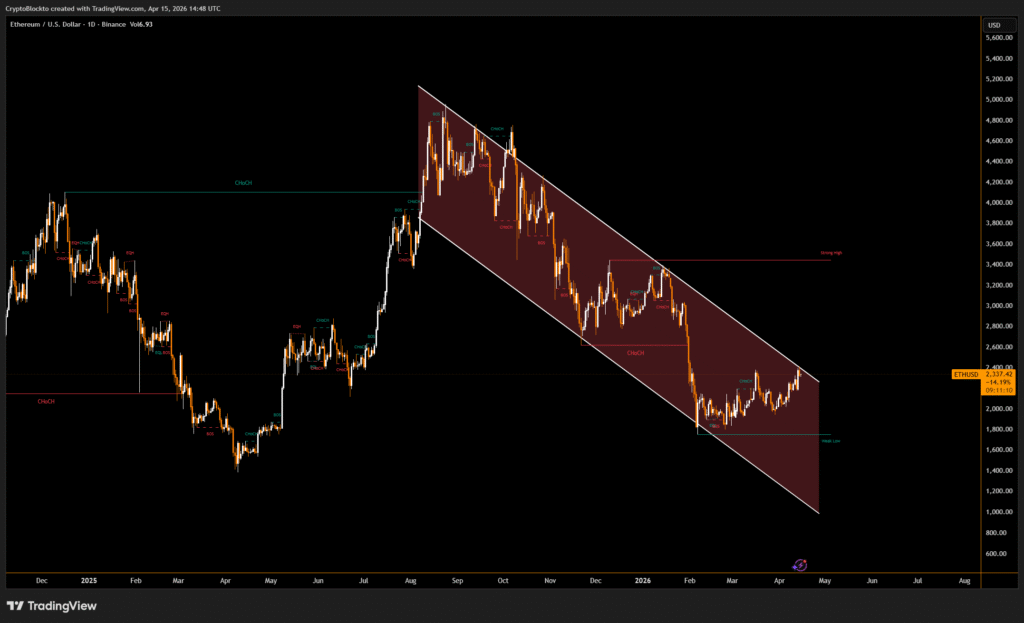
    Ether has declined about 43% since October 2025

    Lee attributed the expected recovery to growing adoption of tokenization and agentic artificial intelligence applications built on the Ethereum ecosystem. He also argued that equity markets may have already bottomed following geopolitical shocks, including tensions linked to the US–Israel–Iran conflict, historically a signal that risk assets could stabilize.

    Bitmine Reports Multi-Billion-Dollar Ether Loss Despite Bullish Outlook

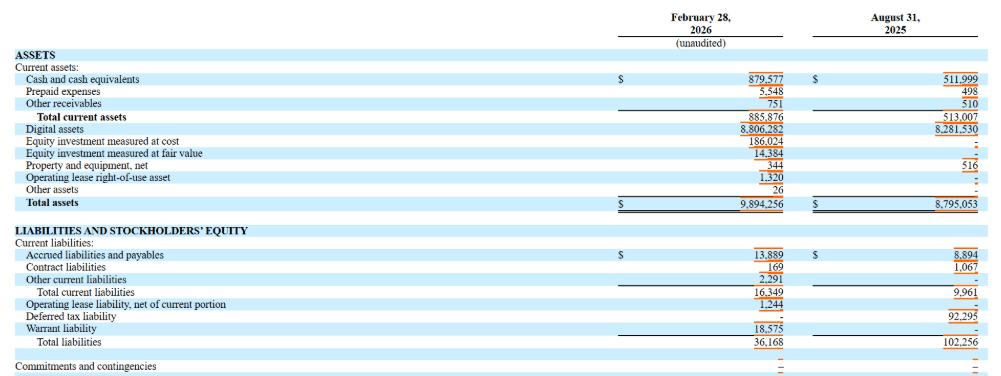
    The comments came shortly after Bitmine Immersion Technologies disclosed a $3.82 billion quarterly loss, largely driven by $3.78 billion in unrealized losses tied to its Ether holdings. The company reported $11 million in revenue, including $10.2 million from ETH staking activities.

    Bitmine form 10-q filing with the  SEC

    Ether has declined about 43% since October 2025, trading near $2,327, significantly below Bitmine’s reported average cost basis of $3,660. Despite the downturn, Bitmine purchased 71,524 ETH recently, bringing its holdings to roughly 4.6 million ETH, representing about 4.04% of total Ether supply.

    Corporate Ether Holdings and Long-Term Market Expectations

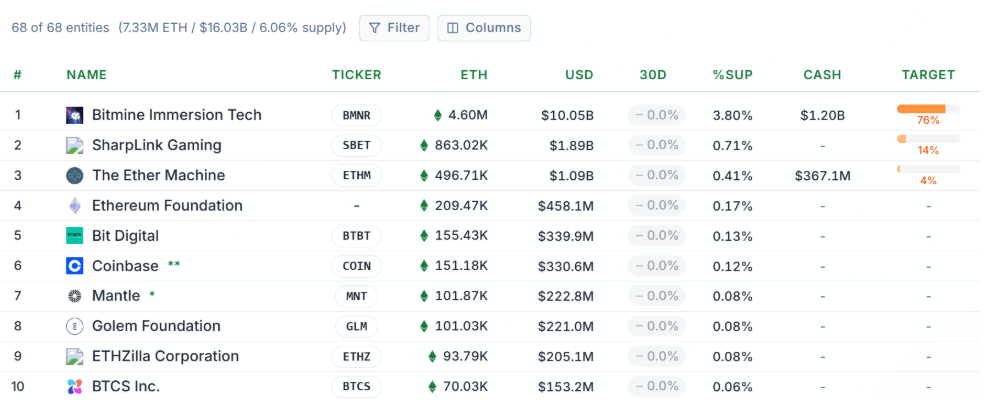
    Bitmine remains the largest corporate Ether holder, with holdings valued at over $10 billion, followed by SharpLink Gaming, which holds approximately 863,000 ETH worth about $1.89 billion. Another firm, Exodus Movement, is among the few companies to publicly report Ether treasury additions in recent weeks.

    The top 10 largest corporate Ether holders

    Lee’s forecast suggests that if Ethereum eventually reaches one-quarter of Bitcoin’s long-term valuation, Ether could achieve multi-year price expansion, reinforcing expectations that institutional demand and network growth may drive future market cycles.

    Disclaimer

    This content is for informational purposes only and does not constitute financial, investment, or legal advice. Cryptocurrency trading involves risk and may result in financial loss.

  • Bitmine Reports $3.8 Billion Quarterly Net Loss Driven by Unrealized Ethereum Decline

    Bitmine Reports $3.8 Billion Quarterly Net Loss Driven by Unrealized Ethereum Decline

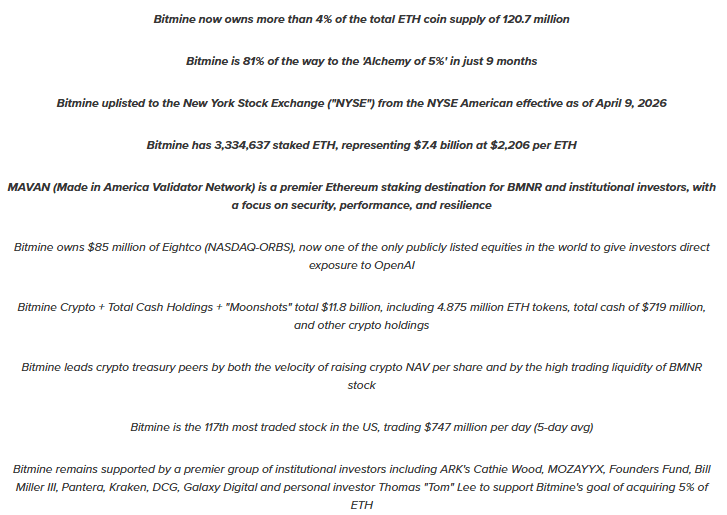
    Bitmine Immersion Technologies has reported a net loss of $3.82 billion for the quarter ended February 28, 2026, primarily driven by unrealized losses on its large Ethereum (ETH) holdings. The company’s filing shows losses widening sharply from $1.15 million in the same period last year, highlighting the volatility impact of digital asset treasury strategies.

    For the six-month period ending February 28, total losses exceeded $9 billion, compared with $2.1 million a year earlier. The company stated that most of the quarterly loss came from approximately $3.78 billion in unrealized declines in the value of its crypto holdings.

    SEC

    Bitmine Expands Ethereum Holdings Despite Market Pressure

    As of April 12, Bitmine held around 4.87 million ETH, worth roughly $10.7 billion, making it the largest corporate Ethereum treasury globally and the second-largest overall crypto treasury after Strategy. The company is targeting control of about 5% of total ETH supply and currently holds approximately 4.04%.

    Chairman Tom Lee said the firm continues to accumulate Ethereum, viewing market weakness as an opportunity tied to long-term network fundamentals and staking yield potential.

    Revenue Growth Offset by Staking Income

    Despite heavy losses, Bitmine reported $11.04 million in quarterly revenue, up significantly from $1.5 million a year earlier. Around $10 million came from ETH staking rewards, supported by staking over 3.33 million ETH, or about 68% of total holdings.

    The company also holds $719 million in cash, 198 Bitcoin, and additional strategic equity investments, while maintaining expansion plans in its Ethereum-focused treasury strategy.

    Disclaimer

    This content is for informational purposes only and does not constitute financial, investment, or legal advice. Cryptocurrency trading involves risk and may result in financial loss.
  • ETH/BTC Ratio Rebounds From 2026 Lows as Ethereum Network Growth Signals Recovery

    ETH/BTC Ratio Rebounds From 2026 Lows as Ethereum Network Growth Signals Recovery

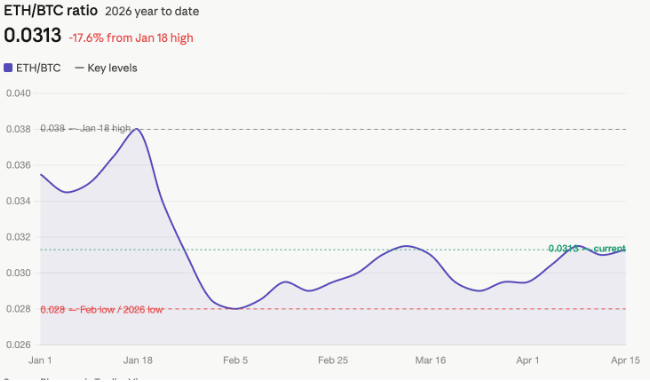
    The ETH/BTC ratio has rebounded from its 2026 lows, climbing to around 0.0313, its highest level in three months. The ratio had previously dropped to nearly 0.028 in February but remains below its January peak near 0.038. Over the past seven days, Ether gained roughly 4% to trade near $2,325, slightly outperforming Bitcoin, which advanced about 3.9% during the same period.

    The ETH/BTC ratio is widely tracked as a measure of relative strength between ether and bitcoin. A rising ratio typically signals increased risk appetite and capital rotation into alternative crypto assets, while a declining ratio often reflects preference for bitcoin’s relative stability.

    Ethereum Network Activity and Stablecoin Growth Support Momentum

    Ethereum’s improving fundamentals have supported the recent rebound. New users on the network increased by 82% quarter over quarter in Q1, reaching approximately 284,000 new participants. Total transactions also surged to a quarterly record of 200.4 million, marking a 43% increase from the previous period.

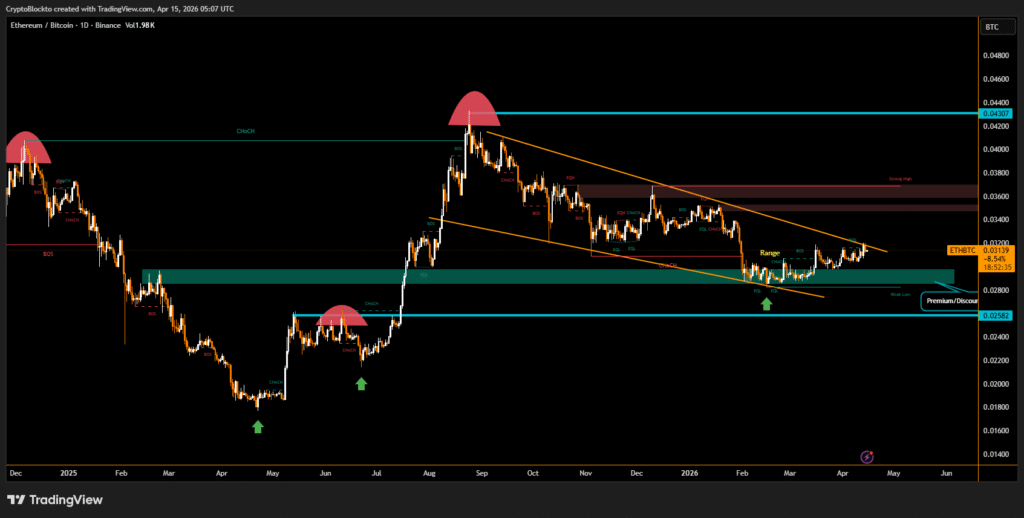
    ETHBTC daily price chart

    Stablecoin supply on Ethereum reached an all-time high of $180 billion, growing about 150% over the past three years. The network currently holds around 60% of the global stablecoin market, reinforcing its role as a dominant settlement layer.

    Despite recent gains, ether remains more than 50% below its 52-week high of $4,831. Market analysts suggest the ETH/BTC ratio must reclaim the 0.035 level on a weekly closing basis to confirm a durable trend shift rather than a short-term bounce driven by short covering.

    Disclaimer

    This content is for informational purposes only and does not constitute financial, investment, or legal advice. Cryptocurrency trading involves risk and may result in financial loss.

  • Ethereum Foundation Launches $1 Million Audit Subsidy Program to Strengthen Blockchain Security

    Ethereum Foundation Launches $1 Million Audit Subsidy Program to Strengthen Blockchain Security

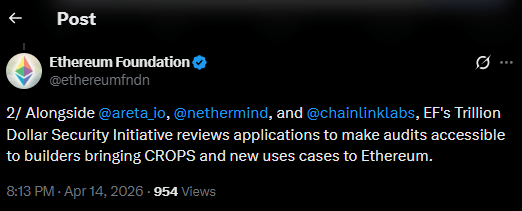
    The Ethereum Foundation has introduced a new initiative called the Ethereum Audit Subsidy Program, designed to provide financial assistance to developers seeking professional security audits. The program forms part of the broader Trillion Dollar Security Initiative, which focuses on improving long-term resilience and safety across the Ethereum ecosystem.

    Security audits are widely recognized as an essential step before launching blockchain applications, yet their high cost often limits access for smaller teams. By offering subsidies, the foundation aims to reduce financial barriers and encourage developers to adopt stronger security standards from the early stages of project development.

    Collaboration With Key Security and Infrastructure Organizations

    The initiative includes collaboration with several established auditing and infrastructure groups, including Nethermind, Chainlink Labs, and Areta, which will help evaluate and review project applications. Their involvement is expected to ensure consistent technical standards and reliable assessment processes.

    The program is also intended to promote innovation by making secure development more accessible. By supporting developers with funding and expert oversight, the Ethereum Foundation aims to foster safer smart contract deployments and expand trust in decentralized applications across the network.

    Disclaimer

    This content is for informational purposes only and does not constitute financial, investment, or legal advice. Cryptocurrency trading involves risk and may result in financial loss.