Author: tristan

  • Yuga Labs Settles Lawsuit With Artists Over Lookalike NFTs

    Yuga Labs Settles Lawsuit With Artists Over Lookalike NFTs

    Yuga Labs, creator of the Bored Ape Yacht Club (BAYC), has reached a settlement with artists Ryder Ripps and Jeremy Cahen, who were accused of producing and selling NFTs that closely resembled BAYC’s iconic cartoon ape collection. Court documents filed in the U.S. District Court for the Central District of California confirm that the parties have agreed to resolve the dispute.
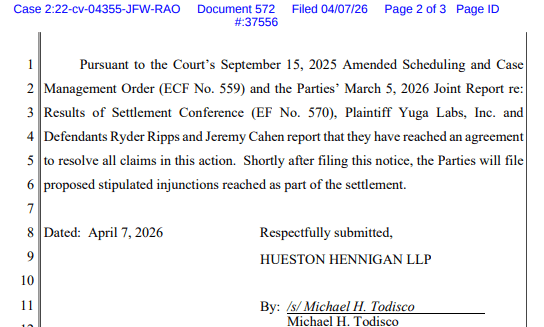
    As part of the settlement, Ripps and Cahen are permanently prohibited from using Yuga Labs’ imagery and trademarks. They are required to transfer control of smart contracts, domains, and any remaining NFTs linked to their RR/BAYC project to Yuga Labs within 10 days. The court also barred the artists from selling, concealing, or otherwise disposing of any assets related to the case to avoid compliance.

    Background of the Legal Dispute

    Yuga Labs initially filed the lawsuit in June 2022, alleging that the RR/BAYC NFTs, minted in May 2022, copied its copyrighted ape designs and caused user confusion, generating millions in profits for Ripps and Cahen. The artists defended their work as satire and parody, citing free speech protections.
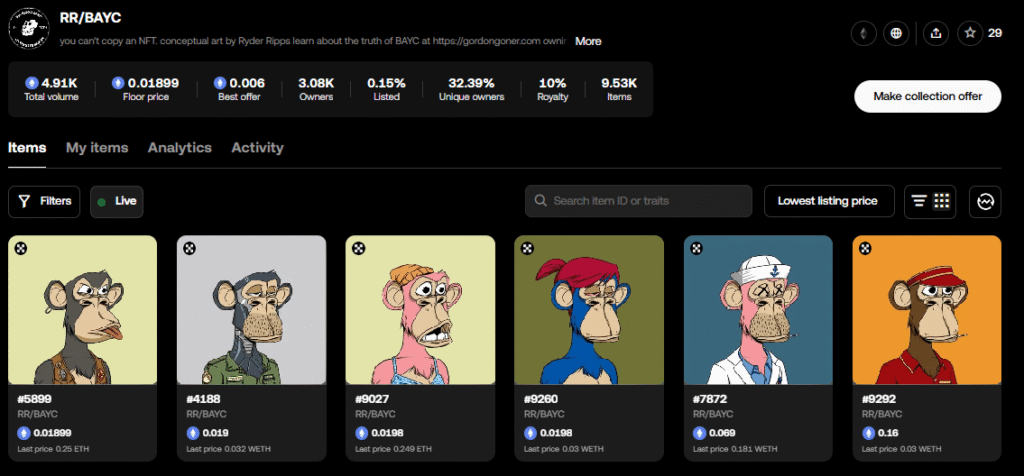
    The RR/BAYC NFTs are still live on OKX Wallet

    A 2023 court ruling favored Yuga Labs, ordering the artists to pay $1.37 million plus $200,000 in additional damages, which later grew to $9 million after a counterclaim in 2024. The appeals process in 2025 overturned part of the ruling and mandated a jury trial to evaluate the trademark infringement claims.

    With the settlement now finalized, Yuga Labs regains control over the disputed assets, bringing an end to a nearly four-year legal saga in the NFT space.

    Disclaimer

    This content is for informational purposes only and does not constitute financial, investment, or legal advice. Cryptocurrency trading involves risk and may result in financial loss.

  • Michael Saylor Says Bitcoin Has Likely Bottomed, Quantum Risk Exaggerated

    Michael Saylor Says Bitcoin Has Likely Bottomed, Quantum Risk Exaggerated

    Michael Saylor, executive chairman of Strategy (MSTR), stated that Bitcoin likely reached its bottom near $60,000 in early February, following a period of forced selling that cleared weaker hands from the market. Speaking at a Mizuho event, Saylor emphasized that market bottoms are driven less by valuation metrics and more by exhaustion among sellers, with trend reversals influenced by capital structure and liquidity conditions.

    According to Saylor, selling pressure is now limited, as ETF inflows continue to absorb daily Bitcoin supply and corporate treasuries increasingly allocate funds to the cryptocurrency. He highlighted that these factors provide a foundation for renewed price strength in the near term.

    Banking Credit and Digital Credit Could Drive Next Bull Market

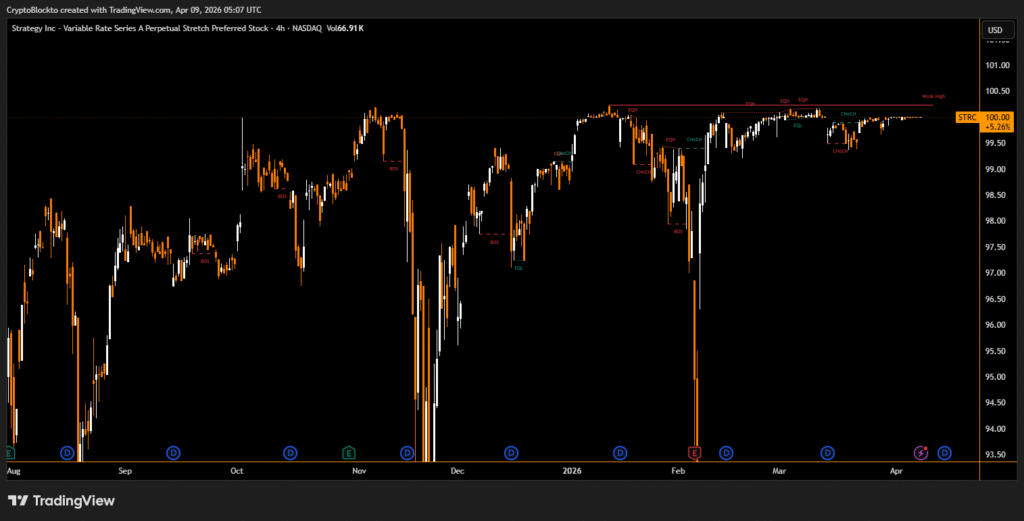
    Saylor identified the formation of banking and digital credit markets built on Bitcoin as the likely catalyst for the next bull cycle. By enabling lending and credit activity on top of BTC holdings, Bitcoin could extend beyond its traditional role as a store-of-value. Strategy’s STRC preferred stock, currently yielding 11.5%, was cited as an example of transforming non-yielding Bitcoin into a capital markets engine.

    STRCK stocks price chart

    Quantum Computing Risks Likely Decades Away

    On the topic of quantum computing, Saylor argued that the threat to Bitcoin is overblown. He described it as theoretical, likely decades away, and solvable with future technological upgrades, countering concerns that quantum attacks pose an immediate risk to network security.

    Mizuho maintains an outperform rating on Strategy with a $320 price target, implying roughly 150% upside from its current $127 share price, reflecting optimism around both Bitcoin adoption and financial innovations built on the network.

    Disclaimer

    This content is for informational purposes only and does not constitute financial, investment, or legal advice. Cryptocurrency trading involves risk and may result in financial loss.
  • Fed Minutes Signal Potential Rate Cuts Amid Iran Conflict Uncertainty

    Fed Minutes Signal Potential Rate Cuts Amid Iran Conflict Uncertainty

    Minutes from the Federal Open Market Committee (FOMC) March meeting indicate that U.S. Federal Reserve officials are divided on the potential for further interest rate cuts in 2026, partly due to ongoing geopolitical tensions in the Middle East. The March 17-18 meeting concluded with an 11-1 vote to maintain the federal funds rate at 3.5% to 3.75%, reflecting caution over economic impacts from the Iran conflict.

    According to the minutes, several participants noted that lowering rates could become appropriate later in the year if inflation declines in line with expectations. At the same time, others warned that rates might need to rise if inflation remains above target. The Fed emphasized that it is “too early to know” how developments in the Middle East would affect the U.S. economy.

    Implications for Crypto and Financial Markets

    Rate cuts are generally viewed as supportive for speculative assets, including cryptocurrencies, because they increase liquidity and encourage investment. The last U.S. rate reduction occurred on December 10, 2025, when the Fed lowered rates by 25 basis points.

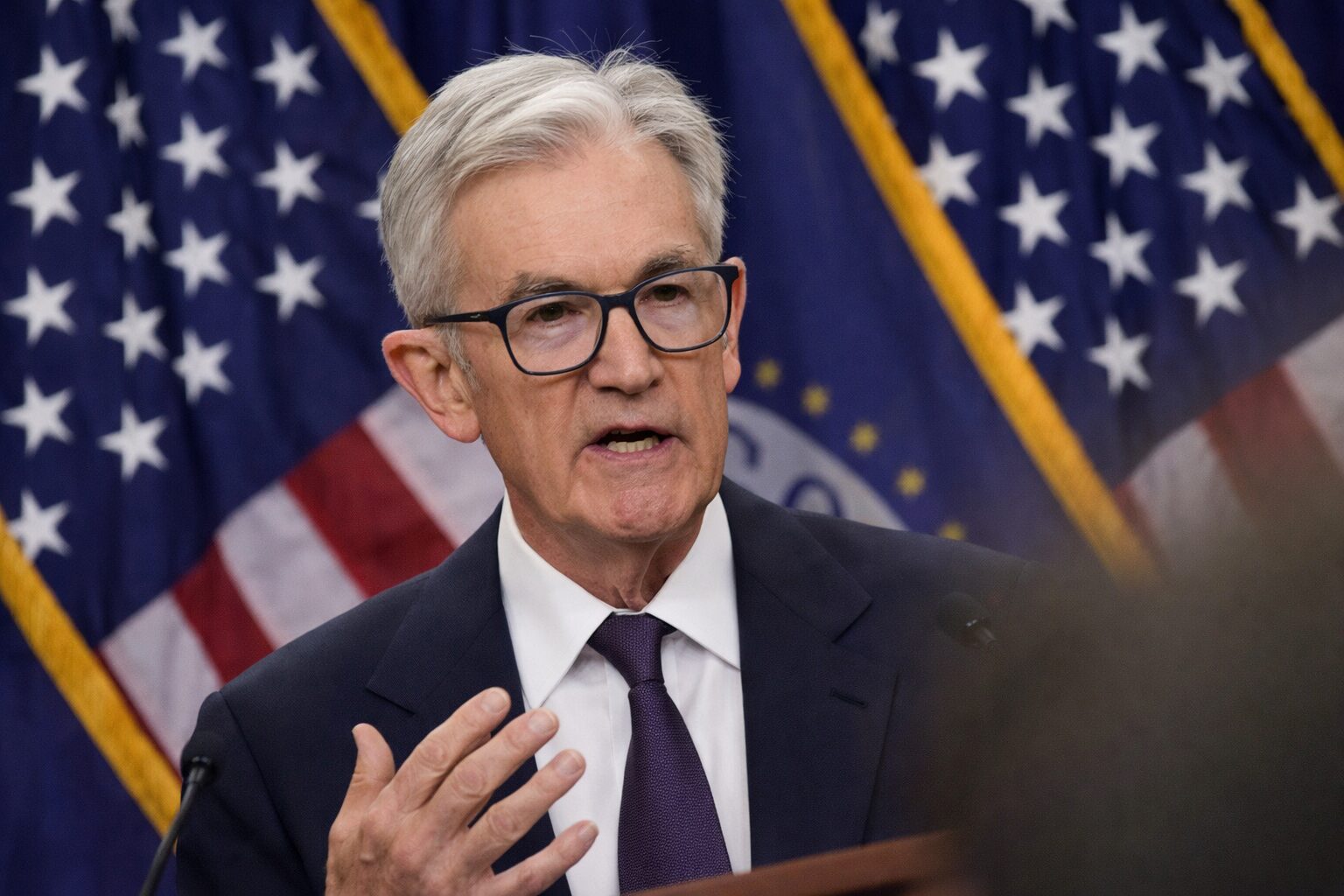
    Fed Chair Jerome Powell speaking at the FOMC news conference.: Federal Reserve

    FOMC members also highlighted labor market vulnerabilities, noting that low net job creation could amplify risks to economic stability if shocks occur. Current market tools, such as CME Group’s FedWatch, suggest a 75.6% probability that rates will remain unchanged by the December 2026 meeting, a 20.4% chance of a rate cut, and a 2.4% chance of a rate hike.

    The Fed’s next policy meeting is scheduled for April 28-29, and investors will be closely watching how geopolitical and inflation dynamics influence future monetary decisions.

    Disclaimer

    This content is for informational purposes only and does not constitute financial, investment, or legal advice. Cryptocurrency trading involves risk and may result in financial loss.
  • U.S. Military to Remain Near Iran, Trump Says, While Tehran Sends Delegation to Pakistan for Peace Talks

    U.S. Military to Remain Near Iran, Trump Says, While Tehran Sends Delegation to Pakistan for Peace Talks

    President Signals Continued Presence in Persian Gulf Amid Ceasefire Disputes

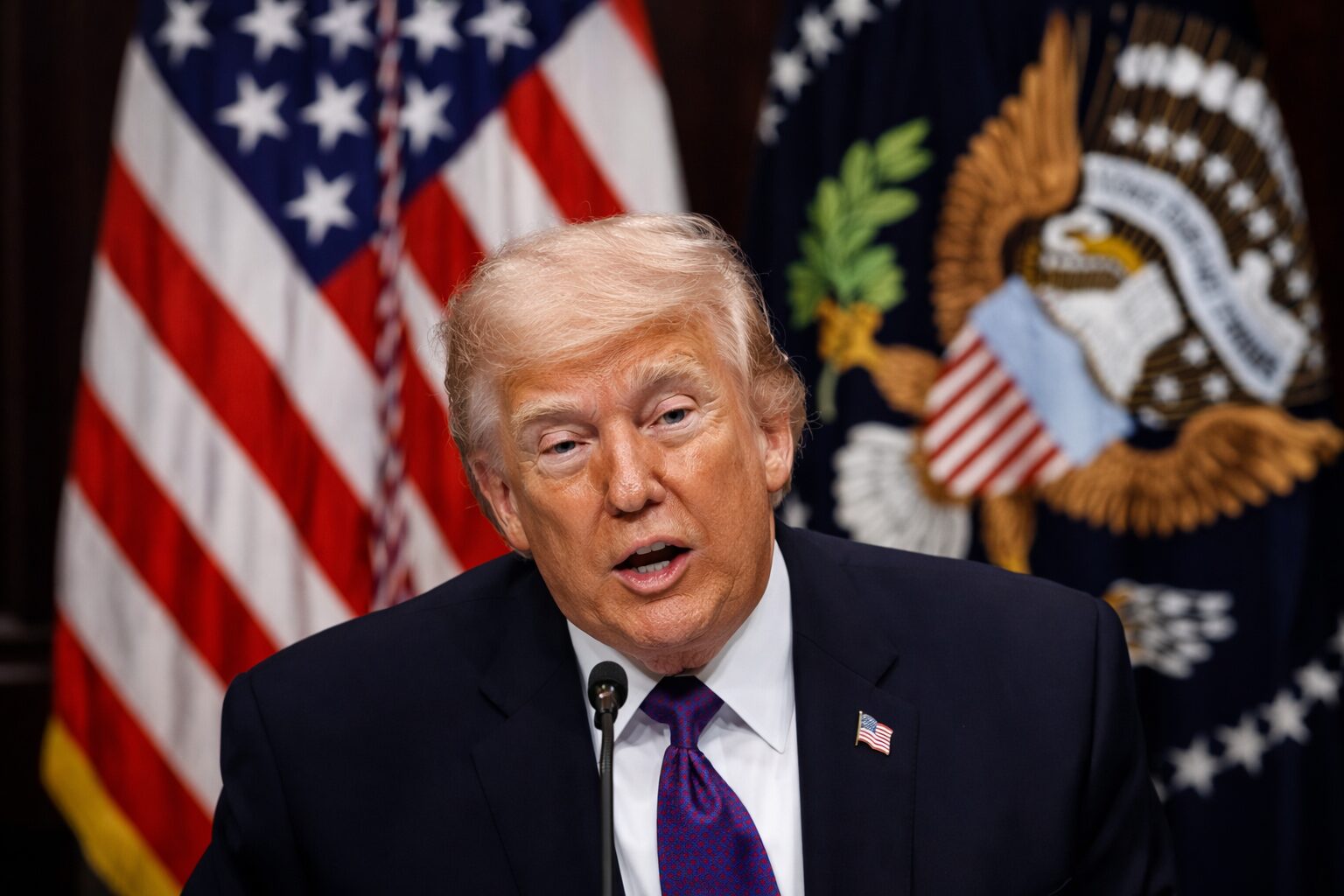
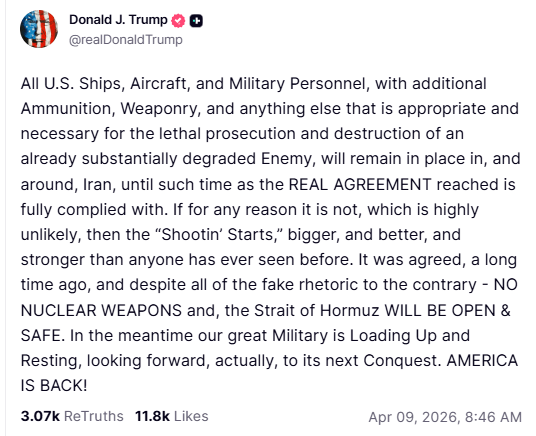
    U.S. President Donald Trump stated on April 8 that American military ships, aircraft, and personnel will remain stationed in and around Iran to enforce compliance with a previously agreed ceasefire. Speaking on Truth Social, Trump warned that if Iran fails to fully comply with the deal, the U.S. will escalate military action. “If for any reason it is not, which is highly unlikely, then the ‘Shootin’ Starts,’ bigger, and better, and stronger than anyone has ever seen before,” he said.

    Disagreements Over Nuclear Program and Strait of Hormuz

    The announcement came after Iranian officials indicated that proceeding with permanent peace talks would be “unreasonable,” citing ongoing Israeli airstrikes in Lebanon that killed hundreds. The two sides also remain at odds over Iran’s nuclear activities. Trump stated that Iran had agreed to stop enriching uranium, while Iran’s parliament speaker Mohammed Bagher Ghalibaf maintained that uranium enrichment is permitted under the ceasefire terms.

    Trump reaffirmed prior commitments, emphasizing that “NO NUCLEAR WEAPONS and, the Strait of Hormuz WILL BE OPEN & SAFE.” The Strait, a critical shipping lane, has been a focal point of international concern amid heightened tensions.

    On the other side Iran ambassador to Pakistan: Iranian delegation to arrive Thursday night in Islamabad for “serious talks” based on 10 points proposed by Iran.

    Strategic and Geopolitical Implications

    The U.S. military presence signals continued American vigilance in the region, reflecting both deterrence against violations and reassurance to allies. Analysts note that the standoff could affect global energy markets, particularly oil prices, and heighten geopolitical uncertainty in the Middle East.

    Disclaimer

    This content is for informational purposes only and does not constitute financial, investment, or legal advice. Cryptocurrency trading involves risk and may result in financial loss.
  • Bitcoin Depot Reports $3.7 Million Loss After Security Breach Hits Company Wallets

    Bitcoin Depot Reports $3.7 Million Loss After Security Breach Hits Company Wallets

    Unauthorized Access Leads to 50.9 BTC Theft From Corporate Wallets

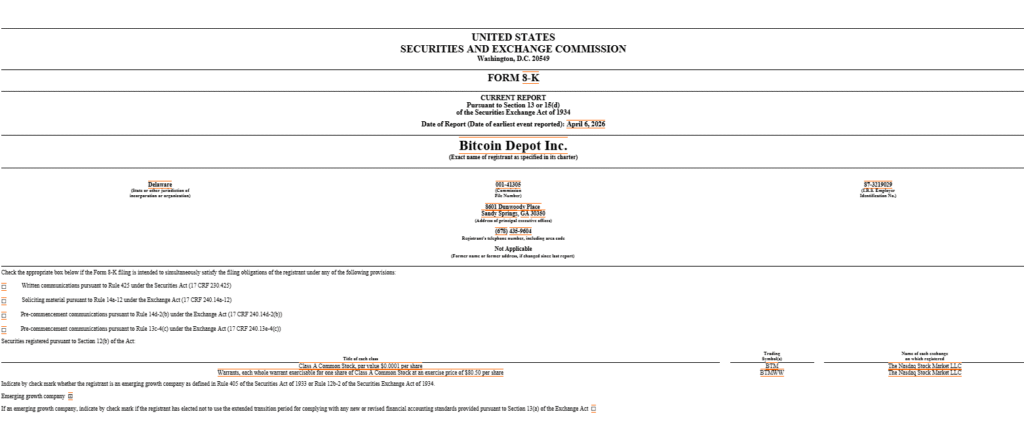
    Bitcoin ATM operator Bitcoin Depot has disclosed a cybersecurity incident that resulted in the loss of approximately $3.7 million worth of Bitcoin from its company controlled wallets. The Nasdaq listed firm confirmed that unauthorized access to its internal IT systems was detected on March 23 according to details shared in a regulatory filing.

    Investigators determined that the attacker gained control of login credentials connected to the company’s crypto settlement accounts. Following the breach, a total of 50.9 Bitcoin, valued at roughly $3.66 million at the time, was transferred out of the affected wallets.

    sec

    The company stated that its incident response procedures were activated immediately after detecting suspicious activity. External cybersecurity specialists were engaged to investigate the matter, and law enforcement agencies were notified. Bitcoin Depot emphasized that the breach did not affect its customer-facing platforms or expose user data, though a third-party investigation remains ongoing.

    Regulatory Pressure and Operational Changes Add to Company Challenges

    The security incident comes during a period of heightened regulatory scrutiny and operational adjustments for Bitcoin Depot. In a recent enforcement action, regulators in Connecticut suspended the company’s money transmission license after alleging that transaction fees exceeded the state’s 15% cap on more than 1,000 transactions. Authorities estimated that about $150,426 in excess fees were charged to more than 500 customers.

    Leadership changes have also taken place, with Alex Holmes recently appointed as chairman and chief executive officer. The company previously reported net income of $4.7 million for 2025, down from $7.8 million in 2024. Looking ahead, Bitcoin Depot expects revenue from its core business to decline by 30% to 40% in 2026, citing increased compliance demands and regulatory pressure as key factors.

    Despite these challenges, company shares closed higher in the latest trading session, although the stock remains significantly lower compared with its performance over the past six months.

    Disclaimer

    This content is for informational purposes only and does not constitute financial, investment, or legal advice. Cryptocurrency trading involves risk and may result in financial loss.
  • Bitcoin Holds Near $71K as Iran Ceasefire Tensions Trigger Crypto Market Pullback

    Bitcoin Holds Near $71K as Iran Ceasefire Tensions Trigger Crypto Market Pullback

    Bitcoin remained near the $71,000 level on April 9 as cryptocurrency markets pulled back following renewed uncertainty around the recently announced ceasefire between Iran and the United States. The two-week truce, which initially fueled a strong rally across global markets, began showing signs of strain less than 48 hours after its announcement.

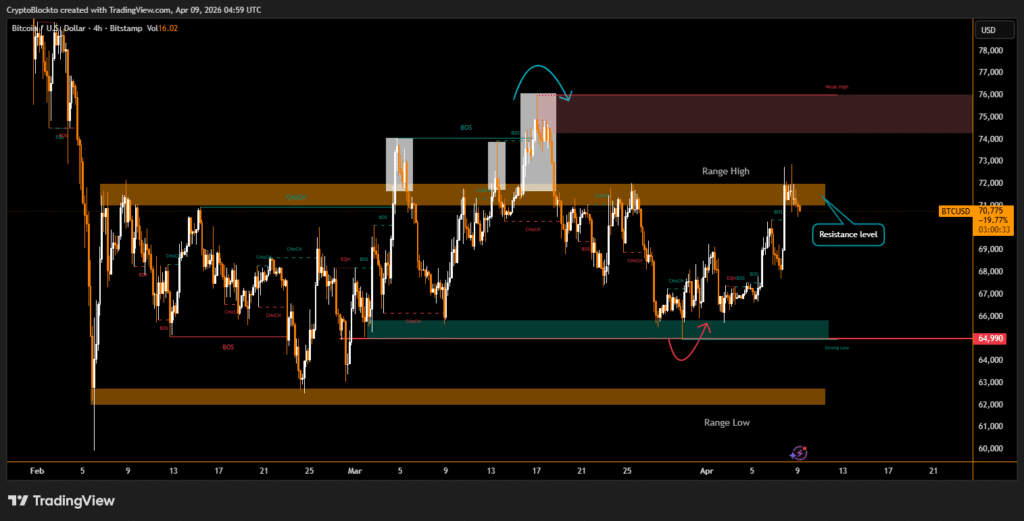
    $BTC 4h price chart

    Bitcoin traded around $70,781, slipping about 0.6% over the past 24 hours but still holding a weekly gain of approximately 6.1%. The digital asset continues to move within a multi-month trading range between $65,000 and $73,000, with current price action testing the upper half of that zone.

    Iranian officials reported that three clauses of the ceasefire agreement had been breached, although specific details were not disclosed. Meanwhile, continued military activity in Lebanon and limited tanker movement through the Strait of Hormuz have increased concerns about the durability of the agreement.

    Altcoins Decline as Oil Prices Rebound Toward $97

    Major cryptocurrencies moved lower alongside Bitcoin as broader market sentiment weakened. Ether declined 2.6% to about $2,180 after leading earlier gains, while Solana dropped 3.1% to roughly $81.96. XRP fell 3% to around $1.33, and Dogecoin lost 3.4% to approximately $0.091. BNB remained comparatively stable near $600 but still recorded a 2.2% decline.

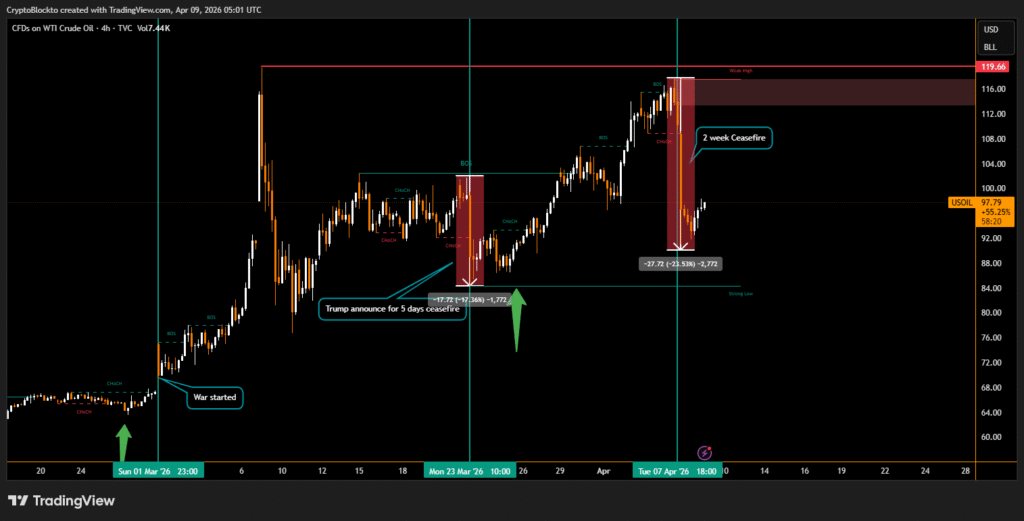
    Energy markets also reacted sharply to the geopolitical uncertainty. Brent crude oil rebounded roughly 2% to near $97 per barrel after experiencing a drop of more than 10% the previous day, reflecting renewed fears about supply disruptions linked to the Strait of Hormuz.

    Cfds on wti crude oil 4h price chart

    Global Markets Face Pressure From Rates and Geopolitical Uncertainty

    Beyond geopolitical developments, global financial markets are facing additional pressure from tightening monetary conditions. The Federal Reserve continues to warn about persistent inflation risks, reinforcing expectations that interest rates may remain elevated for an extended period.

    Despite the recent pullback, Bitcoin’s ability to hold above $70,000 following the earlier surge from around $67,000 to $72,700 is viewed by market observers as a constructive signal, indicating resilience even as geopolitical tensions remain unresolved.

    Disclaimer

    This content is for informational purposes only and does not constitute financial, investment, or legal advice. Cryptocurrency trading involves risk and may result in financial loss.
  • North Korean IT Worker Network Exposed After Earning Millions Through Fake Developer Jobs

    North Korean IT Worker Network Exposed After Earning Millions Through Fake Developer Jobs

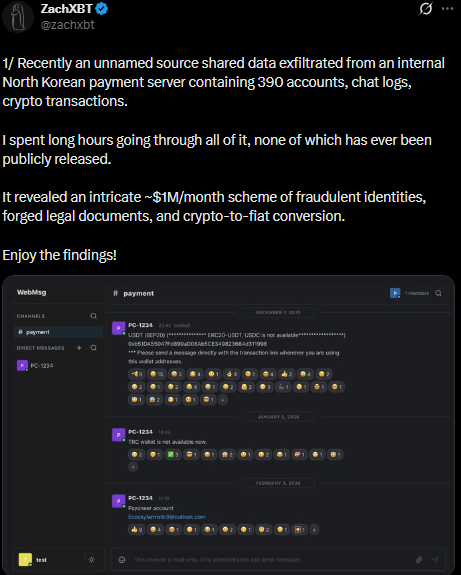
    A network of North Korean IT workers has been exposed after reportedly earning more than $3.5 million in cryptocurrency by posing as freelance developers and software engineers. The operation was uncovered after a counterhacker gained access to one of the workers’ devices, revealing internal data later shared publicly by blockchain investigator ZachXBT.

    According to the leaked information, one worker identified as “Jerry” was part of a team of about 140 members. The group was generating close to $1 million per month, with earnings accumulated since late November. Many of the individuals reportedly secured remote jobs by using falsified identities and forged documentation to appear as legitimate applicants.

    Payment coordination reportedly took place through a website known as luckyguys.site, where members used a shared and easily guessed password, “123456,” to access accounts. Some individuals using the platform were linked to entities believed to be associated with Sobaeksu, Saenal, and Songkwang, organizations previously sanctioned by the United States Office of Foreign Assets Control.

    Crypto Payments Routed Through Online Platforms and Foreign Accounts

    Investigators found that cryptocurrency payments earned by the workers were converted into traditional currency and transferred to bank accounts in China using online financial services such as Payoneer. Blockchain tracing also identified connections between the wallets used in this operation and addresses previously blacklisted by Tether in December.

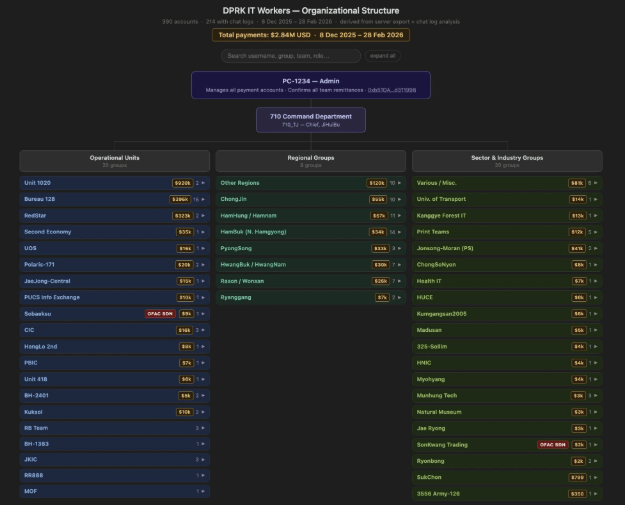
    Additional records revealed that the group maintained an internal leaderboard tracking how much cryptocurrency each worker generated, with transaction links connected to blockchain explorer pages. Evidence also showed attempts to apply for developer and technical roles through popular job platforms, while some members used virtual private networks and falsified identification documents to avoid detection.

    how much crypto each IT worker has brought in for North Korea since Dec. 8: ZachXBT

    Security analysts warn that state-backed cyber groups linked to North Korea remain a persistent threat, with total losses attributed to such operations exceeding $7 billion since 2009. Major incidents associated with these groups include large-scale breaches targeting cryptocurrency platforms and financial infrastructure.

    Disclaimer

    This content is for informational purposes only and does not constitute financial, investment, or legal advice. Cryptocurrency trading involves risk and may result in financial loss.
  • Visa Launches Intelligent Commerce Connect to Enable Autonomous AI Shopping Payments

    Visa Launches Intelligent Commerce Connect to Enable Autonomous AI Shopping Payments

    Visa has introduced a new platform called Intelligent Commerce Connect, designed to support the next phase of digital payments driven by autonomous AI agents. The system functions as a network, protocol, and token vault-agnostic on-ramp that allows merchants and AI developers to connect to agentic commerce through a single integration.

    Through the Visa Acceptance Platform, Intelligent Commerce Connect enables secure payment initiation, tokenization, authentication, spend controls, and compliance with PCI security standards. The platform also makes merchant product catalogs discoverable inside AI environments, allowing AI agents acting on behalf of consumers to browse, select, and complete purchases automatically.

    investor.visa.

    Visa stated that the system supports both Visa and non Visa card payments and is compatible with major AI agent protocols. This flexibility is intended to help merchants participate in AI-driven commerce without overhauling their existing payment infrastructure.

    Integration with x402 Protocol Expands AI Payment Capabilities

    In a related development, AI fintech firm Nevermined announced its integration with Visa’s Intelligent Commerce using Coinbase’s x402 protocol. The x402 standard allows AI agents to programmatically request payments, enabling autonomous purchases of digital goods and services.

    Users enrolling in the system can link their Visa cards and define spending limits, allowing AI agents to transact independently within pre-set guardrails. Merchants continue receiving payments through their current processors without additional operational changes.

    According to data shared by the x402 protocol, the system processed approximately $24 million in transaction volume over the past 30 days. Visa also confirmed that Intelligent Commerce Connect is currently in a pilot phase with selected partners, with a broader global rollout planned for later in 2026.

    Disclaimer

    This content is for informational purposes only and does not constitute financial, investment, or legal advice. Cryptocurrency trading involves risk and may result in financial loss.

  • Morgan Stanley MSBT Bitcoin ETF Records $34 Million First-Day Trading Volume

    Morgan Stanley MSBT Bitcoin ETF Records $34 Million First-Day Trading Volume

    Morgan Stanley’s MSBT Bitcoin ETF delivered a strong market debut, recording $34 million in trading volume on its first day. The performance exceeded expectations and highlighted renewed investor interest in spot Bitcoin exchange-traded funds amid improving market sentiment.

    MSBT Bitcoin ETF Launch Surpasses Analyst Expectations

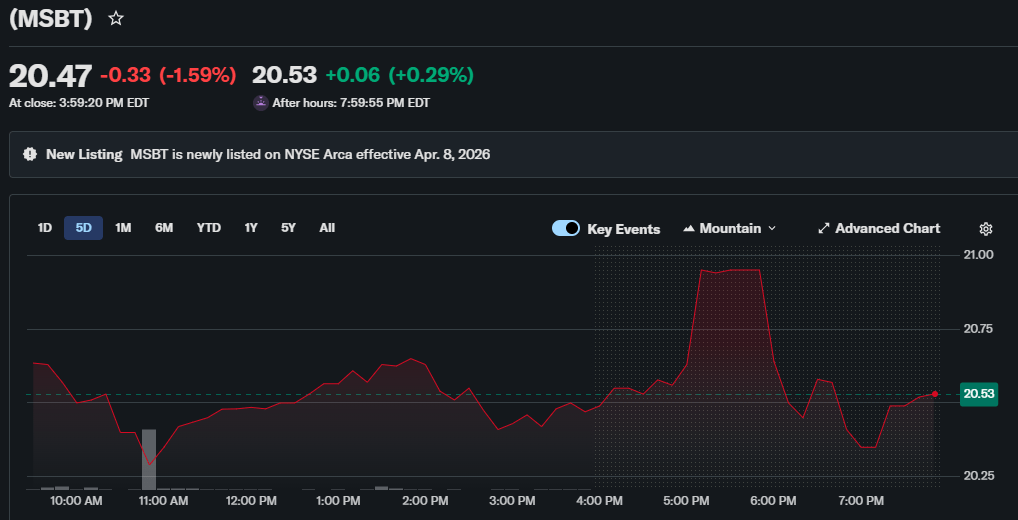
    According to market data, the Morgan Stanley Bitcoin Trust (MSBT) traded 1,658,176 shares on launch day and closed at $20.47 per share. The total trading volume surpassed the $30 million forecast previously estimated by Bloomberg Senior Analyst Eric Balchunas, signaling stronger-than-expected demand for the new fund.

    The ETF was launched with a 0.14% sponsor fee, making it the lowest-cost Bitcoin exchange-traded product (ETP) currently available. By comparison, BlackRock’s iShares Bitcoin Trust (IBIT) charges 0.25%, while the Grayscale Bitcoin Mini Trust ETF carries a 0.15% fee.

    Bitcoin ETF Market Rebounds Alongside Price Surge

    The launch coincided with Bitcoin’s strongest daily gain in about a month, rising more than 7.5% from $67,700 to approximately $72,800 before stabilizing near $71,000.

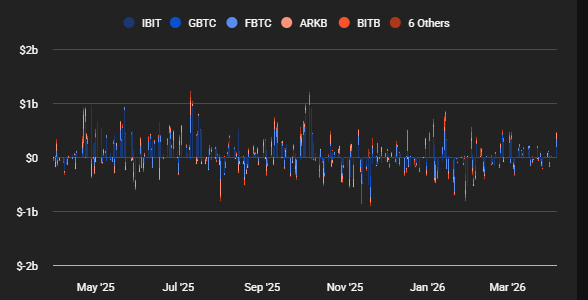
    The broader ETF market also showed recovery signs, with $471 million in net inflows recorded earlier in the week, led by IBIT and Fidelity Investments’ FBTC, despite nearly $5 billion in outflows since November.

    Spot Bitcoin ETF Flows
    Disclaimer

    This content is for informational purposes only and does not constitute financial, investment, or legal advice. Cryptocurrency trading involves risk and may result in financial loss.
  • US Treasury Advances GENIUS Act Rules Targeting Illicit Finance in Stablecoins

    US Treasury Advances GENIUS Act Rules Targeting Illicit Finance in Stablecoins

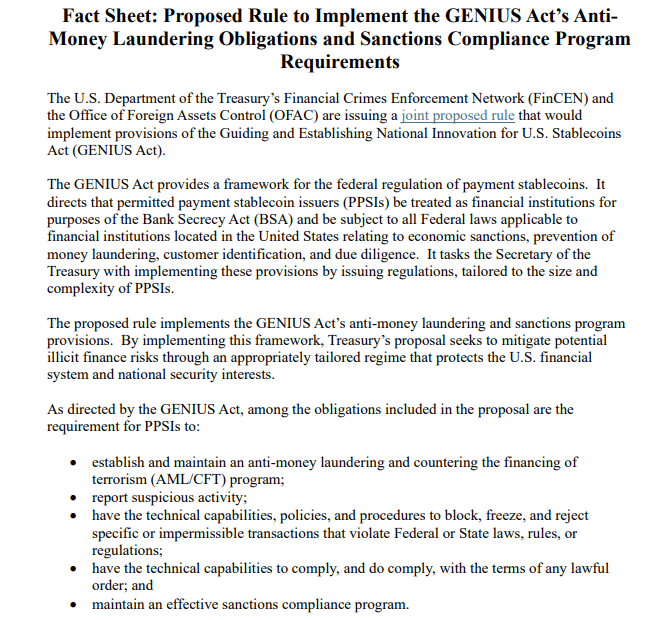
    The US Treasury Department is moving forward with new regulations under the GENIUS Act, focusing on preventing illicit financial activity linked to payment stablecoins. The proposal introduces strict compliance requirements that could significantly reshape how stablecoin issuers operate within the United States financial system.

    GENIUS Act Requires AML and Sanctions Compliance Programs

    Under the proposed framework, payment stablecoin issuers must establish anti-money laundering (AML) and countering the financing of terrorism (CFT) programs. The rules also mandate the creation of sanctions compliance systems capable of identifying suspicious activity.

    Issuers will be required to block, freeze, and reject certain transactions when necessary. Additionally, they will be treated as financial institutions under the Bank Secrecy Act (BSA), placing them under stricter regulatory oversight.

    Financial Crimes Enforcement Network

    Stablecoin Issuers to Function as Bank-Like Gatekeepers

    The rule was jointly issued by the Financial Crimes Enforcement Network (FinCEN) and the Office of Foreign Assets Control (OFAC). Industry analysts suggest the move effectively turns stablecoin issuers into bank-like gatekeepers, enabling large-scale wallet freezes and asset seizures when compliance risks are identified.

    The GENIUS Act, signed into law in July 2025, is expected to take full effect within 18 months or 120 days after related regulations are finalized.

    Disclaimer

    This content is for informational purposes only and does not constitute financial, investment, or legal advice. Cryptocurrency trading involves risk and may result in financial loss.