Author: tristan

  • Bitcoin Quantum-Safe Transaction Method Proposed Without Network Upgrade

    Bitcoin Quantum-Safe Transaction Method Proposed Without Network Upgrade

    A new proposal by Avihu Levy, chief product officer at StarkWare, outlines a method designed to make Bitcoin transactions resistant to quantum computing threats without requiring a soft fork or protocol upgrade. The concept, called Quantum Safe Bitcoin (QSB), aims to protect funds even against powerful quantum machines capable of running Shor’s algorithm, which is widely considered a major risk to traditional cryptographic systems.

    Instead of relying solely on elliptic curve signatures, the system introduces a hash-based puzzle that requires senders to find inputs producing outputs that resemble valid signatures. This brute-force process is designed to remain secure even if quantum computers become capable of breaking current encryption methods.
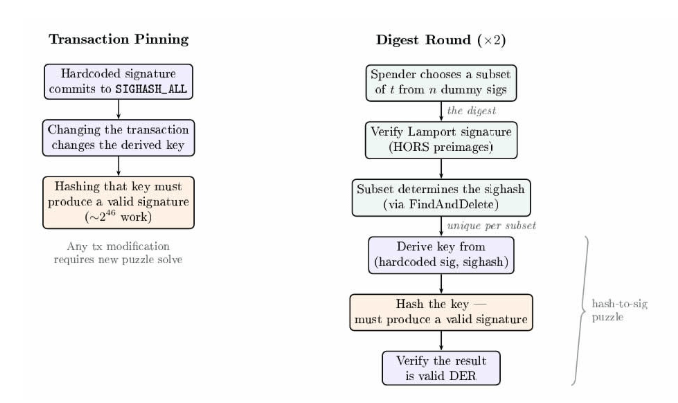
    Far more computing power is required for QSB.: GitHub

    Costs, Limitations, and Industry Reactions

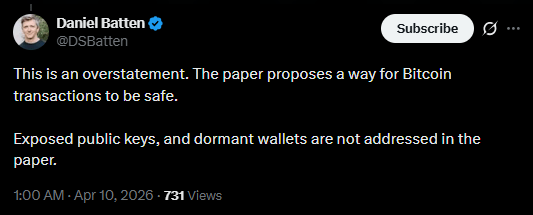
    The method comes with significant trade-offs. Each QSB transaction may cost between $75 and $150 in GPU computing power, making it suitable mainly for large-value transfers rather than everyday payments. Eli Ben-Sasson, StarkWare’s CEO, described the concept as a major step toward immediate protection. However, Daniel Batten, a Bitcoin ESG specialist, argued that it does not address vulnerable early wallets, including an estimated 1.7 million BTC stored in older P2PK addresses.
    Long-Term Quantum Security Debate Continues

    Researchers acknowledged that protocol-level upgrades remain the preferred long-term solution, especially because the approach does not cover systems such as the Lightning Network. Meanwhile, Olaoluwa Osuntokun, chief technology officer at Lightning Labs, introduced a quantum “escape hatch” prototype allowing users to verify wallet ownership using seed phrases without exposing them. A recent quantum research paper from Google has also intensified urgency around preparing Bitcoin for future cryptographic threats.

    Disclaimer

    This content is for informational purposes only and does not constitute financial, investment, or legal advice. Cryptocurrency trading involves risk and may result in financial loss.

  • Circle Stock Falls 10% After Analyst Downgrade and Drift Protocol Probe Concerns

    Circle Stock Falls 10% After Analyst Downgrade and Drift Protocol Probe Concerns

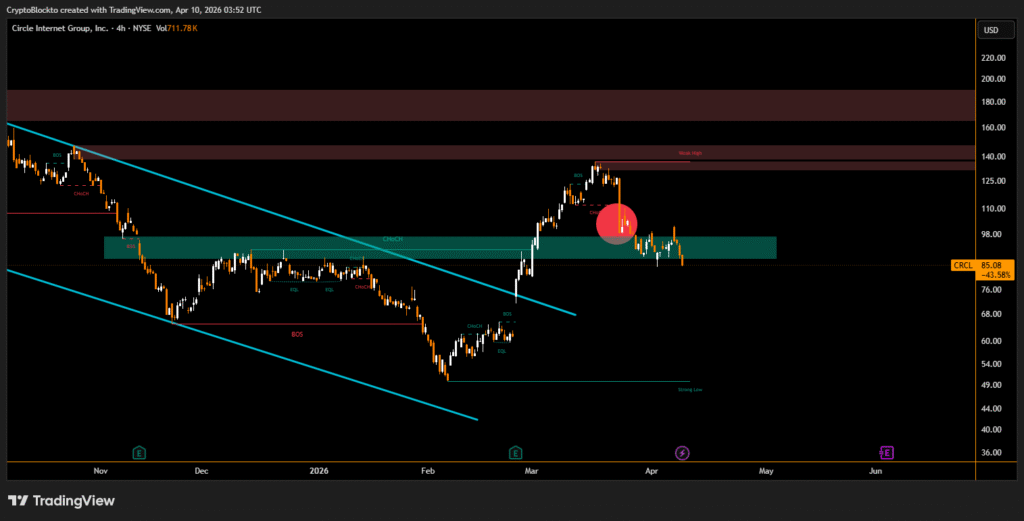
    Shares of stablecoin issuer Circle Internet Group declined sharply on Thursday after an analyst downgrade and growing legal scrutiny linked to a recent crypto exploit. The company’s stock closed near session lows on Nasdaq, falling 9.9% to $85.10.

    Circle Internet Group (CRCL) stock. 

    The latest drop adds to a broader downward trend, with Circle shares falling nearly 24% over the past month and approximately 43% over the last six months. Analysts at Compass Point downgraded the stock from “neutral” to “sell” and set a $77 price target, suggesting roughly 9% additional downside from current levels.

    Regulatory uncertainty has also weighed on investor sentiment, as progress on crypto market structure legislation remains stalled and banking groups continue to challenge yield-bearing stablecoin models.

    Drift Protocol Exploit Adds to Risk Concerns

    Market pressure intensified following fallout from the $280 million Drift Protocol exploit, which triggered legal outreach to affected investors regarding possible recovery actions. The stolen funds were reportedly moved into USDC, raising speculation about whether assets could have been frozen.

    Although Circle was not directly involved in the breach, the incident renewed concerns about counterparty risk and broader stability across decentralized finance platforms.

    Disclaimer

    This content is for informational purposes only and does not constitute financial, investment, or legal advice. Cryptocurrency trading involves risk and may result in financial loss.
  • U.S. Treasury Expands Cybersecurity Threat Sharing to Crypto Firms

    U.S. Treasury Expands Cybersecurity Threat Sharing to Crypto Firms

    The U.S. Department of the Treasury has announced plans to extend its cybersecurity threat information-sharing program to crypto firms, allowing them to receive the same security alerts previously reserved for traditional financial institutions. The initiative will be managed by the Office of Cybersecurity and Critical Infrastructure Protection, which will provide timely and actionable cybersecurity intelligence to eligible crypto organizations.

    While eligibility requirements have not yet been fully defined, the Treasury encouraged interested firms to contact the office directly to enroll in the free service. The decision follows recommendations from the President’s Working Group on Digital Asset Markets, which previously highlighted the need for stronger cyber coordination across the digital asset sector.

    Rising Cyberattacks Drive Need for Stronger Crypto Security Measures

    The move comes as cyber threats against crypto platforms continue to escalate. Recent attacks have demonstrated the scale of the risk, including a North Korea linked hacking incident that resulted in losses exceeding $280 million from a decentralized trading platform.

    Digital asset thefts have totaled billions of dollars annually, often linked to state-sponsored groups. Officials say extending cybersecurity intelligence to crypto firms aims to strengthen industry defenses and support the sector’s integration into the regulated financial system.

    Disclaimer

    This content is for informational purposes only and does not constitute financial, investment, or legal advice. Cryptocurrency trading involves risk and may result in financial loss.

  • Binance Launches Prediction Markets With Gasless Trading via Predict.fun

    Binance Launches Prediction Markets With Gasless Trading via Predict.fun

    Binance Wallet has introduced prediction market functionality within its mobile application, marking a major expansion into the rapidly growing $20 billion prediction market industry. The feature enables users to participate in probability-based markets through integration with third-party platform Predict.fun.

    The company confirmed that all trading and settlement fees will be covered, allowing users to execute “gasless” transactions on the BNB Smart Chain. By sponsoring network costs, Binance aims to simplify participation and attract a wider user base interested in forecasting event outcomes across sectors such as politics, economics and sports.

    Growing Demand Drives Competition Among Prediction Platforms

    Prediction market platforms have seen strong growth in recent months. Industry data indicates that monthly transaction volume reached $20 billion in January, representing a twenty fold increase compared to levels recorded in early 2025. This surge highlights rising interest in event-based financial markets globally.

    At the same time, regulatory scrutiny remains a key challenge. Several US states have taken legal action against platforms offering event-based contracts, citing potential violations of gaming laws. Meanwhile, federal regulators continue to assert oversight authority, shaping the evolving legal landscape surrounding prediction markets.

    Disclaimer

    This content is for informational purposes only and does not constitute financial, investment, or legal advice. Cryptocurrency trading involves risk and may result in financial loss.
  • DOJ and CFTC Seek Court Order to Halt Arizona Action Against Kalshi

    DOJ and CFTC Seek Court Order to Halt Arizona Action Against Kalshi

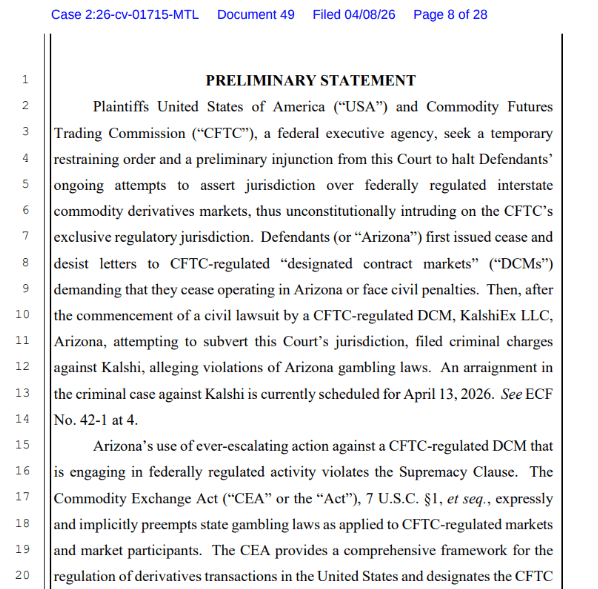
    The US Department of Justice (DOJ) and the Commodity Futures Trading Commission (CFTC) have asked a federal court to block Arizona from enforcing state gambling laws against prediction market platform Kalshi. Federal regulators argue that the company’s event contracts qualify as financial swaps under the Commodity Exchange Act and therefore fall under the CFTC’s exclusive jurisdiction.

    The filing claims Arizona’s enforcement effort unlawfully interferes with federally regulated markets. If the request is approved, Arizona would be prevented from applying state gambling rules to prediction markets operating as federally regulated event-contract platforms.

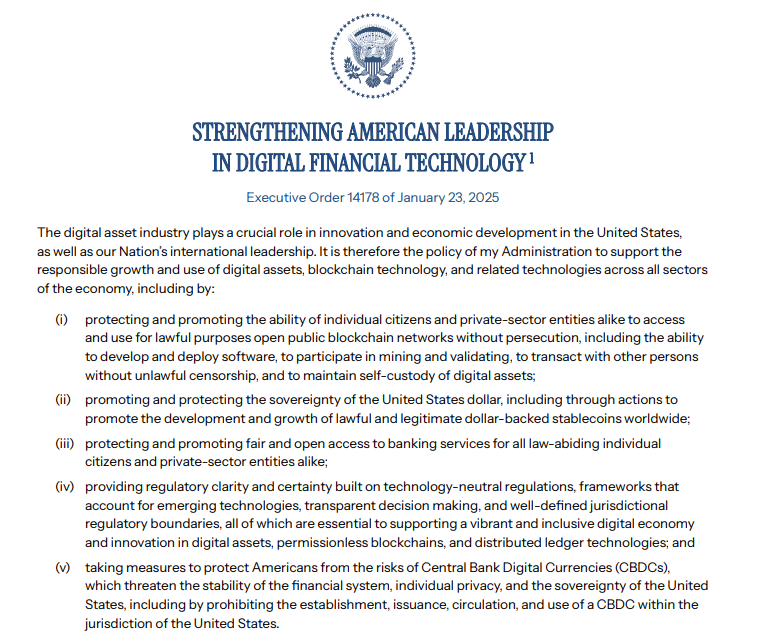
    CFTC, DOJ court filing seeking a TRO against Arizona federal court in case against Kalshi,

    Arizona Charges and Federal-State Legal Clash Intensify

    Arizona Attorney General Kris Mayes previously filed charges on March 17, accusing companies linked to Kalshi of operating an illegal gambling business without a state license and offering election wagering services. An arraignment related to the case is scheduled for April 13.

    The dispute highlights a broader legal conflict over whether prediction markets should be governed by federal commodities law or state gambling regulations. More than ten states have already taken legal action against similar platforms, signaling growing regulatory pressure across the sector.

    Disclaimer

    This content is for informational purposes only and does not constitute financial, investment, or legal advice. Cryptocurrency trading involves risk and may result in financial loss.
  • Crypto Exchanges Expand Into Tokenized Commodities as Pricing Gaps Slow Adoption

    Crypto Exchanges Expand Into Tokenized Commodities as Pricing Gaps Slow Adoption

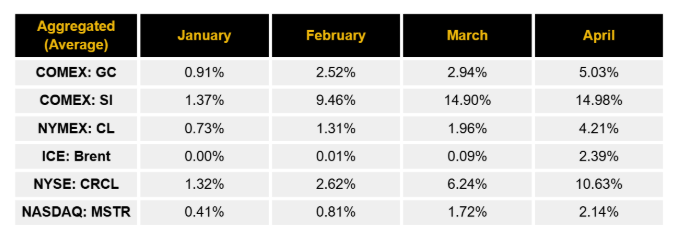
    Crypto exchanges are steadily capturing market share from traditional finance venues by offering tokenized commodity products, particularly in precious metals. Recent market data shows silver perpetual contracts reaching nearly 40% of the trading volume of the Comex Silver (SI) contract at peak levels, one of the largest global silver futures benchmarks.

    During March and April, tokenized silver volumes accounted for 14.90% and 14.98% of Comex trading activity, a sharp increase from 1.37% recorded in January. This growth reflects rising demand for 24/7 access to commodities trading, a feature not available in traditional markets with fixed trading hours.

    Average Aggregated TradFi-Perps Volume to The Primary Futures Equivalents on Traditional Exchanges

    Liquidity and Pricing Challenges Limit Wider Adoption

    Despite strong growth, analysts highlight liquidity depth and price formation as major barriers to mainstream adoption. Tokenized commodities remain vulnerable to widened spreads, thin order books and reduced price reference points, especially when traditional markets close on weekends and holidays.

    Traditional exchanges maintain market quality through centralized clearing, standardized contracts and coordinated trading hours that reduce liquidity gaps. Experts suggest crypto platforms will need stronger liquidity aggregation and improved infrastructure to compete effectively.

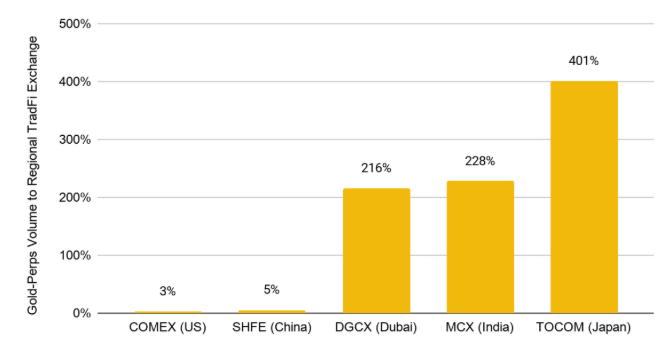
    Average Aggregated Volume of Gold-Perps to Gold Futures in Regional Exchanges

    Gold Perpetuals Show Rapid Expansion

    Gold perpetual contracts have already surpassed trading volumes on several regional commodity exchanges. In March, gold perps reached 401% of Japanese TOCOM volumes, 228% of India’s MCX, and 216% of Dubai’s DGCX, highlighting accelerating demand driven by weekend market risks and continuous trading access.

    Disclaimer

    This content is for informational purposes only and does not constitute financial, investment, or legal advice. Cryptocurrency trading involves risk and may result in financial loss.

  • Bitcoin Surges Above $72,000 as Middle East Ceasefire Optimism Lifts Markets

    Bitcoin Surges Above $72,000 as Middle East Ceasefire Optimism Lifts Markets

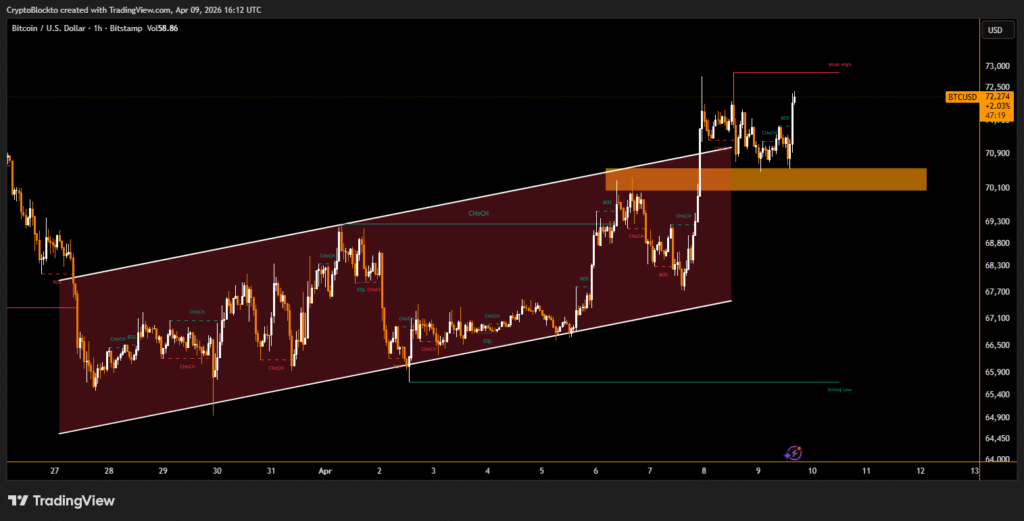
    Bitcoin climbed sharply above $72k, reversing earlier losses after renewed optimism surrounding a possible Middle East ceasefire. The rally followed reports that Israeli Prime Minister Benjamin Netanyahu signaled willingness to begin negotiations with Lebanon focused on disarming Hezbollah.

    $BTC h1 price chart

    Market sentiment improved further after reports indicated that US leadership had urged restraint in military actions, supporting previously announced ceasefire efforts. As geopolitical tensions eased, bitcoin gained nearly 3% intraday, reaching approximately $72,300, marking a 2% increase over 24 hours.

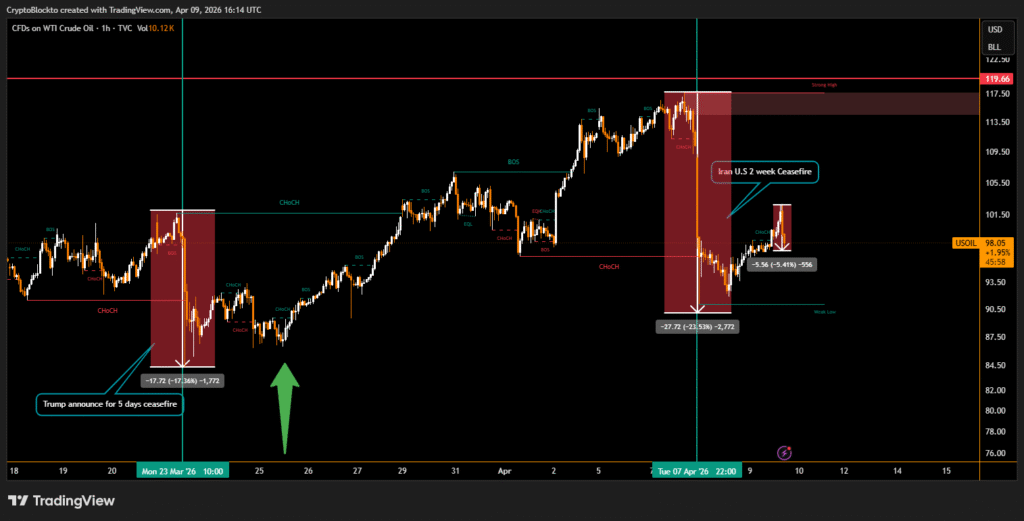
    Oil markets reacted simultaneously, with WTI crude retreating from an earlier peak near $103 per barrel to around $98.60, helping reduce inflation-related fears that had pressured risk assets earlier in the day.

    Cfds on WTI crude oil h1 price chart

    Bitcoin Diverges From Software Stocks Performance

    Bitcoin has also shown growing independence from traditional technology equities. Over the past month, the cryptocurrency advanced roughly 9%, while the iShares Expanded Tech-Software ETF (IGV) declined about 12%, highlighting diverging market trends.

    Disclaimer

    This content is for informational purposes only and does not constitute financial, investment, or legal advice. Cryptocurrency trading involves risk and may result in financial loss.

  • XRP Falls 4% as Selling Pressure Intensifies Despite ETF Inflows

    XRP Falls 4% as Selling Pressure Intensifies Despite ETF Inflows

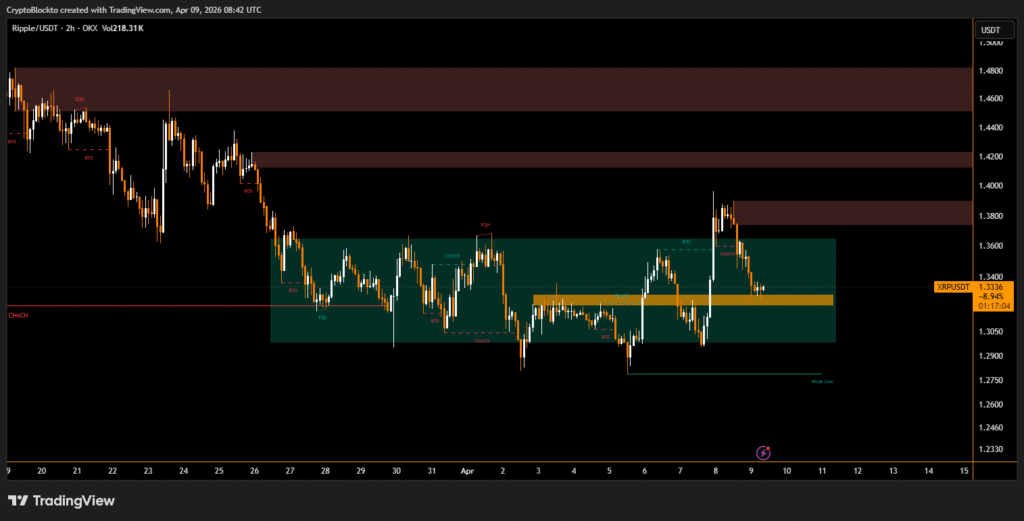
    XRP slipped roughly 4% on April 9, 2026, falling from around $1.37 to $1.33 as persistent selling pressure outweighed modest institutional inflows. Market data shows traders used short-term rallies to exit positions rather than build new ones, reinforcing signs of continued weakness in the asset’s short-term structure.

    $XRP3h price chart

    Ripple-linked investment products recorded $3.32 million in ETF inflows, marking a shift from outflows seen in March. However, the inflows were not strong enough to stabilize prices. At the same time, exchange liquidity has thinned noticeably, increasing the likelihood of sharper price swings if key technical levels are broken.

    Technical Signals Point to Ongoing Distribution Phase

    Recent price action indicates a distribution pattern, with XRP repeatedly failing to hold gains above resistance levels between $1.37 and $1.38. Rising trading volume alongside falling prices further confirmed strong selling activity. The decline accelerated after rejection near $1.38, with late-session volatility pushing the token briefly to $1.31 before minor stabilization.

    Traders are closely monitoring immediate support at $1.33, with stronger downside risk emerging if price falls below the critical $1.28 level. On the upside, XRP must reclaim $1.35 and then break above $1.38 to restore positive short-term momentum and signal a potential shift in market sentiment.

    Disclaimer

    This content is for informational purposes only and does not constitute financial, investment, or legal advice. Cryptocurrency trading involves risk and may result in financial loss.
  • Iran Rejects Limits on Uranium Enrichment Ahead of US Talks

    Iran Rejects Limits on Uranium Enrichment Ahead of US Talks

    Iran Nuclear Chief Dismisses US and Israeli Demands

    Iran has firmly rejected demands from the United States and Israel to limit its uranium enrichment programme, reaffirming that its nuclear activities will continue without restrictions. Mohammad Eslami, head of Iran’s nuclear energy agency, stated that calls to curb enrichment efforts are unrealistic and will not be accepted.

    Eslami said the demands from Iran’s adversaries to restrict enrichment are merely expectations that “will not come true,” emphasizing that past pressure and military actions had failed to halt the programme. His remarks come as renewed negotiations between Iran and the United States are scheduled to take place later this week under Pakistani mediation.

    Uranium Enrichment Remains Core Issue in Global Tensions

    The dispute over uranium enrichment has remained central to Western relations with Iran for more than two decades. The United States and its allies continue to accuse Tehran of pursuing nuclear weapons, while Iran insists its programme is designed for civilian energy purposes.

    Before recent conflicts, Iran enriched uranium to 60% purity, significantly above the 3.67% cap set under the 2015 nuclear agreement and nearing the 90% level typically required for weapons-grade material, according to international nuclear monitoring assessments.

    Disclaimer

    This content is for informational purposes only and does not constitute financial, investment, or legal advice. Cryptocurrency trading involves risk and may result in financial loss.

  • Bitmine Uplists to NYSE With 4.803M ETH Holdings and $4 Billion Buyback Authorization

    Bitmine Uplists to NYSE With 4.803M ETH Holdings and $4 Billion Buyback Authorization

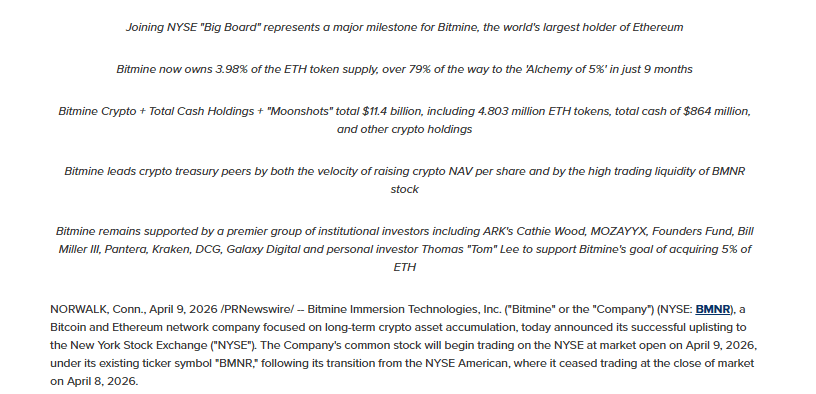
    Bitmine Immersion Technologies officially began trading on the New York Stock Exchange (NYSE) on Thursday after transitioning from the NYSE American, where its shares stopped trading at Wednesday’s close. The move marks a major milestone for the company as it joins one of the world’s most established stock exchanges.

    At the same time, Bitmine’s board unanimously approved expanding its 2025 share repurchase authorization from $1 billion to $4 billion. The buyback program, first approved on July 25, 2025, allows open market purchases under Rule 10b-18 of the Securities Exchange Act of 1934 through an agreement with Cantor Fitzgerald. The expanded authorization includes shares previously repurchased and ranks among the 10 largest buybacks announced in 2026.

    Ethereum Holdings and Staking Activity Continue to Grow

    Bitmine reported holding 4.803 million ETH as of Monday, representing approximately 3.98% of Ethereum’s total supply. In the week ending April 5, the company added 71,252 ETH, marking its largest weekly acquisition since December.

    As of April 6, Bitmine disclosed 3,334,637 staked ETH, valued at approximately $7.1 billion at $2,123 per token, reinforcing its position as one of the largest Ethereum staking participants globally.

    Disclaimer

    This content is for informational purposes only and does not constitute financial, investment, or legal advice. Cryptocurrency trading involves risk and may result in financial loss.