Author: tristan

  • Nakamoto Seeks Reverse Stock Split to Avoid Nasdaq Delisting After 99% Share Price Collapse

    Nakamoto Seeks Reverse Stock Split to Avoid Nasdaq Delisting After 99% Share Price Collapse

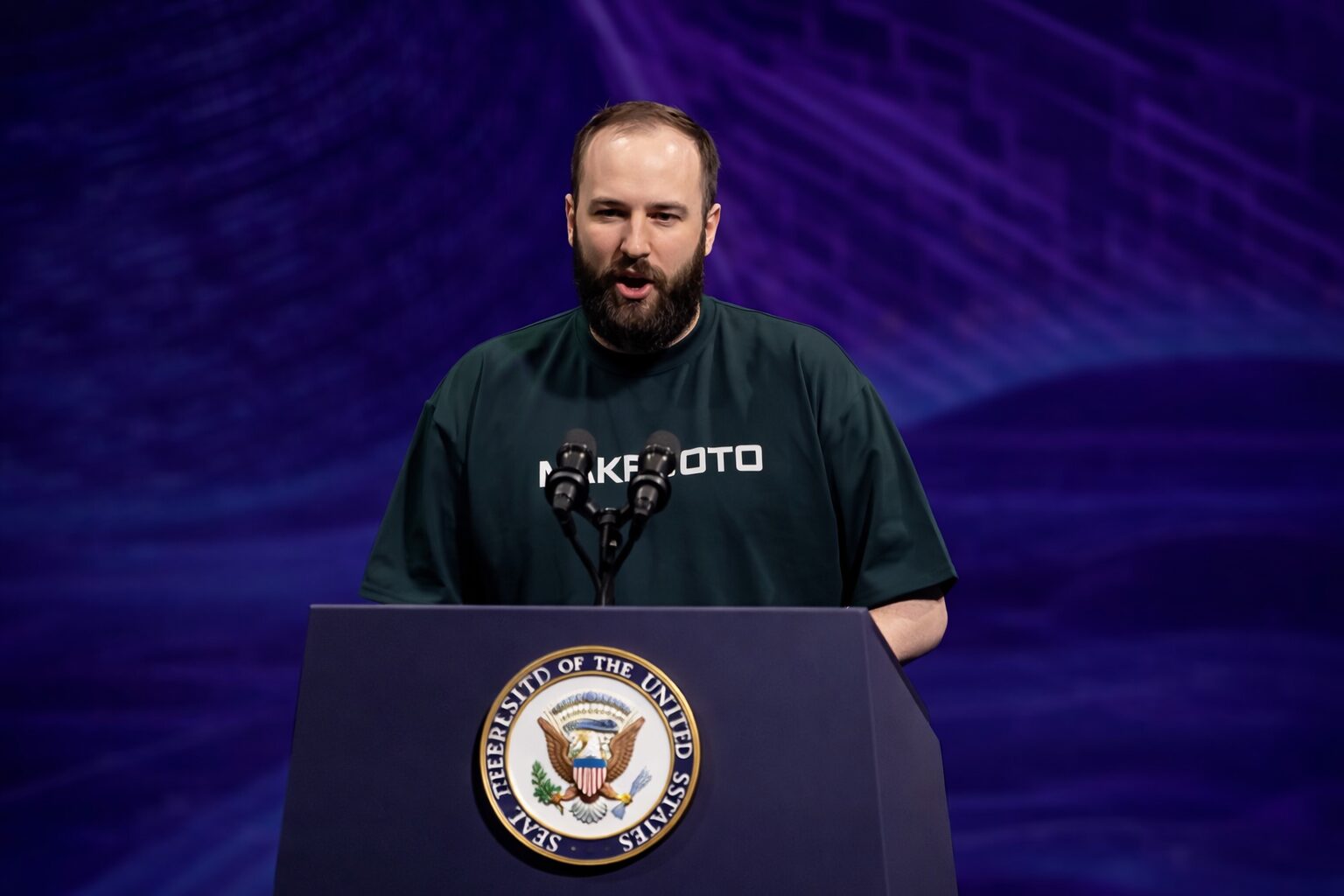
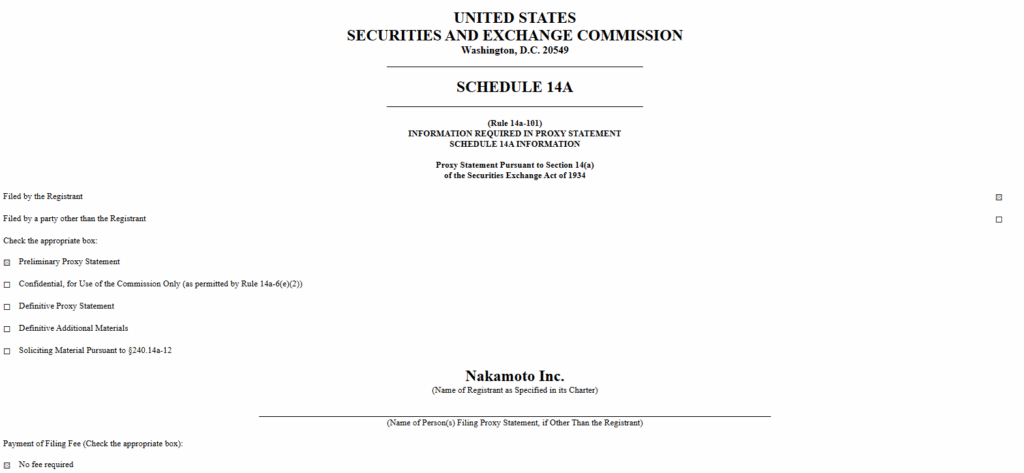
    Bitcoin treasury firm Nakamoto is seeking shareholder approval for a reverse stock split to maintain its listing on the Nasdaq after its share price dropped to about $0.22, down roughly 99% from its May 2025 peak. According to a preliminary Schedule 14A filing, the company proposed a reverse split ratio between 1-for-20 and 1-for-50. This process would reduce the number of outstanding shares while proportionally increasing the share price, helping the company meet Nasdaq’s minimum $1 bid requirement and avoid delisting.
    Share Registration and Future Securities Issuance Plans

    In a separate Form S-3 filing, Nakamoto registered more than 400 million shares for potential resale by existing investors. While this does not immediately raise new capital, it creates a potential stock overhang that could pressure share prices. The company also disclosed a shelf registration allowing up to roughly $7 billion in future securities issuance. This includes an at-the-market (ATM) program worth up to approximately $5 billion, enabling the firm to sell newly issued shares gradually into the market.
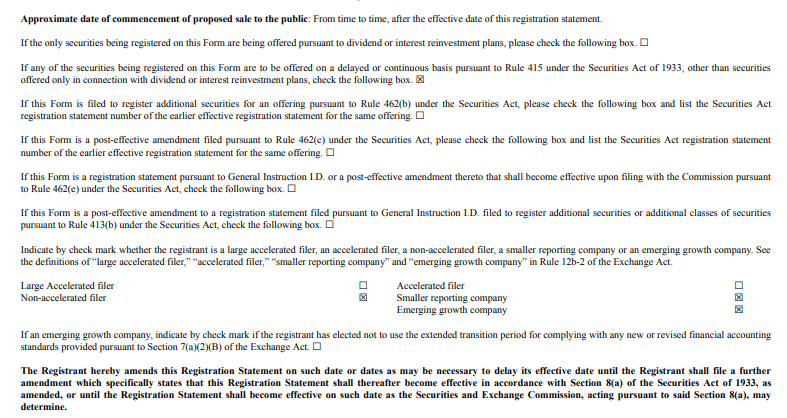
    Form S-3 filing

    Bitcoin Holdings and Industry Market Pressure

    Nakamoto recently sold about 5% of its Bitcoin reserves, leaving it with 5,058 BTC, signaling liquidity management efforts. The company’s share decline mirrors broader pressure across bitcoin treasury firms, as falling Bitcoin prices from above $126,000 in October to near $70,000 have weighed heavily on related stocks.

    Disclaimer

    This content is for informational purposes only and does not constitute financial, investment, or legal advice. Cryptocurrency trading involves risk and may result in financial loss.

  • Japan Reclassifies Crypto as Financial Instruments Under New Regulatory Amendment

    Japan Reclassifies Crypto as Financial Instruments Under New Regulatory Amendment

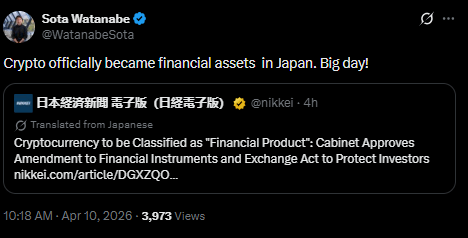
    Japan has officially amended its Financial Instruments and Exchange Act to classify cryptocurrencies as financial instruments, marking a major shift in how digital assets are regulated in the country. The decision moves crypto beyond its previous classification under the Payment and Settlement Act and places it closer to traditional financial markets such as equities and securities.

    Insider Trading Ban and Market Transparency Rules

    Under the updated framework, insider trading involving cryptocurrencies is now explicitly prohibited. This includes buying or selling digital assets based on undisclosed or material non-public information. The law aims to improve market fairness and reduce risks linked to information asymmetry in crypto trading.

    The amendment also introduces stricter disclosure obligations for cryptocurrency issuers. Companies involved in issuing digital assets will now be required to provide annual transparency reports, increasing regulatory oversight and investor protection standards. Authorities have also strengthened penalties for unregistered exchanges operating in the market.

    Japan’s Shift Toward Institutional Crypto Integration

    Japan’s Financial Services Agency previously regulated crypto mainly as a payment tool, but rising institutional participation has driven this reclassification. Officials have stated that the goal is to align crypto markets with traditional financial systems while maintaining transparency and investor safeguards. The country is also exploring crypto exchange-traded funds, signaling continued integration into mainstream financial infrastructure.

    Disclaimer

    This content is for informational purposes only and does not constitute financial, investment, or legal advice. Cryptocurrency trading involves risk and may result in financial loss.
  • BlackRock Bitcoin ETF Sees $269M Inflows as US Spot Funds Hit 5-Week High

    BlackRock Bitcoin ETF Sees $269M Inflows as US Spot Funds Hit 5-Week High

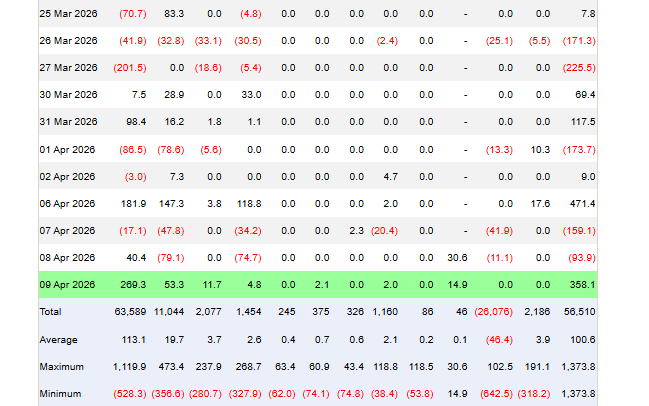
    BlackRock’s iShares Bitcoin Trust recorded $269.3 million in inflows on Thursday, marking its strongest single day performance in five weeks. The inflows helped reverse two consecutive days of net outflows across the 12 US spot Bitcoin ETFs, pushing total net inflows for the day to $358.1 million. The rebound signals renewed investor interest in Bitcoin exposure through regulated financial products.

    Fidelity and Morgan Stanley Also See Positive Demand

    Fidelity’s Wise Origin Bitcoin Fund attracted $53.3 million in inflows, ranking second among competitors. Morgan Stanley’s newly launched Bitcoin Trust (MSBT) added $14.9 million on just its second trading day, contributing to overall market momentum. Smaller inflows were also recorded by Bitwise and ARK 21Shares, while Franklin Templeton and VanEck products collectively added around $2 million.

    Flow data for the US spot Bitcoin ETFs since March 25. Source: Farside Investors

    Institutional Interest Strengthens ETF Market Position

    BlackRock’s Bitcoin ETF alone has now accumulated roughly $1.5 billion in net inflows year-to-date, even as Bitcoin prices have experienced volatility, falling from a 2026 high near $97,000 to around $72,100. Analysts note that inflows suggest long-term accumulation strategies from institutional investors rather than short-term trading behavior.

    Combined ETF flows are now close to turning positive year-to-date, sitting just $80 million below earlier 2025 inflow levels. Market data indicates that sustained institutional participation continues to play a key role in stabilizing demand for Bitcoin-linked investment products.

    Disclaimer

    This content is for informational purposes only and does not constitute financial, investment, or legal advice. Cryptocurrency trading involves risk and may result in financial loss.
  • xAI Sues Colorado Over AI Speech Rules in Senate Bill 24-205 Targeting Grok

    xAI Sues Colorado Over AI Speech Rules in Senate Bill 24-205 Targeting Grok

    Elon Musk’s xAI has filed a lawsuit in a US district court in Colorado seeking to block Senate Bill 24-205, a regulation designed to prevent algorithmic discrimination in employment, housing, and financial services. xAI argues the law could force its chatbot Grok to modify responses based on state-defined standards of fairness and equity, effectively compelling speech. The company claims this violates First Amendment free speech protections and Fifth Amendment rights by requiring disclosure of training data and trade secrets.

    xAI’s Core Arguments on Grok and “Truth-Seeking AI”

    In its filing, xAI states that Colorado cannot alter its message or require Grok to reflect politically influenced viewpoints. It argues such rules interfere with its goal of building “maximally truth-seeking” AI systems and could distort neutral outputs through regulatory pressure.

    Wider US AI Regulation Conflict

    xAI also references its earlier lawsuit against California’s Generative AI Training Data Transparency Act, which raised similar concerns about compelled speech and proprietary data exposure. White House AI adviser David Sacks has warned that inconsistent state laws create a fragmented regulatory system and has pushed for a unified federal AI standard instead of multiple state rules.

    Disclaimer

    This content is for informational purposes only and does not constitute financial, investment, or legal advice. Cryptocurrency trading involves risk and may result in financial loss.

  • Covenant AI exits Bittensor after governance dispute; SN3, SN81, SN39 cited, TAO falls 15%

    Covenant AI exits Bittensor after governance dispute; SN3, SN81, SN39 cited, TAO falls 15%

    Covenant AI, the owner of subnets SN3, SN81, and SN39, has announced it is leaving the Bittensor ecosystem. The decision marks a significant shift within the AI-focused decentralized network, where Covenant had been one of the most prominent subnet operators.

    Allegations of centralized control within “decentralized” network

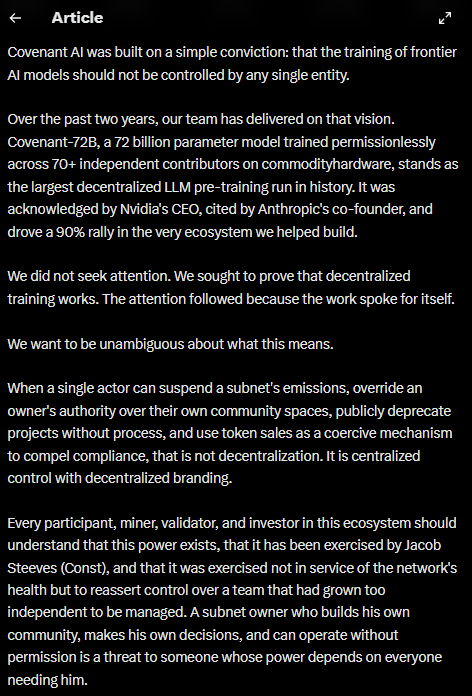
    In a public statement on X, Covenant AI founder Sam Dare said the departure stems from governance conflicts with Bittensor co-founder Jacob Steeves, also known as “Const.” Dare argued that the network’s decentralization promise is misleading, calling it “decentralization theatre” and claiming that no single entity was supposed to control the system.

    Dare further alleged that Steeves maintains effective authority through a “triumvirate structure” managing multisig upgrades. According to Covenant, actions taken against its subnets included suspension of emissions, removal of moderation privileges, and deprecation of subnet infrastructure. The founder also accused Steeves of applying economic pressure through token sales during periods of operational conflict.

    Market impact

    Covenant stated it had developed Covenant-72B, described as a major decentralized large language model pre-training effort within Bittensor. Despite this, the team said it will continue building decentralized AI systems outside the network.

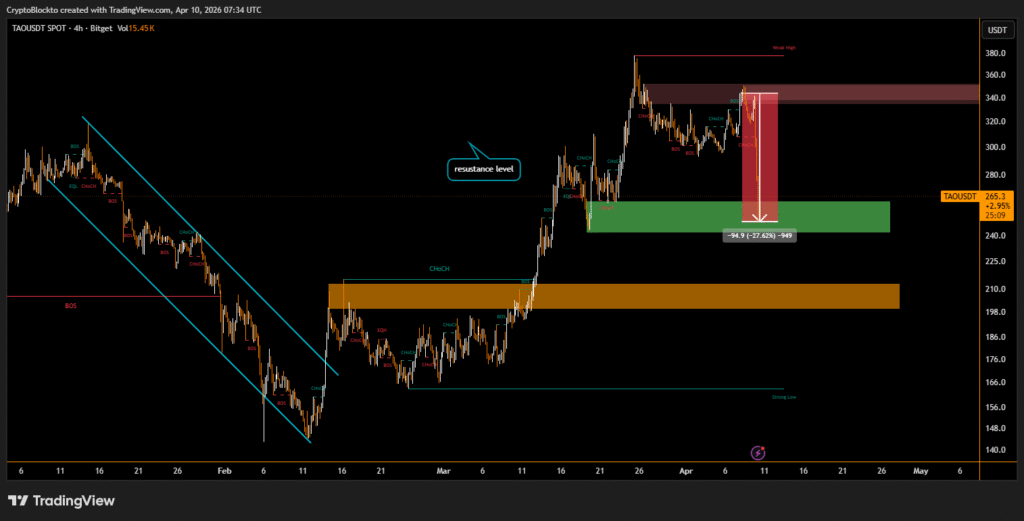
    Following the announcement, TAO dropped about 20%, falling from $338 to $250 before partially recovering near $294. The community reaction on X was divided, with criticism over the abrupt exit. Steeves responded indirectly, suggesting future subnets may operate as “true commodities” independently.

    $Tao 4h price chart

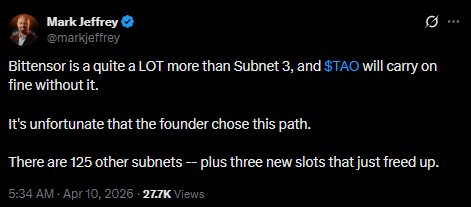
    Mark Jefferey, partner at Bittensor Fund, commented that;

    Disclaimer

    This content is for informational purposes only and does not constitute financial, investment, or legal advice. Cryptocurrency trading involves risk and may result in financial loss.

  • Bitcoin Struggles Below $73,000 as Market Faces Repeated Rejection After Ceasefire Rally

    Bitcoin Struggles Below $73,000 as Market Faces Repeated Rejection After Ceasefire Rally

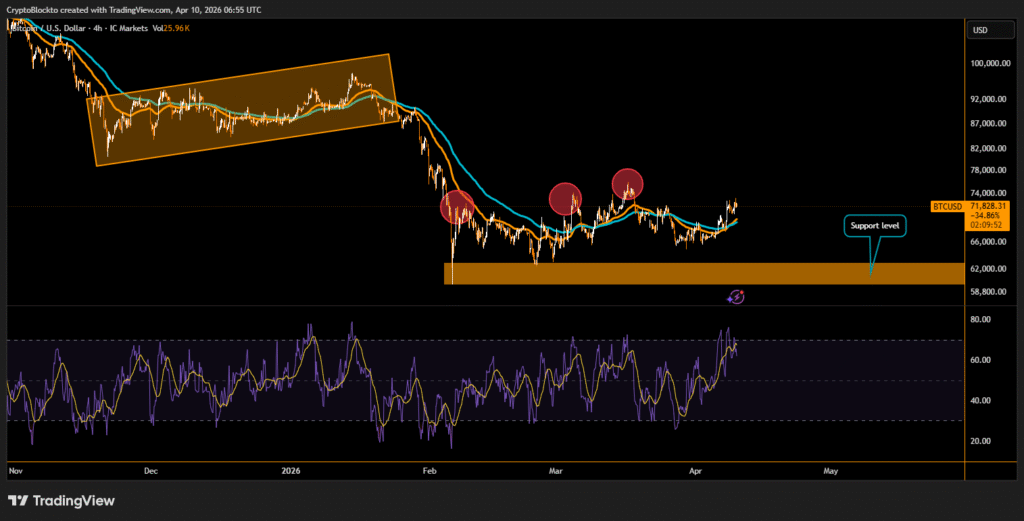
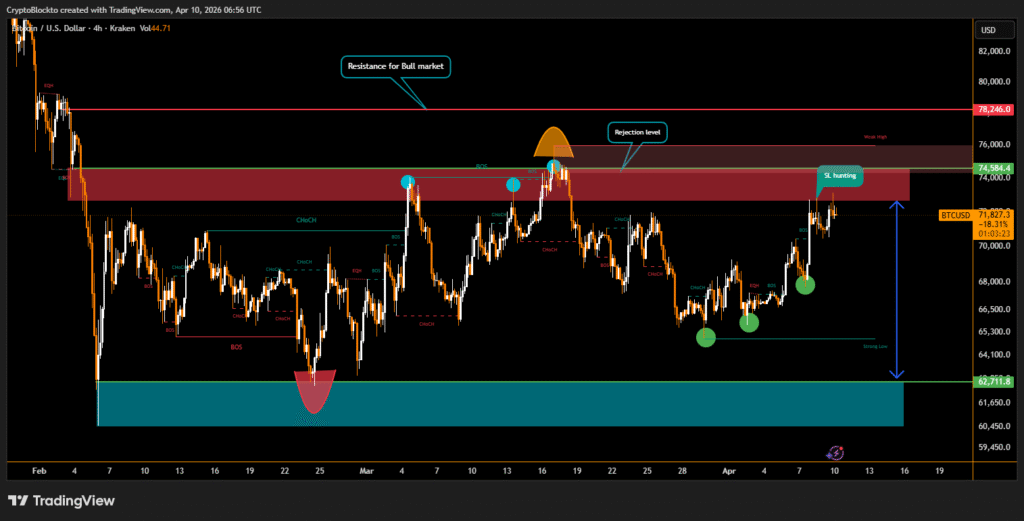
    Bitcoin continues to trade in a tight range, repeatedly failing to break above $73,000 for the third time since the Iran ceasefire announcement. The level has acted as a strong resistance zone throughout the conflict, rejecting every upward attempt since late February. After the latest rejection, Bitcoin slipped back to around $71,843, despite posting its strongest weekly performance during the conflict period.

    $BTC 4h price chart

    Market structure shows Bitcoin holding above its rising 50-day moving average, which has turned upward for the first time since tensions escalated. Even so, analysts say the asset remains trapped between $70,000 and $73,000, with no clear breakout confirmed.

    Analysts Identify $75K–$80K Zone as Bullish Confirmation Range

    Market analysts suggest Bitcoin must first break and hold above $75,000 to signal a renewed bullish phase. Sustained strength above $74,000 is needed before a move toward $80,000 becomes realistic.

    $BTC 4h price chart

    Separately, Mike Novogratz said Bitcoin would need to consolidate above $74,000 and then break $80,000 to confirm a stronger uptrend, potentially triggering renewed market optimism.

    Broader Crypto Market Also Range-Bound Amid Geopolitical Risk

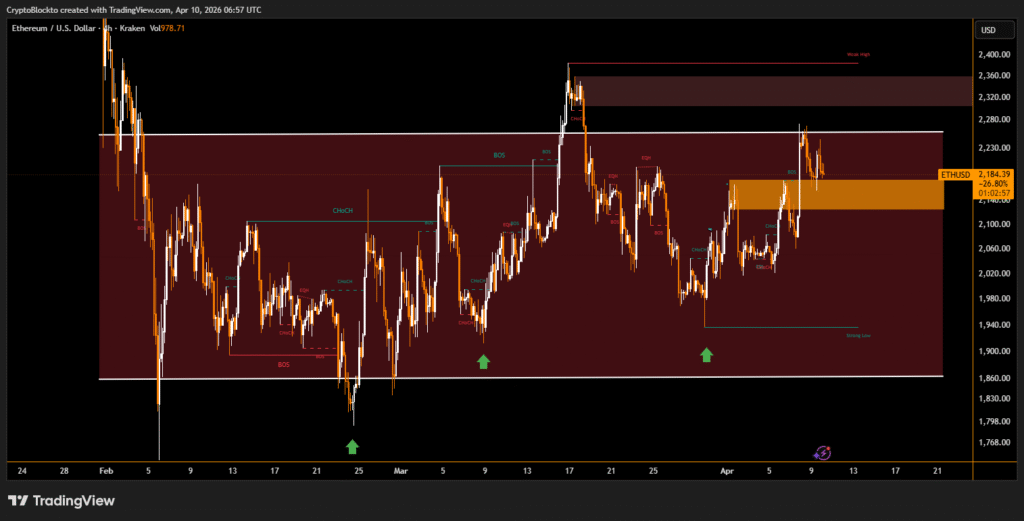
    Major altcoins remain mixed as Ethereum trades near $2,189, down slightly from recent highs and still inside a $2,000–$2,400 consolidation range. Other large tokens such as Solana, XRP, and Dogecoin posted modest weekly gains, while several altcoins including Algorand, Aptos, and Polkadot declined sharply, signaling rotation rather than new capital inflows.

    $ETH 4h price chart

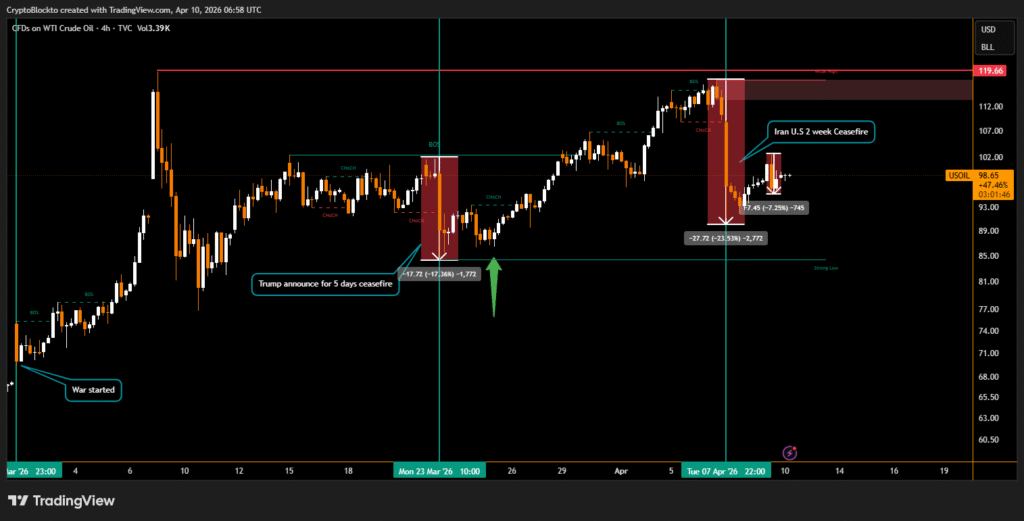
    Geopolitical uncertainty continues to weigh on sentiment as tensions around the fragile ceasefire persist and the Strait of Hormuz remains only partially reopened with operational constraints. Oil prices have rebounded above $98 after a sharp earlier drop.

    USOIL4h price chart

    Market Sentiment Improves but Key Level Holds

    The Fear and Greed Index has moved out of extreme fear territory for the first time in weeks, indicating improving sentiment. However, traders say failure to break $73,000 repeatedly reinforces it as a strong technical ceiling.

    Disclaimer

    This content is for informational purposes only and does not constitute financial, investment, or legal advice. Cryptocurrency trading involves risk and may result in financial loss.

  • Galaxy Stock Rallies 11% Despite $241 Million Net Loss as Core Business Turns Profitable

    Galaxy Stock Rallies 11% Despite $241 Million Net Loss as Core Business Turns Profitable

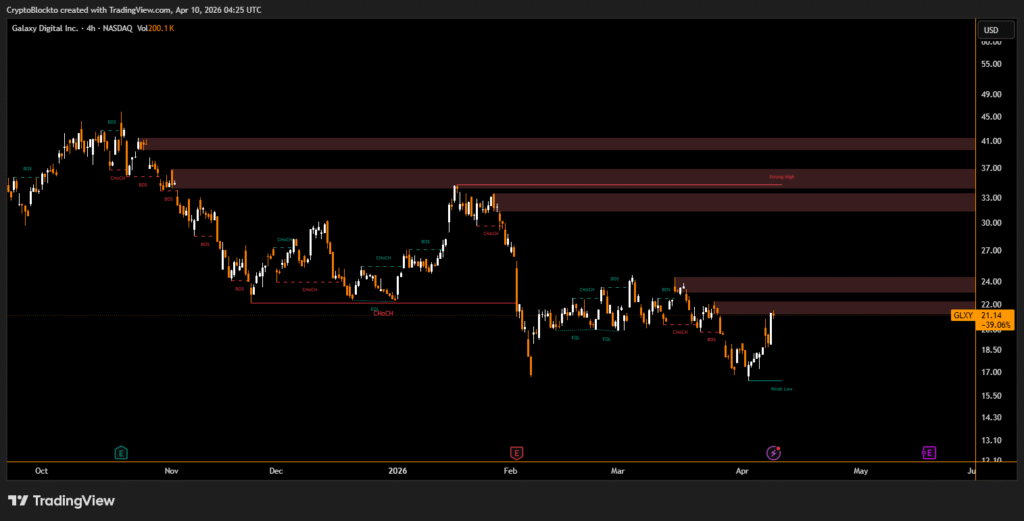
    Shares of Galaxy Digital climbed more than 11% after the company released its annual report, even though it posted a $241 million net loss for full-year 2025. The stock, trading under GLXY, closed at $21.15, ranking as the second-best performing crypto-related stock tracked on industry equity listings that day.

    Galaxy Digital stocks up 11.3%

    The company reported that its core operating business remained profitable on an adjusted, non-GAAP basis. Galaxy recorded an adjusted annual gross loss of $86 million and adjusted EBITDA of $216 million, largely due to unrealized losses on digital asset holdings and investment positions.

    CEO Highlights Infrastructure and Long-Term Strategy

    Chief Executive Officer Mike Novogratz said the company is positioned to benefit from rising demand for blockchain infrastructure. He pointed to the Helios Data Center, which received approval from Electric Reliability Council of Texas to expand to 1.6 gigawatts capacity.

    Cloud firm CoreWeave has signed a long-term agreement to utilize 800 megawatts from Helios, providing stable infrastructure revenue. Galaxy’s Digital Assets segment including trading, lending, asset management and staking generated $505 million in adjusted gross profit, reinforcing Novogratz’s view that the industry is shifting from narrative-driven growth to infrastructure-based development.

    Disclaimer

    This content is for informational purposes only and does not constitute financial, investment, or legal advice. Cryptocurrency trading involves risk and may result in financial loss.

  • Former SEC Director Brett Redfearn Appointed President of Securitize Amid Tokenization Growth

    Former SEC Director Brett Redfearn Appointed President of Securitize Amid Tokenization Growth

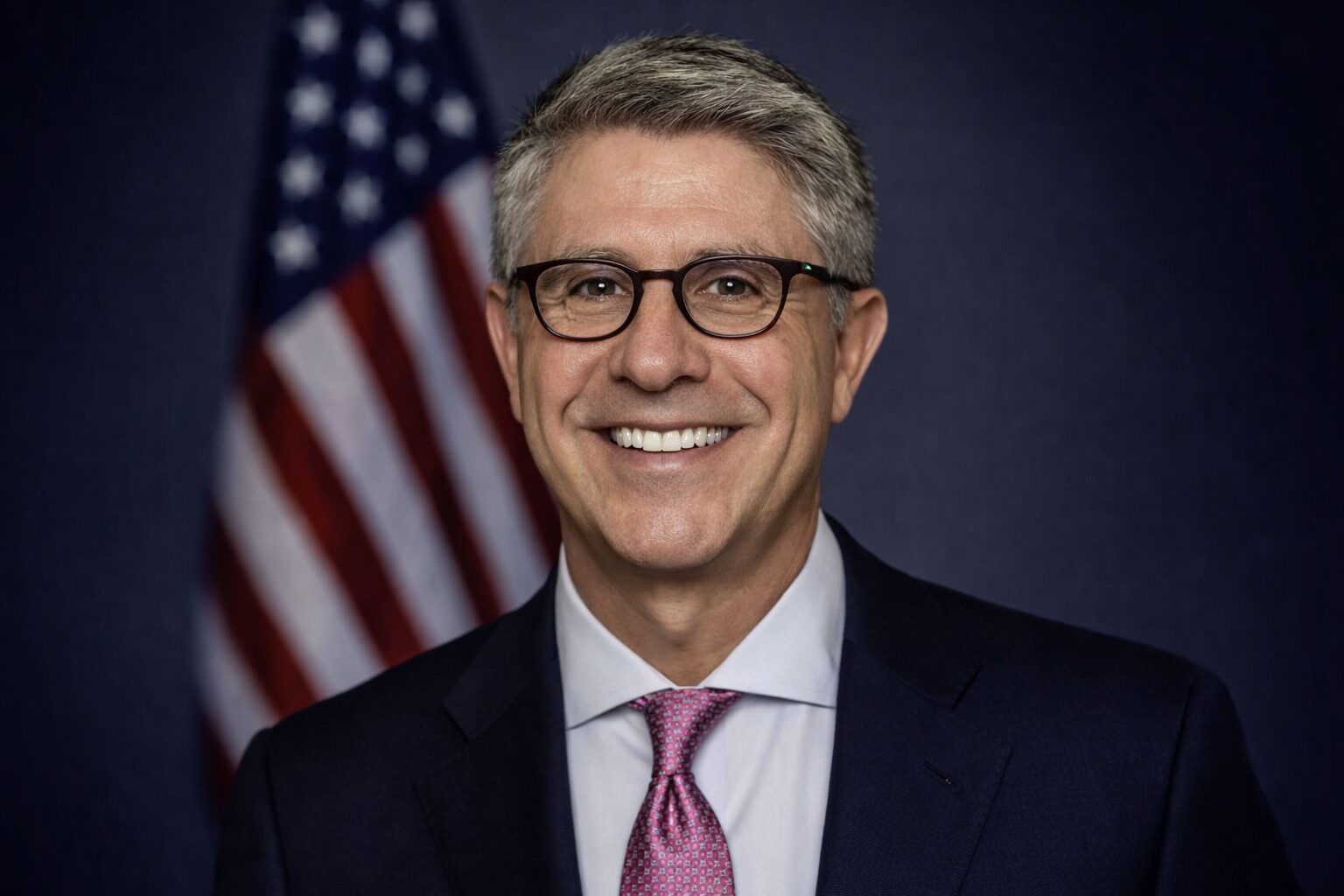
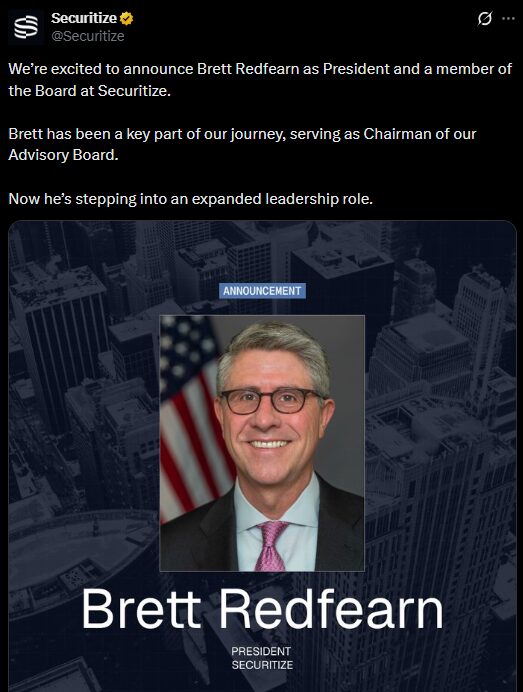
    Digital asset tokenization firm Securitize has named Brett Redfearn as its new president and member of its board of directors. The company announced the appointment on Thursday, noting that Redfearn previously served as director of the Division of Trading and Markets at the US Securities and Exchange Commission.

    His career includes roles as head of capital markets at Coinbase and more than a decade in various positions at JPMorgan. Before becoming president, Redfearn had been serving on Securitize’s advisory board.

    Growing Trend of Regulators Joining Crypto Companies

    Redfearn’s appointment highlights the increasing shift of former government officials into the digital asset sector. Caroline Pham left the US Commodity Futures Trading Commission in December to join crypto payments infrastructure firm MoonPay.

    Tokenization Demand Expands as SEC Leadership Changes

    The leadership move comes as tokenization of real-world assets gains momentum. Data from RWA.xyz showed Securitize recorded $3.85 billion in distributed asset value in March, while tokenized stocks surpassed $1 billion in total onchain value.

    Separately, the SEC announced David Woodcock will lead its Division of Enforcement starting May 4, replacing acting head Sam Waldon. Lawmakers are also seeking answers from Paul Atkins regarding the departure of former enforcement director Margaret Ryan, amid scrutiny over dropped crypto-related cases, including one involving Justin Sun.

    Disclaimer

    This content is for informational purposes only and does not constitute financial, investment, or legal advice. Cryptocurrency trading involves risk and may result in financial loss.
  • CIA Expands Use of AI Co-Workers to Strengthen Intelligence and Counter-Espionage

    CIA Expands Use of AI Co-Workers to Strengthen Intelligence and Counter-Espionage

    The Central Intelligence Agency is preparing to integrate artificial intelligence “co-workers” into its internal analytic systems to help intelligence officers detect espionage threats and anticipate foreign adversary actions.

    Deputy Director Michael Ellis said the agency expects AI assistants to be embedded across all analytic platforms within the next few years. Speaking at an event hosted by the Special Competitive Studies Project in Washington, DC, Ellis explained that the tools will function as a classified version of generative AI designed to support analysts with routine but critical tasks.

    Michael Ellis speaking with Anthony Pompliano about Bitcoin and AI’s role in US national security in May:: Anthony Pompliano

    These AI systems are expected to help draft intelligence assessments, test analytical conclusions and identify hidden patterns within large volumes of global intelligence data. Despite the growing reliance on AI, Ellis emphasized that final decisions will continue to be made by human analysts.

    Hundreds of AI Projects Already Underway

    The CIA has already tested approximately 300 AI projects, focusing on capabilities such as processing large datasets, translating foreign languages and generating intelligence reports. Ellis confirmed that the agency recently produced its first intelligence report with AI assistance, signaling a broader shift toward automation-supported intelligence work.

    Dispute With AI Providers Highlights Security Concerns

    The agency’s push into AI comes during an ongoing dispute involving the United States Department of Defense and AI developer Anthropic. Although Anthropic previously secured a $200 million contract, it restricted the use of its flagship AI model Claude for mass domestic surveillance and fully autonomous weapons.

    In March 2026, Donald Trump ordered federal agencies to stop using Anthropic technology, while defense officials labeled the company a supply chain risk. A US appeals court later denied Anthropic’s request to temporarily pause the designation, leaving the dispute unresolved.

    Global Competition Driving AI Expansion

    Ellis noted that maintaining technological leadership remains a priority, particularly as competition with China intensifies. He stated that the gap in technological innovation between the United States and China has narrowed significantly compared to a decade ago.

    Ellis has also highlighted the importance of Bitcoin transparency, noting that blockchain data analysis supports counterintelligence investigations and represents another critical area of global technological competition.

    Disclaimer

    This content is for informational purposes only and does not constitute financial, investment, or legal advice. Cryptocurrency trading involves risk and may result in financial loss.
  • OKX Ventures and HashKey Invest in VPBank-Linked CAEX for Vietnam Crypto Exchange Pilot

    OKX Ventures and HashKey Invest in VPBank-Linked CAEX for Vietnam Crypto Exchange Pilot

    Crypto platform CAEX, part of the Vietnam Prosperity Joint Stock Commercial Bank ecosystem, has received investment support from OKX Ventures and HashKey as it seeks entry into Vietnam’s regulated crypto exchange pilot program.

    The investors will join VPBank Securities and LynkiD as shareholders. The funding aims to help CAEX meet Vietnam’s minimum charter capital requirement of 10 trillion dong (~$380 million) required for participation.

    Vietnam Crypto Pilot Enforces Strict Entry Rules

    Vietnam’s Ministry of Finance Vietnam and State Securities Commission of Vietnam are overseeing a five-year pilot program for crypto exchanges, allowing only up to five licensed operators. Licensing began on Jan. 20.

    The framework caps foreign ownership at 49% and requires 65% institutional capital, significantly tightening entry requirements. Authorities have also indicated potential restrictions on unlicensed offshore exchanges once domestic platforms launch.

    Investment Goals and Regulatory Collaboration

    OKX confirmed it cannot disclose investment size or stakes but said the funding will help CAEX meet licensing requirements. The firm will collaborate on technical infrastructure, security systems, compliance, and risk management to meet regulatory standards. CAEX is in the final stage of raising capital, while VPBank remains a major private lender in Vietnam.

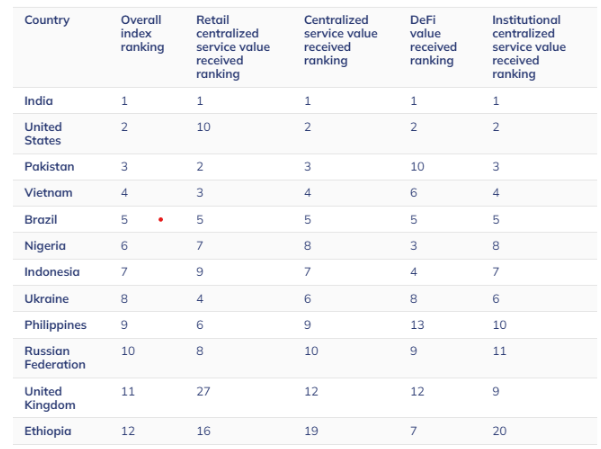
    Vietnam ranks fourth in global crypto adoption: Chainalysis

    Vietnam ranks fourth globally in crypto adoption according to Chainalysis. However, rising scams have increased scrutiny. In March 2026, authorities detained suspects linked to ONUS, accused of fraud and token manipulation involving large investor losses.

    Disclaimer

    This content is for informational purposes only and does not constitute financial, investment, or legal advice. Cryptocurrency trading involves risk and may result in financial loss.