Author: tristan

  • Paxos Labs Raises $12 Million to Expand Crypto Yield, Lending and Stablecoin Issuance Tools

    Paxos Labs Raises $12 Million to Expand Crypto Yield, Lending and Stablecoin Issuance Tools

    Paxos Labs has secured $12 million in a strategic funding round led by Blockchain Capital to accelerate development of its Amplify platform, a suite designed to help companies offer crypto yield, lending and stablecoin issuance through a single integration. The funding round also included participation from Robot Ventures, Maelstrom, and Uniswap, highlighting strong industry backing for infrastructure-focused crypto tools.

    The Amplify suite introduces three main modules Earn, Borrow and Mint enabling platforms to generate yield on customer-held digital assets, support crypto-backed lending and launch branded stablecoins. The platform uses a single software development kit (SDK) with configurable controls, while Paxos manages liquidity sourcing, counterparty screening and backend processes.

    Platform Adoption and Early Performance Metrics

    Several partners, including Aleo, Hyperbeat, and Toku, have already adopted the system. Hyperbeat reported more than $510,000 in assets under management shortly after launching on April 9. Paxos Labs operates as an incubated unit within Paxos, which has processed over $180 billion in tokenization volume for institutional clients.

    The launch reflects a broader shift across crypto platforms toward turning idle digital asset balances into revenue-generating financial tools. Industry participants continue to expand yield-based services as regulatory discussions evolve around stablecoin lending and digital asset frameworks.

    Disclaimer

    This content is for informational purposes only and does not constitute financial, investment, or legal advice. Cryptocurrency trading involves risk and may result in financial loss.
  • Bitcoin Breakout Above $76,000 Fails as Negative Funding Rates Signal Possible Market Bottom

    Bitcoin Breakout Above $76,000 Fails as Negative Funding Rates Signal Possible Market Bottom

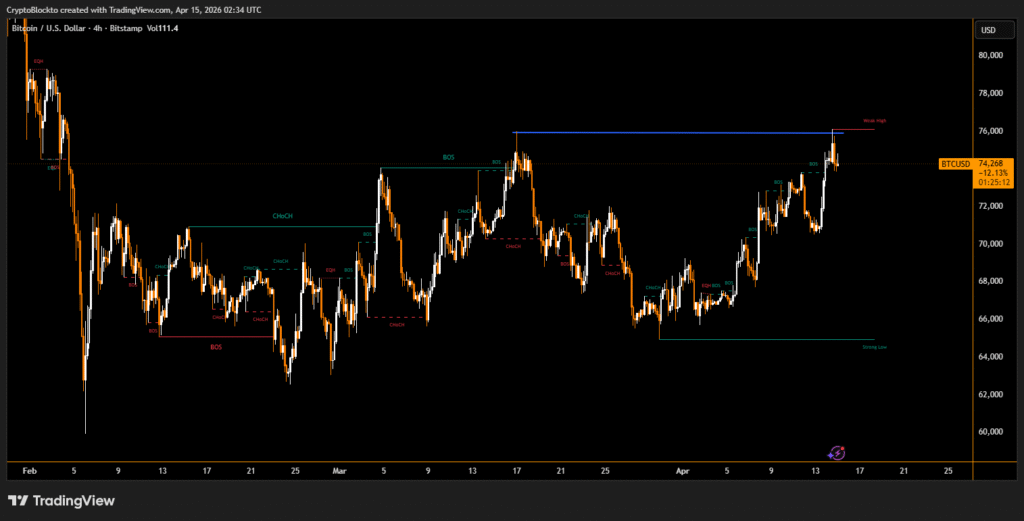
    Bitcoin briefly moved above the $76,000 resistance level but failed to maintain momentum, reversing below $74,000 during the same session. The move highlights a continued two-month struggle to secure a decisive breakout above key resistance zones. Despite the rejection, Bitcoin still recorded about a 1.3% daily gain, trading near $74,300.

    $BTC 4h price chart

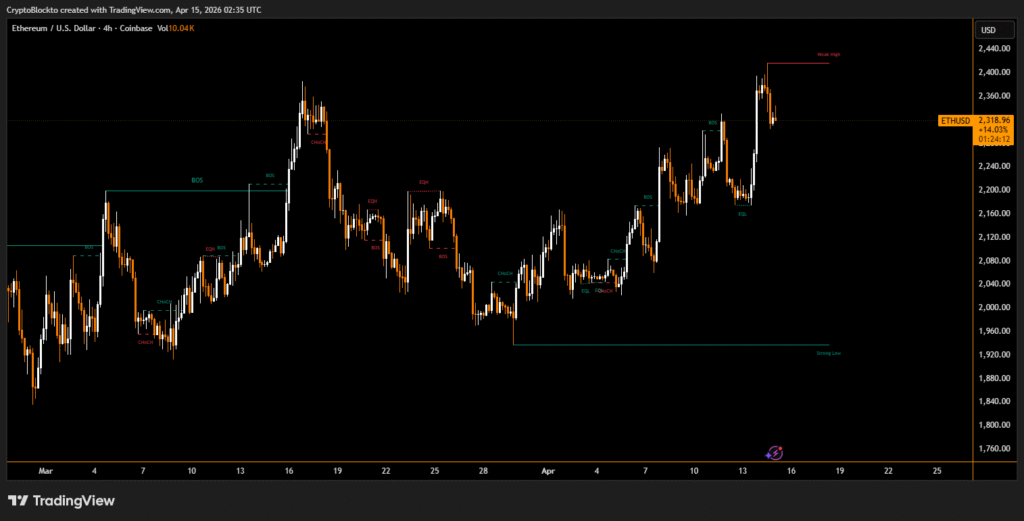
    Ethereum followed a similar pattern, retreating from levels above $2,400 but outperforming Bitcoin with a 2.5% daily increase. Meanwhile, traditional markets showed stronger momentum, with the Nasdaq closing at session highs and the S&P 500 rising 1.2%, nearing record territory. Bitcoin remains roughly 40% below its previous all-time high near $126,000.

    $ETH 4h price hart

    Negative Funding Rates Indicate Persistent Bearish Sentiment

    Data shows bitcoin perpetual funding rates remaining negative for 46 consecutive days, a rare streak last seen after the FTX collapse in late 2022 and during the 2021 mining ban period in China. Rising open interest alongside negative funding suggests traders are increasing short positions rather than closing them.

    Market research observations indicate that extended bearish positioning has historically preceded sharp upward moves. Similar risk-off periods have previously created favorable entry points, as crowded short trades were forced to unwind during sudden price rallies.

    Disclaimer

    This content is for informational purposes only and does not constitute financial, investment, or legal advice. Cryptocurrency trading involves risk and may result in financial loss.
  • Federal Reserve Chair Nominee Kevin Warsh Discloses Crypto and AI Investments Ahead of Senate Hearing

    Federal Reserve Chair Nominee Kevin Warsh Discloses Crypto and AI Investments Ahead of Senate Hearing

    Kevin Warsh, nominated by Donald Trump to lead the Federal Reserve and replace current chair Jerome Powell, has disclosed millions of dollars in assets ahead of his confirmation process. In filings submitted to the US Office of Government Ethics, Warsh reported holdings in several crypto and artificial intelligence-related investment funds.

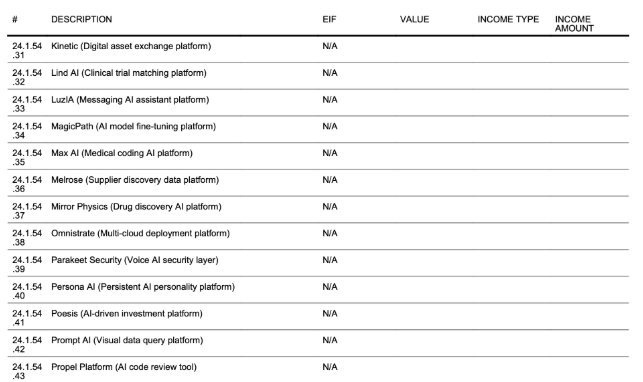
    The disclosure listed Excepted Investment Funds (EIFs) connected to crypto firms such as Compound, Dapper Labs, and Kinetic, along with AI-focused companies including Delphi, Conversion, Factory, and Glue. Although his total assets exceed $100 million, the value ranges for several crypto and AI investments were not specified.

    Sample of Kevin Warsh’s asset disclosure forms.: US Office of Government Ethics

    Senate Confirmation Timeline and Financial Details

    The Senate Banking Committee has scheduled Warsh’s confirmation hearing for April 21. His largest disclosed positions include more than $50 million in the Juggernaut Fund and over $10 million earned in consulting income from Duquesne Family Office, the investment firm associated with Stanley Druckenmiller.

    Warsh was initially announced as the nominee in January, with the formal nomination submitted in March as discussions intensified over replacing Powell, whose second four-year term is set to end on May 15.

    Regulatory Leadership Gaps and Crypto Policy Outlook

    The nomination comes at a time when key US regulatory agencies, including the Securities and Exchange Commission (SEC) and the Commodity Futures Trading Commission (CFTC), face leadership vacancies. The SEC currently operates with three commissioners, while the CFTC has only one confirmed member.

    These staffing gaps could influence the pace of digital asset regulation, especially as lawmakers continue debating a long-delayed crypto market structure bill introduced in July 2025.

    Disclaimer

    This content is for informational purposes only and does not constitute financial, investment, or legal advice. Cryptocurrency trading involves risk and may result in financial loss.

  • Ethereum Foundation Launches $1 Million Audit Subsidy Program to Strengthen Blockchain Security

    Ethereum Foundation Launches $1 Million Audit Subsidy Program to Strengthen Blockchain Security

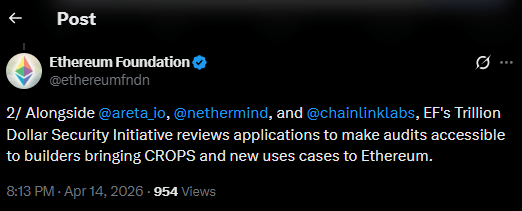
    The Ethereum Foundation has introduced a new initiative called the Ethereum Audit Subsidy Program, designed to provide financial assistance to developers seeking professional security audits. The program forms part of the broader Trillion Dollar Security Initiative, which focuses on improving long-term resilience and safety across the Ethereum ecosystem.

    Security audits are widely recognized as an essential step before launching blockchain applications, yet their high cost often limits access for smaller teams. By offering subsidies, the foundation aims to reduce financial barriers and encourage developers to adopt stronger security standards from the early stages of project development.

    Collaboration With Key Security and Infrastructure Organizations

    The initiative includes collaboration with several established auditing and infrastructure groups, including Nethermind, Chainlink Labs, and Areta, which will help evaluate and review project applications. Their involvement is expected to ensure consistent technical standards and reliable assessment processes.

    The program is also intended to promote innovation by making secure development more accessible. By supporting developers with funding and expert oversight, the Ethereum Foundation aims to foster safer smart contract deployments and expand trust in decentralized applications across the network.

    Disclaimer

    This content is for informational purposes only and does not constitute financial, investment, or legal advice. Cryptocurrency trading involves risk and may result in financial loss.
  • Web3 Hacks Cost $464 Million in Q1 2026 as Phishing Attacks Dominate Crypto Security Losses

    Web3 Hacks Cost $464 Million in Q1 2026 as Phishing Attacks Dominate Crypto Security Losses

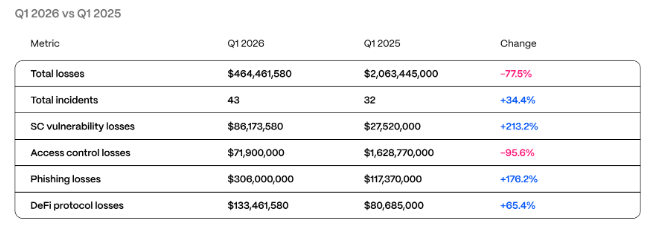
    Web3 platforms recorded losses of approximately $464.5 million across 43 security incidents during the first quarter of 2026, according to a new report by Hacken. The findings show that phishing and social engineering attacks were the leading causes of financial damage, accounting for $306 million in total losses. A single hardware wallet phishing incident in January alone resulted in a $282 million loss, representing roughly 81% of the quarter’s total damage.

    Smart contract vulnerabilities also remained a key threat, contributing $86.2 million in losses, while compromised keys and access control failures added another $71.9 million. Despite these figures, the quarter ranked as the second-lowest first-quarter loss level since 2023, largely due to the absence of mega-scale incidents like the $1.46 billion hack involving Bybit in early 2025.

    Q1 2025 compared to Q1 2026.: Hacken.

    Legacy Code and Infrastructure Weaknesses Increase Attack Risks

    Security experts noted that many of the most costly failures occurred outside core blockchain code, particularly within infrastructure and operational layers. Notable incidents included a $40 million attack involving fake venture capital outreach targeting Step Finance and a $25 million compromise involving cloud-based key management at Resolv Labs. Older smart contract deployments also remained vulnerable, including a $26.4 million exploit affecting Truebit and a donation attack impacting Venus Protocol.

    Regulators Tighten Compliance and Incident Response Standards

    Growing losses and operational risks have prompted regulators to strengthen enforcement requirements worldwide. Frameworks such as the Markets in Crypto-Assets Regulation and the Digital Operational Resilience Act are introducing stricter monitoring, reporting, and response standards.

    Additional regulatory measures have also been implemented in regions such as Dubai, Singapore, and the United Arab Emirates, reflecting a global shift toward faster incident detection timelines. Recommended targets now include detecting threats within 24 hours, labeling suspicious activity within four hours, and blocking attacks within seconds, signaling a new era of continuous security oversight in the Web3 sector.

    Disclaimer

    This content is for informational purposes only and does not constitute financial, investment, or legal advice. Cryptocurrency trading involves risk and may result in financial loss.

  • Goldman Sachs Files for Bitcoin Premium Income ETF to Expand Crypto Investment Strategy

    Goldman Sachs Files for Bitcoin Premium Income ETF to Expand Crypto Investment Strategy

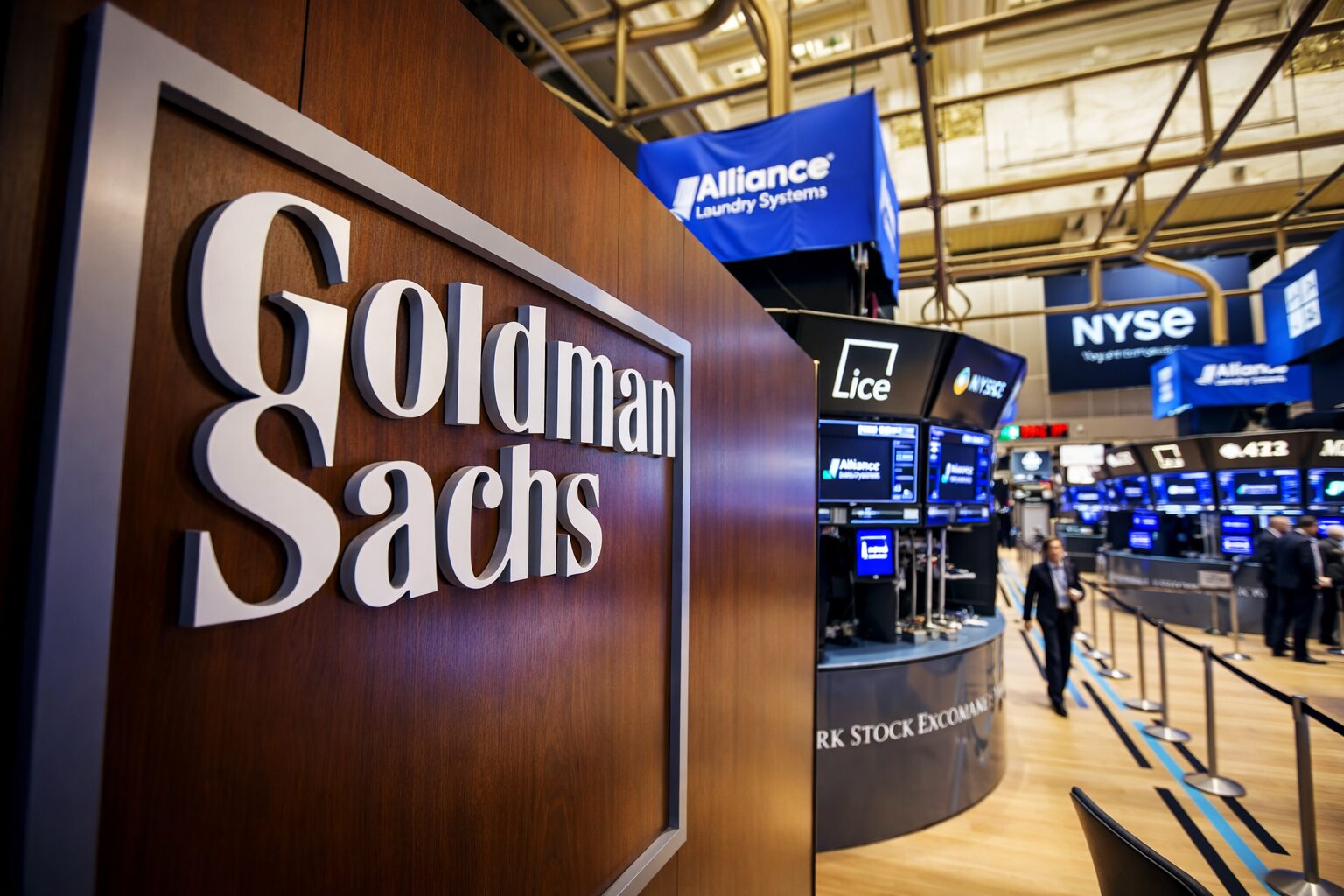
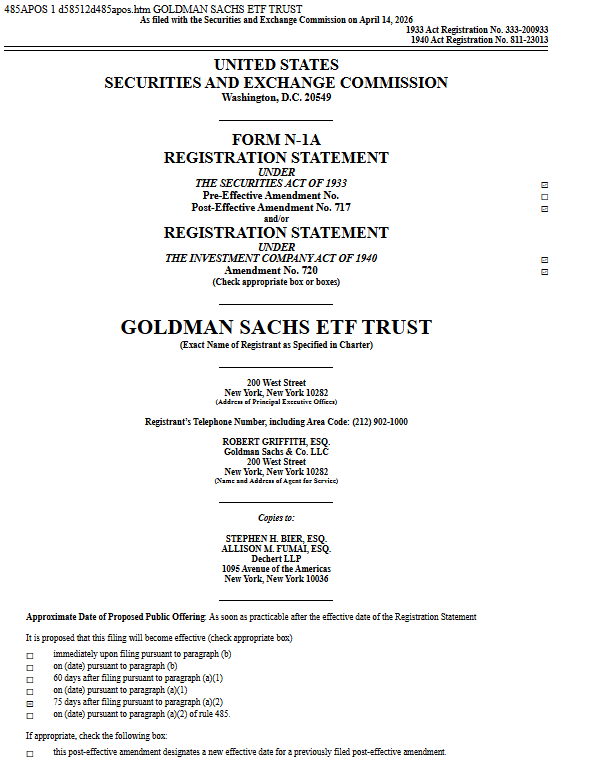
    Goldman Sachs has filed an application to launch a Bitcoin Premium Income exchange traded fund, marking one of its first major direct moves into cryptocurrency-linked investment products. The proposed ETF is designed to provide exposure to bitcoin while generating income through an options-based premium strategy.

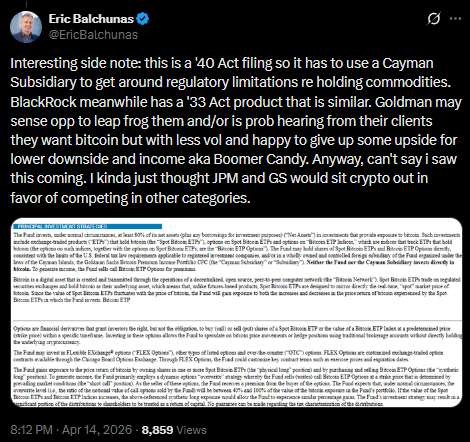
    The structure involves selling options tied to bitcoin-linked exchange traded products, allowing the fund to collect premium income. However, this approach may limit potential gains during strong market rallies, reflecting a trade-off between steady yield and full price participation.

    Bloomberg Senior ETF analyst Eric Balchunas wrote in a post on X;

    Competition Intensifies With Similar Bitcoin Income Products

    The filing follows recent developments from BlackRock, which is preparing to introduce a similar income-focused product, the iShares Bitcoin Premium Income ETF expected to trade under the ticker BITA. This signals growing competition among major financial institutions seeking to offer more advanced bitcoin investment strategies.

    Industry trends show that asset managers are moving beyond simple spot exposure, developing products that resemble income-generating funds rather than relying solely on bitcoin price appreciation.

    Strategic Shift Reflects Growing Institutional Confidence

    The move highlights a gradual shift in Goldman Sachs’ approach toward digital assets. Chief executive David Solomon has previously acknowledged holding a small amount of bitcoin and emphasized the importance of tokenization in reshaping financial markets.

    The filing also suggests that improving regulatory clarity is encouraging large banks to expand into crypto-related products, potentially attracting investors seeking both yield opportunities and bitcoin market exposure.

    Disclaimer

    This content is for informational purposes only and does not constitute financial, investment, or legal advice. Cryptocurrency trading involves risk and may result in financial loss.

  • Banks Challenge White House Findings on Stablecoin Yields and Deposit Risks

    Banks Challenge White House Findings on Stablecoin Yields and Deposit Risks

    The American Bankers Association has pushed back against a recent report from the White House Council of Economic Advisers that suggested banning stablecoin yield payments would have only a minimal effect on the banking sector. The White House analysis estimated that prohibiting yields on stablecoins would increase bank lending by about $2.1 billion, representing just a 0.02% rise under baseline conditions.

    However, ABA chief economist Sayee Srinivasan and vice president Yikai Wang argued that the report focused on the wrong metric. They stressed that the primary concern is whether allowing stablecoin yields would encourage deposit outflows, particularly from smaller community banks that rely heavily on local funding.

    Community Banks Warned of Rising Funding Costs

    According to the ABA analysis, even if total deposits across the banking system remain stable, funds could shift from smaller institutions to larger banks offering more competitive rates. This movement could increase funding costs for community banks and reduce their ability to provide local lending services. Some smaller lenders may need to rely on higher-cost wholesale borrowing if deposit outflows accelerate.

    Earlier estimates from the United States Department of the Treasury suggested that widespread adoption of stablecoins could lead to as much as $6.6 trillion in deposit outflows from traditional banks.

    Stablecoin Rewards Seen as Competitive Threat to Traditional Banking

    Despite raising concerns, banking researchers acknowledged that stablecoin rewards could be attractive to households and businesses seeking higher returns than traditional savings accounts. Industry voices such as Brian Armstrong have argued that stablecoin yields could push banks to offer more competitive interest rates.

    The ABA represents major financial institutions including JPMorgan Chase, Goldman Sachs, and Citigroup, highlighting the broad industry attention on stablecoin yield policy discussions.

    Disclaimer

    This content is for informational purposes only and does not constitute financial, investment, or legal advice. Cryptocurrency trading involves risk and may result in financial loss.
  • Bitcoin Halving Cycle Passes Midpoint as Post-Halving Gains Continue to Slow

    Bitcoin Halving Cycle Passes Midpoint as Post-Halving Gains Continue to Slow

    Bitcoin has moved past 50.01% of its current halving cycle, according to network data from mempool.space, marking a key milestone in epoch 5 that began in April 2024 and runs toward the next halving expected on April 12, 2028. The block subsidy now stands at 3.125 BTC per block, with issuance averaging about 450 BTC per day as blocks are mined roughly every 10 minutes.

    The Bitcoin network maintains stability through difficulty adjustments every 2,016 blocks, ensuring consistent issuance as supply trends toward the fixed 21 million cap. More than 20 million BTC have already been mined, leaving the final supply to be distributed over the next ~114 years.

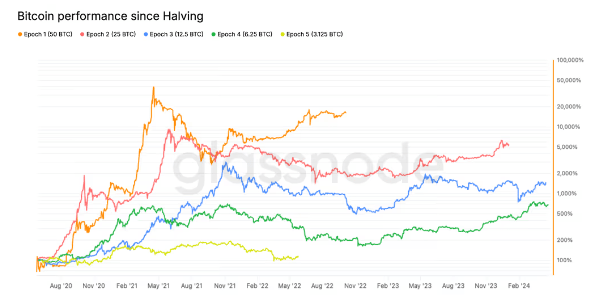
    Price performance has been more subdued this cycle, with Bitcoin up around 15% from $64,000 to nearly $75,000 since the April 2024 halving. It previously hit an all-time high near $126,000 in October 2025 before falling to about $60,000 in February 2026, according to Glassnode data.

    Price Performance Since Halving

    Analysts say diminishing returns reflect growing market maturity, higher adoption, and reduced volatility across cycles.

    Disclaimer

    This content is for informational purposes only and does not constitute financial, investment, or legal advice. Cryptocurrency trading involves risk and may result in financial loss.

  • Fake Ledger Live App Scam Drains $9.5 Million From Crypto Users

    Fake Ledger Live App Scam Drains $9.5 Million From Crypto Users

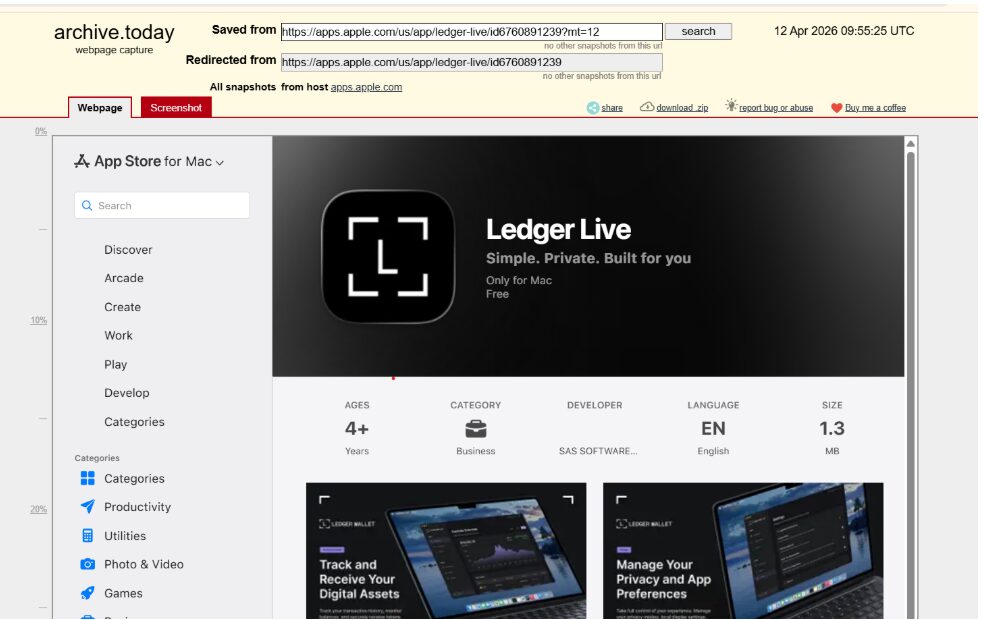
    Onchain investigator ZachXBT reported that a fraudulent Ledger Live application listed on Apple App Store was responsible for roughly $9.5 million in stolen cryptocurrency between April 7 and April 13. According to findings shared in a Telegram post, more than 50 suspected victims were affected across multiple blockchain networks, including Bitcoin, Ethereum, Solana, Tron, and XRP Ledger.

    The stolen funds were reportedly routed through more than 150 deposit addresses linked to KuCoin, allegedly tied to a centralized mixing service known as AudiA6. The fake application was removed from the platform on April 13 after the thefts were identified.

    Largest Victim Losses and Ongoing Investigation

    Among the most significant cases, one victim reportedly lost about $1.95 million in Bitcoin, Ether, and staked Ether. Another lost $3.23 million in USDT on April 9, while a third saw approximately $2 million in USDC stolen on April 11. These figures remain based on ZachXBT’s investigation and have not yet been officially confirmed by Apple or KuCoin.

    Fake Ledge Live app in the App Store.: Archive.ph

    Security Warnings Highlight Seed Phrase Risks

    Ledger’s chief technology officer, Charles Guillemet, emphasized that users should never enter their 24-word recovery phrase into any application. He warned that even official-looking software environments, including major app stores, can host malicious tools if attackers exploit distribution channels.

    Disclaimer

    This content is for informational purposes only and does not constitute financial, investment, or legal advice. Cryptocurrency trading involves risk and may result in financial loss.
  • Bitcoin Surges Above $76K and Breaks March High During New York Session

    Bitcoin Surges Above $76K and Breaks March High During New York Session

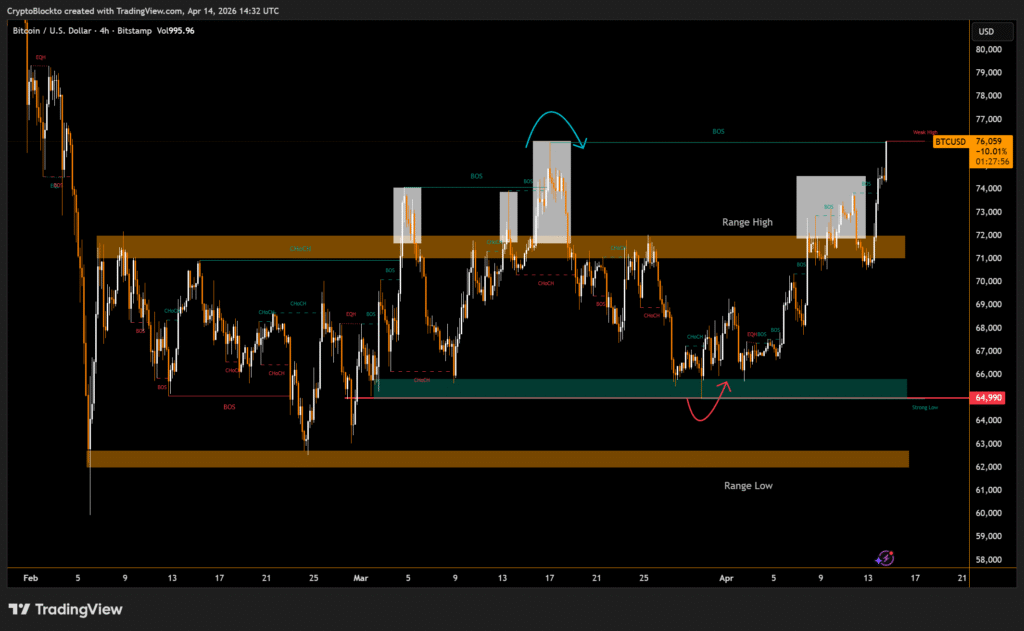
    Bitcoin surged above the $76,000 level during the New York trading session, breaking above its March highs and signaling renewed bullish momentum. The move marks a key technical breakout, as the $72,000–$76,000 zone had acted as a strong resistance area for weeks. Analysts note that clearing this level is often viewed as confirmation of a trend reversal and sustained upside momentum.

    $BTC 4h price chart

    Recent market action shows Bitcoin had been consolidating between roughly $62,500 and $75,000 before pushing higher, indicating growing buying pressure and renewed demand from traders and institutions.

    Key Levels Traders Are Watching Next

    With the March high now broken, the next resistance zones are expected near $80,000 and above. Market analysts suggest that sustained trading above $76,000 could open the path toward higher price targets, while support is likely forming near the $72,000–$74,000 range.

    If momentum continues, this breakout could mark the beginning of a stronger upward phase after months of consolidation.

    Disclaimer

    This content is for informational purposes only and does not constitute financial, investment, or legal advice. Cryptocurrency trading involves risk and may result in financial loss.