Author: tristan

  • Ether Outperforms Bitcoin as ETF Outflows Rise and Ethereum Transactions Jump 41%

    Ether Outperforms Bitcoin as ETF Outflows Rise and Ethereum Transactions Jump 41%

    Ether has begun outperforming Bitcoin as capital rotates away from US spot bitcoin exchange traded funds and into ether focused products. Bitcoin ETFs recorded net outflows of about $325.8 million on April 13, led by $229 million from Fidelity Wise Origin Bitcoin Fund and $63 million from ARK 21Shares Bitcoin ETF, signaling a cooling of one of bitcoin’s major demand sources.
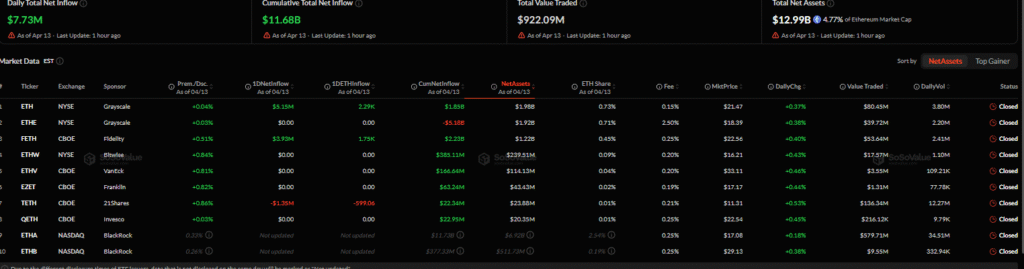
    In contrast, ether funds recorded modest daily inflows of roughly $7.7 million, while weekly inflows climbed to $187 million for the period ending April 10 — the strongest performance so far in 2026 after three weeks of combined outflows totaling about $308 million. Total cumulative inflows into ether funds have now reached a record $11.68 billion, supporting price gains of about 8% over 24 hours compared with bitcoin’s 5% increase.

    Ethereum Network Activity Surges but Transaction Value Weakens

    Activity on the Ethereum network has accelerated significantly, with daily transactions rising 41% week over week to approximately 3.6 million from around 2.5 million recorded on April 10. Among major networks, only Sonic and TON reported larger percentage increases, though from smaller starting levels.
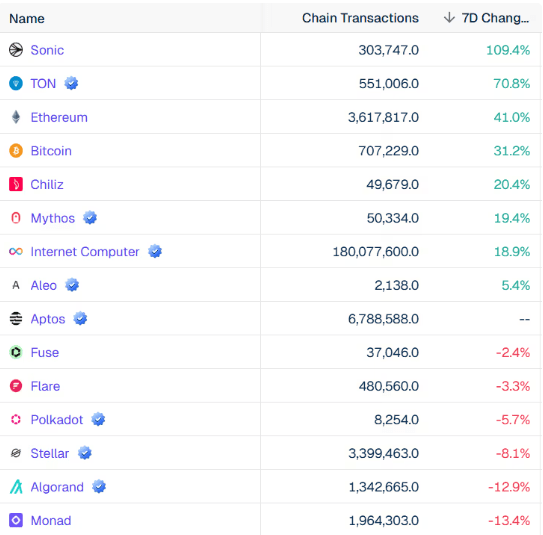
    Daily transactions have jumped 41% week over week to roughly 3.6 million

    Despite the surge in activity, stablecoin transfer volume on Ethereum dropped 42.6% during the same period, while transaction fees declined nearly 50%, indicating smaller transaction sizes and reduced economic throughput. Analysts note that bitcoin has remained stable despite ETF outflows, suggesting strong underlying spot demand, but the durability of ether’s outperformance will depend on continued fund inflows and stronger economic value behind network activity.
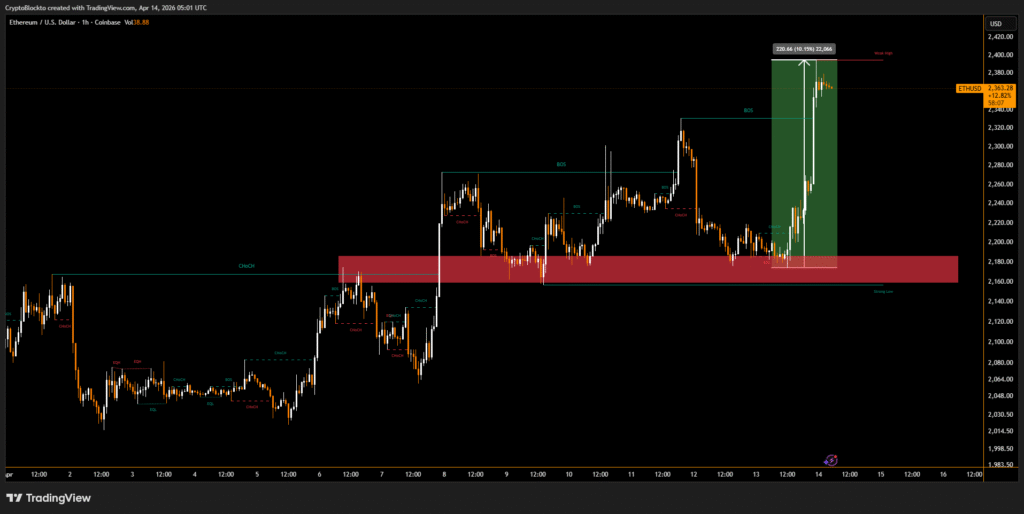
    Ether tapped a 10-week high
    Disclaimer

    This content is for informational purposes only and does not constitute financial, investment, or legal advice. Cryptocurrency trading involves risk and may result in financial loss.


  • Sanctioned Chinese Tanker Crosses Strait of Hormuz Despite US Naval Blockade

    Sanctioned Chinese Tanker Crosses Strait of Hormuz Despite US Naval Blockade

    A Chinese owned tanker under US sanctions has successfully passed through the Strait of Hormuz, despite a US naval blockade of Iranian ports that began earlier this week. The vessel, Rich Starry, is owned by Shanghai Xuanrun Shipping Co Ltd. and had previously been sanctioned for transporting Iranian crude oil.

    According to data from Kpler and MarineTraffic, the tanker transited the key maritime chokepoint without disruption. Reports indicate it was carrying around 250,000 barrels of methanol loaded at the Emirati port of Hamriyah, a factor that may have allowed it to pass without enforcement action. US Central Command clarified that the blockade applies specifically to Iranian ports and vessels traveling to or from them, rather than restricting all maritime traffic in the region.

    Sanctions Enforcement Focused on Iranian Trade Routes

    A second sanctioned tanker, the Murlikishan, also entered the strait during the same period while heading toward Iraq to load fuel oil, according to Kpler and LSEG data. The vessel has previously been linked to transporting Iranian and Russian oil.

    US President Donald Trump announced that the US Navy would begin blocking ships entering or leaving Iranian ports, though official statements later clarified that freedom of navigation for non-Iranian routes through the Strait of Hormuz would not be impeded.

    Disclaimer

    This content is for informational purposes only and does not constitute financial, investment, or legal advice. Cryptocurrency trading involves risk and may result in financial loss.

  • X Product Head Nikita Bier Hints at New Launch as Crypto Struggles and X Money Nears Rollout

    X Product Head Nikita Bier Hints at New Launch as Crypto Struggles and X Money Nears Rollout

    X head of product Nikita Bier suggested the platform may be preparing a new initiative for the crypto sector, writing that “crypto has had a rough year” and hinting that X could “launch something to fix it.” His post quickly went viral, drawing more than 677,000 views within hours and fueling speculation about the company’s direction ahead of its upcoming payments product.

    The comments come just weeks before X launches X Money, a fiat-based payments system expected to include peer-to-peer transfers, bank deposits, a debit card, and cashback rewards. The service is being developed in partnership with Visa and a licensed subsidiary operating across more than 40 U.S. states, according to previous announcements by Elon Musk.

    Although X Money is currently described as a fiat-only product with no confirmed crypto features, recent hiring decisions have intensified speculation about possible blockchain integration. The platform recently brought in crypto-experienced talent, including former Aave executive Benji Taylor, signaling deeper fintech ambitions.

    Bier’s remarks have left open whether X will directly compete with crypto services or potentially integrate blockchain infrastructure behind the scenes as part of its evolving payments ecosystem.

    Disclaimer

    This content is for informational purposes only and does not constitute financial, investment, or legal advice. Cryptocurrency trading involves risk and may result in financial loss.
  • SEC Signals Some Crypto Interfaces May Avoid Broker Registration Under New Guidance

    SEC Signals Some Crypto Interfaces May Avoid Broker Registration Under New Guidance

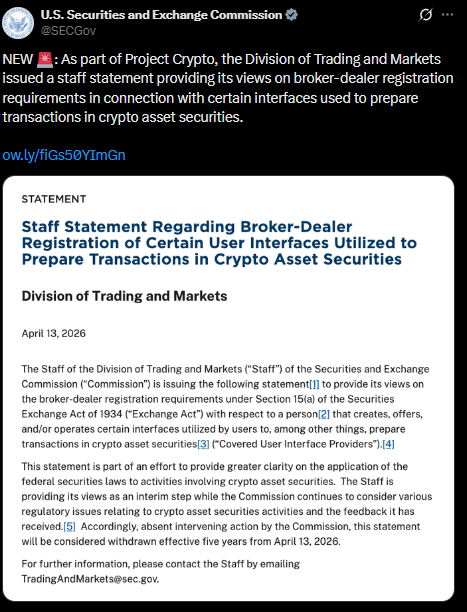
    The U.S. Securities and Exchange Commission released a staff statement outlining how broker dealer rules may apply to crypto transaction interfaces. According to the SEC Division of Trading and Markets, certain software interfaces that assist users in conducting crypto asset securities transactions through self-custodial wallets may not need to register as broker-dealers if they meet specific conditions.

    The guidance states that these interfaces must not solicit investors to carry out specific transactions or provide recommendations on execution routes. The clarification aims to help define how federal securities laws apply to crypto related tools, although the staff statement does not carry the same authority as a formal rulemaking process.

    Leadership Gaps and Policy Debate Continue at SEC and CFTC

    Hester Peirce, who leads the agency’s crypto task force, described the statement as a step toward addressing evolving market conditions but noted the need for more permanent regulatory solutions. She said digital assets are challenging long-standing interpretations of securities law.

    Leadership shortages remain a concern at both the SEC and the Commodity Futures Trading Commission, where staffing levels have declined following resignations, including the departure of former acting chair Caroline Pham. Some lawmakers are considering requiring minimum staffing levels before major crypto market structure legislation can take effect.

    Disclaimer

    This content is for informational purposes only and does not constitute financial, investment, or legal advice. Cryptocurrency trading involves risk and may result in financial loss.
  • Bitcoin Nears $75K as Iran Offers 5-Year Nuclear Pause, Trump Pushes 20-Year Deal

    Bitcoin Nears $75K as Iran Offers 5-Year Nuclear Pause, Trump Pushes 20-Year Deal

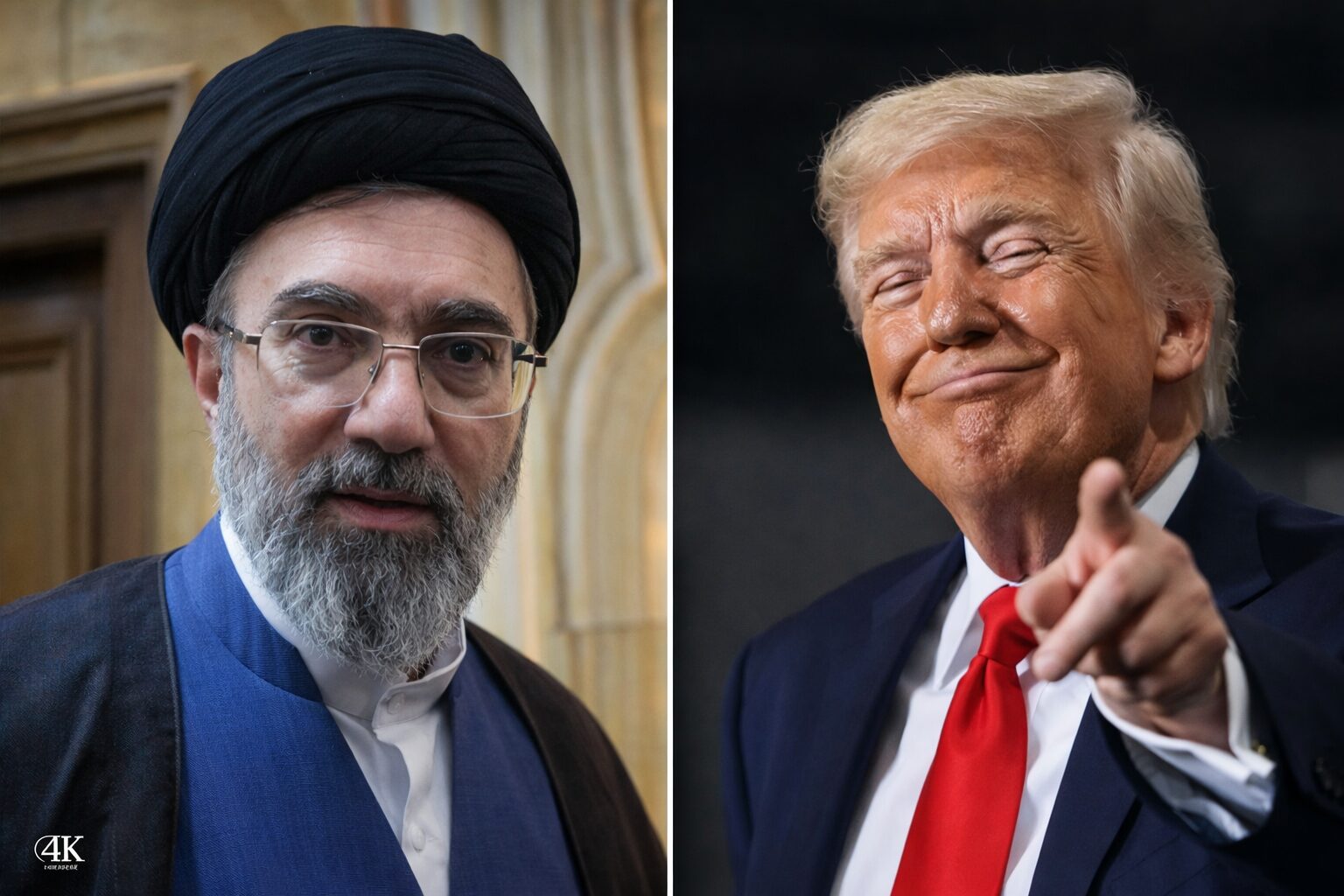
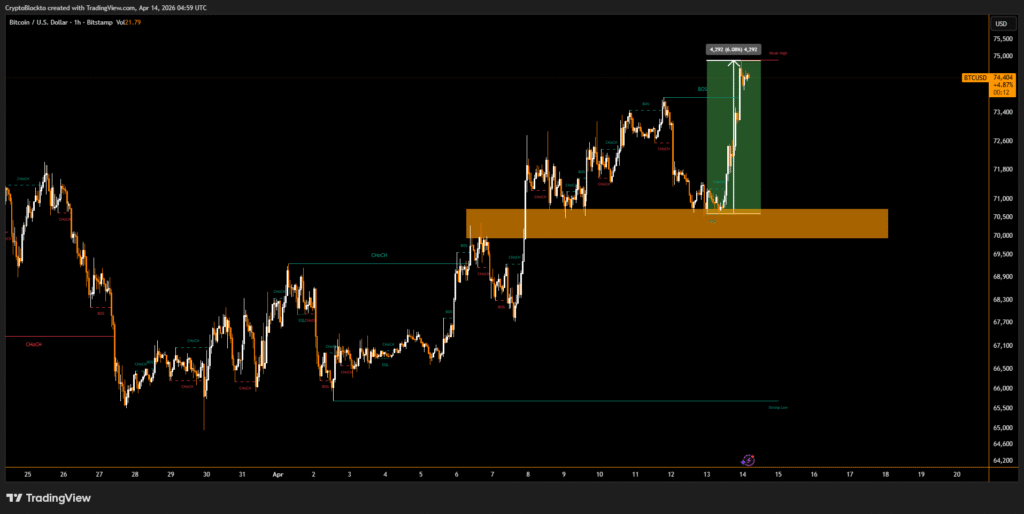
    Bitcoin surged close to $75,000, reaching its highest level in nearly four weeks as optimism grew around possible negotiations between the United States and Iran. Reports indicate Iran has offered to pause nuclear activity for up to five years, while Donald Trump is seeking a longer suspension period of up to 20 years. Markets interpreted the developments as a step toward easing weeks of geopolitical tensions, increasing investor confidence in risk assets.

    $BTC h1 price chart

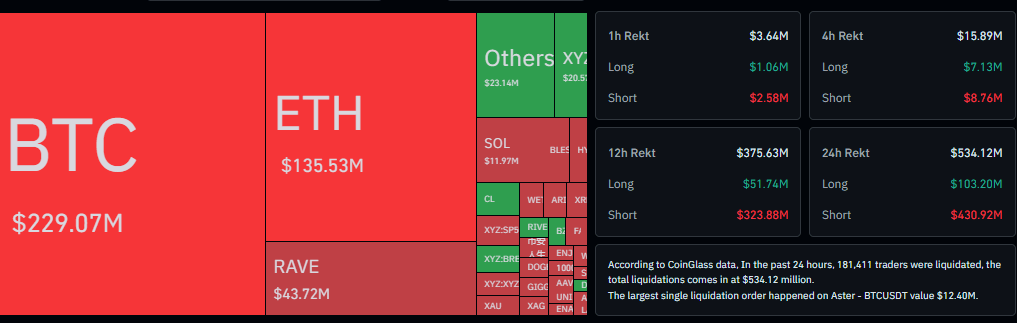
    The broader crypto market climbed to a total value of approximately $2.6 trillion, triggering liquidations affecting about 177,000 traders and totaling roughly $530 million within 24 hours, according to CoinGlass. Around 80% of liquidations about $425 million were leveraged short positions in bitcoin and Ether, highlighting the intensity of the market rebound.

    Short Squeeze and Institutional Demand Drive Price Momentum

    Market observers noted that the rally was driven largely by derivatives activity rather than long-term buying pressure. Large scale short liquidations added significant value to total crypto market capitalization in a short period. Meanwhile, research firm Valerius Labs cautioned that the move may represent a temporary short squeeze rather than a sustained breakout, noting that stronger buying interest typically emerges above major technical resistance levels such as the 200-day simple moving average.

    Ether tapped a 10-week high

    Optimism around a potential diplomatic breakthrough has also been supported by commentary from Jeff Mei of BTSE, who noted that Iran’s dependence on oil exports and the ongoing blockade of the Strait of Hormuz are increasing pressure to reach an agreement.

    Disclaimer

    This content is for informational purposes only and does not constitute financial, investment, or legal advice. Cryptocurrency trading involves risk and may result in financial loss.
  • Former CFTC Chair Chris Giancarlo Retires From Law to Advise Crypto and Fintech Firms

    Former CFTC Chair Chris Giancarlo Retires From Law to Advise Crypto and Fintech Firms

    Chris Giancarlo, the former head of the Commodity Futures Trading Commission, has announced he is stepping away from legal practice to focus fully on advising cryptocurrency and fintech companies. Giancarlo revealed that he is leaving the law firm Willkie Farr & Gallagher and retiring from law to support founders, executives and boards working in digital finance and emerging technologies.

    Giancarlo, widely known as “Crypto Dad” for his supportive stance on blockchain innovation, served as a commissioner beginning in 2014 before being nominated as chairman by Donald Trump, holding the role between August 2017 and July 2018. During his tenure, he oversaw the launch of the first regulated Bitcoin futures markets in the United States, marking a major step toward institutional participation in digital assets.

    Continued Influence on Regulation and Industry Development

    Since leaving public office, Giancarlo has remained active in the sector, advising digital asset bank Sygnum on global regulatory strategy and partnerships. He has also commented on proposed legislation such as the CLARITY Act, suggesting that even without full legislative progress, regulators like the CFTC and the Securities and Exchange Commission could still establish clearer rules for the industry.

    Giancarlo emphasized that blockchain technology represents a new financial architecture, urging institutions to modernize systems and adopt digital asset innovations to remain globally competitive.

    Disclaimer

    This content is for informational purposes only and does not constitute financial, investment, or legal advice. Cryptocurrency trading involves risk and may result in financial loss.
  • Coinbase International Policy Chief Tom Duff Gordon Moves to OpenAI in EMEA Leadership Role

    Coinbase International Policy Chief Tom Duff Gordon Moves to OpenAI in EMEA Leadership Role

    Tom Duff Gordon, former vice president of international policy at Coinbase, has left the company to join OpenAI as head of Europe, Middle East and Africa (EMEA) policy. According to a company spokesperson, Duff Gordon concluded nearly four years at Coinbase before transitioning to his new role focused on regional policy development across EMEA markets.

    Before entering the cryptocurrency sector, Duff Gordon spent approximately 8.5 years working as a banker at Credit Suisse, gaining experience in financial services and regulatory environments. His tenure at Coinbase included active involvement in international crypto policy discussions and regulatory engagement across multiple jurisdictions.

    Regulatory Expertise and UK Banking Concerns Highlighted

    Duff Gordon has been recognized as an expert in digital asset regulation and recently raised concerns about banking access in the United Kingdom. He noted that several UK banks were restricting millions of customers from accessing legally compliant crypto services, often failing to distinguish between firms registered with the Financial Conduct Authority and higher-risk operators with elevated fraud concerns.

    Disclaimer

    This content is for informational purposes only and does not constitute financial, investment, or legal advice. Cryptocurrency trading involves risk and may result in financial loss.
  • US Lawmakers Revive PARITY Act to Reform Crypto Tax Reporting and Stablecoin Rules

    US Lawmakers Revive PARITY Act to Reform Crypto Tax Reporting and Stablecoin Rules

    US Representatives Steven Horsford and Max Miller have reintroduced the Digital Asset Protection Accountability Regulation Innovation Taxation and Yields Act, aiming to modernize how the Internal Revenue Service handles digital asset taxation. The proposal, initially released in December 2025 and updated on March 26, focuses on simplifying reporting rules for cryptocurrency users.

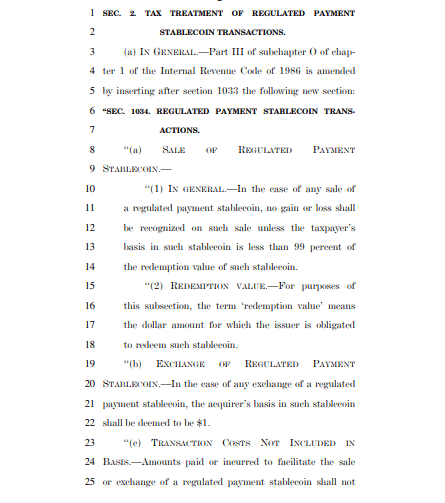
    One of the most notable revisions involves treatment of small transactions, commonly referred to as de minimis gains. The earlier draft proposed a $200 exemption threshold for payments made using regulated payment stablecoins, allowing minor purchases such as everyday retail transactions without tax reporting. The March 2026 version removes the fixed threshold but introduces a new rule stating that no gain or loss would be recognized on the sale of regulated payment stablecoins unless the taxpayer’s basis falls below 99% of the redemption value. The bill also introduces a deemed $1 basis for exchange transactions separate from stablecoin sales.

    Wash Sale Rules and Staking Distinction Included in Updated Proposal

    The revised legislation would also apply wash sale rules to digital assets, aligning crypto taxation more closely with traditional securities regulations. Similar provisions were previously supported by Cynthia Lummis, who included comparable rules in a separate crypto tax proposal last year.

    Additionally, the bill distinguishes between passive staking and more active activities such as trading, recognizing differences in how digital assets generate income. Although the timeline for passing the bill remains uncertain, discussions in United States Congress suggest crypto taxation may be included in broader fiscal negotiations tied to future federal budget planning under Donald Trump’s fiscal year 2027 proposals.

    Disclaimer

    This content is for informational purposes only and does not constitute financial, investment, or legal advice. Cryptocurrency trading involves risk and may result in financial loss.
  • Bitcoin Reclaims $74,400 as Oil Falls Below $100 and Markets Rebound

    Bitcoin Reclaims $74,400 as Oil Falls Below $100 and Markets Rebound

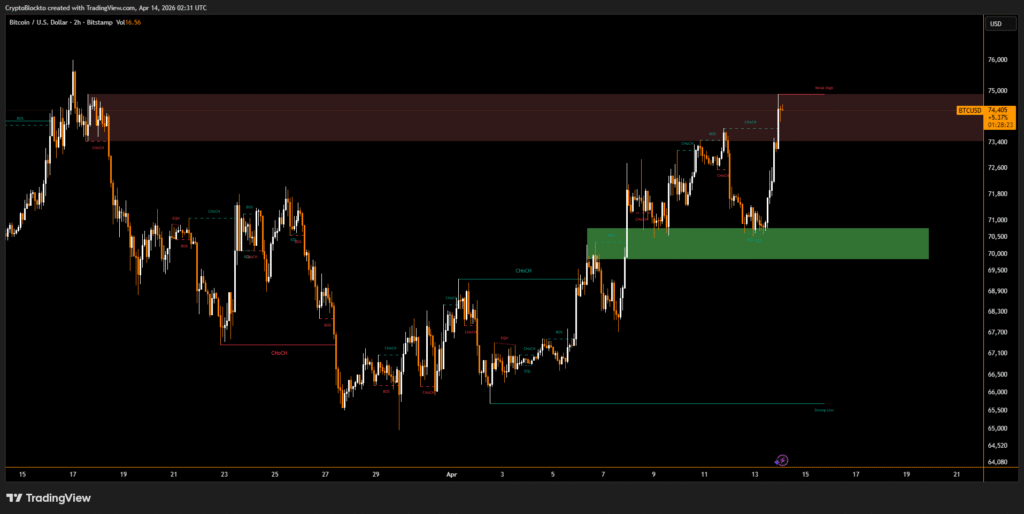
    Bitcoin rebounded sharply to around $74,400, erasing a weekend decline triggered by geopolitical tensions after failed US-Iran negotiations and the announcement of a blockade in the Strait of Hormuz. Prices had dropped roughly 4% from late Saturday into early Monday following news that US Vice President JD Vance left Pakistan without securing a deal and Donald Trump ordered the blockade.

    $BTC 2h price chart

    Market sentiment reversed during Monday’s US session, with bitcoin rising more than 3% over 24 hours to trade near $73,400 at the close. Other major tokens including Ethereum, Solana, and XRP also moved higher, though with smaller gains. Crypto-linked equities advanced as well, with Circle up 11%, Gemini rising 9%, and MARA Holdings and Bullish each gaining over 8%.

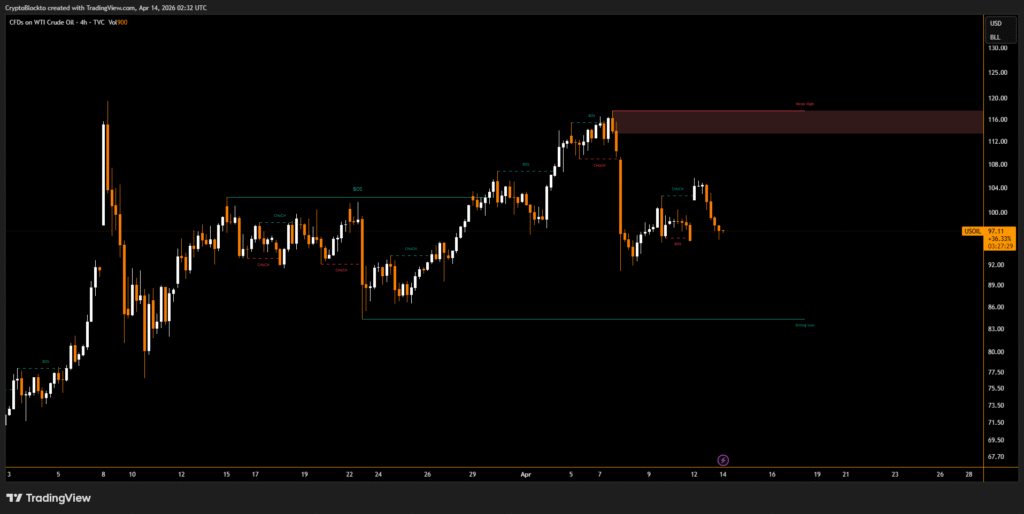
    In traditional markets, the Nasdaq rose 1.2%, while WTI crude oil retreated to about $97 per barrel after topping $105. Meanwhile, Strategy continued aggressive accumulation, buying 13,927 BTC for $1 billion via STRC preferred stock, as record $770 million trading volume signaled potential further purchases.

    Wti crude oil
    Disclaimer

    This content is for informational purposes only and does not constitute financial, investment, or legal advice. Cryptocurrency trading involves risk and may result in financial loss.

  • ECB Supports Tokenized EU Capital Markets With Strict Regulatory Guardrails

    ECB Supports Tokenized EU Capital Markets With Strict Regulatory Guardrails

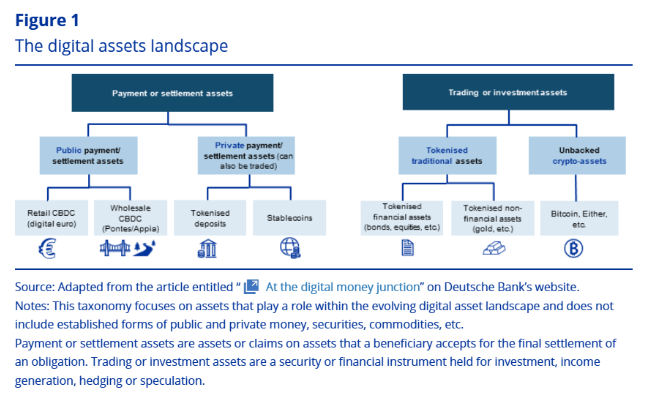
    The European Central Bank has backed the development of tokenized capital markets across the European Union, stating that distributed ledger technology could improve efficiency if supported by strong regulation and central bank infrastructure. In its latest Macroprudential Bulletin, the ECB said tokenization is moving from early experimentation toward limited real-world deployment, but warned that benefits will depend on interoperable systems and careful policy oversight.

    Digital assets landscape.: ECB

    The central bank emphasized that settlement in tokenized markets should remain anchored to central bank money rather than relying solely on commercial bank deposits or privately issued digital tokens. Officials cautioned that fragmented or incompatible platforms could weaken efficiency gains and introduce new systemic risks.

    Tokenized Bonds and Market Efficiency Gains Under Review

    The ECB noted that tokenized securities could reshape the issuance-to-settlement process by reducing reliance on intermediaries and automating functions such as corporate actions. Early findings suggest tokenized bonds may lower borrowing costs and narrow bid-ask spreads compared with traditional structures. However, policymakers described these advantages as preliminary, warning that liquidity, legal, and technological risks remain under close review as adoption expands beyond pilot projects.

    Stablecoins and Tokenized Funds Raise New Risk Considerations

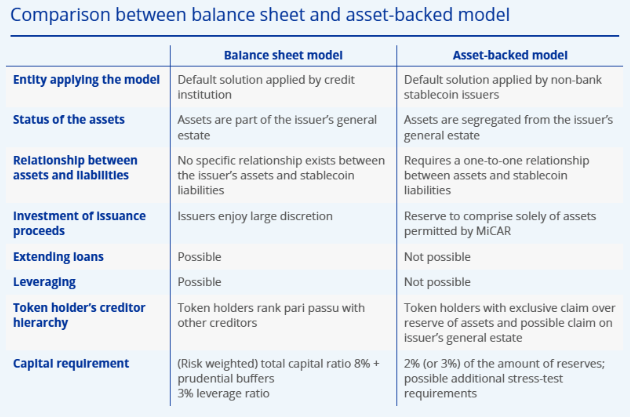
    The Bulletin also examined tokenized money market funds and euro-denominated stablecoins, highlighting their potential to transform short-term liquidity markets. Under frameworks such as Markets in Crypto-Assets Regulation, compliant euro stablecoins could influence demand for sovereign bonds and either support market liquidity or increase contagion risks during financial stress.

    Comparison between balance sheet and asset-backed model.: ECB

    Across multiple analyses, the ECB concluded that tokenization can support a more integrated European capital market, but only if regulatory safeguards, prudential supervision, and infrastructure modernization advance together.

    Disclaimer

    This content is for informational purposes only and does not constitute financial, investment, or legal advice. Cryptocurrency trading involves risk and may result in financial loss.