Author: tristan

  • UBS and Five Major Swiss Banks Launch Swiss Franc Stablecoin Sandbox

    UBS and Five Major Swiss Banks Launch Swiss Franc Stablecoin Sandbox

    UBS and five major Swiss banks have partnered to test a Swiss franc based crypto stablecoin through a new sandbox initiative scheduled for 2026. The project brings together PostFinance, Sygnum, Raiffeisen, Zürcher Kantonalbank, Banque Cantonale Vaudoise, and Swiss Stablecoin AG to explore blockchain-powered payment systems within Switzerland.

    Swiss Franc Stablecoin Sandbox to Test Digital Payment Use Cases

    The initiative will allow participating banks to test selected Swiss franc stablecoin use cases in what partners described as a secure digital live environment. The sandbox aims to build practical experience in handling digital payment methods and evaluating how blockchain-based financial tools function in real-world settings.

    Swiss Stablecoin AG will provide the issuance infrastructure for the project. Organizers confirmed the sandbox will remain open to additional banks, companies, and institutions interested in participating.

    Swiss Banks Expand Blockchain Payment Experiments

    This project follows earlier blockchain testing by Swiss lenders. In September 2025, UBS, PostFinance, and Sygnum Bank completed a deposit token proof of concept under the Swiss Bankers Association. The trial tested legally binding interbank payments on a public blockchain and included programmable payment and escrow-style transactions involving tokenized real-world assets.
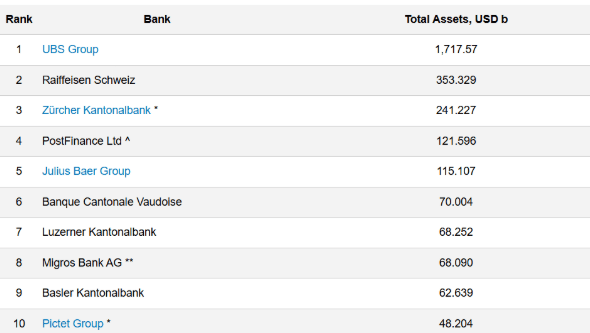
    The largest Swiss banks by total assets, in USD, billion

    Switzerland Strengthens Stablecoin and Tokenization Efforts

    The latest sandbox also reflects ongoing experimentation with Swiss franc-based digital tokens. Bitcoin Suisse AG previously issued the CryptoFranc (XCHF) stablecoin but discontinued issuance and redemption on Aug. 16, 2024.

    UBS remains Switzerland’s largest bank with about $1.7 trillion in total assets, followed by Raiffeisen Schweiz ($353 billion), Zürcher Kantonalbank ($241 billion), and PostFinance ($121 billion). The new initiative signals continued momentum among Swiss institutions to integrate blockchain into traditional banking infrastructure.

    Disclaimer

    This content is for informational purposes only and does not constitute financial, investment, or legal advice. Cryptocurrency trading involves risk and may result in financial loss.
  • Coinbase Expands to Stock Trading in Australia After Securing Financial License

    Coinbase Expands to Stock Trading in Australia After Securing Financial License

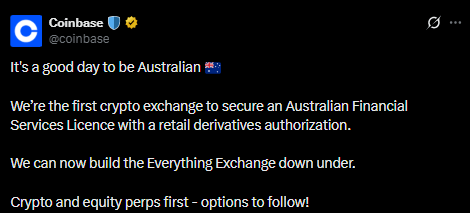
    Coinbase is planning to expand its services in Australia to include derivatives, equities, and payments after receiving an Australian Financial Services License (AFSL). The move positions the exchange to compete with traditional financial institutions on stock trading, payments, and other financial products with the speed and execution typical of crypto markets.

    John O’Loghlen, Coinbase’s APAC regional managing director, said the license will allow the platform to initially offer crypto and equity perpetuals, with future plans for futures, options, and additional traditional products. Holding an AFSL subjects Coinbase to the same conduct, disclosure, governance, and consumer protection standards as conventional financial services providers, marking a milestone in Australia’s regulatory framework for digital assets.

    The licensing comes as the Corporations Amendment (Digital Assets Framework) Bill 2025 awaits royal assent. The legislation will take effect 12 months after assent, formalizing oversight of crypto platforms.

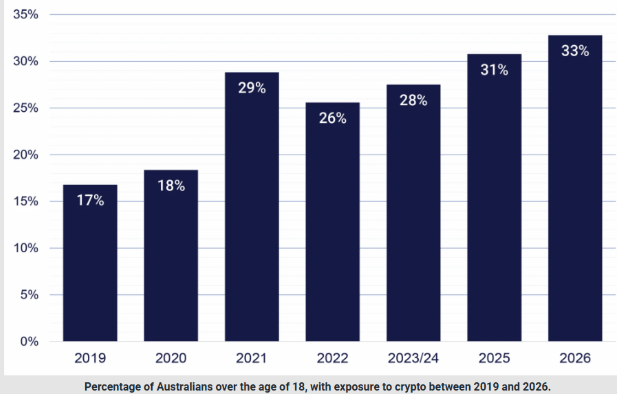
    An estimated 33% of Australians had exposure to crypto in 2026

    Regulatory Framework and Legislation

    Coinbase has also been expanding its Australian team, hiring senior staff in legal, compliance, marketing, and operations, while previously partnering with OKX to offer self-managed superannuation fund services. Crypto adoption is growing in Australia, with estimates showing 33% of Australians holding crypto in 2026, up from 31% in 2025, reflecting a rise in both investment and use for payments.

    Disclaimer

    This content is for informational purposes only and does not constitute financial, investment, or legal advice. Cryptocurrency trading involves risk and may result in financial loss.
  • Ethereum Stablecoin Supply Hits $180 Billion All-Time High

    Ethereum Stablecoin Supply Hits $180 Billion All-Time High

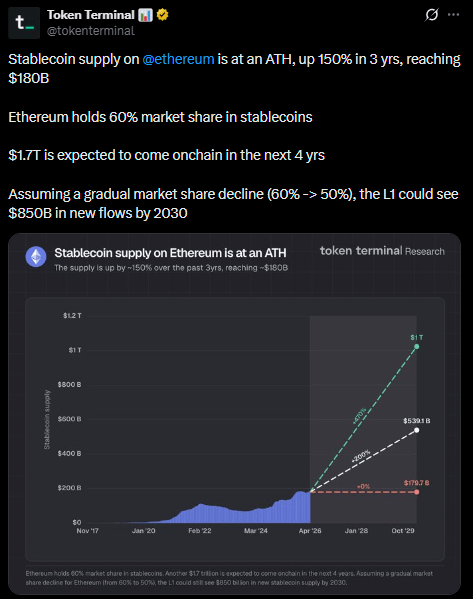
    The on-chain value of stablecoins on the Ethereum network has reached an all-time high of $180 billion, according to blockchain analytics firm Token Terminal. This marks a 150% increase over the past three years, highlighting Ethereum’s continued dominance in the stablecoin ecosystem.

    Ethereum Leads Stablecoin Growth

    Ethereum currently holds around 60% of the total stablecoin supply, and projections suggest that the network could see up to $850 billion in new inflows by 2030 if current growth trends continue. Across all blockchain networks, roughly $1.7 trillion is expected to move on-chain over the next four years.

    Major financial institutions, including BlackRock, JPMorgan, and Amundi, have launched tokenized funds on Ethereum, reinforcing its role as the leading platform for stablecoins and tokenized real-world assets (RWAs). In the first quarter of 2026, the total stablecoin supply across all networks hit a record $315 billion.

    Market Momentum and Institutional Adoption

    Ethereum’s dominance extends beyond the main network. Including EVM-compatible and Layer-2 networks like Arbitrum, ZKsync Era, and Base, Ethereum’s share of stablecoins rises to over 65%. Analysts note that this liquidity surge has contributed to positive sentiment and crypto market rallies.

    Nick Ruck, director at LVRG Research, said the momentum supports a long-term bull cycle driven by tokenized assets and institutional adoption, though competition, regulatory challenges, and macroeconomic factors remain potential hurdles.

    JPMorgan CEO Highlights Tokenization

    JPMorgan CEO Jamie Dimon emphasized the growing impact of blockchain-based solutions, including stablecoins and smart contracts. JPMorgan launched its first tokenized money market fund (MONY) on Ethereum in December 2025, signaling major banks’ increasing adoption of tokenized financial products.

    Disclaimer

    This content is for informational purposes only and does not constitute financial, investment, or legal advice. Cryptocurrency trading involves risk and may result in financial loss.

  • Morgan Stanley Set to Launch First Spot Bitcoin ETF From Major U.S. Bank

    Morgan Stanley Set to Launch First Spot Bitcoin ETF From Major U.S. Bank

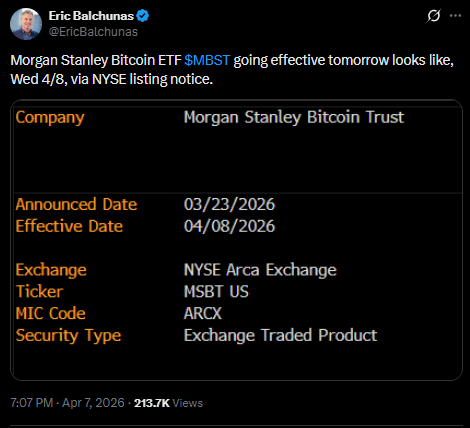
    Morgan Stanley is preparing to launch the Morgan Stanley Bitcoin Trust, the first spot bitcoin ETF issued by a top tier U.S. bank. The fund could start trading as early as Wednesday on NYSE Arca under the ticker MSBT, marking a milestone in institutional bitcoin adoption.

    Key Features of the Morgan Stanley Bitcoin Trust

    The ETF will hold actual bitcoin, tracking the 4 PM NY Settlement Rate. Unlike leveraged or derivative-based funds, it will not actively trade to outperform bitcoin’s price movements. BNY and Coinbase Custody will handle bitcoin storage, providing secure, institutional-grade safekeeping.

    The fund is launching with about $1 million in initial capital and 50,000 shares available for trading. Investors gain direct exposure to bitcoin without managing the cryptocurrency themselves.

    A major advantage is cost: the trust charges a 0.14% annual fee, undercutting BlackRock’s iShares Bitcoin Trust, which charges 0.25%, making it one of the most affordable bitcoin ETFs available.

    Impact on Institutional Adoption and Market Trends

    The launch reinforces Morgan Stanley’s broader push into digital assets. Earlier this year, the bank filed for spot Solana ETFs and plans to enable trading in bitcoin, ethereum, and Solana on ETrade through a partnership with Zero Hash.

    Bloomberg’s ETF Analyst Eric Balchunas said on X;

    Since the first 11 spot bitcoin ETFs launched in January 2024, these funds have collectively attracted more than $56 billion in net inflows, reflecting growing institutional demand. Spot ETFs have also contributed to stabilizing bitcoin volatility, with BTC’s implied volatility increasingly mirroring Wall Street indicators like the VIX.

    Morgan Stanley’s ETF is expected to continue these trends, further mainstreaming bitcoin investment and strengthening the role of traditional financial institutions in the cryptocurrency market.

    Disclaimer

    This content is for informational purposes only and does not constitute financial, investment, or legal advice. Cryptocurrency trading involves risk and may result in financial loss.
  • Anthropic Restricts AI Model Access Over Cybersecurity Concerns

    Anthropic Restricts AI Model Access Over Cybersecurity Concerns

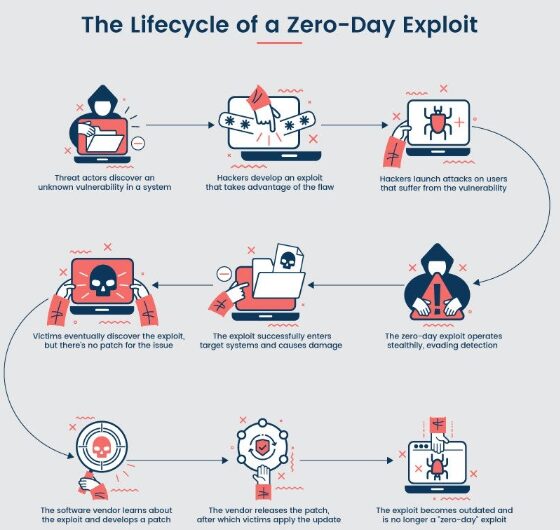
    Anthropic has limited access to its new AI model, Claude Mythos Preview, after the system discovered thousands of critical vulnerabilities across operating systems, web browsers, and widely used software. The company warned that AI’s ability to identify and exploit software flaws could soon surpass all but the most skilled human hackers, raising concerns over malicious use.

    In 2025, AI powered cyberattacks surged 72% year-over-year, affecting 87% of global organizations, according to AllAboutAI. Anthropic emphasized the risk of these capabilities falling into the wrong hands and announced Project Glasswing, a defensive initiative involving over 40 partners, including Amazon Web Services, Apple, Cisco, Google, JPMorgan, Microsoft, Nvidia, and the Linux Foundation. The project will leverage Claude Mythos Preview to identify vulnerabilities and patch them before malicious actors can exploit them.

    Discovery of Long-Standing Software Bugs

    Anthropic revealed that many vulnerabilities uncovered are decades old. Highlights include a 27-year-old bug in OpenBSD, a 17-year-old remote code execution flaw in FreeBSD, and a 16-year-old bug in FFmpeg, alongside numerous Linux kernel and cryptography library weaknesses, including TLS, AES-GCM, and SSH. Web applications were also found vulnerable to SQL injection, cross-site scripting, and cross-site request forgery.

    AI-Driven Cybersecurity and the Future

    While Claude Mythos Preview could dramatically improve software security, Anthropic cautioned that patching vulnerabilities at scale will take years. The company stated that 99% of the flaws identified remain unpatched, underscoring a transitional period where risks remain high. Anthropic envisions a future where AI-driven defenses strengthen global cyber infrastructure, though the path will be challenging.

    Lifecycle of a zero-day exploit: PhoenixNAP

    Disclaimer

    This content is for informational purposes only and does not constitute financial, investment, or legal advice. Cryptocurrency trading involves risk and may result in financial loss.

  • Bitcoin, Ether and Oil Shorts Trigger $427 Million Liquidation After Ceasefire Rally

    Bitcoin, Ether and Oil Shorts Trigger $427 Million Liquidation After Ceasefire Rally

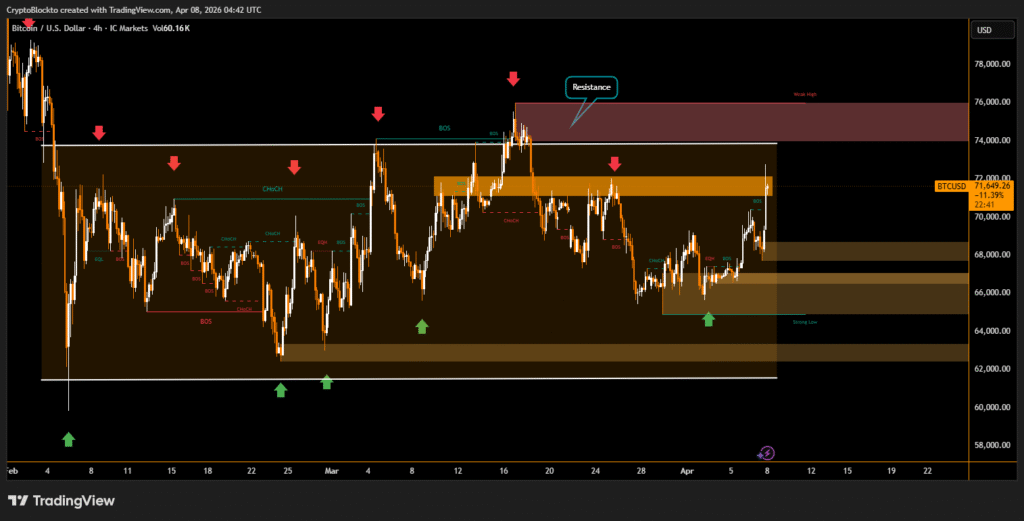
    Short sellers across crypto and commodity markets suffered heavy losses after bitcoin surged past $72,700 following confirmation of a two-week ceasefire between the United States and Iran. The rapid market reversal wiped out about $595 million in total leveraged positions across 118,489 traders within 24 hours.

    $BTC 4h price chart

    Short positions accounted for roughly $427 million of the liquidations, compared with $168 million in long positions, highlighting how heavily markets were positioned for continued downside before the announcement. The largest single liquidation recorded was an $11.79 million BTC-USDT short position on Binance. Bitcoin led losses with about $245 million in liquidations, followed by ether at $126 million. Tokenized Brent oil futures added $33 million, while WTI crude contracts contributed another $42 million as oil prices dropped sharply.

    Oil Price Drop and Market Sentiment Intensify Liquidations

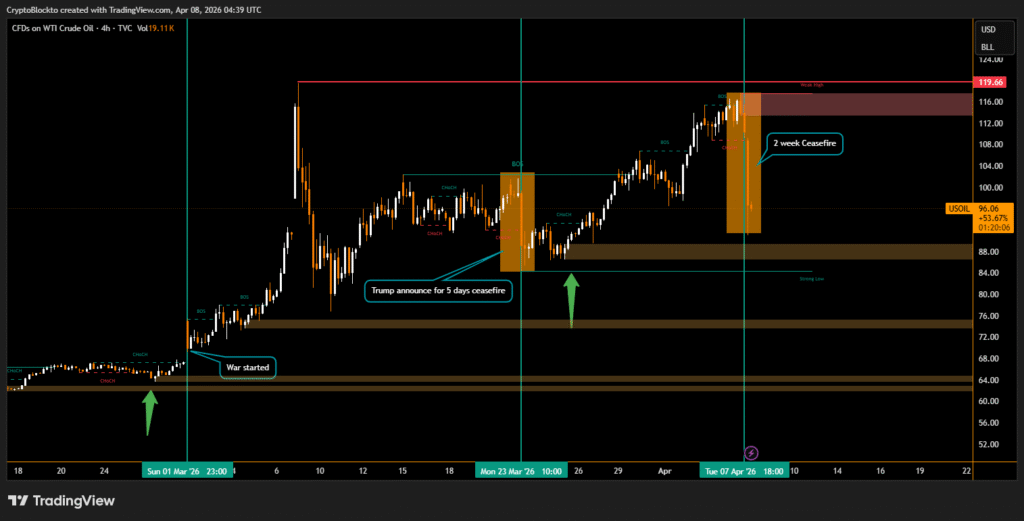
    Oil markets reversed direction as geopolitical risk eased, with Wti crude falling to around $91 per barrel and West Texas Intermediate declining to approximately $95. The sharp move affected tokenized commodity trades, including positions tied to silver and gold, which were also caught in the unwind.

    USOIL 4h price chart

    Most of the losses occurred within a 12-hour window, where $508 million in positions were liquidated, including $398 million in short trades. This marked the most aggressive short squeeze since March 4, when bitcoin rallied during earlier ceasefire speculation. Solana recorded $19.6 million in liquidations.

    Ceasefire News Shifts Market Direction and Tests Bitcoin Range

    The market reaction followed an announcement by Donald Trump, who described the agreement as a “double sided ceasefire,” stating that U.S. military objectives had been achieved. Iranian officials confirmed the suspension of hostilities but noted that oil tanker movement through the Strait of Hormuz would require coordination with military forces and remain subject to technical limitations.

    Before the ceasefire announcement, market sentiment had been heavily bearish. Bitcoin’s surge placed it near the top of the $65,000 to $73,000 trading range that has defined market movement throughout the conflict, leaving traders focused on whether the ceasefire will lead to a sustained breakout or another short-term reversal.

    Disclaimer

    This content is for informational purposes only and does not constitute financial, investment, or legal advice. Cryptocurrency trading involves risk and may result in financial loss.
  • CZ Autobiography Revisits Binance Growth, Legal Troubles and Prison Sentence

    CZ Autobiography Revisits Binance Growth, Legal Troubles and Prison Sentence

    Changpeng “CZ” Zhao, founder of Binance, has released a memoir recounting the dramatic rise of the cryptocurrency exchange and the legal challenges that followed. The 364-page autobiography, titled Freedom of Money, offers a first-person narrative of Zhao’s life, career, and the events that shaped one of the most influential companies in the digital asset sector. The foreword was written by Yi He, Binance co-founder who has worked alongside Zhao since 2014.

    In the book, Zhao explains that much of his public story has been shaped by media coverage, legal filings, and commentary, and he aims to provide deeper context behind those narratives. The memoir traces his early years in finance and technology before detailing the founding of Binance in 2017 and its rapid expansion into one of the world’s largest cryptocurrency exchanges.

    Legal Challenges and Regulatory Failures Described in Detail

    Zhao recounts the regulatory pressures that led to a major settlement with U.S. authorities. In 2024, he served a four-month prison sentence after pleading guilty to violating U.S. Anti-Money-Laundering laws. The settlement required him to step down as Binance chief executive and led the company to pay billions of dollars in penalties while implementing extensive compliance reforms.

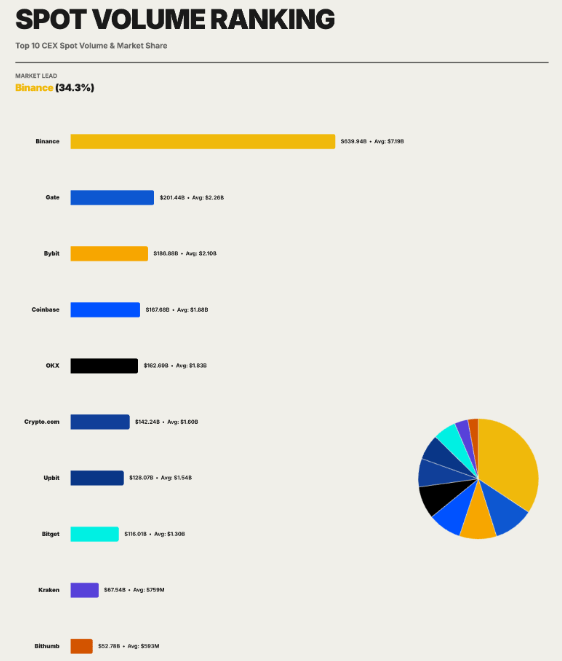
    Binance remains a top venue for crypto access, including derivatives trading, where it ranks first globally in trading volume: CoinGlass

    Regulators had scrutinized Binance for years over alleged shortcomings in anti-money-laundering controls, sanctions compliance, and operating without proper licenses. In the memoir, Zhao reflects on key decisions made during the company’s rapid growth and the tradeoffs that contributed to later enforcement actions. He also describes his time in federal prison, including the transition from leading a global firm to living in confinement.

    “Freedom of Money” Theme Explores Global Crypto Adoption

    The title Freedom of Money reflects Zhao’s belief that cryptocurrency can reduce barriers to financial access, particularly in regions with limited banking services or strict capital controls. He links Binance’s global expansion to demand from users in emerging markets seeking cross-border transfers, currency hedging, and access to international financial systems.

    Zhao also acknowledges that Binance’s rapid growth sometimes outpaced regulatory frameworks, creating compliance gaps that eventually attracted enforcement scrutiny and reshaped the company’s future.

    Disclaimer

    This content is for informational purposes only and does not constitute financial, investment, or legal advice. Cryptocurrency trading involves risk and may result in financial loss.

  • Iran Bitcoin Hashrate Plunges 77% Amid Conflict While Global Network Holds Steady

    Iran Bitcoin Hashrate Plunges 77% Amid Conflict While Global Network Holds Steady

    Iran’s Bitcoin hashrate has dropped significantly over the past quarter, falling about 77% as conflict involving the United States and Israel intensified. According to data from the Hashrate Index, the country lost roughly 7 exahashes per second quarter-over-quarter, leaving its total hashrate at around 2 EH/s. Ian Philpot, marketing director at Luxor Technology, said the decline showed a clear regional impact, though the disruption remained largely limited to Iran. Neighboring countries such as the United Arab Emirates and Oman showed no measurable decline in mining capacity.

    Iran is estimated to operate approximately 427,000 active Bitcoin mining rigs. Although tensions escalated in February following strikes and retaliatory actions, the global Bitcoin network remained stable at close to 1,000 EH/s. Philpot explained that regional disruptions typically redistribute mining power rather than eliminate it, reducing the risk of widespread network instability.

    Global Hashrate Weakness Linked to Falling Bitcoin Prices

    The global 30 day simple moving average hashrate declined from 1,066 EH/s in the first quarter to about 1,004 EH/s in the second quarter, representing a 5.8% quarter-over-quarter drop. Philpot attributed this trend primarily to declining Bitcoin prices rather than conflict or regulatory pressure. Bitcoin has fallen more than 45% from its all-time high of $126,000 recorded in October, reducing mining profitability across the sector.

    He noted that older-generation mining machines operating at efficiencies above 25 J/TH are now running at negative gross margins, forcing shutdowns. Estimates suggest around 252 EH/s of marginal capacity is currently offline as legacy hardware is retired and replaced with more efficient systems.

    Leading Countries Continue to Dominate Global Hashrate Distribution

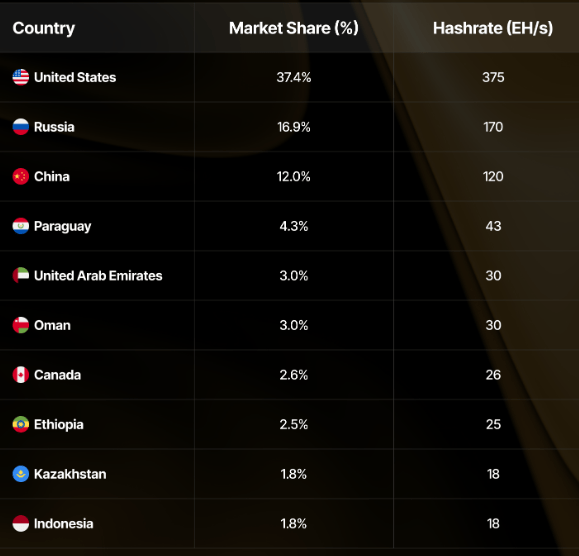
    The United States holds the largest share of global hashrate at over 37%, followed by Russia at about 17% and China at roughly 12%, together accounting for 65.6% of the total network. Philpot added that while overall capacity among major regions remains stable, the internal mix of hardware continues to evolve, with modern equipment gradually replacing outdated machines.

    US miners contribute the largest share of global hashrate.: Hashrate Index

    Disclaimer

    This content is for informational purposes only and does not constitute financial, investment, or legal advice. Cryptocurrency trading involves risk and may result in financial loss.
  • FDIC Proposes Stablecoin Issuer Rules Under GENIUS Act Framework

    FDIC Proposes Stablecoin Issuer Rules Under GENIUS Act Framework

    The U.S. Federal Deposit Insurance Corporation has proposed new rules to regulate stablecoin issuers supervised by the agency under the Guiding and Establishing National Innovation for U.S. Stablecoins, or GENIUS Act. In a statement released Tuesday, the FDIC said its board approved a proposal establishing standards covering reserves, redemption practices, capital requirements, risk management, and custody obligations for stablecoin issuers and insured depository institutions under its supervision.

    The FDIC currently insures deposits at more than 4,000 financial institutions and supervises over 2,700 banks and savings associations, positioning the agency to play a central role in maintaining financial stability as stablecoin activity expands. The GENIUS Act granted the FDIC authority to oversee stablecoin-related operations within supervised banks when it was signed into law in July, with implementation scheduled for Jan. 18, 2027, unless introduced earlier.

    Insurance Coverage Will Not Extend to Stablecoin Holders

    Under the proposal, reserve deposits backing payment stablecoins would qualify for FDIC insurance coverage. However, the agency clarified that the protection would not apply directly to stablecoin holders. Officials stated that treating token holders as insured depositors would conflict with the GENIUS Act’s prohibition on payment stablecoins being covered by federal deposit insurance.

    Despite this limitation, the FDIC said the rules are intended to create a more secure environment by ensuring stablecoin issuers meet elevated regulatory and supervisory standards, offering greater confidence in the safety of reserve backing.

    Public Feedback Invited as Implementation Efforts Continue

    The FDIC has invited public feedback on 144 specific questions related to the regulation of stablecoin issuers, with comments open for a 60-day period. This marks the agency’s second rulemaking proposal under the GENIUS Act, following a Dec. 19 plan outlining application procedures for insured depository institutions seeking approval to issue payment stablecoins through subsidiaries.

    Meanwhile, the Office of the Comptroller of the Currency is also working on implementing the law, covering a broader range of stablecoin activity, including national bank subsidiaries and certain nonbank issuers.

    Disclaimer

    This content is for informational purposes only and does not constitute financial, investment, or legal advice. Cryptocurrency trading involves risk and may result in financial loss.

  • SEC Admits Some Crypto Enforcement Cases Provided No Investor Benefit

    SEC Admits Some Crypto Enforcement Cases Provided No Investor Benefit

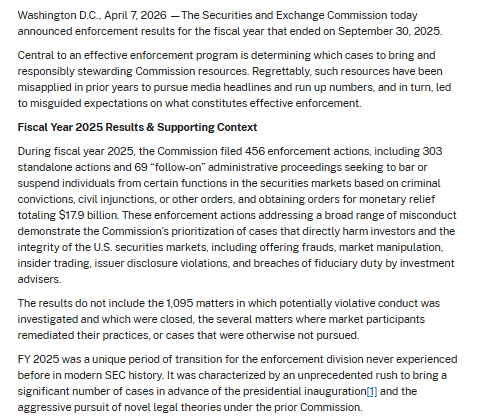
    The U.S. Securities and Exchange Commission said some enforcement actions involving cryptocurrency firms failed to deliver clear benefits to investors and were based on misinterpretations of federal securities laws. In its enforcement results for 2025, the agency reported bringing 95 actions since fiscal year 2022 related to book-and-record violations, resulting in approximately $2.3 billion in penalties.

    The SEC stated that seven crypto firm registration-related cases and six cases tied to the “definition of a dealer” identified no direct investor harm and produced no measurable investor protection. The agency described this as a bias toward the volume of cases rather than investor protection, leading to a misallocation of resources. It also noted that, ahead of Donald Trump’s 2025 inauguration, enforcement teams moved quickly to file cases using aggressive and novel legal theories.

    Enforcement Strategy Shifts Under New Leadership

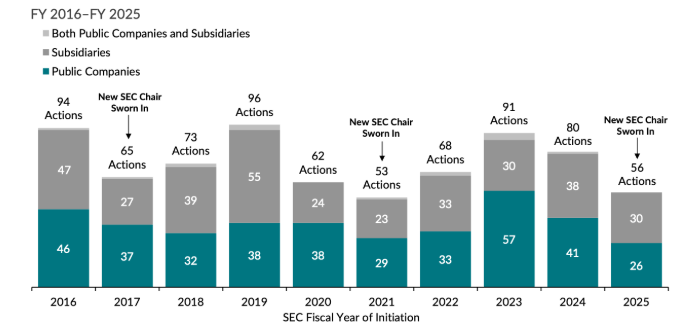
    Under SEC Chair Paul Atkins, who assumed the role in April 2025, the agency said it shifted toward prioritizing quality over quantity. Atkins emphasized ending regulation by enforcement and redirecting resources toward cases involving fraud, market manipulation, and abuses of trust. Research from Cornerstone Research showed enforcement actions against public companies dropped by about 30% in fiscal 2025 compared with fiscal 2024.

    Despite the shift, the SEC reported obtaining $17.9 billion in monetary relief in 2025, including $7.2 billion in civil penalties, with the remainder collected through disgorgement and prejudgment interest.

    Under Paul Atkins, the number of SEC enforcement actions has dropped

    Crypto Enforcement Actions Continue Despite Policy Changes

    Several crypto related cases continued during 2025. The SEC filed a lawsuit against Unicoin and four current and former executives, alleging they raised $100 million by misleading investors about certificates claiming rights to receive Unicoin tokens and company stock. The company denied the allegations and accused regulators of distorting its regulatory statements to support the case.

    In another case, the SEC filed a civil complaint against Ramil Ventura Palafox, chief executive of Praetorian Group International, accusing him of orchestrating a $200 million Ponzi scheme. A parallel criminal case brought by the U.S. Department of Justice resulted in Palafox receiving a 20-year prison sentence in February.

    Disclaimer

    This content is for informational purposes only and does not constitute financial, investment, or legal advice. Cryptocurrency trading involves risk and may result in financial loss.