Author: tristan

  • Bitcoin Surges Above $72,000 as Ceasefire News Boosts Global Risk Assets

    Bitcoin Surges Above $72,000 as Ceasefire News Boosts Global Risk Assets

    Bitcoin surged past the $72,000 level after confirmation of a two week ceasefire between the United States and Iran, triggering a broader rally across cryptocurrency and stock futures markets. The leading cryptocurrency climbed to about $72,699, marking a 5% gain within 24 hours.
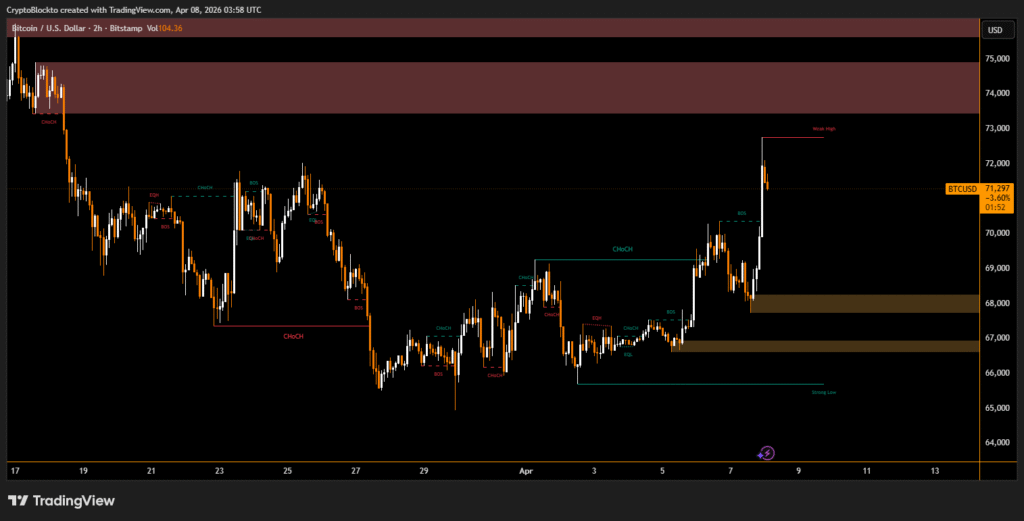
    $BTC 2h price chart

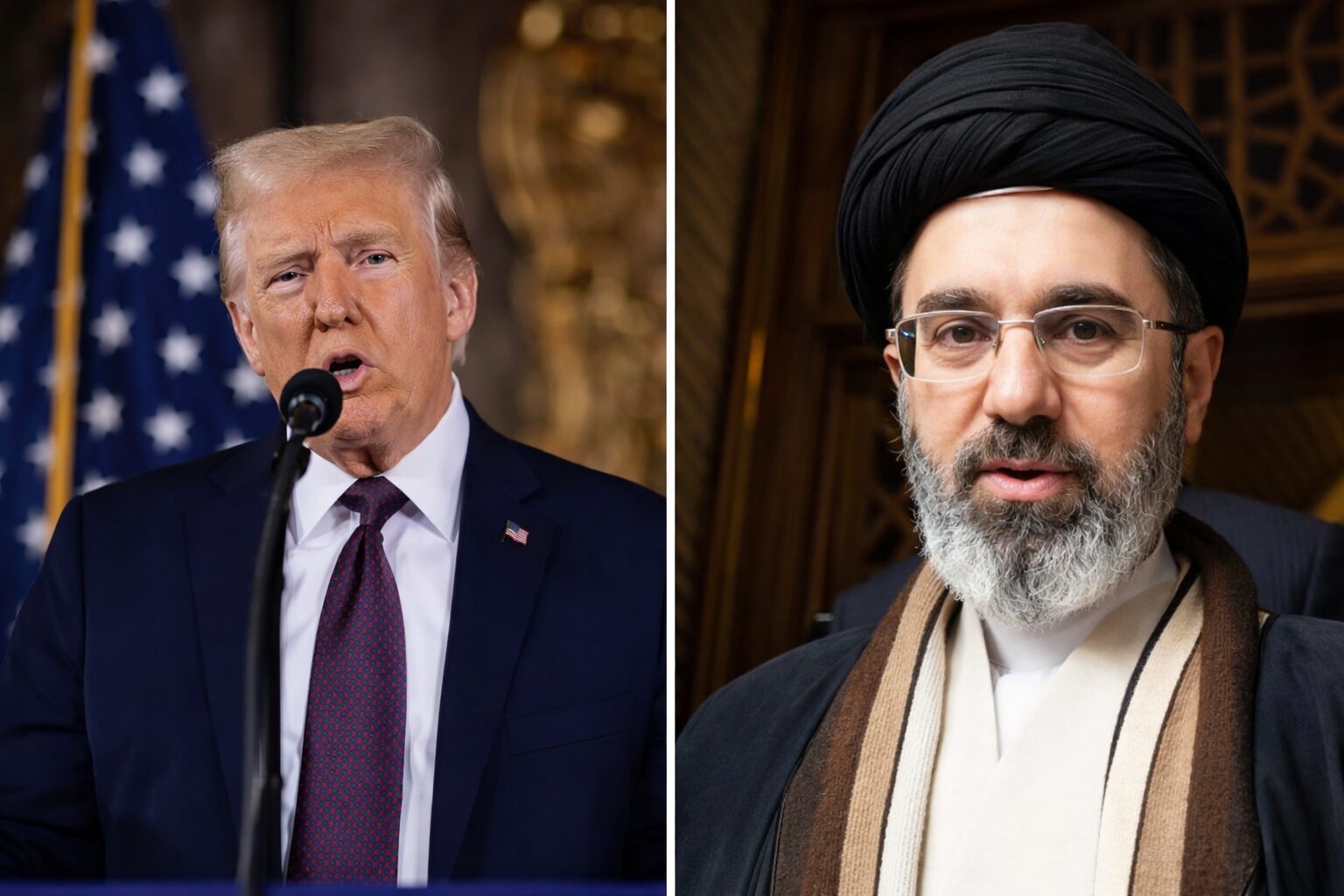
    The rally followed an announcement by Donald Trump, who stated that planned military strikes against Iran would be suspended for two weeks. He described the move as a “double sided ceasefire,” noting that military objectives had been achieved and discussions toward long-term peace were progressing. Iranian officials also confirmed the ceasefire, adding that defensive operations would pause if attacks against the country were halted.

    Stock Futures Rise While Oil Prices Drop Sharply

    Alongside bitcoin’s rise, U.S. stock futures moved higher, reflecting renewed risk appetite among investors. Futures linked to the S&P 500 advanced about 1.9%, while Nasdaq futures gained roughly 2.2%. Dow Jones futures also rose by nearly 1.8%, signaling broader optimism across financial markets.

    At the same time, oil prices dropped significantly as fears of supply disruption eased. West Texas Intermediate crude fell more than 10% to around $95 per barrel, with Brent crude recording a similar decline. Iran also indicated that oil tankers could transit the Strait of Hormuz for the next two weeks, subject to coordination with its armed forces and technical limitations.
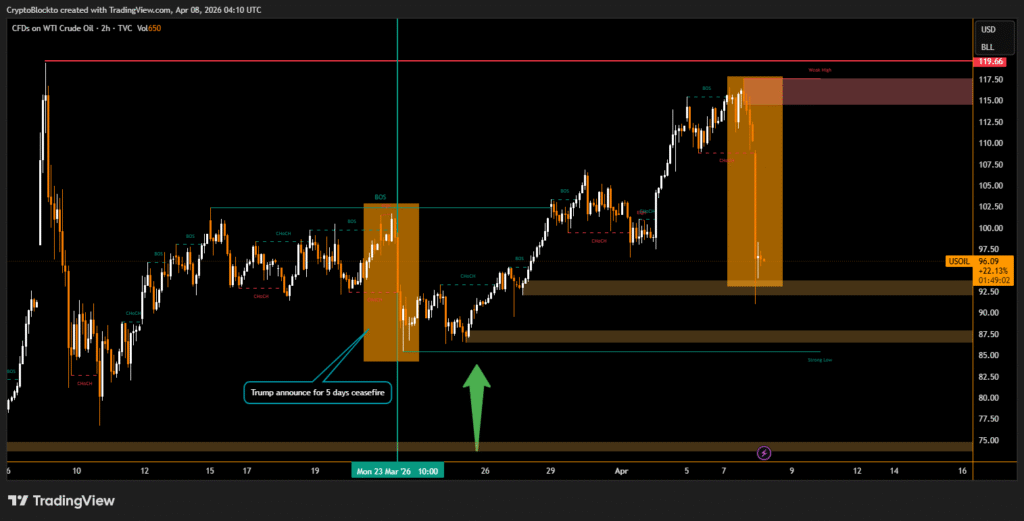
    USOIL 2h price chart
    Disclaimer

    This content is for informational purposes only and does not constitute financial, investment, or legal advice. Cryptocurrency trading involves risk and may result in financial loss.
  • Democrats Press CFTC on Offshore Prediction Market War Bets Oversight

    Democrats Press CFTC on Offshore Prediction Market War Bets Oversight

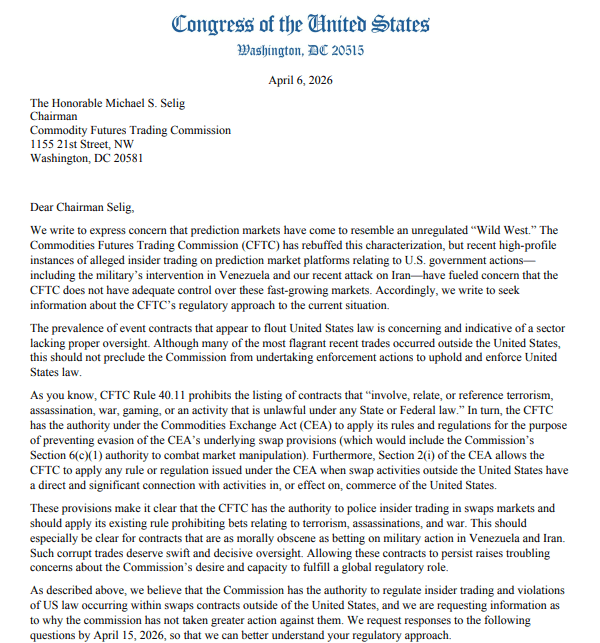
    House Democrats are urging stronger oversight of offshore prediction market platforms that allow users to place bets tied to sensitive events, including U.S. military operations. In a letter posted Tuesday, lawmakers led by Seth Moulton and Jim McGovern asked CFTC Chair Michael Selig what actions the agency can take to prevent platforms outside the United States from listing such contracts.

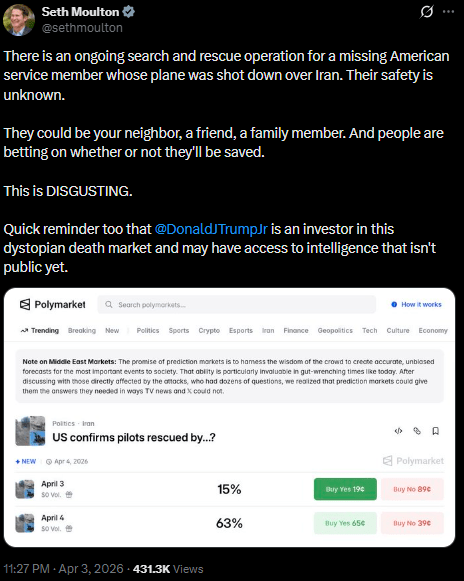
    The concerns intensified after contracts circulated over the weekend linked to the rescue of American airmen in Iran. McGovern stated that turning war into gambling opportunities was deeply troubling, arguing that wagers tied to bombings, bloodshed, and military actions treat human lives as numbers rather than real consequences.

    Growing Popularity of Prediction Markets Draws Scrutiny

    Prediction market platforms such as Kalshi and Polymarket have grown rapidly in popularity, particularly following the 2024 U.S. presidential election cycle. These platforms allow trading based on real-world outcomes, ranging from geopolitical developments to sporting events. Lawmakers previously raised insider trading concerns after markets appeared to predict the capture of Venezuelan President Nicolás Maduro earlier this year.

    Moulton also criticized Polymarket for allowing bets on when downed U.S. fighter jet pilots in Iran would be rescued. The company later removed the market, stating it should not have been posted and that an internal review was underway.

    Questions Over CFTC Authority and Enforcement Powers

    Lawmakers noted that the CFTC has asserted exclusive jurisdiction over prediction markets and is developing new rules as the sector expands. Existing internal rules already block contracts referencing terrorism, assassination, war, gaming, or unlawful activity under federal or state law.

    In their letter, the lawmakers questioned why enforcement action had not yet been taken and whether the agency has authority to address insider trading concerns linked to these markets. They requested formal responses to their questions by April 15, highlighting concerns that continued activity on offshore platforms reflects a sector lacking proper oversight.

    Disclaimer

    This content is for informational purposes only and does not constitute financial, investment, or legal advice. Cryptocurrency trading involves risk and may result in financial loss.
  • US Prosecutors Reject Roman Storm’s Dismissal Bid in Tornado Cash Case

    US Prosecutors Reject Roman Storm’s Dismissal Bid in Tornado Cash Case

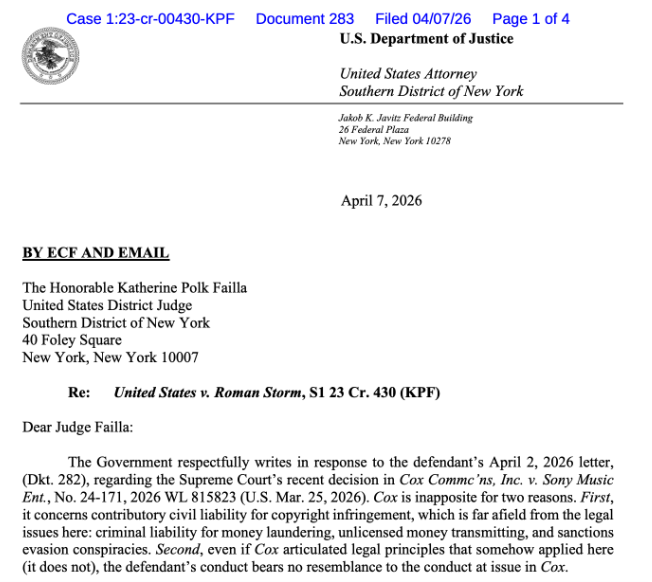
    US prosecutors have rejected Roman Storm’s motion to dismiss charges in the Tornado Cash case, stating that his defense relies on arguments irrelevant to the criminal allegations. US Attorney Jay Clayton described Storm’s approach as “window dressing at best and outright misdirection at worst.”

    Storm’s lawyers cited the 2026 Supreme Court case Cox Communications, Inc. v. Sony Music Entertainment, claiming it could demonstrate he lacked criminal intent for charges of conspiracy to commit money laundering and conspiracy to violate sanctions. Prosecutors argued that the Cox case involved civil copyright issues and bore no resemblance to Storm’s conduct, highlighting the absence of effective anti-money-laundering measures in Tornado Cash operations.

    Partial Jury Verdict Leaves Retrial Possible

    A jury convicted Storm in August 2025 of conspiracy to operate an unlicensed money transmitting business but deadlocked on two counts, leaving the possibility of a retrial. Prosecutors have requested an October retrial, though no date is confirmed.

    Justice Department Leadership Changes Add Uncertainty

    Recent DOJ changes include President Donald Trump replacing Attorney General Pam Bondi with Todd Blanche as acting AG. Blanche’s April 2025 memo opposing “regulation by prosecution” was cited by Storm, who warned the retrial could lead to up to 40 years in prison for open-source code he did not control.

    Disclaimer

    This content is for informational purposes only and does not constitute financial, investment, or legal advice. Cryptocurrency trading involves risk and may result in financial loss.

  • Crypto Scam Losses in the U.S. Surpass $11.4 Billion in 2025, FBI Reports

    Crypto Scam Losses in the U.S. Surpass $11.4 Billion in 2025, FBI Reports

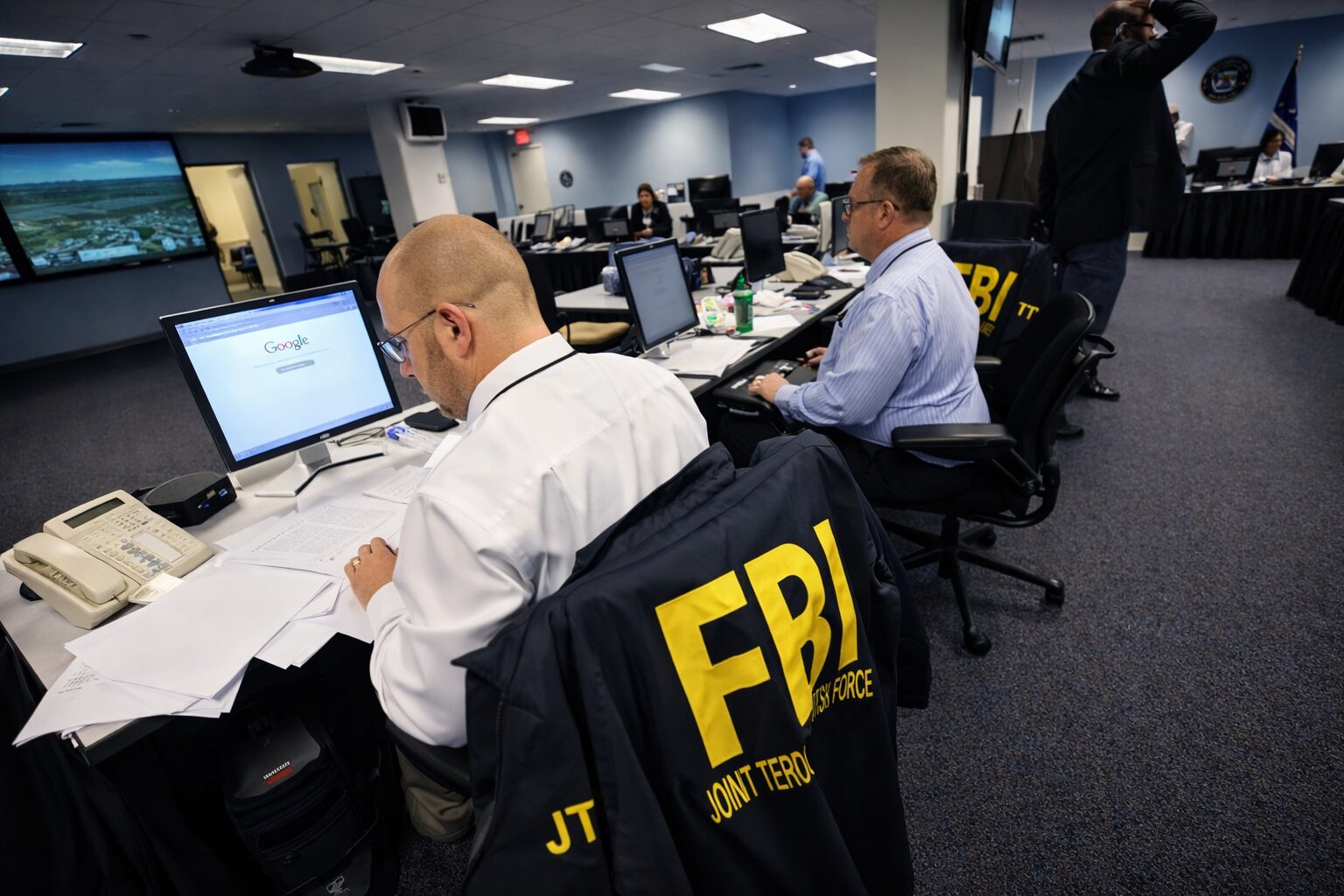
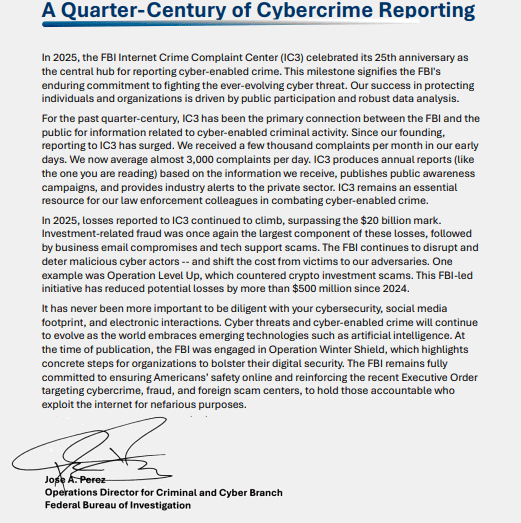
    Americans lost $11.4 billion to cryptocurrency scams in 2025, marking a 22% increase from 2024, according to a new report from the Federal Bureau of Investigation. The agency recorded 181,565 crypto related complaints, a 21% rise, with an average loss of $62,604 per case.

    The report described cryptocurrency investment scams as long-term schemes using psychological manipulation and false legitimacy to convince victims to invest significant amounts of money. Losses were heavily concentrated, with nearly 18,600 victims each losing more than $100,000, often affecting savings and retirement funds.

    Organized Crime and Global Fraud Networks Drive Scams

    According to the FBI, many operations are run by organized criminal groups in Southeast Asia, often using human trafficking victims as forced labor to manage scam networks.

    A separate report from Chainalysis estimated that up to $17 billion in crypto was lost worldwide to scams and fraud in 2025. Methods such as impersonation schemes, fake crypto exchange platforms, and AI-generated scams increasingly surpassed cyberattacks as the leading tactics used by criminals.

    Online Fraud Trends Show Rapid Expansion

    Overall cybercrime activity also climbed sharply, with more than 1 million complaints filed in 2025 and total losses exceeding $20.8 billion, underscoring the rapid evolution of digital fraud threats.

    Disclaimer

    This content is for informational purposes only and does not constitute financial, investment, or legal advice. Cryptocurrency trading involves risk and may result in financial loss.
  • Vice President Vance Predicts War May Conclude Shortly as Talks Continue

    Vice President Vance Predicts War May Conclude Shortly as Talks Continue

    45-Day Ceasefire and Strait of Hormuz Reopening Under Discussion

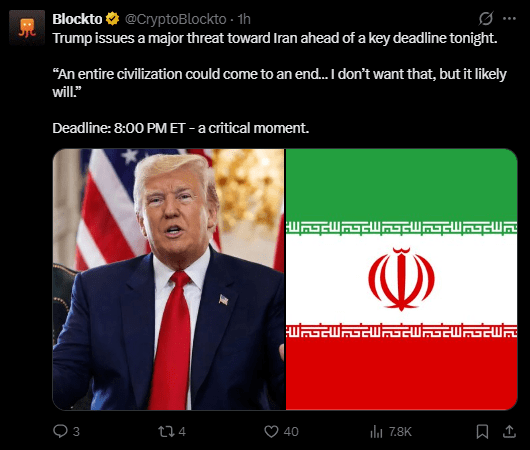
    Negotiations between the United States and Iran showed signs of progress over the past 24 hours, though reaching a deal before the 8 p.m. ET deadline set by Donald Trump still appears unlikely. U.S. officials said the focus has shifted from whether a deal is possible to whether it can be finalized before the deadline expires.

    Senior officials involved in the discussions include Vice President JD Vance, envoy Steve Witkoff, and adviser Jared Kushner, who have maintained communication channels with Iranian representatives, including Foreign Minister Abbas Araghchi.

    Sources indicated that negotiations may continue until the final hours before the deadline, with discussions underway about a possible in-person or virtual meeting between delegations. Officials described the talks as serious, with mediators pushing for rapid decisions as the deadline approaches.

    The talks center on reopening the Strait of Hormuz and securing a 45-day ceasefire to allow broader negotiations. Trump previously warned that U.S. forces could target Iran’s bridges, power plants, and infrastructure if the waterway remains closed, while Iran signaled possible retaliation against energy and water facilities in Gulf states.

    Mediators Push Proposals as Counteroffers Continue

    Diplomatic exchanges have taken place through mediators from Pakistan, Egypt, and Turkey, with both sides sending proposals and counter-proposals over the past two weeks. Officials said Iran submitted a revised proposal on Monday, which, although not fully aligned with U.S. demands, was viewed as more encouraging than expected.

    White House Press Secretary Karoline Leavitt stated that only the president knows the current status of the negotiations and the potential response if the deadline passes without agreement.

    Disclaimer

    This content is for informational purposes only and does not constitute financial, investment, or legal advice. Cryptocurrency trading involves risk and may result in financial loss.
  • Iran Cuts US Diplomatic Channels as Bab al-Mandeb Threat Raises Global Trade Risks

    Iran Cuts US Diplomatic Channels as Bab al-Mandeb Threat Raises Global Trade Risks

    Iran-US Conflict Escalates With Strait of Hormuz Deadline Near

    Iran has cut diplomatic channels with the United States and warned of possible disruption around the Bab al-Mandeb Strait, placing a second major global trade chokepoint at risk as tensions escalate. The White House said only Donald Trump knows the next course of action as his 8 p.m. ET deadline for Iran to reopen the Strait of Hormuz approaches.

    Press Secretary Karoline Leavitt said Iran must “meet the moment and make a deal,” adding that the president alone would decide the response. Trump warned on Truth Social that “a whole civilization will die tonight” if Iran fails to comply, alongside threats targeting bridges and power plants.

    Strikes, Infrastructure Damage and Regional Warnings

    Multiple strikes were reported across Iran, including attacks on Kharg Island, through which nearly 90% of Iran’s oil exports pass. Railway operations in Mashhad were halted after warnings to avoid rail networks. Iranian sources also warned that attacks on power plants could leave Saudi Arabia and the wider region in darkness through retaliatory strikes.

    Regional Diplomacy and Market Reaction

    Countries including Pakistan, Egypt, and Turkey are pushing for a 45-day ceasefire framework, while explosions were reported in Tehran, Karaj, and near Erbil airport in Iraqi Kurdistan. Meanwhile, Brent crude rose 0.5% to $110 per barrel, and S&P 500 futures dipped 0.2%, reflecting rising market anxiety as the conflict intensifies.

    Disclaimer

    This content is for informational purposes only and does not constitute financial, investment, or legal advice. Cryptocurrency trading involves risk and may result in financial loss.
  • Ether Treasuries Turn to Liquid Staking to Compete With Staked ETH ETFs

    Ether Treasuries Turn to Liquid Staking to Compete With Staked ETH ETFs

    Ether treasury companies may need liquid staking and other active yield strategies to outperform staked Ether ETFs, according to Kean Gilbert, head of institutional relations at Lido Finance, speaking at ETHCC 2026. Liquid staking allows ETH holders to stake tokens while receiving a transferable token that can be deployed in DeFi. Gilbert suggested strategies such as posting ETH as collateral and borrowing against it to generate higher returns than passive staking products.

    U.S.-Listed Staked ETH Products

    Current ETFs include the REX-Osprey ETH + Staking ETF (launched September 2025), Grayscale Ethereum Staking ETF and Ethereum Staking Mini ETF, and BlackRock iShares Staked Ethereum Trust ETF (introduced March 12). Net staking rewards vary: Grayscale ETHE reported 2.26% as of April 6, Grayscale ETH 2.56%, and native ETH staking yields about 2.72% annually.

    Liquid Staking Adoption by Treasuries

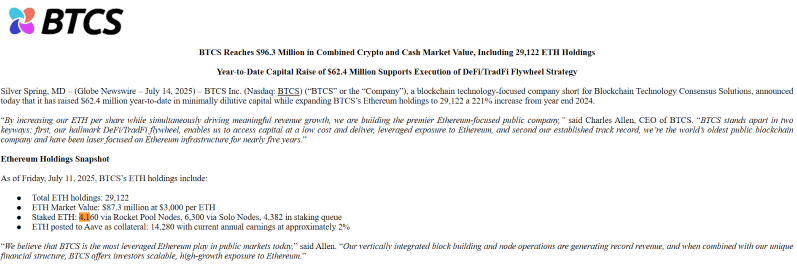
    Sharplink Gaming, the second-largest corporate ETH holder, earned 14,516 ETH ($30.8 million) in staking rewards, with 33% from liquid staking. BTCS Inc. liquid staked 4,160 ETH ($8.8 million) through Rocket Pool, out of total holdings of 29,122 ETH. Jimmy Xue, co-founder of Axis, emphasized that treasuries focus on active deployment and basis trading, which passive ETFs cannot deliver.

    BTCS Inc. SEC filing: SEC.gov

    These strategies aim to provide investors with returns beyond traditional staking products, reflecting growing adoption of liquid staking in institutional Ether treasuries.

    Disclaimer

    This content is for informational purposes only and does not constitute financial, investment, or legal advice. Cryptocurrency trading involves risk and may result in financial loss.

  • Binance Introduces Spot Trading Guardrails to Limit Abnormal Executions

    Binance Introduces Spot Trading Guardrails to Limit Abnormal Executions

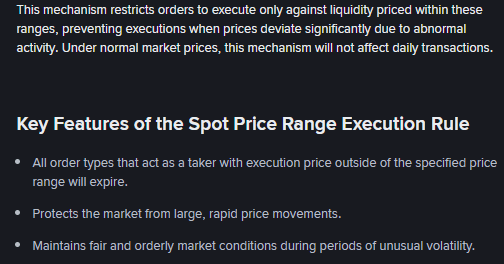
    Crypto exchange Binance announced a new Spot Price Range Execution Rule (PRER), set to roll out on April 14, designed to restrict spot trading orders from executing outside a defined price range during periods of high volatility or thin liquidity. The move aims to maintain fair and orderly markets and reduce abnormal trade executions.

    PRER ties order execution to a dynamic reference price derived from recent trades, with percentage-based bands set above and below that level. Orders attempting to fill outside the range are partially or fully canceled. Binance emphasized that this mechanism differs from user-set stop-loss or limit orders, as it is an exchange-level protection applied during order matching, independent of user intent.

    Targeted Market Protection During Volatile Conditions

    Binance said the rule may not apply to all trading pairs at all times, particularly if a reliable reference price cannot be determined. The feature does not eliminate slippage but is intended to limit extreme executions during market stress, which can occur when liquidity thins.

    The update comes after an October 2025 liquidation-driven market dislocation, when certain platform modules faced technical glitches and some assets briefly depegged. Binance co founder Changpeng Zhao later denied that the exchange contributed to the liquidation event.

    PRER’s dynamic price bands can adjust by trading pair and market conditions, providing a flexible risk management tool for the platform amid ongoing volatility.

    Disclaimer

    This content is for informational purposes only and does not constitute financial, investment, or legal advice. Cryptocurrency trading involves risk and may result in financial loss.

  • CME Group Expands Crypto Derivatives With 24/7 Trading and New Avalanche, Sui Contracts

    CME Group Expands Crypto Derivatives With 24/7 Trading and New Avalanche, Sui Contracts

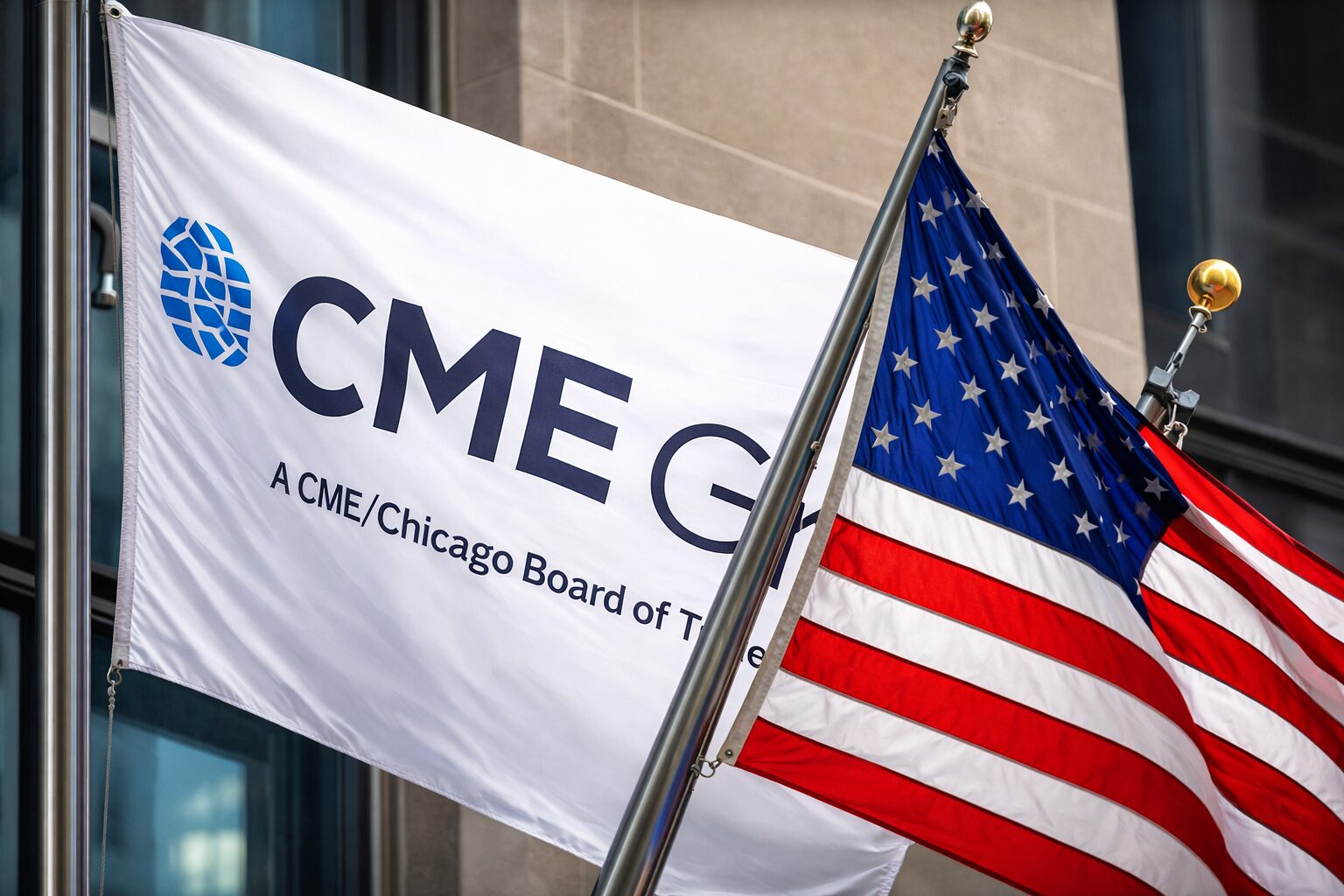
    The CME Group will offer 24/7 trading for crypto futures and options starting May 29, providing continuous access to regulated U.S. crypto markets. The move follows demand for around-the-clock crypto trading, already offered by exchanges such as Binance Futures, Coinbase Derivatives, and other crypto-native venues. CME first announced the expansion last year, with Tim McCourt, CME’s global head of equities, noting that “not all markets lend themselves to operating 24/7.”

    Avalanche and Sui Futures Added

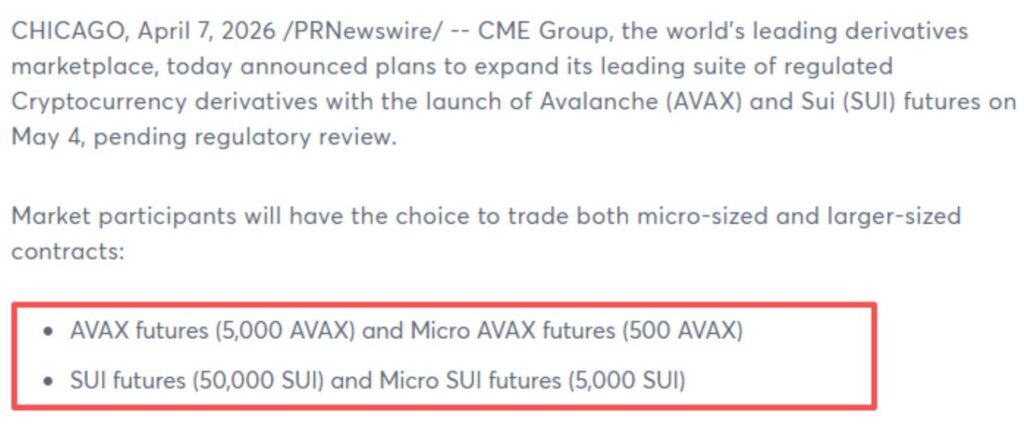
    CME will launch Avalanche (AVAX) and Sui (SUI) futures, including standard and micro contracts. Traders can access 5,000 AVAX or 500 AVAX and 50,000 SUI or 5,000 SUI contracts. Giovanni Vicioso, CME Global Head of Cryptocurrency Products, said the new offerings provide “greater choice, enhanced flexibility and more capital efficiencies across our deeply liquid, regulated crypto derivatives complex.”

    Market Reach and Institutional Adoption

    CME’s crypto suite now covers over 75% of total crypto market capitalization, including BTC, ETH, SOL, XRP, ADA, LINK, and XLM, with average daily open interest reaching $25 billion in 2025. CME entered crypto with Bitcoin futures in 2017 and Ether futures in 2021. The 24/7 expansion positions CME alongside crypto-native exchanges and reflects broader interest in regulated digital assets.

    Disclaimer

    This content is for informational purposes only and does not constitute financial, investment, or legal advice. Cryptocurrency trading involves risk and may result in financial loss.
  • Bitcoin Diverges From Software Stocks as Iran Conflict and AI Pressures Shift Market Trends

    Bitcoin Diverges From Software Stocks as Iran Conflict and AI Pressures Shift Market Trends

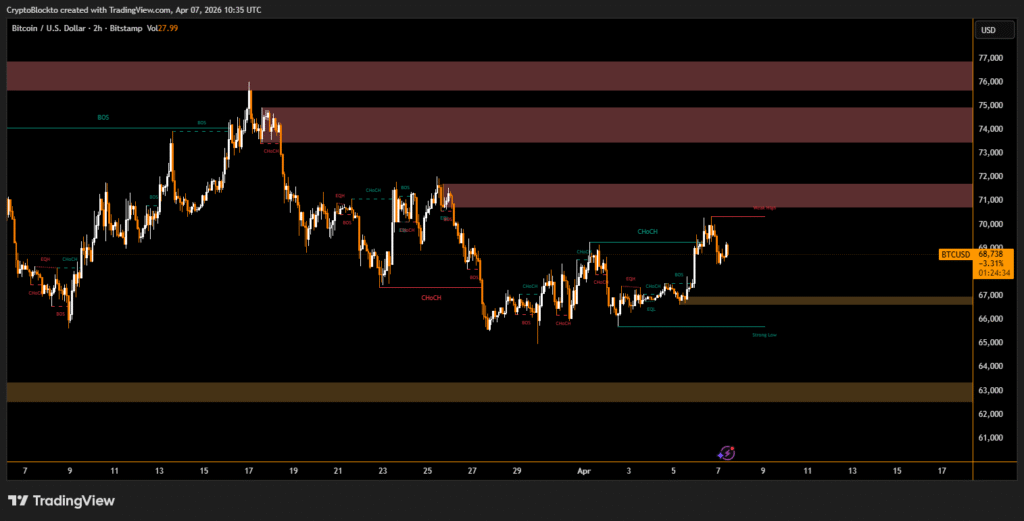
    Bitcoin has started to move independently from software stocks following the outbreak of conflict involving Iran on Feb. 28, marking a sharp shift after months of close alignment. Since that date, Bitcoin has gained more than 5%, climbing back above $69k, including an increase of over 0.5% in the past 24 hours.

    $BTC 2h price chart

    In contrast, the iShares Expanded Tech-Software Sector ETF has fallen more than 2% during the same period. The performance gap signals that investors are beginning to treat cryptocurrency and software equities as separate assets in the short term.

    Correlation Breakdown Signals Market Decoupling Trend

    Correlation between Bitcoin and IGV dropped sharply after the conflict began. In early February, the relationship stood near 1.0, indicating the two assets were moving almost in lockstep. Following the outbreak, the correlation plunged to 0.13, reflecting near decoupling, before partially recovering to around 0.7.

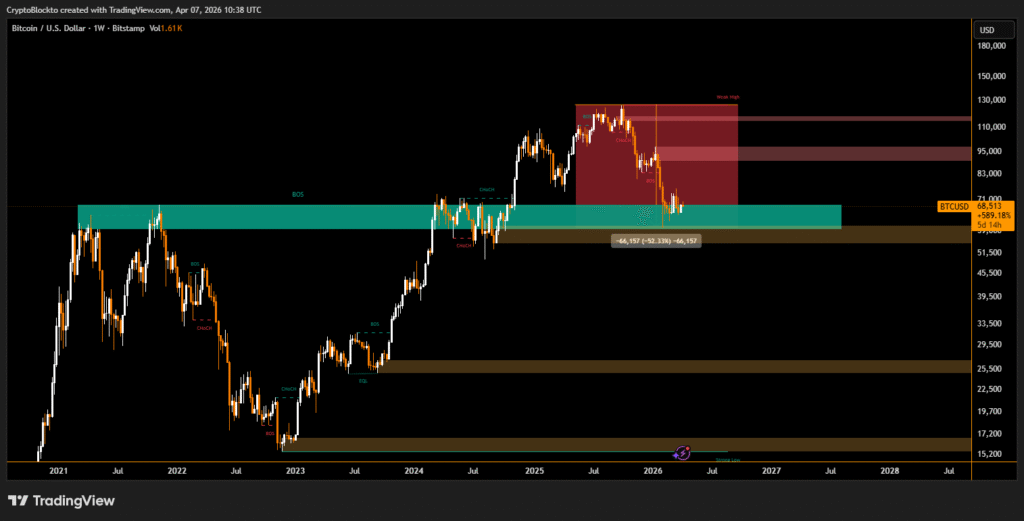
    Over the past three months, both assets showed similar declines, with Bitcoin falling 26% and IGV losing 23%. Year to date, both remain down around 21%, while over five years Bitcoin has gained 18%, compared with 10% for IGV. Bitcoin also experienced a deeper drawdown, falling about 50% from its October all-time high, while IGV declined roughly 35% from its own peak.

    $BTC weekly price chart

    AI Pressure and Software Sector Risks Drive Divergence

    Software stocks tracked by IGV include major companies such as Microsoft, Oracle, and Salesforce. Investors are increasingly concerned that rapid growth in artificial intelligence could compress profit margins and valuation multiples across Software-as-a-Service businesses as competition rises and barriers to entry decline.

    Bitcoin, meanwhile, is behaving more like a macro-sensitive asset, drawing support from heightened geopolitical uncertainty linked to the Iran conflict, which has encouraged investors to diversify away from traditional technology equities.

    Disclaimer

    This content is for informational purposes only and does not constitute financial, investment, or legal advice. Cryptocurrency trading involves risk and may result in financial loss.