Author: tristan

  • Russia Warns US–Iran Peace Talks May Be Cover for Possible Military Escalation

    Russia Warns US–Iran Peace Talks May Be Cover for Possible Military Escalation

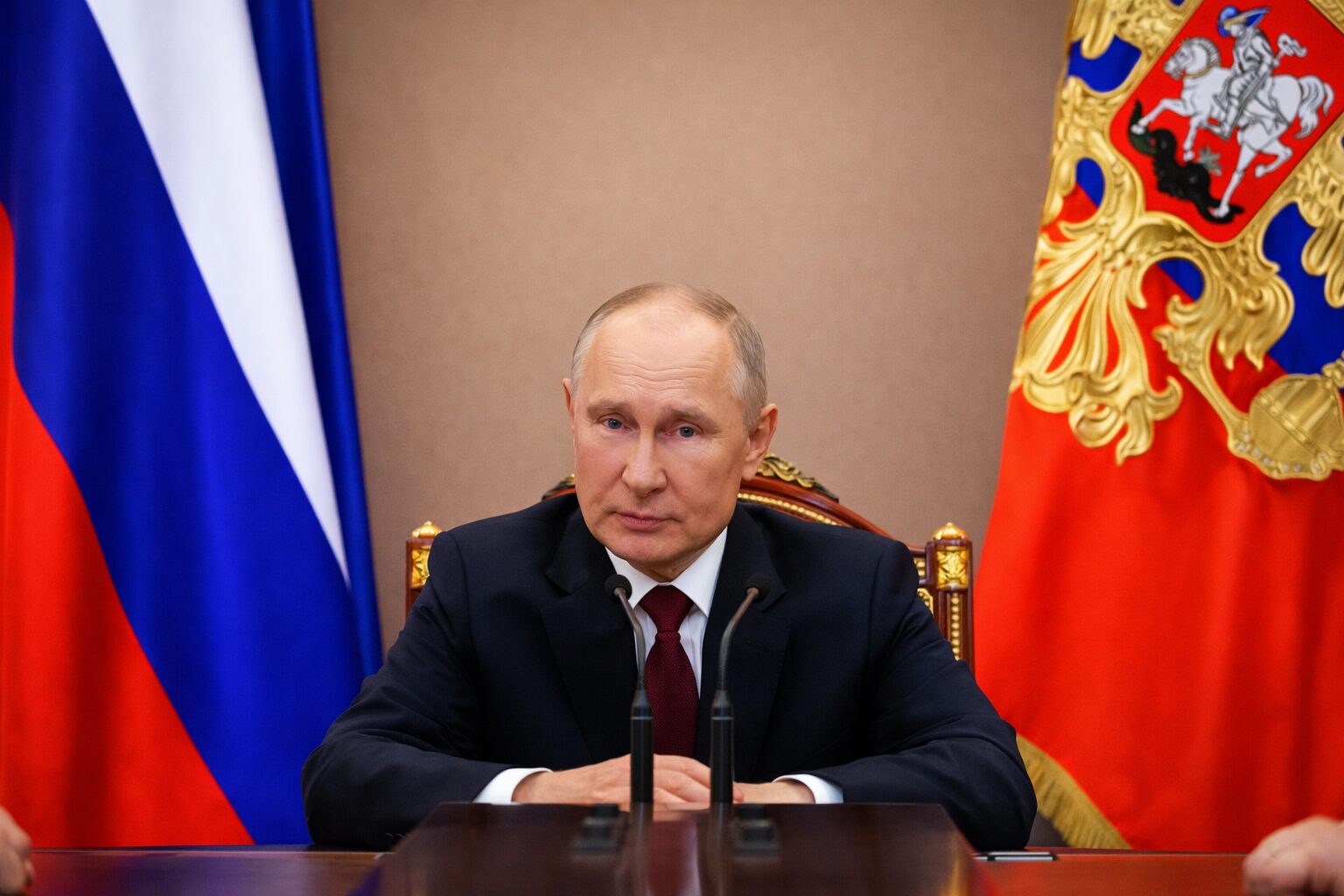
    Russia has warned that ongoing peace negotiations between the United States and Iran could be used as a cover for preparing a potential military strike on Tehran. According to Russia’s Security Council, reported by TASS, the Pentagon has continued increasing its military presence in the region, raising concerns over possible escalation despite diplomatic activity.

    The council suggested that both the United States and Israel could potentially use the current negotiation process as a strategic pause to prepare for a ground operation. Officials also stated that Iran maintains sufficient defensive and offensive capabilities to respond to any attack from either country.

    https://cms.blockto.io/russia-to-ban-gasoline-exports-from-april-1-amid-global-oil-market-volatility/

    Ceasefire Holds Amid Rising Diplomatic Tension

    A two week ceasefire between the United States, Israel, and Iran is currently in effect while diplomatic efforts continue. Recent talks between the United States and Iran were held in Islamabad, with reports indicating that a second round of negotiations may take place within the next two days.

    Despite ongoing discussions aimed at de escalation, uncertainty remains high as military movements and political warnings continue to shape expectations around the fragile ceasefire and the broader regional security outlook.

    Disclaimer

    This content is for informational purposes only and does not constitute financial, investment, or legal advice. Cryptocurrency trading involves risk and may result in financial loss.

  • Morgan Stanley Bitcoin Trust Surpasses WisdomTree ETF in Just Six Trading Days

    Morgan Stanley Bitcoin Trust Surpasses WisdomTree ETF in Just Six Trading Days

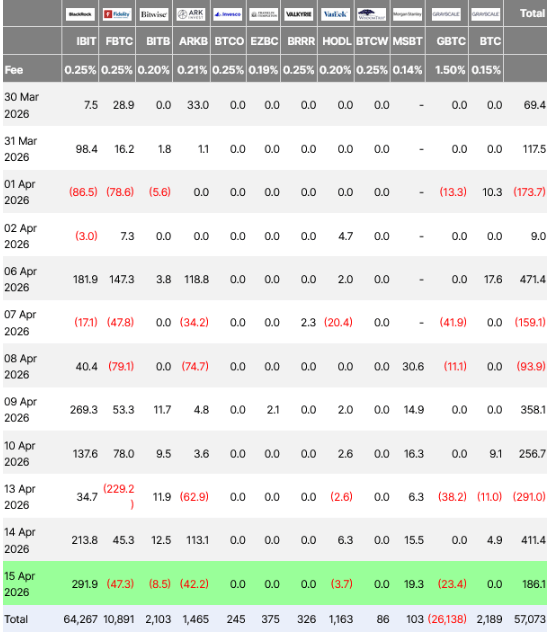
    The Morgan Stanley Bitcoin Trust (MSBT) has quickly overtaken the WisdomTree Bitcoin Fund (WBTC) in total net inflows, marking a significant milestone just days after its launch. The fund added $19.3 million in inflows on Wednesday, bringing its cumulative total to approximately $103 million.

    This performance pushed MSBT ahead of WisdomTree’s Bitcoin Fund, which had accumulated about $86 million in inflows since its launch in January 2024. The rapid growth highlights increasing competition among financial institutions entering the spot Bitcoin exchange-traded fund market.

    Flow data for the US spot Bitcoin ETFs since March 30. : Farside Investors

    The MSBT fund launched on April 8 with a competitive fee of 0.14%, slightly undercutting pricing offered by competing products such as the Grayscale Investments Bitcoin Mini Trust.

    Intensifying Competition in the Bitcoin ETF Market

    The new fund joined a crowded field of spot Bitcoin ETFs, including the industry-leading BlackRock iShares Bitcoin Trust (IBIT), which currently leads the market with more than $64 billion in total net inflows. Other major competitors include products from Fidelity Investments, Bitwise Asset Management, ARK Invest, and Invesco.

    Meanwhile, Goldman Sachs recently filed with the U.S. Securities and Exchange Commission to launch its own Bitcoin-linked ETF, signaling continued institutional expansion into digital asset products.

    ETF Lifespans Shrink as Market Competition Increases

    Industry data shows the average lifespan of ETFs has declined sharply, falling from 4.66 years in 2024 to about 3.5 years in 2025. More than 40 ETFs were liquidated during the first two months of 2026, though major cryptocurrency ETFs were not among those closures.

    Analysts warn that continued growth in ETF launches could lead to increased competition, with some predicting that less successful crypto exchange-traded products may be phased out by 2027 due to weaker investor demand.

    Disclaimer

    This content is for informational purposes only and does not constitute financial, investment, or legal advice. Cryptocurrency trading involves risk and may result in financial loss.
  • Nvidia CEO Warns China Has Capacity to Train Mythos-Level AI, Raising Cybersecurity Concerns

    Nvidia CEO Warns China Has Capacity to Train Mythos-Level AI, Raising Cybersecurity Concerns

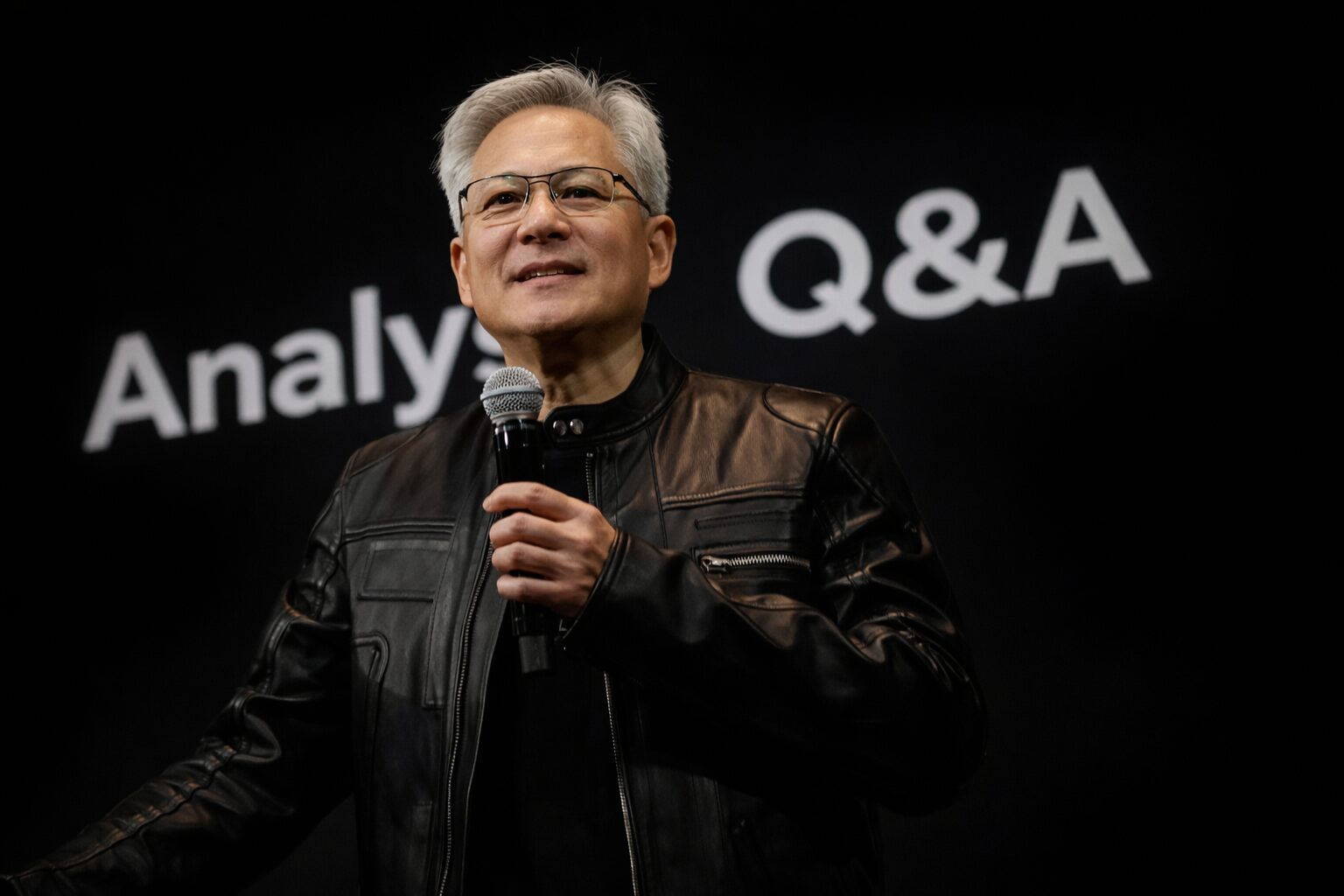
    Jensen Huang, chief executive of Nvidia, has warned that China already possesses enough computing power and infrastructure to train advanced artificial intelligence models comparable to Claude Mythos. Speaking in a recent podcast interview, Huang said the type of compute used to train Mythos is widely available in China, highlighting the country’s large network of data centers and chip manufacturing capacity.

    He noted that China manufactures roughly 60% of the world’s mainstream chips and has a large share of global AI researchers, along with significant energy resources. Huang described China’s computing infrastructure as “enormous,” with many facilities capable of scaling up operations quickly if required.

    Cybersecurity Risks Linked to Powerful AI Models

    The advanced capabilities of Mythos have already raised concerns across the cybersecurity sector. Developer Anthropic restricted access to the model after it identified thousands of software vulnerabilities across major operating systems and browsers. The company reported that nearly 99% of the discovered vulnerabilities had not yet been patched, increasing fears of potential misuse.

    Further evaluation by the AI Security Institute found that the model could autonomously conduct multi-stage cyberattacks and identify security flaws, tasks that typically require experienced professionals days to complete.

    Calls for Cooperation Amid Rising AI Competition

    Huang urged policymakers to prioritize dialogue over confrontation, emphasizing that collaboration and research exchanges could reduce risks associated with advanced AI development. Meanwhile, U.S. Treasury Secretary Scott Bessent described Mythos as a major technological breakthrough that could help maintain U.S. leadership in the global AI race, underscoring the strategic importance of secure and responsible AI innovation.

    Disclaimer

    This content is for informational purposes only and does not constitute financial, investment, or legal advice. Cryptocurrency trading involves risk and may result in financial loss.

  • Cato Institute Urges U.S. to Remove Crypto Capital Gains Tax to Boost Currency Competition

    Cato Institute Urges U.S. to Remove Crypto Capital Gains Tax to Boost Currency Competition

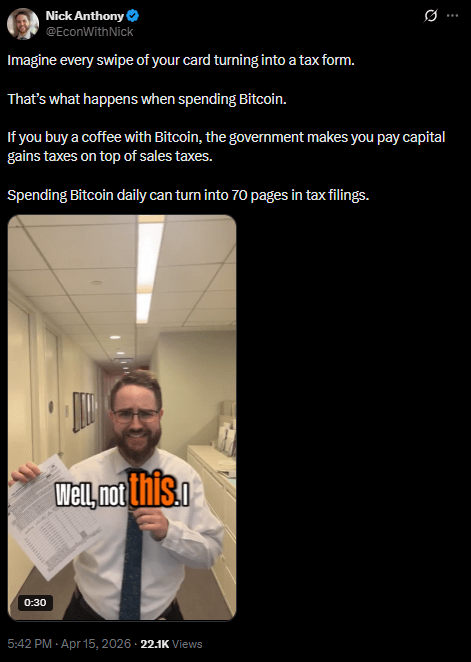
    The Cato Institute, a Washington, D.C.–based public policy think tank, has called on the United States government to eliminate capital gains taxes on cryptocurrencies such as Bitcoin to encourage broader currency competition. Policy scholar Nicholas Anthony argued that current tax rules discourage the everyday use of digital assets as payment methods.

    Under existing U.S. law, using crypto to purchase goods or services can trigger a taxable event, similar to selling stocks or real estate. Anthony noted that frequent small transactions such as daily purchases can result in complex reporting requirements, making crypto less practical as a currency.

    Alternative Tax Models Under Consideration

    Anthony suggested that fully removing capital gains taxes would be the simplest approach. However, he also outlined other possible solutions, including eliminating taxes only on cryptocurrency and foreign currency transactions to encourage monetary competition.

    Another option discussed was introducing a de minimis tax rule, which would exempt small transactions from capital gains reporting. While partial exemptions could reduce the burden, Anthony warned they might still create compliance challenges if users must verify transaction details.

    Growing Crypto Adoption Strengthens Policy Debate

    Data cited in the report shows that crypto usage for payments continues to expand. A 2025 survey by the National Crypto Association found that 39% of U.S. crypto holders reported using digital assets to purchase goods and services.

    Additionally, research from Springer Nature identified approximately 11,000 merchants worldwide accepting Bitcoin payments, highlighting the growing relevance of digital currencies in global commerce.

    Disclaimer

    This content is for informational purposes only and does not constitute financial, investment, or legal advice. Cryptocurrency trading involves risk and may result in financial loss.

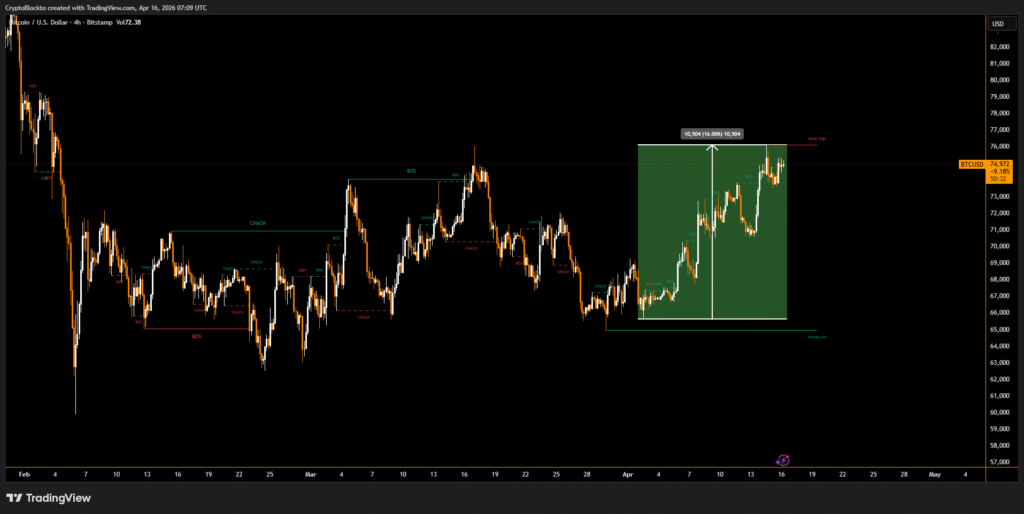
  • Bitcoin Rally Near $75K Stalls as Profit-Taking and Weak Derivatives Demand Cap Upside

    Bitcoin Rally Near $75K Stalls as Profit-Taking and Weak Derivatives Demand Cap Upside

    Bitcoin has climbed nearly 10% this month, but its upward momentum has stalled near the $75k level over the past 48 hours. The slowdown comes even as U.S. equities continue to hit record highs, highlighting a divergence between traditional markets and crypto sentiment.

    BTC gain 10% Monthly in April

    On-chain data suggests that investors are increasingly taking profits into strength. A key metric, the realized profit/loss ratio, shows elevated profit-taking activity, with the 30-day exponential moving average at 1.16—well above the neutral threshold. This indicates holders are actively selling into recent price strength.

    CryptoQuant data also shows that roughly $1.14 billion in profits were realized during a brief surge toward $76,000, marking one of the largest single-day profit-taking events this year.

    Mixed Exchange Demand and Weak Conviction

    Market activity is uneven across exchanges. Buying pressure appears concentrated mainly on Binance, while Coinbase and other platforms show weaker demand, according to Glassnode data.

    At the same time, funding rates remain slightly negative, suggesting traders are still cautious rather than aggressively positioning long. Options markets reinforce this view, with a consistent bias toward put contracts across multiple timeframes, signaling demand for downside protection.

    Taken together, profit-taking, fragmented spot demand, and defensive derivatives positioning suggest Bitcoin is pausing at resistance rather than entering a new breakout phase.

    Disclaimer

    This content is for informational purposes only and does not constitute financial, investment, or legal advice. Cryptocurrency trading involves risk and may result in financial loss.
  • BitMEX Proposes Canary Fund Model as Alternative to Bitcoin Quantum Coin Freeze

    BitMEX Proposes Canary Fund Model as Alternative to Bitcoin Quantum Coin Freeze

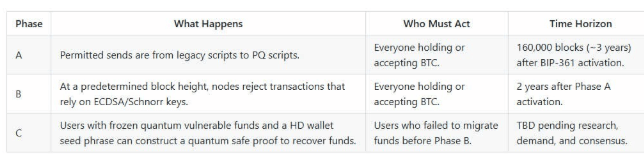
    BitMEX Research has introduced a proposed alternative to freezing dormant Bitcoin that may be vulnerable to future quantum computing attacks. Instead of immediately restricting access to older coins, the proposal recommends a soft fork that would only activate a full freeze if a quantum computer capable of stealing Bitcoin is proven to exist.

    The concept relies on a “canary approach,” which creates a special Bitcoin address generated using a Nothing-Up-My-Sleeve Number (NUMS). This cryptographic method ensures the private key is unknown, meaning the address cannot be spent under normal circumstances but could be accessed if powerful quantum technology becomes available.

    How the Canary Watch System Would Work

    Under the model, users could voluntarily donate Bitcoin to the canary address as a bounty. If a quantum-capable actor successfully spends funds from the address, it would act as proof of a real threat and automatically trigger protective measures. Until then, older coins would remain spendable under a “canary watch state,” reducing disruption to the network.

    The proposal also allows participants to secure funds using multisignature wallets and withdraw contributions at any time.

    Proposed 3 phase solution in BIP-361.: GitHub

    Debate Around BIP-361 and Quantum Security Plans

    This proposal comes after the introduction of BIP-361, a plan that suggested freezing dormant Bitcoin considered vulnerable to quantum attacks. The idea drew criticism from parts of the community, with some describing it as overly restrictive. BIP-361 co-author Jameson Lopp later clarified that the proposal was intended as a preliminary contingency concept rather than a finalized upgrade plan, highlighting concerns about potential supply shocks if quantum computing capabilities advance rapidly.

    Disclaimer

    This content is for informational purposes only and does not constitute financial, investment, or legal advice. Cryptocurrency trading involves risk and may result in financial loss.

  • CFTC Probes Oil Futures Trades Linked to Trump Iran Decisions

    CFTC Probes Oil Futures Trades Linked to Trump Iran Decisions

    The US Commodity Futures Trading Commission (CFTC) has opened an investigation into unusual oil futures trades placed shortly before key announcements by President Donald Trump concerning the Iran conflict. The probe focuses on trading activity on CME Group’s NYMEX and the Intercontinental Exchange platforms, where regulators observed sudden surges in trading volumes.

    According to reports, the CFTC is requesting “Tag 50” identity data from exchanges. This information is commonly used for regulatory audits and helps authorities identify individual traders involved in specific transactions.

    Key Trading Spikes Before Iran Announcements

    Investigators are examining at least two instances over a two week period. The first occurred on March 23, when billions of dollars in oil futures were traded roughly 15 minutes before Trump postponed planned strikes on Iranian energy infrastructure. The second spike took place on April 7, shortly before the administration announced a two-week ceasefire with Iran. These trades coincided with falling oil prices and gains in equity markets.

    Officials Warn of Insider Trading Risks in Prediction Markets

    Brian Young, a partner at Jones Day and former director of the CFTC enforcement division, noted that cases involving oil futures are a high priority because fuel prices closely track futures markets. Meanwhile, current enforcement director David Miller stated on March 31 that insider trading laws also apply to prediction markets. Growing scrutiny from lawmakers has pushed platforms such as Kalshi and Polymarket to introduce stricter rules, while the proposed Public Integrity in Financial Prediction Markets Act of 2026 aims to limit insider advantages among government officials.

    Disclaimer

    This content is for informational purposes only and does not constitute financial, investment, or legal advice. Cryptocurrency trading involves risk and may result in financial loss.
  • Bitcoin Holds Near $75K as Markets Rally, but Options Signal Caution

    Bitcoin Holds Near $75K as Markets Rally, but Options Signal Caution

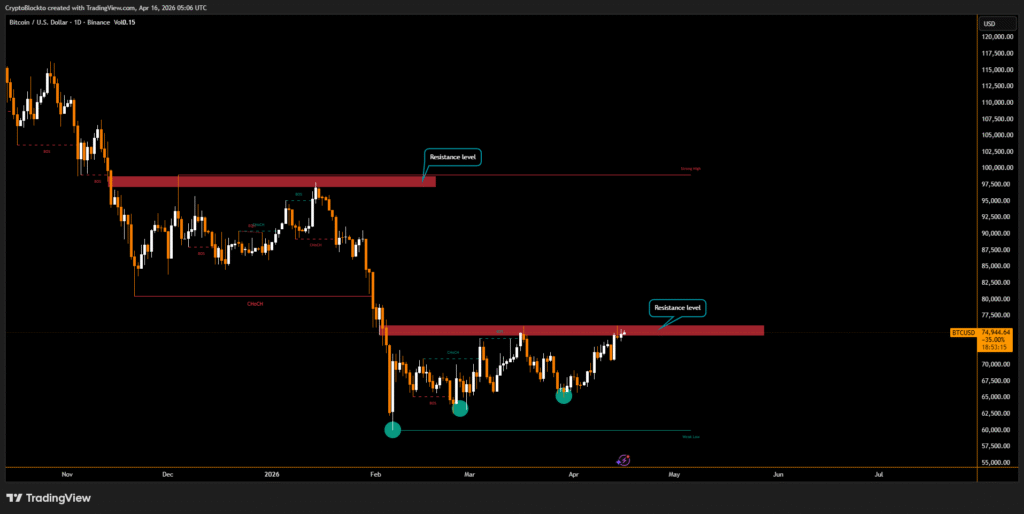
    Bitcoin traded near $74,944 as U.S. equities reached record levels, with the S&P 500 gaining 0.8% and the Nasdaq 100 rising 1.4%. Markets reacted to reports of an in-principle U.S.–Iran agreement to extend cease-fire talks beyond the April 7 deadline, easing short-term geopolitical concerns.

    $BTC daily price chart

    Bitcoin rose 0.7% on the day and 5.4% over the week. Ether outperformed, jumping 8.1% to around $2,370.

    Derivatives Market Shows Defensive Positioning

    Analysts at QCP Capital said Bitcoin’s move is largely spot-driven, not backed by strong leveraged positioning. Funding rates on perpetual futures remain negative, while open interest has softened, indicating traders are not aggressively chasing the upside.

    Options markets also reflect defensive sentiment. Demand for downside protection remains elevated, with 30-day risk reversals showing stronger interest in put options than calls. One-month implied volatility is unusually subdued compared with longer term contracts, suggesting the move may be a temporary bounce rather than a confirmed trend shift.

    Broader Market Signals and Ether Strength

    Long term Treasury yields and gold prices showed little reaction, while oil climbed amid continued tensions in the Strait of Hormuz. Ether’s strength is supported by record on-chain activity and rising stablecoin supply, with the ETH/BTC ratio recovering from multi-year lows. Analysts say markets are still pricing relief rather than resolution.

    Disclaimer

    This content is for informational purposes only and does not constitute financial, investment, or legal advice. Cryptocurrency trading involves risk and may result in financial loss.

  • World Liberty Financial Proposal Sparks Governance Backlash as Justin Sun Calls It ‘Absurd Scam’

    World Liberty Financial Proposal Sparks Governance Backlash as Justin Sun Calls It ‘Absurd Scam’

    World Liberty Financial is facing strong criticism after introducing a governance proposal that would extend lock-up and vesting periods for early supporters of WLFI tokens by up to four years. The proposal aims to restructure token distribution across founders, advisors, partners, and early investors.

    Under the plan, more than 62 billion WLFI tokens currently under indefinite lockups would be shifted to fixed schedules. Founders and team members would face a two-year lock-up followed by a three-year linear vesting period, along with a requirement to burn 4.5 billion tokens. Early supporters holding over 17 billion tokens would be subject to a two-year cliff and an additional two-year vesting period, fully unlocking after four years.

    Justin Sun and Investors Criticize Governance Model

    Tron founder Justin Sun, the project’s largest individual investor, strongly opposed the proposal, calling it one of the “most absurd governance scams” he has encountered. He argued the system effectively punishes dissent, stating that holders who do not approve the new schedule would remain locked indefinitely under current terms.

    Sun also alleged that voting rights are undermined by centralized control mechanisms, including an anonymous multisignature wallet and an externally controlled account capable of blacklisting addresses. He claimed this structure makes governance votes ineffective and symbolic.

    Broader Investor Concerns and Market Fallout

    Other WLFI holders have also raised concerns, with some warning of potential legal action and questioning the fairness of the proposed changes. Critics argue the structure could trap investors while allowing early insiders to maintain control over token liquidity and financial benefits.

    X user Isonips wrote;

    Additional controversy stems from reports that WLFI tokens were used as collateral on lending platforms to borrow stablecoins, further intensifying scrutiny over the project’s transparency and governance practices.

    Disclaimer

    This content is for informational purposes only and does not constitute financial, investment, or legal advice. Cryptocurrency trading involves risk and may result in financial loss.

  • Iran Threatens Red Sea Shipping While Trump Signals Efforts to Ease Israel–Lebanon Conflict

    Iran Threatens Red Sea Shipping While Trump Signals Efforts to Ease Israel–Lebanon Conflict

    Iran has warned it could escalate maritime disruptions if the U.S. continues its blockade of the Strait of Hormuz. Iranian armed forces said they may target shipping routes across the Persian Gulf, Sea of Oman, and Red Sea if Iranian commercial vessels and oil tankers face continued restrictions or insecurity.

    The threat raises concerns over global energy supply chains, as the Strait of Hormuz remains one of the world’s most critical oil transit corridors.

    U.S. Signals on De-escalation and Diplomatic Talks

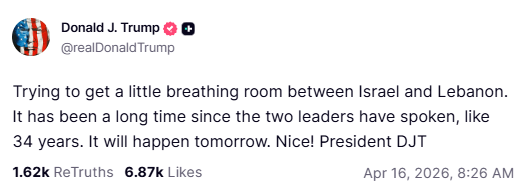
    U.S. President Donald Trump said efforts are underway to create “breathing room” between Israel and Lebanon as regional tensions persist. He also suggested the conflict is “very close to over,” while diplomatic communication with Tehran reportedly continues through intermediaries, including Pakistan.

    According to reports, in-person U.S.–Iran talks could resume as early as this week, with both sides still exchanging messages amid ongoing negotiations.

    China Response and Regional Diplomatic Shifts

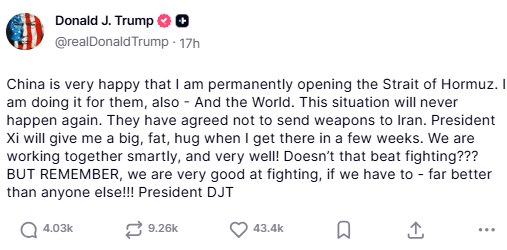
    Trump also claimed that China is “very happy” about efforts to stabilize maritime routes, after Beijing criticized the U.S. blockade as “dangerous.” He further stated that Chinese President Xi Jinping agreed not to supply weapons to Iran, though no independent confirmation has been provided.

    Separately, Israel and Lebanon have continued rare direct discussions in Washington while conflict with Hezbollah escalates, displacing over one million people in Lebanon.

    According to Iranian forensic officials, more than 3,300 people have been killed in Iran since late February. Additional reported casualties include over 2,100 in Lebanon, 32 in Gulf states, 23 in Israel, and 13 U.S. service members, alongside two non-combat deaths.

    Disclaimer

    This content is for informational purposes only and does not constitute financial, investment, or legal advice. Cryptocurrency trading involves risk and may result in financial loss.