Author: tristan

  • Adam Back Says Bitcoin’s Post-Quantum Upgrade Could Reveal Satoshi Nakamoto’s True BTC Holdings

    Adam Back Says Bitcoin’s Post-Quantum Upgrade Could Reveal Satoshi Nakamoto’s True BTC Holdings

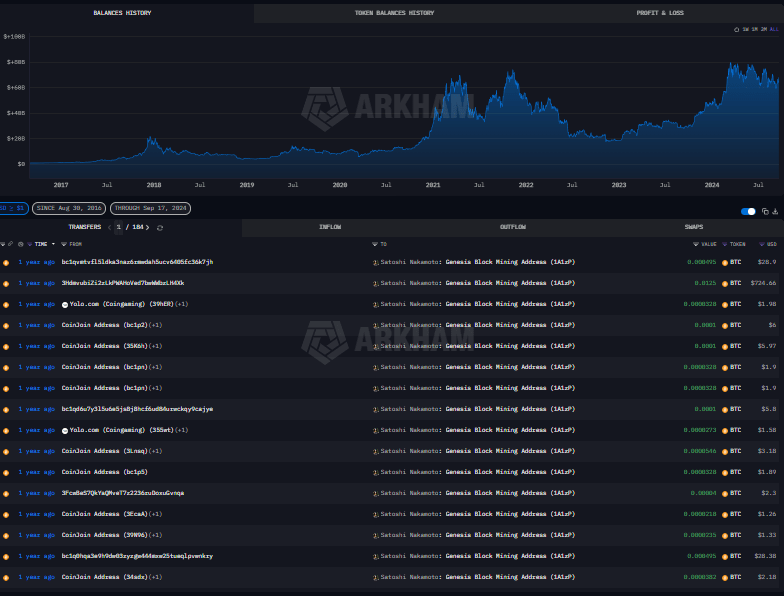
    Adam Back has suggested that a future post quantum upgrade to Bitcoin could help determine the true size of coins linked to Satoshi Nakamoto. Speaking at Paris Blockchain Week, Back said that a network-wide migration to quantum-resistant addresses would require holders to move funds, potentially revealing which coins remain active.

    He estimated that Satoshi Nakamoto’s holdings are between 500,000 and 1 million BTC, while blockchain analytics firm Arkham Intelligence places the figure closer to 1.09 million BTC. Back argued that coins left unmoved after such a transition could reasonably be considered lost.
    Post-Quantum Migration and Security Transition

    The proposed shift would involve moving Bitcoin to new quantum-resistant address formats using hash-based signature schemes. This would replace current cryptographic standards such as ECDSA and Schnorr signatures, which rely on elliptic-curve cryptography.
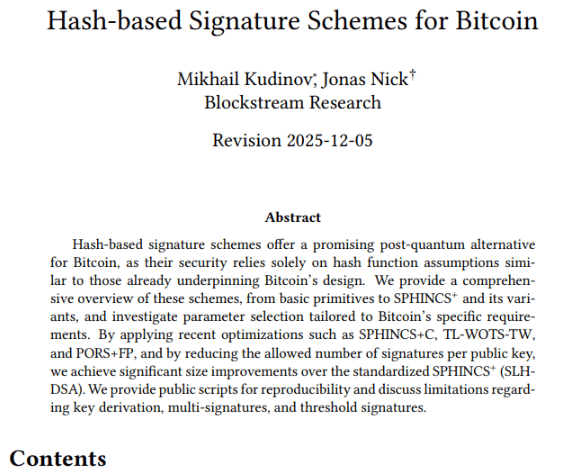
    Hash-based signature schemes for Bitcoin, research paper

    Back noted that users would likely be given sufficient time to migrate funds, reducing disruption while improving long-term security against future quantum threats. He added that Bitcoin developers still have a long runway, estimating that meaningful quantum risk is likely decades away.

    Debate Over Quantum Risk and Network Preparedness

    The discussion comes amid broader debate over Bitcoin’s vulnerability to future quantum computing advances. While some proposals suggest restricting movement of older coins, others argue for gradual migration to new cryptographic standards to preserve network integrity without forced asset freezes.

    Disclaimer

    This content is for informational purposes only and does not constitute financial, investment, or legal advice. Cryptocurrency trading involves risk and may result in financial loss.
  • Bitcoin Funding Rates Turn Deeply Negative as Market Signals Potential Local Bottom

    Bitcoin Funding Rates Turn Deeply Negative as Market Signals Potential Local Bottom

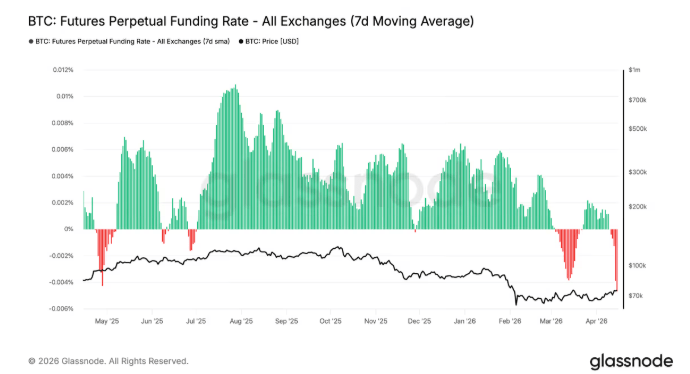
    Bitcoin funding rates have fallen to their lowest levels since 2023, suggesting a sharp increase in short positioning even as prices continue to climb toward the $75,000 range. Data from Glassnode shows the seven-day moving average of funding rates sitting around -0.005%, reflecting sustained bearish sentiment in derivatives markets.

    Funding rates are periodic payments exchanged between long and short traders in perpetual futures contracts to keep prices aligned with spot markets. Negative funding typically indicates that short traders are paying longs, signaling a market leaning toward downside bets.

    Historical Patterns Point to Possible Market Bottoms

    Despite persistent negative funding throughout March and April, Bitcoin has steadily risen from the low $60,000 range to around $75,000. Historically, similar conditions have often coincided with major market bottoms.

    $BTC price action since March

    Past examples include the March 2020 COVID-19 crash, the mid-2021 China mining ban selloff, and the FTX collapse in November 2022, all periods where extreme negative funding aligned with price lows. Similar patterns also appeared during the 2023 Silicon Valley Bank crisis and subsequent market corrections.

    Market Structure Shows Contrarian Strength

    The continued rise in price despite heavy short positioning suggests the market may be “climbing a wall of worry.” Analysts note that overcrowded bearish trades can create conditions for short squeezes, potentially fueling further upside if sentiment reverses.

    Disclaimer

    This content is for informational purposes only and does not constitute financial, investment, or legal advice. Cryptocurrency trading involves risk and may result in financial loss.
  • UAE Investors Buy AI Dip While Maintaining Crypto Exposure Amid Regional Conflict

    UAE Investors Buy AI Dip While Maintaining Crypto Exposure Amid Regional Conflict

    UAE Investors Increase AI and Software Holdings During Market Dip

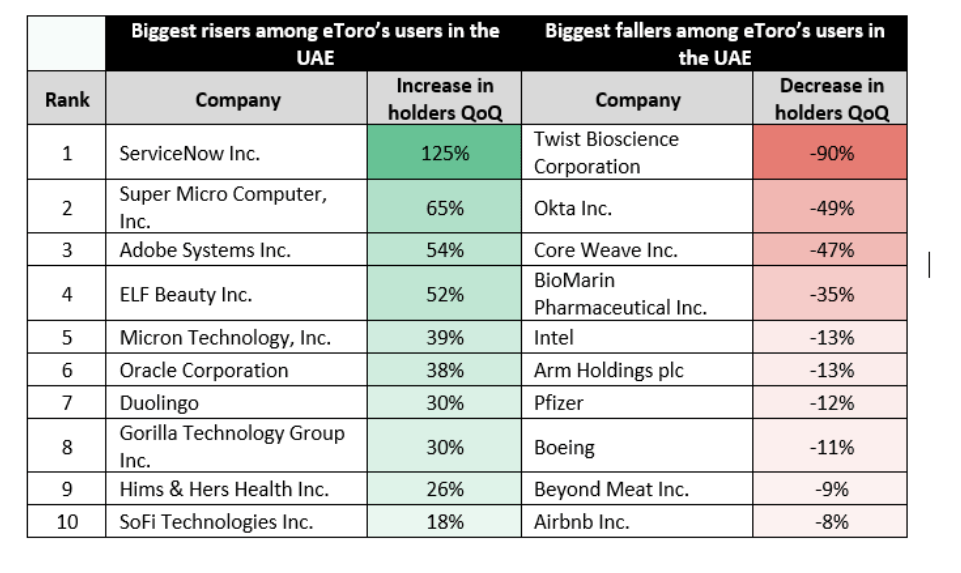
    Investors in the United Arab Emirates increased their exposure to artificial intelligence and technology stocks during the recent market downturn, signaling confidence in long-term digital growth despite regional tensions. Data from eToro showed that UAE users boosted holdings in software and AI infrastructure companies during the first quarter, choosing to buy the dip rather than reduce overall risk.

    Analyst Josh Gilbert said investors became more selective in their strategies, focusing on long-term opportunities rather than shifting to a broad risk-off approach. Several major companies recorded strong increases in investor holdings, including ServiceNow, Super Micro Computer, Adobe and Oracle, highlighting continued demand for AI-related infrastructure despite market pressure.

    What UAE investors bought in Q1, 2026.

    Crypto Exposure Remains Strong as Gulf Tech Strategy Faces Conflict Risks

    Crypto linked investments also remained resilient, with Strategy Inc. ranking as the eighth-most-held stock among UAE investors, indicating ongoing exposure to digital asset markets. Regional tensions involving Iran created volatility and raised concerns about risks to data centers, logistics networks and cross-border technology projects.

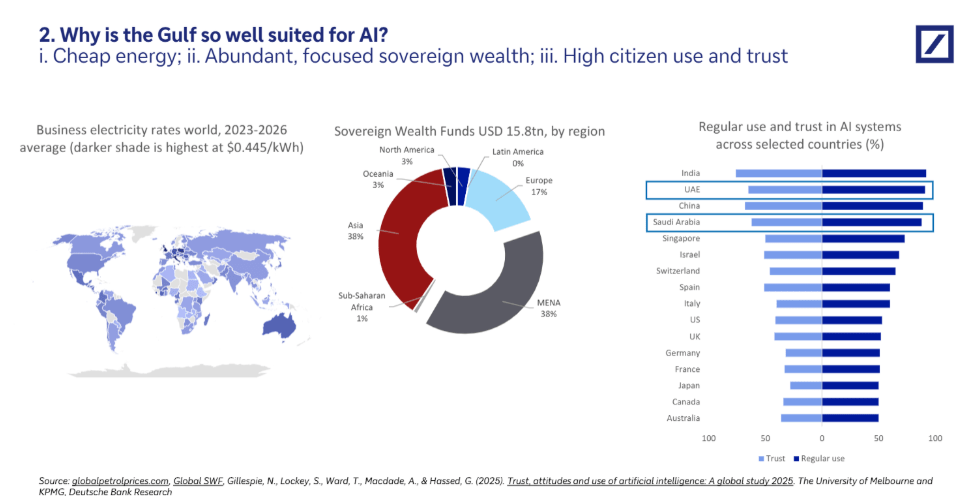
    An April 13 report from Deutsche Bank stated that demand for artificial intelligence, cybersecurity and sovereign digital infrastructure in the Gulf is more likely to strengthen than weaken. With sovereign wealth funds controlling about $5 trillion globally in 2025 and Dubai’s Virtual Assets Regulatory Authority continuing to expand regulatory guidance, the region remains positioned to advance its ambitions as a global hub for AI and crypto innovation.

    Why is the Gulf so well-suited for AI? 
    Disclaimer

    This content is for informational purposes only and does not constitute financial, investment, or legal advice. Cryptocurrency trading involves risk and may result in financial loss.

  • Bitcoin Falls Below $74,000 After Repeated Failure to Break Key $75K Resistance

    Bitcoin Falls Below $74,000 After Repeated Failure to Break Key $75K Resistance

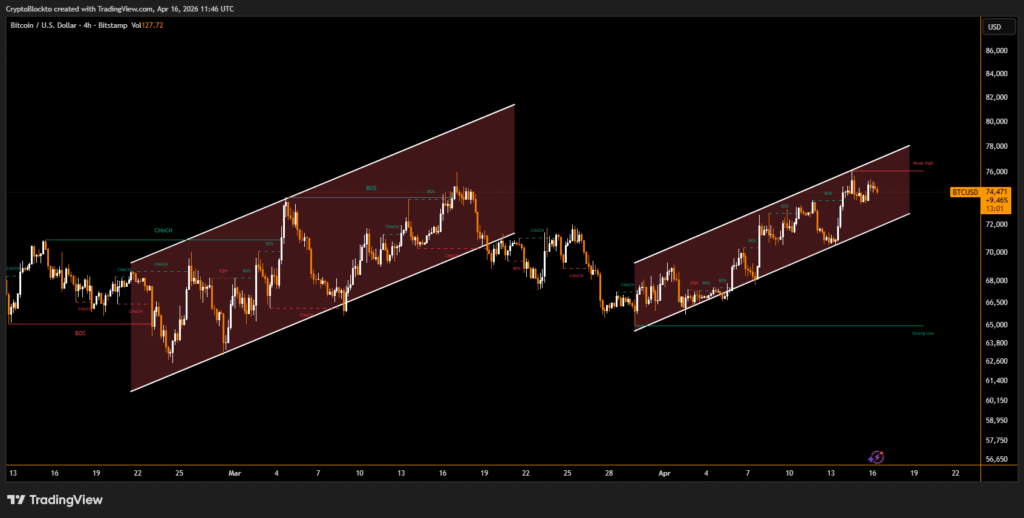
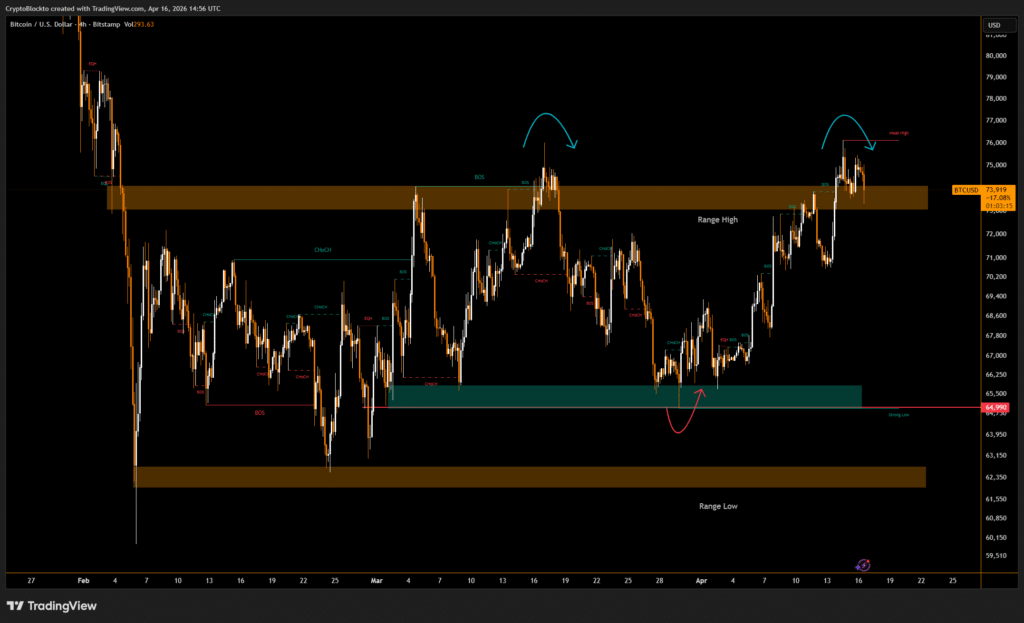
    Bitcoin slipped below the $74k mark during U.S. morning trading after another failed attempt to break through the critical $75k to $76k resistance zone. The leading cryptocurrency dropped about 2% within minutes, briefly falling to nearly $73,414 and extending its 24-hour losses to more than 1%.

    $BTC 4h price chart

    The $75,000–$76,000 range remains a significant technical barrier, as it was the level where Bitcoin traded before the Feb. 5 market crash that pushed prices down to around $60,000. Analysts view a successful breakout above this range as a potential signal for a broader recovery that could drive prices toward the $90,000 level seen at the start of the year.

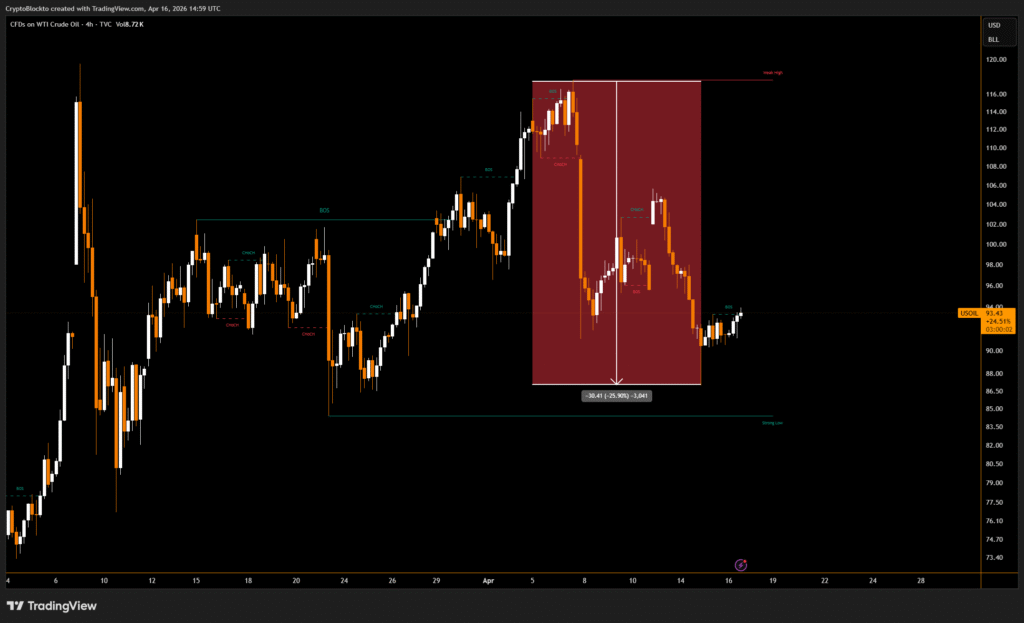
    Major U.S. indices paused following record highs, while crude oil prices climbed roughly 2% to reclaim the $90 level amid ongoing geopolitical supply concerns.

    WTI crude oil 4h price chart

    Software Stocks Gain Momentum as Bitcoin Performance Stalls

    Technology and software stocks have recently shown renewed strength after trailing Bitcoin earlier this year. Before the Middle East conflict began in late February, Bitcoin and software equities moved closely together, showing nearly a one-to-one correlation.

    Since the conflict started, Bitcoin has gained more than 11%, while the IGV software exchange-traded fund rose about 2%, creating expectations that Bitcoin was separating from traditional tech performance. However, over the past five days, IGV surged nearly 11% while Bitcoin remained mostly flat, suggesting software stocks may simply be catching up rather than losing correlation.

    Disclaimer

    This content is for informational purposes only and does not constitute financial, investment, or legal advice. Cryptocurrency trading involves risk and may result in financial loss.
  • AllUnity Expands MiCA-Regulated EURAU Stablecoin Into Major DeFi Liquidity Pools

    AllUnity Expands MiCA-Regulated EURAU Stablecoin Into Major DeFi Liquidity Pools

    AllUnity is expanding its euro pegged stablecoin EURAU deeper into decentralized finance markets, adding liquidity pools across major decentralized exchanges. The firm said the rollout includes integration with Uniswap, the largest decentralized exchange by trading volume, along with Raydium on Solana.

    The new liquidity structure introduces trading pairs such as EURAU/Tether (USDT) on Ethereum, EURAU/USDT0 on the Tempo blockchain, and EURAU/USDT on Solana. The expansion is aimed at improving euro-denominated liquidity and enabling more efficient cross-chain trading.

    MiCA-Regulated Stablecoin Expands Under EU Framework

    EURAU operates under the European Union’s Markets in Crypto-Assets (MiCA) framework after AllUnity secured an electronic money institution license from Germany’s financial regulator BaFin in 2025. The stablecoin was launched on July 31, 2025, and remains relatively small compared to dominant dollar-pegged assets.

    Market capitalization of euro-pegged stablecoins and the top three stablecoins by market cap

    DeFi Expansion Amid Regulatory Uncertainty

    The move comes as regulators continue to debate how decentralized finance should be treated under MiCA rules, with questions raised about whether fully decentralized protocols fall outside the framework. Despite this uncertainty, AllUnity is expanding EURAU across both centralized and decentralized venues, aiming to strengthen euro liquidity in a market still dominated by U.S. dollar stablecoins.

    Disclaimer

    This content is for informational purposes only and does not constitute financial, investment, or legal advice. Cryptocurrency trading involves risk and may result in financial loss.
  • HIVE Digital Technologies $75M Note Offering to Fund AI Infrastructure Expansion

    HIVE Digital Technologies $75M Note Offering to Fund AI Infrastructure Expansion

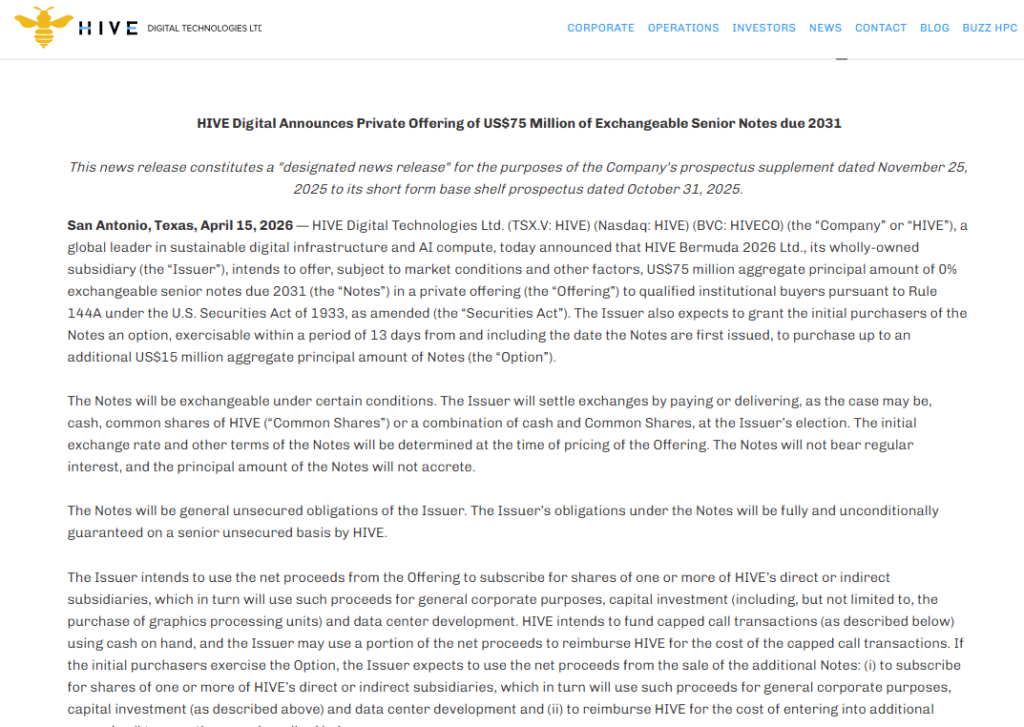
    HIVE Digital Technologies has announced a private offering of $75 million in 0% exchangeable senior notes due 2031, issued through its wholly owned subsidiary HIVE Bermuda 2026 Ltd.. The proceeds are intended for general corporate purposes, with a strong focus on AI infrastructure development, GPU procurement, and data center expansion.

    HIVE Digital Technologies

    The company also granted initial purchasers a 13-day option to purchase an additional $15 million in notes, potentially increasing total fundraising. The notes will not pay regular interest and may be exchanged into cash, HIVE common shares, or a combination, based on final pricing and exchange terms set at issuance.

    Capped Call Strategy and Capital Structure Protection

    HIVE said it plans to use cash on hand to fund capped call transactions, which are designed to reduce potential dilution from future note exchanges or offset cash obligations above principal amounts, subject to a defined cap.

    The company also received conditional approval from the Toronto Stock Exchange (TSX) to move its listing from the TSX Venture Exchange, with a target transition date of around April 30, 2026, pending compliance requirements including minimum public shareholder distribution.

    AI Pivot and Financial Performance

    HIVE continues shifting from Bitcoin mining toward high-performance computing and AI workloads, including GPU clusters in Paraguay and upgrades in Sweden for Tier-III data centers. The firm reported $93.1 million revenue in Q3 FY2025, up 219% year-over-year, alongside a $91.3 million net loss driven by expansion costs and non-cash revaluation charges.

    Disclaimer

    This content is for informational purposes only and does not constitute financial, investment, or legal advice. Cryptocurrency trading involves risk and may result in financial loss.

  • Drift’s $148M Recovery Plan Backed by Tether Signals Major Shift Away From USDC

    Drift’s $148M Recovery Plan Backed by Tether Signals Major Shift Away From USDC

    Drift Protocol has secured a funding package of up to $147.5 million from Tether and partner investors to recover user losses following a major security breach. The deal includes up to $127.5 million from Tether and an additional $20 million from ecosystem partners, aimed at restoring funds and relaunching the platform.

    The protocol was hit by a North Korea-linked exploit on April 1, resulting in losses exceeding $270 million in user assets. Under the recovery plan, Drift will transition its settlement layer from USD Coin (USDC) issued by Circle to Tether (USDT), rebuilding its system as a USDT-based perpetual futures exchange on Solana.

    Revenue-Linked Recovery Plan Targets User Compensation

    The funding structure includes a combination of loans, ecosystem grants, and market maker incentives. A portion of future trading revenue will be directed into a recovery pool designed to repay approximately $295 million in affected user funds over time.

    Drift, one of the largest decentralized perpetual exchanges on Solana, previously supported more than 175,000 users and processed roughly $150 billion in cumulative trading volume.

    Stablecoin Competition Intensifies After Exploit Fallout

    The incident has intensified competition between USDT and USDC, with Tether positioning itself as a more flexible settlement layer due to its ability to freeze funds linked to illicit activity. The shift highlights growing tension in the stablecoin sector as platforms increasingly choose infrastructure based on liquidity control, security response speed, and regulatory alignment.

    Disclaimer

    This content is for informational purposes only and does not constitute financial, investment, or legal advice. Cryptocurrency trading involves risk and may result in financial loss.
  • France Plans New Crypto Security Measures After Surge in Kidnappings

    France Plans New Crypto Security Measures After Surge in Kidnappings

    Government Responds to Rising “Wrench Attack” Threats

    France is preparing new security measures to protect crypto investors following a sharp rise in crypto related kidnappings and physical coercion attacks. Jean Didier Berger said at Paris Blockchain Week that authorities are working on additional protections in coordination with Interior Minister Laurent Nuñez.

    Berger stated that the government has already introduced preventative steps, including a dedicated online prevention platform that has attracted thousands of users. A broader security plan is expected in the coming weeks as incidents continue to increase.

    Crypto Kidnappings Raise National Security Concerns

    France has recently seen multiple crypto linked abductions, including a case where a mother and her child were kidnapped in Burgundy by suspects demanding a €400,000 ransom from a crypto entrepreneur. The victims were later rescued, and suspects were arrested.

    Authorities are increasingly concerned about so-called “wrench attacks,” where criminals use physical threats to force victims to transfer digital assets. Reports suggest France has become one of the most affected countries in Europe for such incidents.

    Sharp Rise in Global Crypto-Related Violence

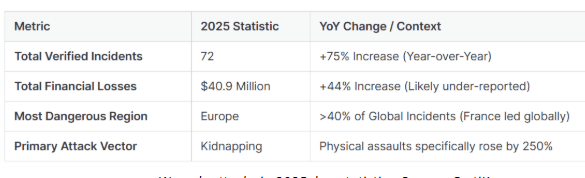
    Wrench attacks in 2025, key statistics

    Security data indicates that crypto linked kidnappings have surged significantly in recent years, with France accounting for a notable share of global cases. Cybersecurity analysts report a steady increase in physical attacks targeting digital asset holders, highlighting growing risks as crypto adoption expands.

    Disclaimer

    This content is for informational purposes only and does not constitute financial, investment, or legal advice. Cryptocurrency trading involves risk and may result in financial loss.
  • China Could Launch Yuan Stablecoin Within 3 to 5 Years, Circle CEO Says

    China Could Launch Yuan Stablecoin Within 3 to 5 Years, Circle CEO Says

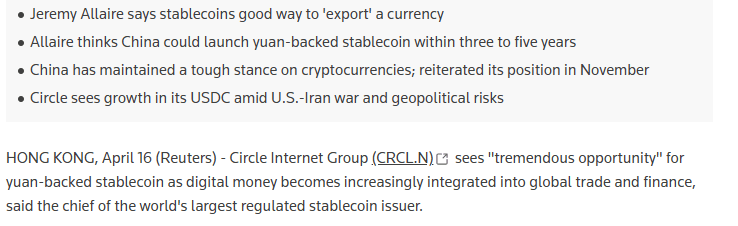
    Jeremy Allaire, chief executive of Circle Internet Financial, said In a Thursday interview with Reuters that China could introduce a yuan backed stablecoin within the next three to five years, signaling a potential shift in global digital currency competition. Speaking about the future of digital finance, he described the opportunity for a yuan-linked stablecoin as significant, particularly as digital assets increasingly support cross-border trade and settlement.

    Reuters

    Chinese authorities have reportedly explored the concept in recent years, marking a notable development for a country that imposed strict restrictions on cryptocurrency trading and mining in 2021. Analysts suggest that stablecoins are now being viewed less as speculative tools and more as infrastructure capable of supporting international financial flows.

    Capital Controls Remain Key Barrier to Adoption

    Experts note that launching a fully functional yuan stablecoin would require China to make the renminbi freely convertible. Currently, strict capital controls limit how funds move in and out of the country, which could complicate efforts to create a widely accepted digital yuan-backed token.

    While offshore yuan-based models may align with existing policies, a fully convertible onshore version would require broader financial reforms. With the global stablecoin market valued at roughly $315 billion, dominated by tokens such as Tether and USD Coin, China’s decision could influence the future balance of digital currency power.

    Disclaimer

    This content is for informational purposes only and does not constitute financial, investment, or legal advice. Cryptocurrency trading involves risk and may result in financial loss.

  • South Korea to Pilot Tokenized Deposits for Government Spending Efficiency

    South Korea to Pilot Tokenized Deposits for Government Spending Efficiency

    South Korea is preparing to test tokenized deposit technology for selected government expenses under a regulatory sandbox led by the Ministry of Economy and Finance. The pilot is expected to begin in Sejong City, with broader rollout plans targeted for the fourth quarter of 2026.

    Tokenized deposits represent digital versions of traditional bank deposits issued on distributed ledger infrastructure. Unlike many stablecoins, these deposits remain liabilities of banks, allowing them to operate within the regulated financial system while benefiting from blockchain transparency.

    Programmable Spending Controls to Improve Oversight

    The pilot will test preset spending rules, including limits on transaction timing and approved expense categories. Officials aim to evaluate whether programmable payment tools can improve oversight of public funds and reduce misuse compared with traditional government-issued credit and debit cards.

    Authorities will collaborate with financial institutions to define the operational scope and identify any legal or regulatory adjustments needed following the trial period.

    Part of a Broader Digital Treasury Strategy

    The initiative builds on earlier experiments involving tokenized payments for electric vehicle subsidies and reflects long-term plans to digitize public finance operations. Officials have previously indicated a goal of shifting a significant share of treasury transactions to digital formats by 2030, positioning the country among early adopters of blockchain-enabled government payment systems.

    Disclaimer

    This content is for informational purposes only and does not constitute financial, investment, or legal advice. Cryptocurrency trading involves risk and may result in financial loss.