Author: tristan

  • Ethereum NFT Platform Foundation Shuts Down After Failed Blackdove Acquisition

    Ethereum NFT Platform Foundation Shuts Down After Failed Blackdove Acquisition

    One of the prominent marketplaces from the 2021 NFT boom, Foundation, has announced it will shut down operations after a planned acquisition by digital art distribution firm Blackdove collapsed.

    Founder and CEO Kayvon Tehranian confirmed the closure in a statement posted on X, explaining that the intended sale was meant to keep the platform running under new ownership. He said that outcome was no longer possible and that the company lacked the resources to relaunch the marketplace independently. Foundation later noted the site would temporarily return to allow users to delist NFTs before permanent closure.

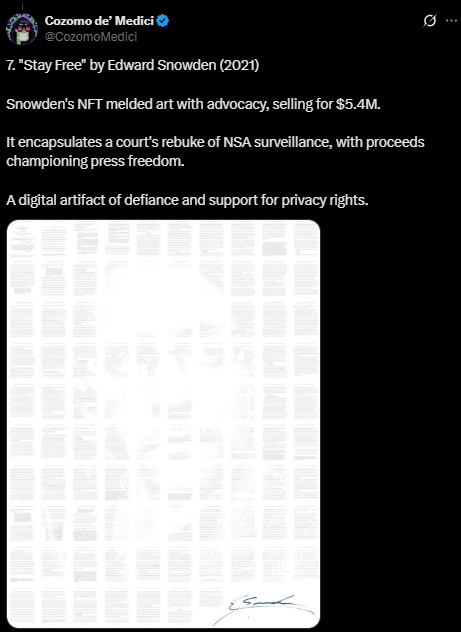
    Launched in early 2021 during the peak of NFT adoption, Foundation facilitated more than $230 million in primary NFT sales. The platform hosted digital works from artists including Jen Stark, James Jean and Reuben Wu. It also featured work by whistleblower Edward Snowden, whose NFT titled “Stay Free” sold for about 2,200 Ether, valued near $5 million in 2021.
    The shutdown highlights the ongoing contraction across NFT markets as liquidity declines and fewer independent platforms remain viable. Several platforms have recently exited the space, including Nifty Gateway and Rodeo, while MakersPlace closed last year and X2Y2 pivoted away from NFT trading.

    Despite the downturn, OpenSea remains dominant, accounting for more than 73% of sector activity, with competition from rivals such as Blur. Some industry leaders, including Yat Siu of Animoca Brands, believe the NFT sector could eventually recover and reach new highs.
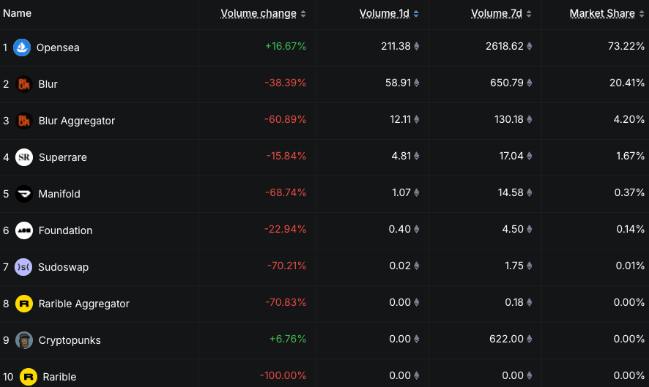
    Top 10 NFT marketplaces by volume.: DefiLlama
    Disclaimer

    This content is for informational purposes only and does not constitute financial, investment, or legal advice. Cryptocurrency trading involves risk and may result in financial loss.


  • Bitcoin Breaks Above $77,000 as Oil Plunges on Strait of Hormuz Reopening

    Bitcoin Breaks Above $77,000 as Oil Plunges on Strait of Hormuz Reopening

    Bitcoin surged back above the $77,000 level, as improved geopolitical conditions triggered a sharp shift in global markets. The move followed comments from Seyed Abbas Araghchi stating that the Strait of Hormuz would remain fully open for commercial shipping during the ceasefire period. The announcement was positively received by Donald Trump, who publicly welcomed the development.

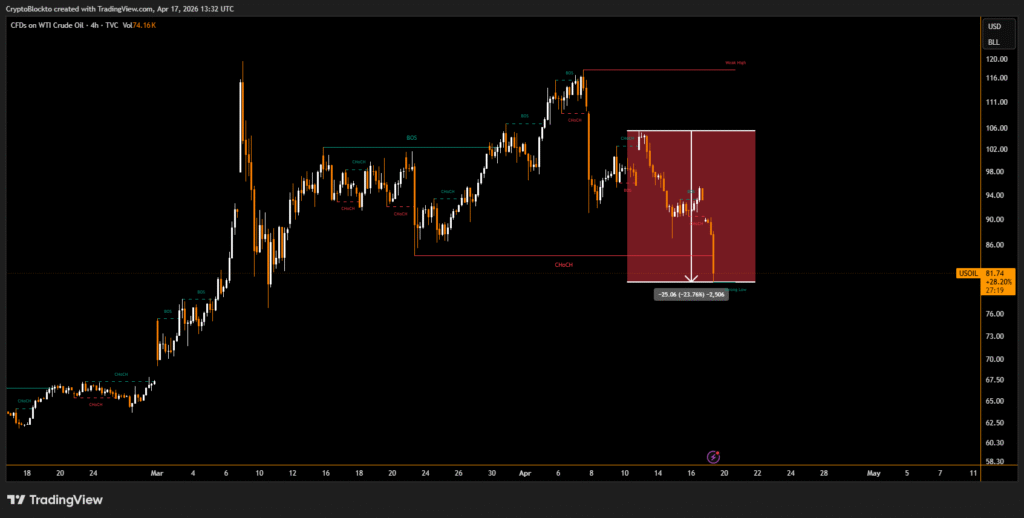
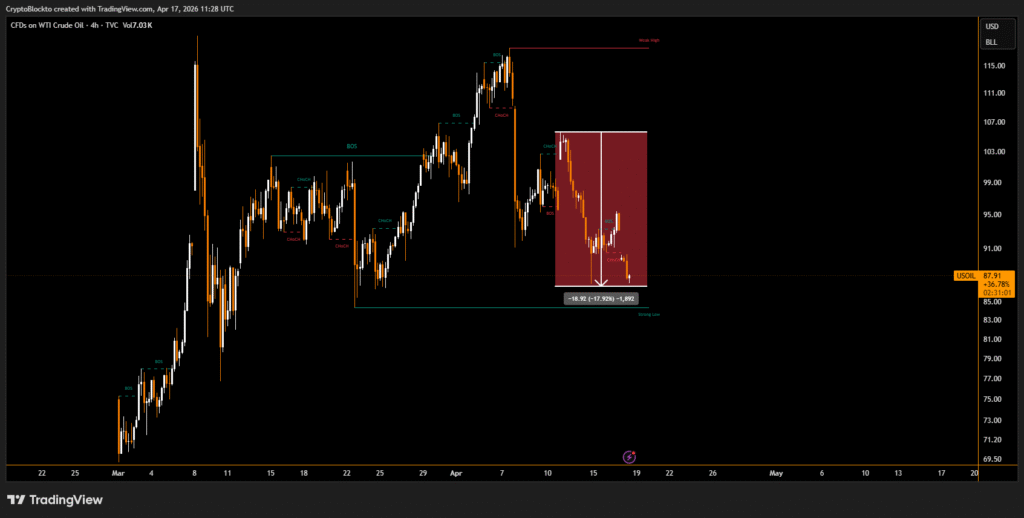
    The easing of tensions led to a steep decline in oil prices, with crude falling nearly 13% to around $81.90 per barrel, marking its lowest level since the early stages of the conflict in March. The drop reflects reduced concerns over supply disruption through one of the world’s most critical energy chokepoints.

    USOIL 4h price chart

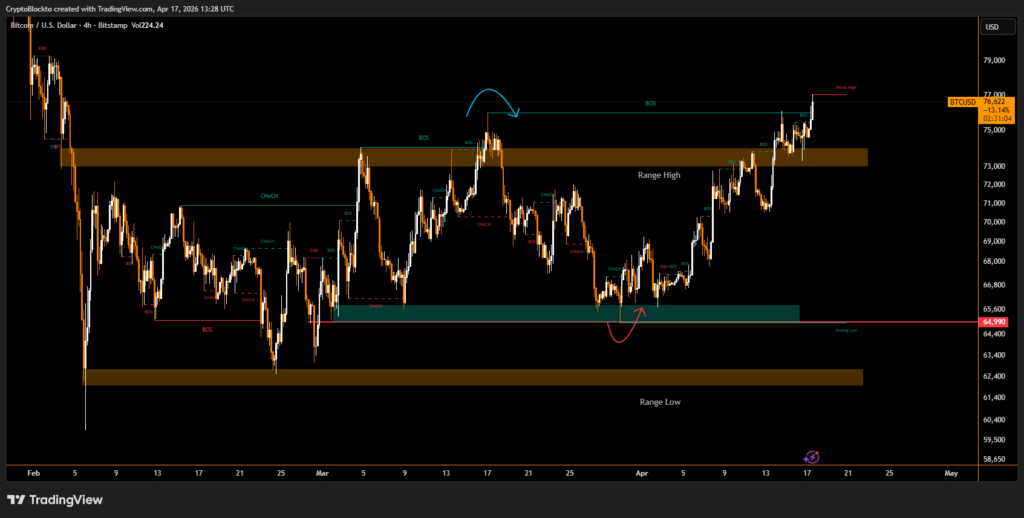
    Bitcoin Faces Key Resistance at $76K–$78K Zone

    Bitcoin rose to approximately $76,400, gaining around 3% over the past 24 hours as risk sentiment improved across financial markets. U.S. equity futures also climbed roughly 1%, reflecting a broader risk-on environment.

    The $76,000–$78,000 range remains a significant technical resistance zone, as it previously preceded a sharp decline earlier in the year. Market participants note that repeated rejections at this level suggest strong selling pressure, although a decisive breakout above $77,000 could open the path toward higher price targets.

    $BTC 4h price chart

    Market Outlook Hinges on Sustained Energy Stability

    Traders are closely watching whether the reopening of the Strait of Hormuz leads to lasting stability in oil flows. Continued weakness in crude prices is reinforcing expectations of easing inflationary pressure, which has historically supported Bitcoin and other risk assets during macro-driven rallies.

    Disclaimer

    This content is for informational purposes only and does not constitute financial, investment, or legal advice. Cryptocurrency trading involves risk and may result in financial loss.
  • U.S.–Iran $20 Billion Uranium Deal Talks Advance as Oil Prices Weaken

    U.S.–Iran $20 Billion Uranium Deal Talks Advance as Oil Prices Weaken

    Nuclear Material Swap at Center of Draft Agreement

    The United States and Iran are negotiating a three page framework aimed at ending the conflict, with a proposal under discussion to release $20 billion in frozen Iranian funds in exchange for Iran surrendering its enriched uranium stockpile. Officials said the talks have made steady progress this week, though major gaps remain unresolved.

    President Donald Trump said negotiators are expected to meet again this weekend, with discussions likely taking place in Islamabad. The mediation effort is being led by Pakistan with support from Egypt and Turkey. A broader diplomatic meeting involving Saudi Arabia is also expected on the sidelines of regional talks in Turkey.

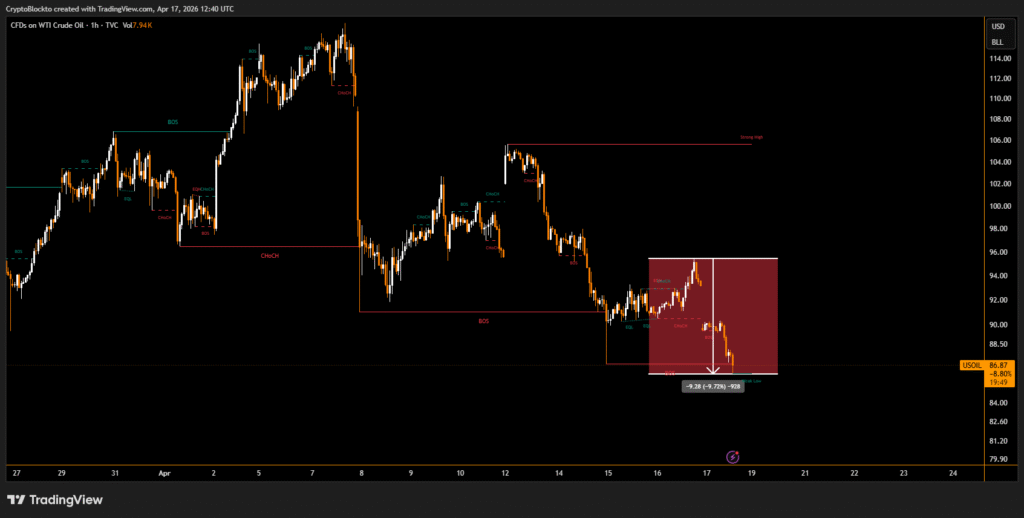
    Oil markets showed weakness during the talks.Wti Crude drops to $86 per barrel.

    WTI crude oil h1 price chart

    Funding Demands and Diplomatic Positions

    Earlier discussions included a $6 billion humanitarian release, while Iranian negotiators reportedly demanded $27 billion. U.S. officials said Iran has shown some movement but not enough for a final deal.

    Iran is also seeking the ability to sell oil at global market rates without sanctions and re-enter the international financial system, while U.S. officials insist the agreement must include full nuclear rollback measures. White House spokesperson Anna Kelly called the talks productive but declined to confirm details, citing sensitivity.

    Political Pressure and Ceasefire Outlook

    Senator Lindsey Graham said President Trump has communicated directly with Iranian officials during negotiations. Trump stated Iran agreed in principle to give up enriched uranium and pledged not to pursue nuclear weapons. He also warned that if no deal is reached, conflict could resume but said the ceasefire could be extended beyond April 21 if needed.

    Disclaimer

    This content is for informational purposes only and does not constitute financial, investment, or legal advice. Cryptocurrency trading involves risk and may result in financial loss.
  • Citadel Securities Signals Possible Entry Into Prediction Markets

    Citadel Securities Signals Possible Entry Into Prediction Markets

    Firm Explores Non-Sports Prediction Market Opportunities

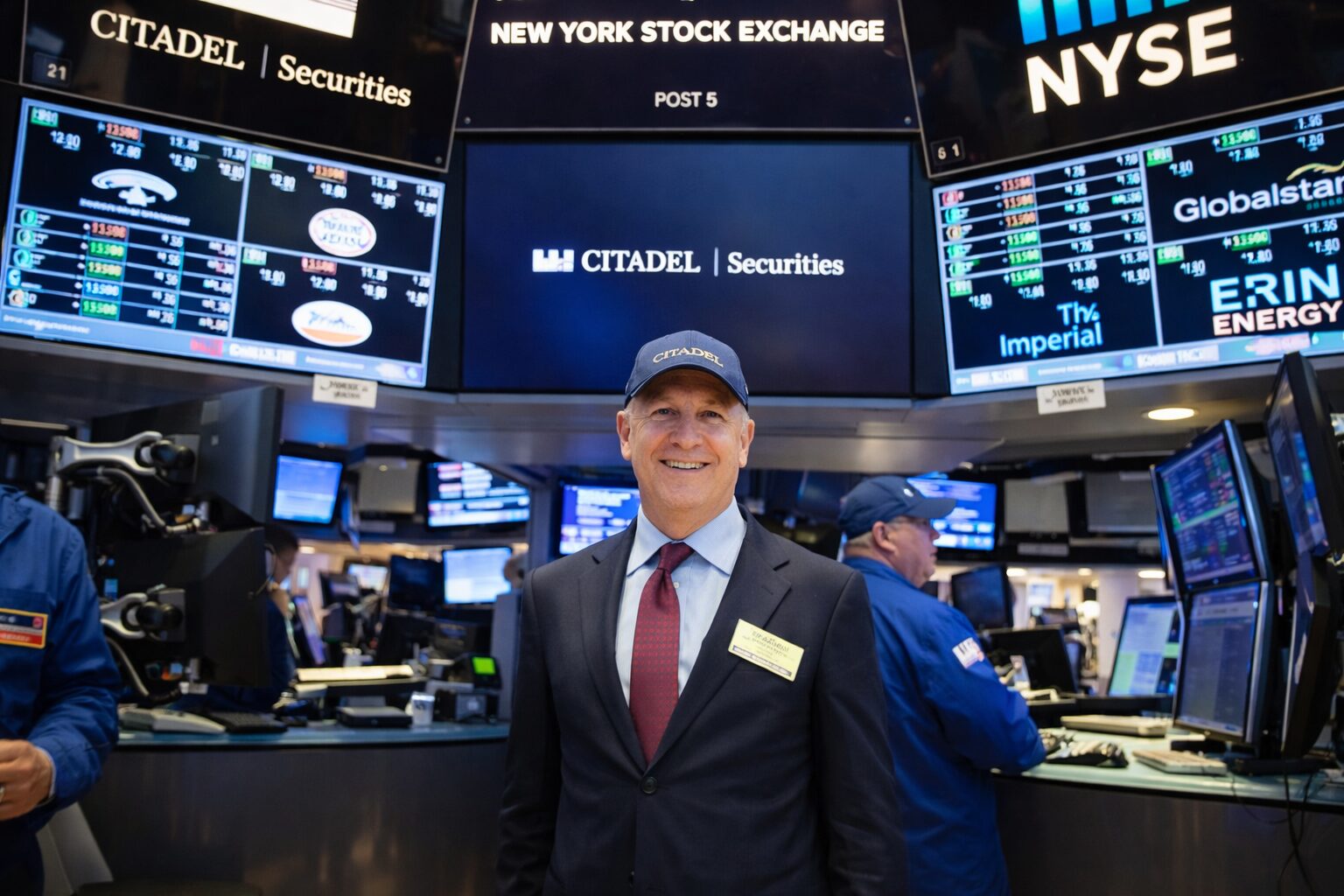
    Citadel Securities is considering entering the rapidly expanding prediction markets sector, according to its president Jim Esposito. Speaking at the Semafor World Economy Summit, Esposito said it is “certainly possible” the firm could provide liquidity to event-based markets as institutional demand grows.

    Esposito emphasized that the firm is not targeting sports contracts, which currently dominate the sector, but instead sees stronger long-term value in prediction markets tied to geopolitical and macroeconomic risks. He noted that institutional investors could use such contracts to hedge exposure to major events, including elections and global political developments.

    Prediction Market Growth Attracts Institutional Interest

    Prediction markets generated about $51 billion in trading volume during 2025, according to analysts at Bernstein, representing a tripling in activity year over year. Platforms such as Kalshi and Polymarket have already recorded a combined $60 billion in volume so far in 2026.

    Analysts project the sector could reach $240 billion in annual volume in 2026, with an estimated 80% compound annual growth rate over the next five years. Longer-term forecasts suggest prediction markets could approach $1 trillion in yearly trading volume by 2030, supported by regulatory clarity and broader distribution partnerships.

    Regulatory Debate Continues as Market Expands

    Oversight of prediction markets remains a key issue. The Commodity Futures Trading Commission has asserted exclusive jurisdiction over the sector and is working to establish formal rules as adoption increases.

    At a recent congressional hearing, Michael Selig faced questions from lawmakers regarding the agency’s capacity to supervise the growing industry. Meanwhile, sports-related contracts still account for approximately 62% of total prediction market activity, driven by fragmented sports betting regulations across U.S. states.

    Citadel Securities already processes retail trades through brokerages such as Charles Schwab and Robinhood, the latter of which integrates prediction markets through Kalshi. Esposito added that the firm continues to monitor developments closely, while CEO Peng Zhao previously participated in a $185 million funding round supporting Kalshi’s expansion.

    Disclaimer

    This content is for informational purposes only and does not constitute financial, investment, or legal advice. Cryptocurrency trading involves risk and may result in financial loss.

  • Bitcoin Rally Stalls as Ceasefire Momentum Fades and Markets Await Oil Flow Recovery

    Bitcoin Rally Stalls as Ceasefire Momentum Fades and Markets Await Oil Flow Recovery

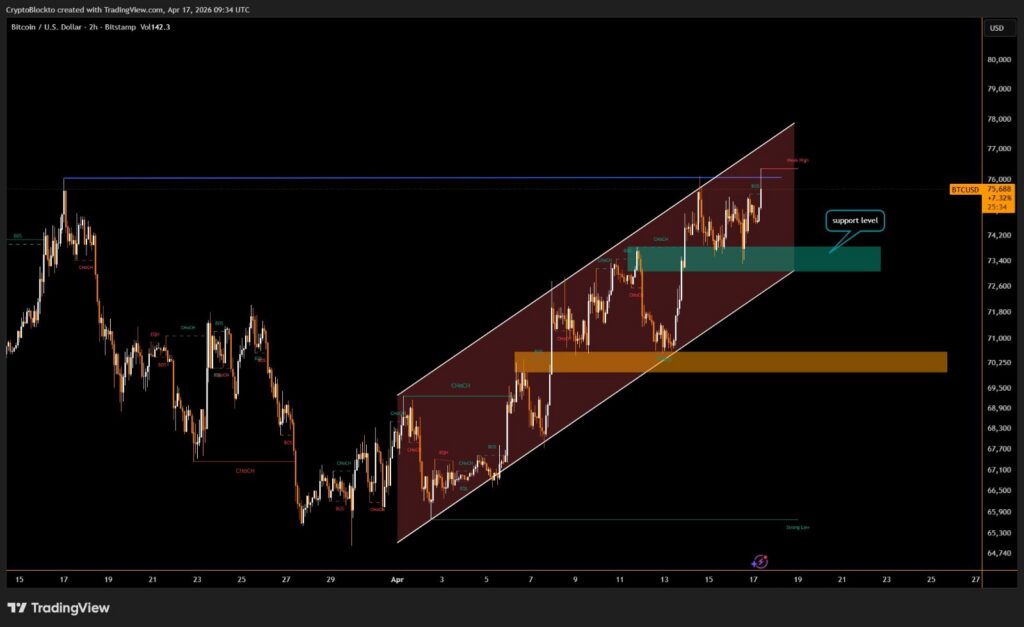
    Bitcoin’s recent rally has begun to lose momentum as the early optimism tied to the U.S.–Iran ceasefire shows signs of fading. After climbing roughly 10% over the past week, Bitcoin briefly moved above $76,000 before retreating, repeating earlier choppy trading patterns and signaling hesitation among investors.

    $BTC 2h price chart

    Market participants now appear to be waiting for concrete developments rather than relying on ceasefire headlines alone. Bitcoin’s chart structure suggests a bullish trend, but momentum is being capped by a double-top resistance forming near the $76,000 level.

    Oil Supply Restoration Seen as Key Market Trigger

    Investors are closely watching progress on restoring oil shipments through the Strait of Hormuz, a vital energy corridor that previously handled about 20% of global oil flows before the conflict began. Analysts argue that normalization in energy markets, including reduced crude risk premiums and clearer disinflation signals, is necessary before markets fully regain confidence.

    Recent oil prices reflect cautious sentiment, with WTI trading near $87.50 and Brent crude holding around $90 since early April. Stability in energy markets is widely seen as an early indicator of broader economic recovery.

    WTI crude Oil 4h price chart

    Altcoins and Volatility Trends Signal Mixed Market Outlook

    While Bitcoin volatility has eased alongside declining Treasury market stress, certain altcoins could experience sharper price swings. Leveraged positions tied to Solana and Dogecoin futures have increased to multiweek highs, a development that historically amplifies volatility during market shifts.

    Disclaimer

    This content is for informational purposes only and does not constitute financial, investment, or legal advice. Cryptocurrency trading involves risk and may result in financial loss.
  • Crypto Market Enters Sustained Winter as Exchange Volumes Drop 39% in Q1

    Crypto Market Enters Sustained Winter as Exchange Volumes Drop 39% in Q1

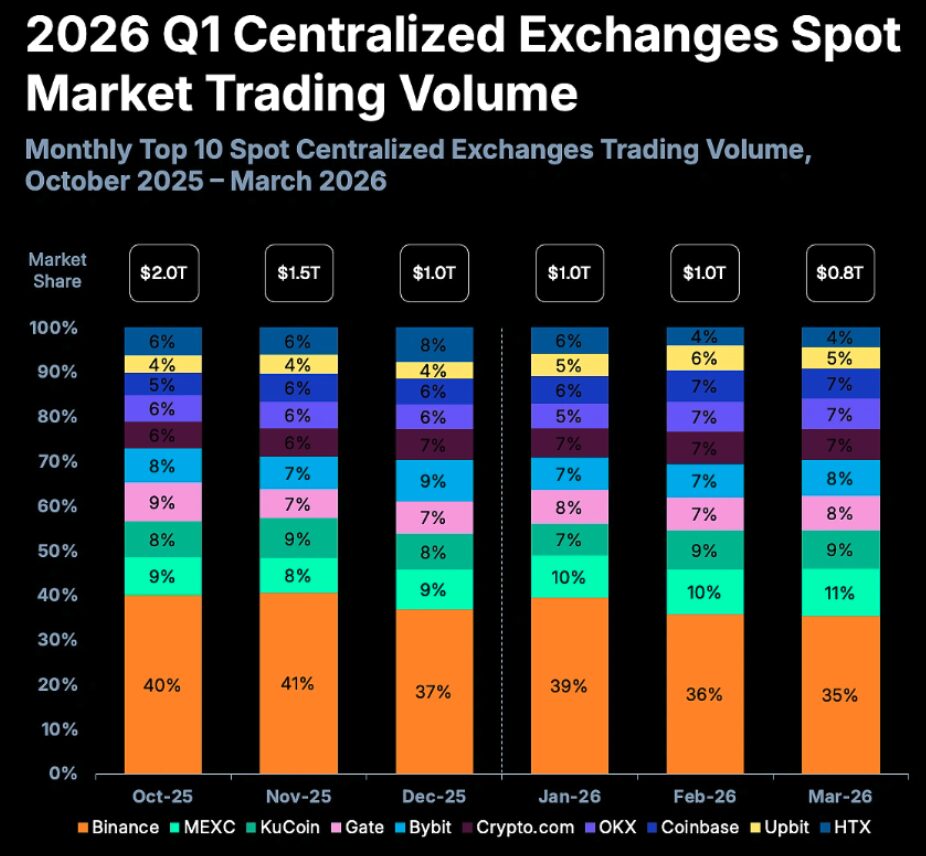
    The cryptocurrency market has entered what analysts describe as a sustained crypto winter, according to a new report from CoinGecko, as spot trading volumes across centralized exchanges declined sharply in the first quarter of 2026.

    Total crypto market capitalization dropped by more than 20% during the quarter, as bearish momentum from late 2025 combined with ongoing geopolitical instability. The top 10 centralized exchanges recorded a 39% decline in trading volume, falling to $2.7 trillion in Q1 from $4.5 trillion in the fourth quarter of 2025.

    Monthly trading volumes remained relatively steady at around $1 trillion in both January and February before falling sharply in March. The month recorded approximately $800 billion in total volume, making it the weakest month since November 2023.

    Trading volumes among the top 10 exchanges remained steady at $1 trillion a month in Jan and Feb before falling in March

    Bitcoin Weakness and Policy Uncertainty Add Pressure

    The downturn follows a period of market cooling after Bitcoin reached an all-time high above $126,000 about six months earlier. Since then, the market has faced pressure from fears of a global economic slowdown and uncertainty following U.S.–Israeli strikes on Iran in February.

    Average daily trading volume across the crypto market fell to $117.8 billion, representing a 27% decline compared to the previous quarter.

    Exchange and Asset Performance Show Broad Declines

    All of the top 10 centralized exchanges recorded falling volumes, with HTX experiencing the largest decline. The exchange saw trading activity fall 55% quarter-on-quarter to approximately $133.6 billion.

    During the same period, bitcoin prices declined by 22%, underperforming traditional markets such as the NASDAQ Composite and the S&P 500, which fell 7.1% and 4.8% respectively, marking their weakest quarterly performances since 2022.

    Disclaimer

    This content is for informational purposes only and does not constitute financial, investment, or legal advice. Cryptocurrency trading involves risk and may result in financial loss.
  • At Least 12 Crypto Entities Hit in Wave of Attacks After Drift Protocol Exploit

    At Least 12 Crypto Entities Hit in Wave of Attacks After Drift Protocol Exploit

    At least 12 DeFi protocols and crypto businesses have been attacked in just over two weeks following the Drift Protocol exploit on April 1, which saw losses of about $280 million in a long-running social engineering attack suspected to involve North Korean affiliated actors.

    The affected platforms include CoW Swap, Hyperbridge, Bybit, Dango, Silo Finance, BSC TMM, Aethir, MONA, Zerion, Rhea Finance, and Grinex exchange, showing a broad impact across both DeFi protocols and centralized services.

    Major Losses: Rhea Finance and Grinex Exchange

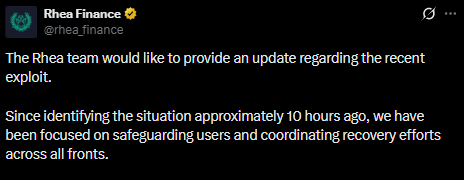
    DeFi protocol Rhea Finance lost around $7.6 million after an attacker exploited its Margin Trading feature, launching a coordinated pool manipulation attack that targeted the Rhea Lend smart contract. Blockchain security firm CertiK reported that the attacker created fake token contracts and added liquidity into new pools, likely tricking oracle and validation systems.

    Meanwhile, the Russia-linked Grinex exchange suspended operations after a $13.7 million hack, blaming “unfriendly states” for the breach. The exchange has been previously linked to Russia’s crypto ecosystem and sanctions-evasion concerns.

    Other April Attacks Across DeFi Ecosystem

    Additional incidents include a $1.67 million reserve manipulation attack on the Binance Smart Chain TMM/USDT liquidity pool, a $410,000 exploit at bridge aggregator Dango, a $392,000 oracle misconfiguration exploit at Silo Finance, and a $423,000 access control attack affecting Aethir.

    Expanding Threats and AI-Driven Social Engineering

    Analysts warn that attackers are increasingly using advanced AI tools for social engineering and credential theft, improving their ability to impersonate developers and infiltrate projects.

    Overall, malicious actors stole over $168.6 million from 34 DeFi protocols in Q1 2026, highlighting escalating coordinated threats across the crypto sector.

    Disclaimer

    This content is for informational purposes only and does not constitute financial, investment, or legal advice. Cryptocurrency trading involves risk and may result in financial loss.

  • Texas Man Sentenced to 23 Years for $20 Million Meta-1 Coin Cryptocurrency Fraud

    Texas Man Sentenced to 23 Years for $20 Million Meta-1 Coin Cryptocurrency Fraud

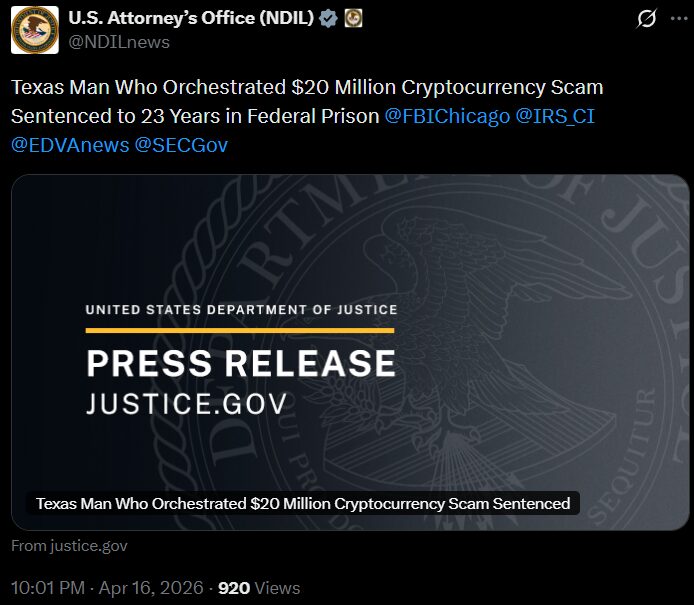
    A Texas resident, Robert Dunlap, has been sentenced to 23 years in federal prison for his role in a cryptocurrency fraud scheme that defrauded nearly 1,000 investors of approximately $20 million. The sentencing was handed down by U.S. District Judge LaShonda Hunt on Tuesday, with Dunlap also ordered to pay restitution to victims.

    Federal prosecutors, including Assistant U.S. Attorneys Jared Hasten and Paige Nutini, described Dunlap as unrepentant in their sentencing memorandum, stating that his misrepresentations continued over several years.

    False Claims of Gold and Artwork Backing Misled Investors

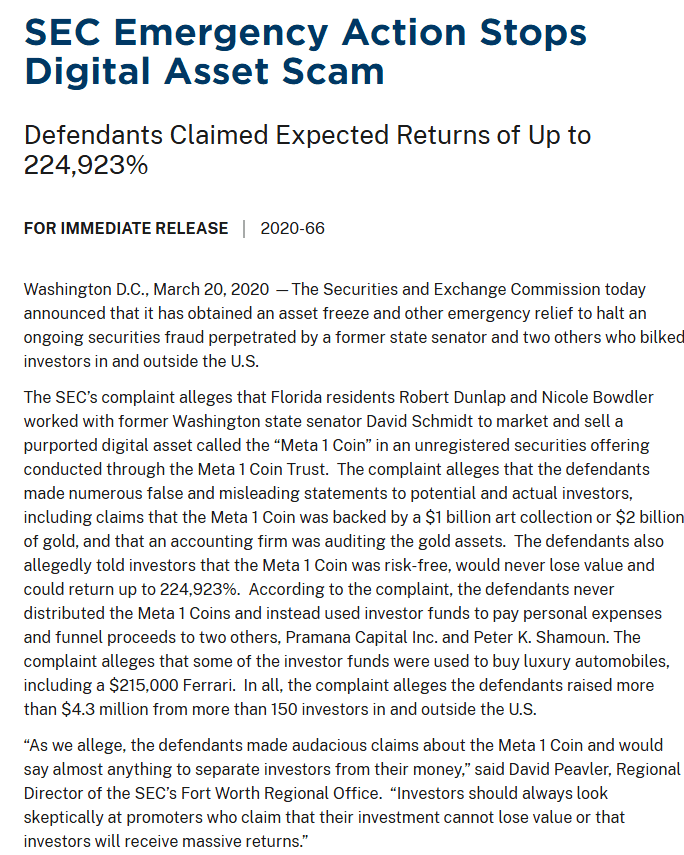
    A federal jury in the Northern District of Illinois convicted Dunlap in November on two counts of mail fraud, each carrying a potential sentence of up to 20 years. Authorities said he conspired to market and sell the Meta-1 Coin through a trust structure between 2018 and 2023, making false claims that the token was backed by $44 billion in gold and a $1 billion art collection featuring works attributed to artists such as Pablo Picasso and Vincent van Gogh.

    Investigators found these claims to be fictional, with no legitimate assets supporting the token. Dunlap and associates also allegedly used automated trading bots to artificially inflate trading volume and prices on a platform called the Meta Exchange, which Dunlap created.

    SEC Intervention and Misuse of Investor Funds

    In March 2020, the U.S. Securities and Exchange Commission obtained emergency relief orders and an asset freeze against Dunlap and alleged accomplices Nicole Bowdler and former Washington state Senator David Schmidt.

    Regulators said investors were promised risk-free returns of up to 224,923%, but tokens were never delivered. Instead, funds were diverted for personal expenses and luxury purchases, including high-end vehicles such as a Ferrari, highlighting ongoing enforcement efforts against large-scale crypto fraud schemes.

    Disclaimer

    This content is for informational purposes only and does not constitute financial, investment, or legal advice. Cryptocurrency trading involves risk and may result in financial loss.
  • XRP Leads Weekly Crypto Gains but Low Volume Signals Consolidation Risk

    XRP Leads Weekly Crypto Gains but Low Volume Signals Consolidation Risk

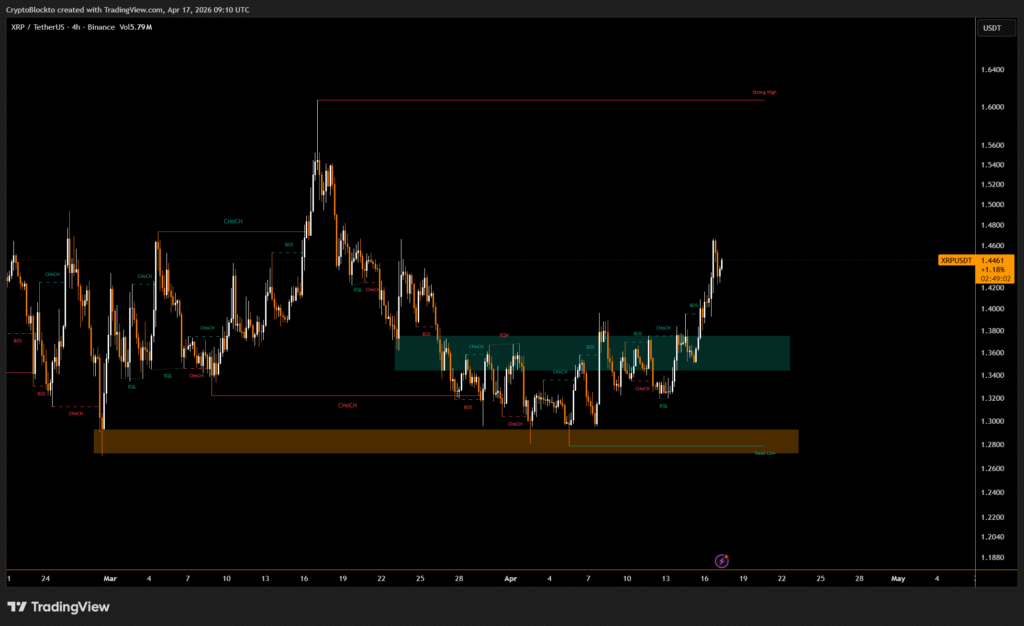
    XRP has emerged as the top weekly performer among major cryptocurrencies, gaining about 5.4% over the past seven days and outperforming both Bitcoin and Ethereum. The token’s gradual climb reflects selective capital rotation into higher-beta assets rather than a broad-based market rally.

    $XRP 4h price chart

    Price action shows XRP rising steadily toward $1.43–$1.44, maintaining a controlled upward structure throughout the week. The move developed without sharp spikes, suggesting accumulation by traders rather than speculative momentum. However, the token has struggled to break through the $1.44 resistance level, which continues to cap upside attempts.

    Muted Trading Volume Raises Risk of Short-Term Pullback

    Despite relative strength, trading volume remains subdued at roughly 70% of the weekly average, limiting confidence in a sustained breakout. Analysts view this low-volume environment as a sign of consolidation rather than a decisive bullish shift.

    Technically, XRP continues to form higher lows, indicating underlying buying interest. However, without stronger participation, upward momentum may fade if broader market sentiment weakens.

    Key levels remain critical for short-term direction. A decisive break above $1.44 could confirm continuation of the upward trend, while holding support near $1.40 is essential to maintain the current structure. Continued weak volume increases the likelihood of consolidation or a modest pullback in the near term.

    Disclaimer

    This content is for informational purposes only and does not constitute financial, investment, or legal advice. Cryptocurrency trading involves risk and may result in financial loss.
  • U.S. Government Moves $606,000 in Bitcoin Linked to 2016 Bitfinex Hack

    U.S. Government Moves $606,000 in Bitcoin Linked to 2016 Bitfinex Hack

    Coinbase Transfer Sparks Attention but Not Immediate Selling Signal

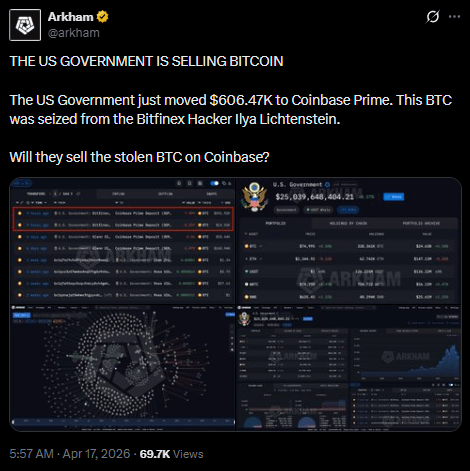
    The U.S. government has moved approximately $606,000 worth of bitcoin to Coinbase Prime, involving around 8 BTC tied to the 2016 Bitfinex hack. On-chain data from Arkham Intelligence links the transfer to wallets associated with hacker Ilya Lichtenstein, who orchestrated the original breach.

    While transfers to exchanges are often interpreted as potential selling pressure, analysts note this movement does not necessarily indicate liquidation. It may also reflect custody restructuring or administrative handling of seized assets.

    Court Rules Bitcoin Must Be Returned to Bitfinex

    Federal proceedings have established that the seized bitcoin must be returned in kind to Bitfinex, rather than being sold and sent to the U.S. Treasury. This means the government is required to transfer the actual bitcoin back to the exchange instead of converting it into fiat currency.

    Bitfinex plans to use the returned assets to fully redeem outstanding Recovery Right Tokens, which were issued to users affected by the 2016 hack. After redemptions, at least 80% of remaining net proceeds will be used to buy back and burn the exchange’s native token, UNUS SED LEO.

    Inside the 2016 Bitfinex Hack and Long Legal Aftermath

    The original exploit occurred in August 2016, when Lichtenstein executed more than 2,000 unauthorized transactions, draining 119,756 BTC, worth about $72 million at the time and roughly $8.9 billion today.

    Authorities later tracked complex laundering activity involving mixers, darknet services, and cross-chain transfers, along with gold purchases. In 2022, U.S. investigators seized a portion of the stolen bitcoin valued at $3.6 billion, marking one of the largest crypto seizures in history.

    Lichtenstein was sentenced to 60 months in federal prison in 2024 and released in January 2026 under the First Step Act. He later publicly thanked President Donald Trump on social media following his release.

    Government Holdings and Strategic Reserve Plans

    The seized bitcoin remains under U.S. custody and is part of broader government-held crypto assets. The U.S. has previously indicated that confiscated bitcoin may contribute to a national strategic bitcoin reserve, highlighting its evolving stance on digital asset holdings.

    Current estimates place U.S. government crypto holdings at approximately $24.54 billion in bitcoin, along with smaller positions in ether and other digital assets.

    Disclaimer

    This content is for informational purposes only and does not constitute financial, investment, or legal advice. Cryptocurrency trading involves risk and may result in financial loss.