
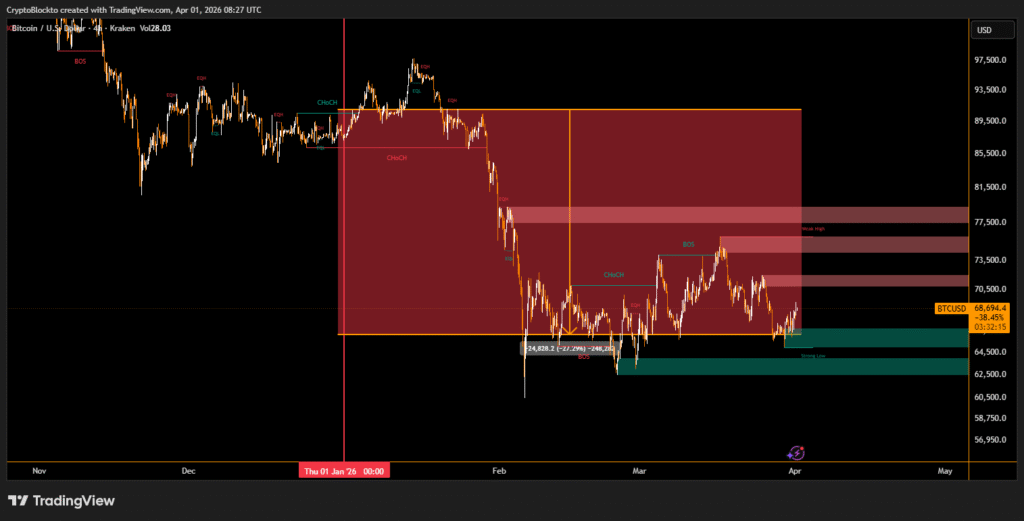
Bitcoin ended the first quarter of 2026 down 23.8%, closing at $66,619, marking its worst Q1 performance since 2018. The decline extends losses from Q4 2025, when bitcoin dropped 23% from $114,057 to $87,508, resulting in a six-month decline of about 41.6%.
Factors Driving the Decline
Analysts cited several factors contributing to bitcoin’s first-quarter fall. ETF outflows played a significant role, with spot bitcoin ETFs seeing $496.5 million in net outflows during Q1, including $1.8 billion in the first two months, partially offset by $1.32 billion inflows in March. Macro uncertainty, sticky inflation, and cautious Federal Reserve policy further weighed on the cryptocurrency market.
Geopolitical tensions in the Middle East also pressured investor sentiment, with ongoing U.S.-Iran conflicts creating market uncertainty.
Long-Term Bitcoin Outlook
Despite the recent decline, analysts note that long-term conviction in bitcoin remains strong, with institutional adoption and participation trends largely intact. Recovery in Q2 2026 will likely depend on renewed ETF inflows, clearer crypto regulations, and stabilization of geopolitical conditions.
Disclaimer
This content is for informational purposes only and does not constitute financial, investment, or legal advice. Cryptocurrency trading involves risk and may result in financial loss.
Leave a Reply