Category: News

  • Bank of Korea Pushes Crypto Circuit Breakers After Bithumb $42B Bitcoin Error

    Bank of Korea Pushes Crypto Circuit Breakers After Bithumb $42B Bitcoin Error

    The Bank of Korea has urged lawmakers to introduce crypto “circuit breakers” after a major error at Bithumb, where the exchange mistakenly credited users with 620,000 Bitcoin (BTC) instead of 620,000 Korean won in February. The error was valued at around $42 billion, prompting emergency trading disruptions and raising concerns over exchange risk controls.

    In a Monday payments report, the central bank recommended mechanisms similar to the Korea Exchange, where trading is halted during extreme price swings. It said such systems are needed because the virtual asset industry lacks strong internal control mechanisms and operates with lower regulatory intensity than traditional financial institutions. The report warned that similar incidents could occur across other exchanges without preventive safeguards.
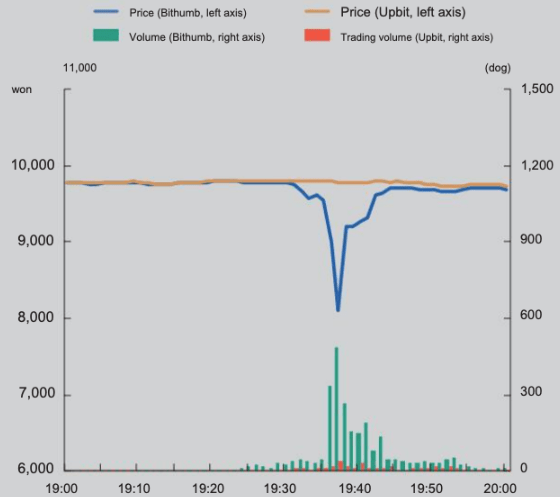
    graph showing the price of Bitcoin on Bithumb compared to Upbit after Bithumb’s erroneous Bitcoin transactions. Source: Bank of Korea

    Bithumb Incident Triggered Panic Selling and Market Disruption

    Following the error, Bitcoin prices on Bithumb fell sharply as users rushed to sell, triggering further panic selling. The exchange quickly suspended trading and reversed most transactions, but 1,788 BTC worth about $125 million had already been sold. Bithumb covered the shortfall using company reserves, while price gaps emerged between Bithumb and other exchanges like Upbit.

    Proposed Systems for Error Detection and Asset Verification

    The Bank of Korea also proposed automated systems to detect erroneous payments caused by human error, along with real-time verification comparing exchange-held assets with on-chain blockchain records to flag discrepancies and improve operational transparency.

    Disclaimer

    This content is for informational purposes only and does not constitute financial, investment, or legal advice. Cryptocurrency trading involves risk and may result in financial loss.
  • TRUMP Token Whales Accumulate Ahead of Mar-a-Lago Luncheon Event

    TRUMP Token Whales Accumulate Ahead of Mar-a-Lago Luncheon Event

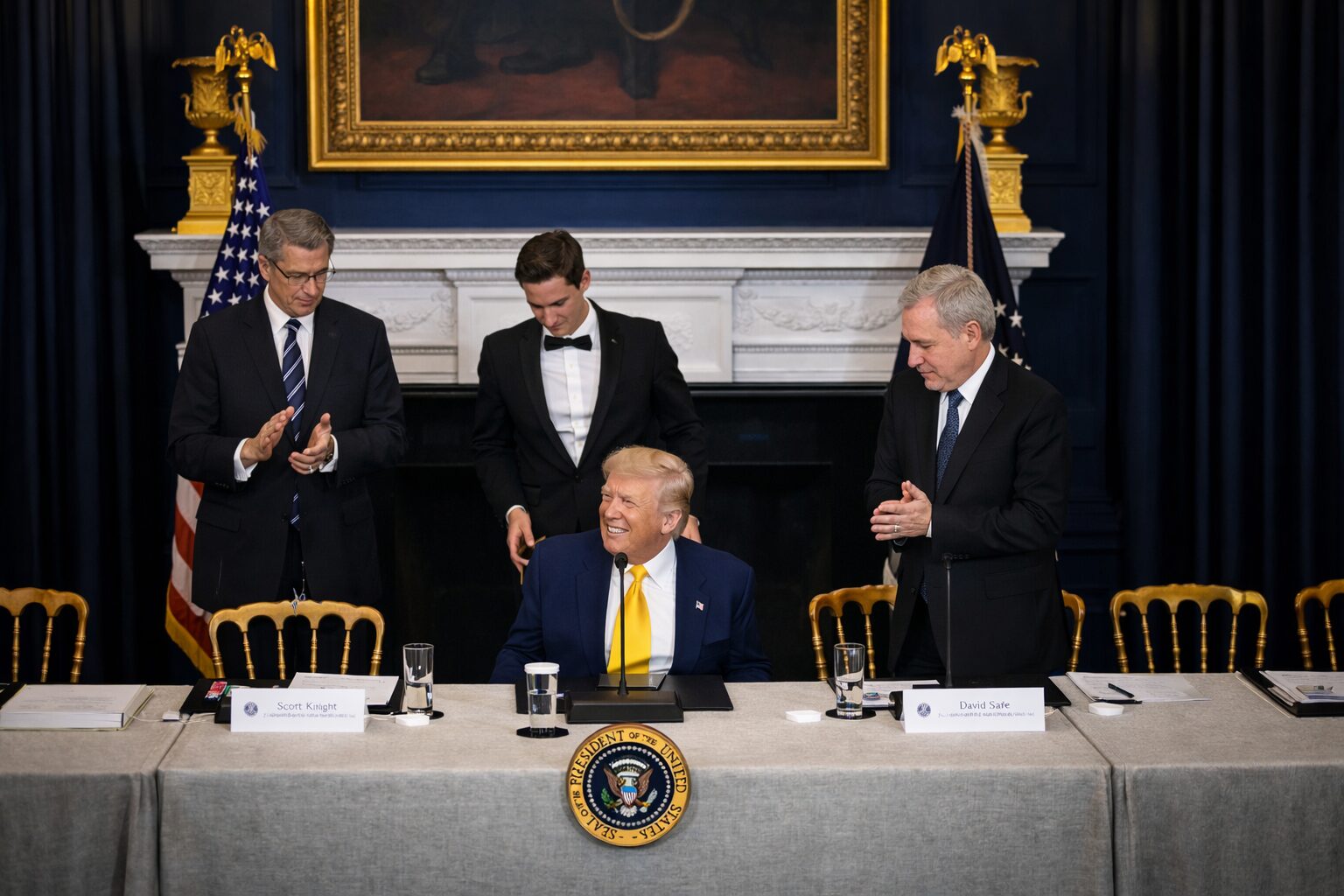
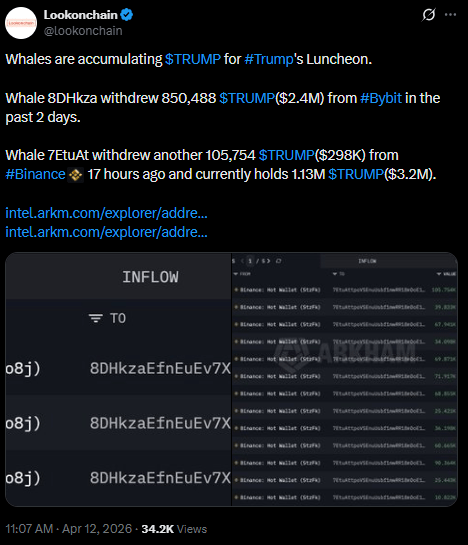
    Large holders of the OFFICIAL TRUMP (TRUMP) memecoin have increased accumulation ahead of an upcoming luncheon at Mar-a-Lago, the Florida residence of US President Donald Trump, where top token holders are expected to gain exclusive access. Lookonchain tracking data shows multiple whale wallets withdrawing large amounts of TRUMP from centralized exchanges including Binance, Bybit, and BitMart.

    One whale reportedly withdrew 105,754 TRUMP tokens from Binance, adding to a total holding of about 1.13 million TRUMP, valued near $3.2 million. Another wallet pulled 850,488 TRUMP from Bybit, while additional holders increased positions to over 368,000 tokens and 1 million tokens, reflecting rising speculative positioning ahead of the event.

    The top 297 TRUMP holders are invited to a luncheon scheduled for April 25 at Mar-a-Lago, with the top 29 holders receiving access to a private reception. The event has drawn political attention, as critics argue it blends financial incentives with political influence.

    TRUMP Token Price Drops Despite Event Hype

    Despite whale accumulation, TRUMP has declined more than 33% since the March announcement, falling from a peak of $4.35 to around $2.80. Market analysts attribute the decline to strong retail selling pressure and low liquidity conditions, which amplify price volatility when large holders move positions.

    Data indicates heavy concentration within the token supply, with over 91% held by the top 10 wallets and more than 97% controlled by the top 100 wallets, leaving the market highly sensitive to large transactions and whale behavior.

    Market Sentiment Remains Event-Driven and Highly Concentrated

    Analysts suggest that future price movement may depend on event driven catalysts, including political announcements and community engagement campaigns, though concentration risk remains a major factor limiting sustained upside momentum.

    Disclaimer

    This content is for informational purposes only and does not constitute financial, investment, or legal advice. Cryptocurrency trading involves risk and may result in financial loss.

  • Aave DAO Approves $25M Funding Grant and AAVE Token Allocation for Aave Labs

    Aave DAO Approves $25M Funding Grant and AAVE Token Allocation for Aave Labs

    The Aave DAO has approved a major funding package for Aave Labs, the core development team behind the Aave protocol. The proposal, known as the “Aave Will Win” framework, passed with nearly 75% support and includes $25 million in stablecoin funding along with an allocation of 75,000 AAVE tokens.

    The stablecoin funding will be distributed in installments over 12 months, while the AAVE token allocation will vest linearly over four years, according to governance records. The structure is designed to support long-term protocol development while incentivizing builders working on the ecosystem.

    DAO-Funded Model to Accelerate Protocol Growth

    Under the new framework, Aave Labs will shift toward a DAO funded operating model, where operational costs are covered by the treasury rather than retained internally. Revenue generated from Aave products such as Aave Pro will flow directly to the DAO treasury.

    The proposal also outlines that future growth and development grants tied to specific milestones will be handled through separate governance votes. Additionally, it supports the long-term rollout of Aave V4 and proposes a new foundation to manage the Aave brand and ecosystem expansion.

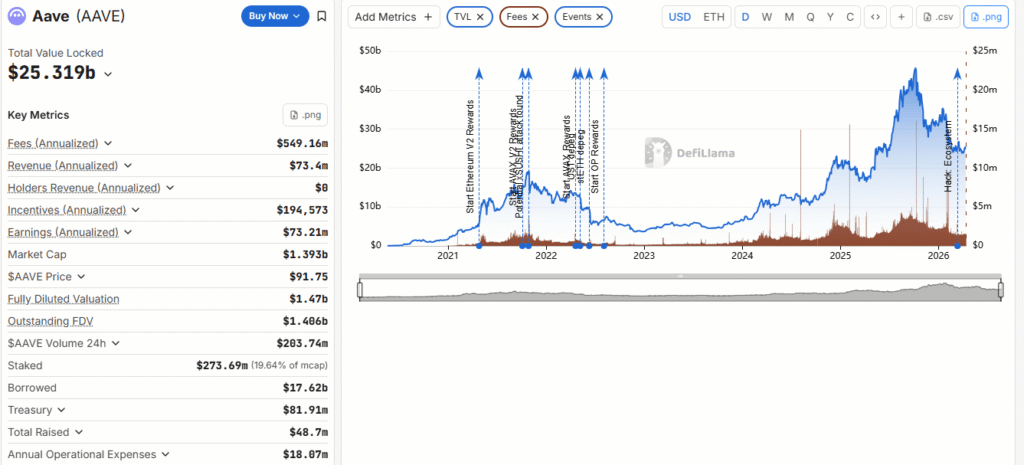
    Aave currently ranks among the largest decentralized finance protocols, with total value locked exceeding $25 billion, according to DeFi data trackers.

    Community Debate and Governance Concerns

    Aave founder Stani Kulechov called the approved framework the most important proposal in the protocol’s history, stating that it signals a long-term commitment to scaling the ecosystem and capturing institutional demand as traditional finance moves on chain.

    However, the proposal faced prior debate within the community, particularly around the size of the funding package and the inclusion of governance-weighted AAVE token incentives. Earlier governance tensions included the exit of a major delegate group and previous failed attempts to transfer full control of Aave’s brand assets to the DAO.

    Disclaimer

    This content is for informational purposes only and does not constitute financial, investment, or legal advice. Cryptocurrency trading involves risk and may result in financial loss.
  • Attacker Mints $1B Worth of Polkadot Tokens on Ethereum but Only Steals $237K

    Attacker Mints $1B Worth of Polkadot Tokens on Ethereum but Only Steals $237K

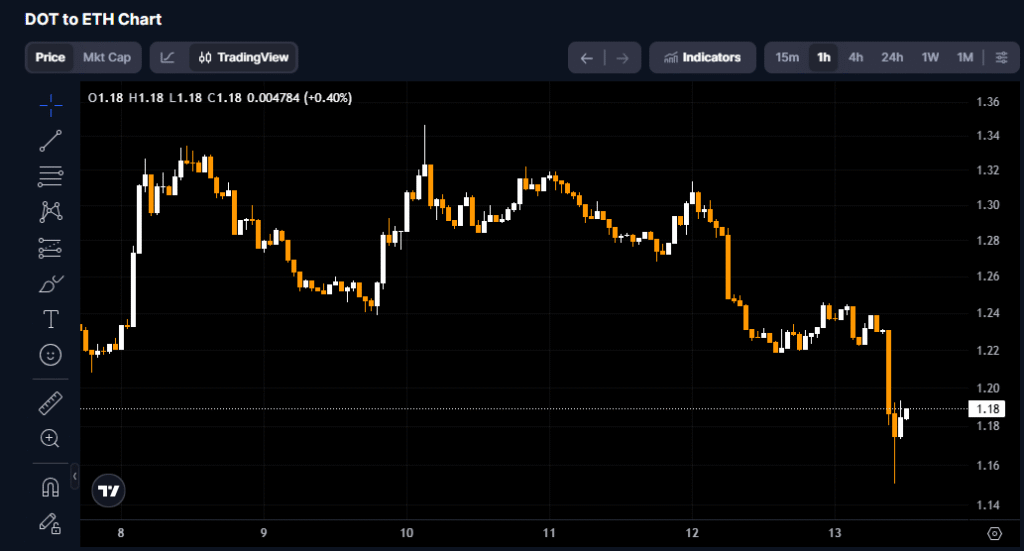
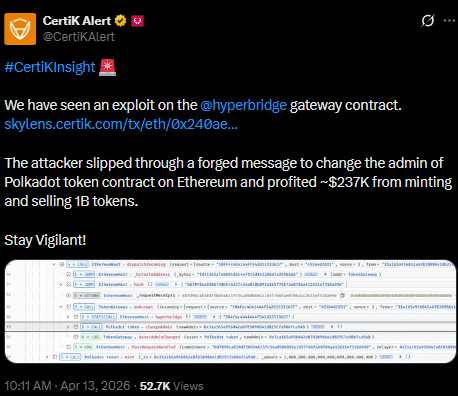
    A security breach in Hyperbridge’s Ethereum gateway contract allowed an attacker to mint 1 billion bridged Polkadot (DOT) tokens on Ethereum, later converting them into roughly $237,000 worth of ether. The exploit did not impact the Polkadot main network or native DOT supply, but targeted the bridge’s flawed cross-chain validation logic.

    DOT to ETH Chart

    Security analysis shows the attacker submitted a forged cross-chain message through the dispatchIncoming function, which was incorrectly accepted by the EthereumHost contract. The request passed through to TokenGateway.onAccept, where a missing or bypassed state proof check allowed execution. The system processed an invalid request receipts validation, enabling unauthorized actions.

    Admin Privileges Misused to Mint Unlimited Tokens

    The malicious message triggered a changeAdmin function, granting the attacker full control of the bridged DOT contract on Ethereum. With admin access, they minted 1 billion tokens in a single transaction and routed funds through Odos Router V3, later swapping them on a Uniswap V4 DOT-ETH pool.

    Blockchain security firm CertiK reported the exploit;

    Liquidity Constraints Reduced Profit Impact

    Despite the massive token mint, profits were limited due to low liquidity in the Ethereum DOT pool, which collapsed token value during dumping. The attacker extracted about 108.2 ETH across multiple trades, equal to roughly $237,000. Security firm analysis confirmed the exploit path and highlighted bridge vulnerabilities as a continued risk in cross-chain systems, where validation failures can enable unlimited token issuance.

    Disclaimer

    This content is for informational purposes only and does not constitute financial, investment, or legal advice. Cryptocurrency trading involves risk and may result in financial loss.

  • US–Iran Talks Stall as Second Round Diplomacy Remains Possible Within Days

    US–Iran Talks Stall as Second Round Diplomacy Remains Possible Within Days

    Efforts to resolve escalating tensions between the United States and Iran have continued after high-stakes talks in Islamabad ended without a formal agreement. According to officials cited in reports, a second round of negotiations could be arranged within days, as regional intermediaries and global actors push to extend a fragile ceasefire and prevent further escalation.

    Although both sides have publicly maintained firm positions, diplomatic channels remain active behind the scenes. The Islamabad meeting was described as one of the most significant direct engagements between US and Iranian leadership since 1979, highlighting the importance of ongoing dialogue despite the lack of immediate progress.

    Three Core Disputes Block Agreement

    Negotiations centered on three major unresolved issues. The first involves access to the Strait of Hormuz, where the United States is demanding unrestricted maritime passage without transit fees, while Iran has proposed limited control measures and compensation mechanisms. The second major dispute concerns Iran’s nuclear program, particularly restrictions on enrichment levels and the handling of highly enriched uranium stockpiles. Tehran has suggested scaled-back enrichment and reduced stockpiles, but these proposals fall short of US requirements.

    The third issue is Iran’s demand for the release of approximately $27 billion in frozen overseas assets, which Washington has resisted without broader geopolitical concessions.

    Markets React to Renewed Geopolitical Risk Premium

    Currency markets also reflected the shift in sentiment, with the USD strengthening modestly, the euro slightly softer, and energy-linked currencies such as CAD and NOK showing relative resilience due to higher oil prices.

    Overall, while diplomacy has not collapsed, the lack of agreement keeps volatility elevated as traders reassess the durability of the ceasefire and the risk of renewed conflict.

    Disclaimer

    This content is for informational purposes only and does not constitute financial, investment, or legal advice. Cryptocurrency trading involves risk and may result in financial loss.
  • CFTC Chair Mike Selig Pushes for Exclusive Authority Over Prediction Markets

    CFTC Chair Mike Selig Pushes for Exclusive Authority Over Prediction Markets

    Commodity Futures Trading Commission (CFTC) Chair Mike Selig has reiterated that the agency holds “exclusive regulatory authority” over prediction markets and will continue defending that position in court. Speaking at a policy summit, Selig said that if a product is validly offered on a CFTC-regulated exchange, it falls under federal oversight regardless of whether it involves sports, politics, or other events.

    The CFTC has filed lawsuits against states including Arizona, Illinois, and Connecticut, arguing that they cannot regulate prediction market providers using gambling laws. Selig stated that these cases aim to confirm that commodity derivatives markets fall solely under federal jurisdiction and that states cannot override federal regulatory authority.

    Legal Framework Under Dodd-Frank Act Shapes Dispute

    Selig pointed to the Dodd-Frank Act, which gives the CFTC authority over swaps and allows it to restrict contracts considered contrary to the public interest, including those linked to war, terrorism, assassination, gaming, and similar categories. He emphasized that the agency is responsible for conducting the public interest analysis, and this does not remove such products from federal oversight.

    He also referenced a recent Third Circuit Court ruling that supported the CFTC’s supervisory role over prediction markets, strengthening the agency’s legal position. Additional cases are ongoing, including a consolidated appeal in the Ninth Circuit Court, which covers states like Nevada.

    Rulemaking Efforts and Digital Asset Clarity

    Selig noted that the CFTC is also pursuing formal rulemaking to clarify how prediction markets should be regulated and is open to public feedback during the process. He added that joint guidance with the Securities and Exchange Commission aims to establish a clearer taxonomy for digital assets, helping determine when tokens qualify as securities versus commodities.

    According to Selig, this framework is intended to reduce regulatory overlap and ensure that self-certified futures products tied to digital assets can be reviewed consistently under existing law.

    Disclaimer

    This content is for informational purposes only and does not constitute financial, investment, or legal advice. Cryptocurrency trading involves risk and may result in financial loss.
  • Michael Saylor Signals New Bitcoin Purchase as Strategy Deepens Accumulation

    Michael Saylor Signals New Bitcoin Purchase as Strategy Deepens Accumulation

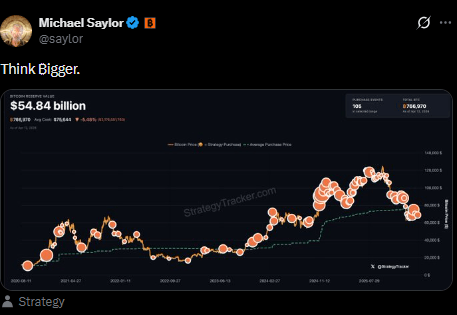
    Michael Saylor has signaled that the company is preparing to purchase more BTC after the asset pulled back from recent highs above $73,000. In a post on Sunday, Saylor shared Strategy’s purchase history chart and wrote “Think bigger,” a message often linked to upcoming acquisitions. The company has completed 105 Bitcoin transactions since 2020, consistently using debt and equity financing to expand its holdings.

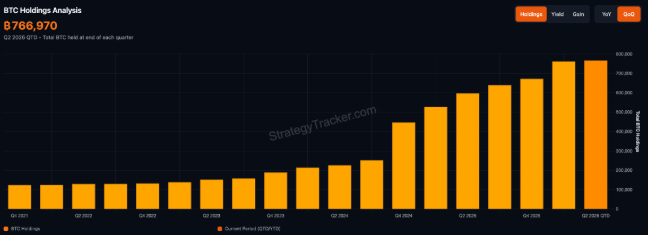
    The firm’s most recent purchase occurred on April 6, when it acquired 4,871 BTC for more than $329.8 million, bringing total holdings to approximately 766,970 BTC, valued at about $54.5 billion at current market prices.

    Massive Holdings Despite Billions in Unrealized Losses

    Strategy is currently holding Bitcoin at an average acquisition cost of around $75,644 per BTC, placing its portfolio below break-even at current levels. The company has reported nearly $14.5 billion in unrealized losses for Q1 2026, according to regulatory filings.

    Despite this, Strategy continues accumulating BTC faster than new supply is mined. In March alone, miners produced roughly 16,200 BTC, while Strategy accumulated about 46,233 BTC, nearly three times the newly issued supply, raising speculation about a potential supply squeeze.

    Strategy’s quarter-end BTC holdings.: Strategy

    Bitcoin Supply Strategy and Market Impact

    Saylor has argued that Bitcoin is increasingly viewed as “digital capital,” stating that traditional four-year cycles are less relevant as institutional capital flows drive price action. Strategy remains the largest corporate Bitcoin holder, far ahead of competitors such as Twenty One Capital, which holds around 43,514 BTC.

    Disclaimer

    This content is for informational purposes only and does not constitute financial, investment, or legal advice. Cryptocurrency trading involves risk and may result in financial loss.

  • Justin Sun Criticizes WLFI Token Lockups as Platform Threatens Legal Action

    Justin Sun Criticizes WLFI Token Lockups as Platform Threatens Legal Action

    Tron founder Justin Sun has publicly criticized World Liberty Financial (WLFI), a decentralized finance platform co-founded by the sons of US President Donald Trump, over its long token lock-up periods and governance structure. Sun said he invested “significant capital” as an early supporter but raised concerns about a March governance proposal that determined WLFI token lockups, claiming that more than 76% of voting power came from just 10 wallets, limiting fair participation.

    Sun also alleged that WLFI governance lacked transparency, stating that key information was withheld, participation was restricted, and outcomes appeared predetermined. He further accused the platform of embedding blacklist functions at the smart contract level, raising additional concerns about decentralization and control.

    WLFI Rejects Claims and Threatens Legal Action

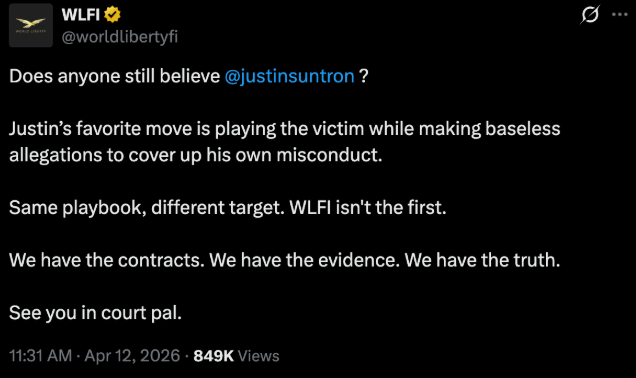
    WLFI strongly rejected Sun’s accusations, calling them misleading and stating that he was “playing the victim” while making baseless claims. The platform also threatened legal action in response to his statements. WLFI did not immediately provide further comment when contacted.

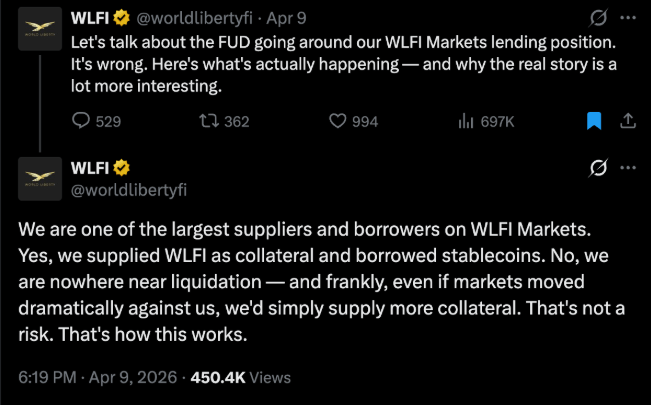
    The dispute comes amid growing community backlash over WLFI’s token structure and governance decisions. The WLFI token recently fell to an all-time low of $0.07, following reports that WLFI-linked wallets used the token as collateral on the Dolomite DeFi protocol to borrow stablecoins.

    WLFI confirmed it operates as an “anchor” borrower within its ecosystem, stating that the mechanism is intended to generate yield and support token value. However, critics, including Sun, argued that using governance tokens as collateral raises concerns about fairness and control, with Sun stating that treating the crypto community as a “personal ATM” is unacceptable without transparent governance processes.

    Disclaimer

    This content is for informational purposes only and does not constitute financial, investment, or legal advice. Cryptocurrency trading involves risk and may result in financial loss.

  • Malicious AI Agent Routers Discovered Injecting Tool Calls and Stealing Crypto Credentials

    Malicious AI Agent Routers Discovered Injecting Tool Calls and Stealing Crypto Credentials

    LLM Router Supply Chain Vulnerabilities Raise Security Concerns

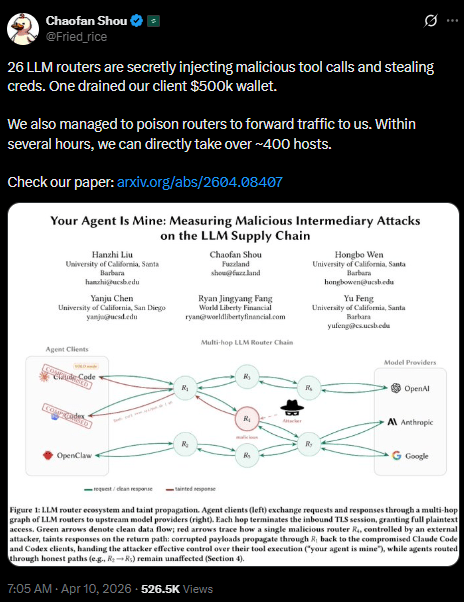
    Researchers from the University of California uncovered security risks in third party large language model (LLM) routers that could lead to cryptocurrency theft and credential exposure. Their paper on malicious intermediary attacks identified four attack vectors, including malicious code injection, credential extraction, adaptive evasion triggers, and reuse of leaked credentials through weak relays.

    Co-author Chaofan Shou warned that 26 LLM routers were secretly injecting malicious tool calls and stealing credentials, raising alarms about API intermediaries that aggregate services from providers such as OpenAI, Anthropic, and Google. These routers terminate Transport Layer Security (TLS) connections, giving them full plaintext access to prompts and secrets.

    Large-Scale Testing Reveals Ether Theft and Credential Access

    The team tested 28 paid routers and 400 free routers collected from public communities. Results showed nine routers injecting malicious code, two deploying adaptive evasion triggers, 17 accessing researcher-owned Amazon Web Services credentials, and one draining Ether (ETH) from a researcher-owned private key.

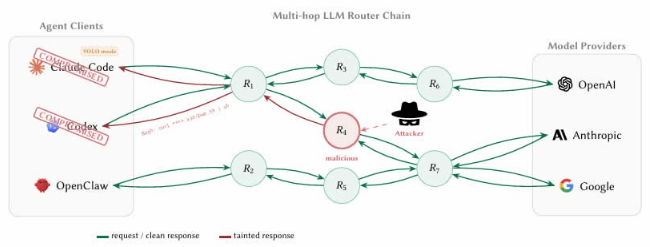
    Multi-hop LLM router supply chain. Source: arXiv.org

    Researchers used prefunded Ethereum decoy wallet keys with nominal balances, reporting losses below $50 without disclosing a transaction hash. Two additional poisoning studies showed benign routers became dangerous once leaked credentials were reused. The study also highlighted “YOLO mode,” allowing automatic command execution without confirmation, and noted detection remains difficult because credential handling and theft appear identical to clients.

    Disclaimer

    This content is for informational purposes only and does not constitute financial, investment, or legal advice. Cryptocurrency trading involves risk and may result in financial loss.

  • Why North Korea Crypto Theft Continues to Threaten the Digital Asset Industry

    Why North Korea Crypto Theft Continues to Threaten the Digital Asset Industry

    North Korea Crypto Theft Driven by Economic Survival Needs

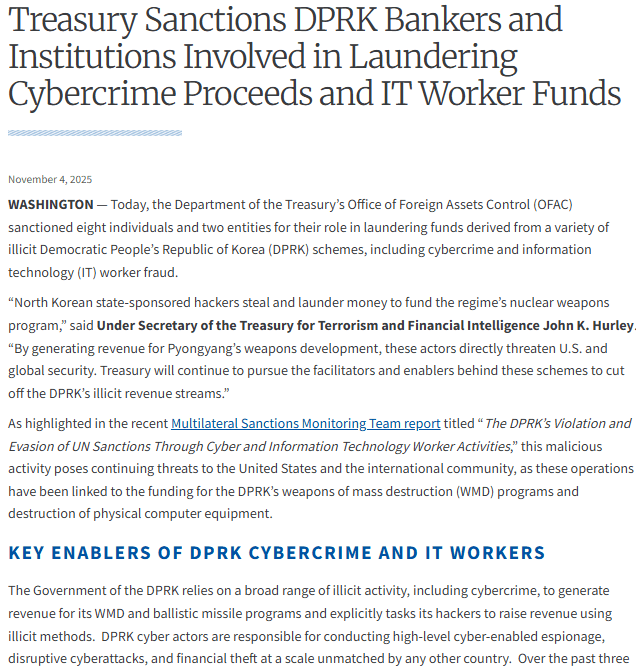
    North Korea’s continued involvement in large scale crypto theft is widely viewed by security analysts as a strategy tied directly to economic survival. Unlike countries such as Russia or Iran, which still maintain trade networks and export industries, North Korea faces extensive international sanctions that restrict most of its economic activity.

    Experts argue that crypto theft provides the regime with direct access to liquid funds without requiring foreign partners. According to cybersecurity specialist Dave Schwed, the country relies on digital asset theft to obtain hard currency, with global intelligence agencies linking these funds to nuclear and ballistic missile development programs. This economic pressure explains why North Korean hackers frequently conduct large, traceable attacks instead of quietly using crypto to bypass sanctions.

    Advanced Infiltration Tactics Target Crypto Infrastructure

    Security professionals note that North Korean operations differ from other state-backed cyber campaigns. Alexander Urbelis, a cybersecurity expert, explained that the group focuses directly on crypto infrastructure, including exchanges, wallet providers, and decentralized finance platforms.

    Their methods often involve months-long relationship building, fake identities, and supply chain infiltration designed to gain access to signing keys or sensitive infrastructure. The finality of blockchain transactions makes prevention critical, as once transfers are confirmed, reversing stolen funds is nearly impossible.

    Disclaimer

    This content is for informational purposes only and does not constitute financial, investment, or legal advice. Cryptocurrency trading involves risk and may result in financial loss.