Category: News

  • AI Infrastructure Boom Intensifies Competition Between Bitcoin Mining and Data Centers

    AI Infrastructure Boom Intensifies Competition Between Bitcoin Mining and Data Centers

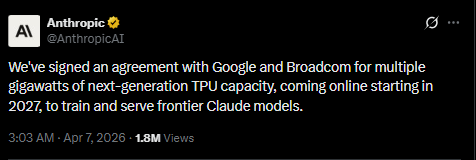
    Anthropic announced a partnership with Google and Broadcom to secure multiple gigawatts of next-generation TPU compute capacity, scheduled to begin coming online in 2027. The agreement marks the company’s most significant infrastructure commitment to date and follows rapid revenue expansion to a $30 billion annual run rate, up sharply from $9 billion at the end of 2025.
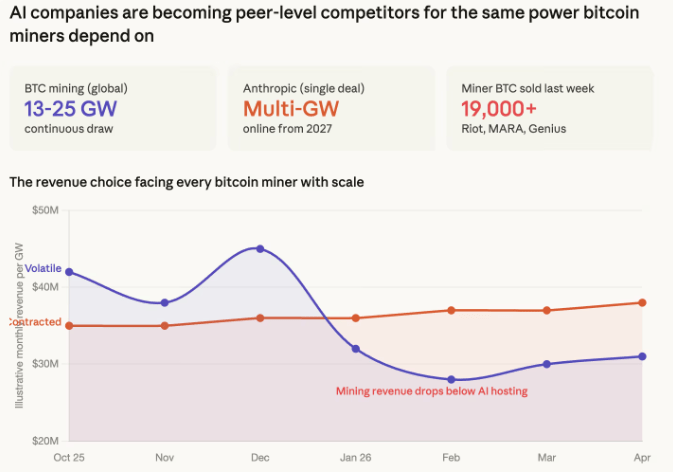
    This scale of compute demand highlights growing competition between artificial intelligence developers and bitcoin miners for scarce resources such as grid connections, land permits, cooling systems, and low-cost electricity. According to a Cambridge tracking estimate, bitcoin mining globally consumes between 13 and 25 gigawatts of continuous power, depending on hardware efficiency assumptions.

    Bitcoin Miners Weigh AI Hosting as Revenue Stability Shifts

    Anthropic’s expansion adds to existing capacity across AWS Trainium, Google TPUs, and Nvidia GPUs, showing how quickly AI demand is reaching levels comparable to large industrial users. At the same time, OpenAI recently raised $122 billion and described compute infrastructure as a strategic moat, expanding across five cloud providers and four chip platforms.

    A gigawatt dedicated to bitcoin mining produces revenue that fluctuates with bitcoin price and network difficulty, while leasing that same capacity to AI firms generates contracted and predictable income. With bitcoin near $69,000, difficulty at all-time highs, and electricity costs rising, leasing often provides stronger returns.
    Mining Firms Shift Strategy as Economics Tighten

    Core Scientific converted a significant portion of its mining capacity to AI hosting through a deal with CoreWeave. Iris Energy and Hut 8 expanded high-performance computing services, while Riot Platforms, MARA Holdings, and Genius Group disclosed selling more than 19,000 BTC from treasuries last week.

    Anthropic also reported that the number of customers spending over $1 million annually on Claude doubled from 500 to more than 1,000 in under two months. Despite these shifts, bitcoin’s network hashrate continues to set records above 1 zetahash per second, suggesting miners may increasingly operate as infrastructure providers renting power capacity alongside mining operations.

    Disclaimer

    This content is for informational purposes only and does not constitute financial, investment, or legal advice. Cryptocurrency trading involves risk and may result in financial loss.

  • On-Chain Evidence Secures Convictions of Three Terrorism Financiers in Indonesia

    On-Chain Evidence Secures Convictions of Three Terrorism Financiers in Indonesia

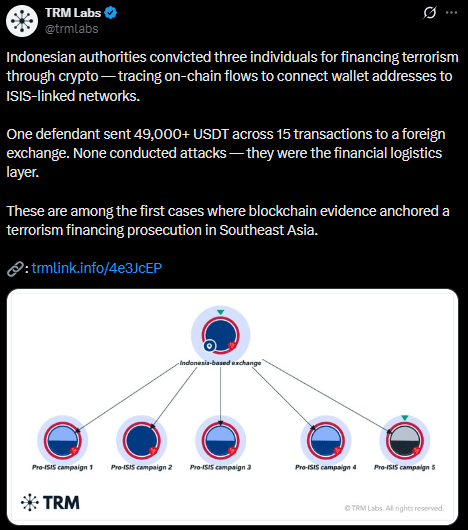
    Three individuals were convicted for terrorism financing in Indonesia during 2024–2025, with on-chain cryptocurrency evidence playing a central role, according to TRM Labs. Courts accepted wallet addresses, transaction histories, and blockchain flows as admissible evidence, demonstrating a shift toward recognizing digital assets in legal proceedings.

    Indonesian authorities traced one defendant sending over $49,000 in USDt across 15 transactions from a local exchange to an international platform. The funds were ultimately routed to an ISIS-linked fundraising campaign in Syria. Analysis was conducted by Indonesia’s financial intelligence team and Densus 88, whose findings were accepted by the courts.

    Southeast Asia Expands Blockchain Surveillance

    TRM Labs highlighted that similar capabilities are emerging across Southeast Asia, with agencies in Singapore and Malaysia developing blockchain intelligence to trace illicit finance.

    The firm noted that stablecoin based illicit transfers reached approximately $141 billion in 2025, marking a five-year high. This trend underscores the growing importance of blockchain analytics in countering terrorism financing and other crypto-related crimes in the region.

    Disclaimer

    This content is for informational purposes only and does not constitute financial, investment, or legal advice. Cryptocurrency trading involves risk and may result in financial loss.

  • New Evidence in Libra Probe Raises Questions About Milei’s Role

    New Evidence in Libra Probe Raises Questions About Milei’s Role

    Newly uncovered phone records indicate that Javier Milei had seven calls with an entrepreneur behind the Libra token around the time he promoted the token on X, according to documents reviewed by prosecutors. The calls took place before and after Milei’s February 2025 post, which touted Libra as a tool to fund small businesses and boost Argentina’s economy. The content of the calls remains undisclosed.

    Investor Losses and Fraud Allegations

    Libra surged briefly before collapsing over 96%, causing at least $251 million in investor losses. Milei has denied wrongdoing, asserting his promotion was personal and that he had no connection to the project. Argentina’s Anti-Corruption Office cleared him of public ethics violations in June 2025, determining his posts were made in a private capacity.

    Ongoing Federal Investigation

    Federal prosecutors continue to investigate Milei’s involvement. Recent findings include a draft note on crypto lobbyist Mauricio Novelli’s phone suggesting a possible $5 million agreement linked to Milei’s Libra promotion, though it does not specify a recipient. The case remains active, with Milei named as a person of interest and legal scrutiny continuing over potential fraud charges and impeachment calls.

    Disclaimer

    This content is for informational purposes only and does not constitute financial, investment, or legal advice. Cryptocurrency trading involves risk and may result in financial loss.

  • Iran Proposes $2 Million Strait of Hormuz Fee as Part of 10-Point Peace Plan

    Iran Proposes $2 Million Strait of Hormuz Fee as Part of 10-Point Peace Plan

    Tehran Seeks Guarantees in Exchange for Reopening Strait

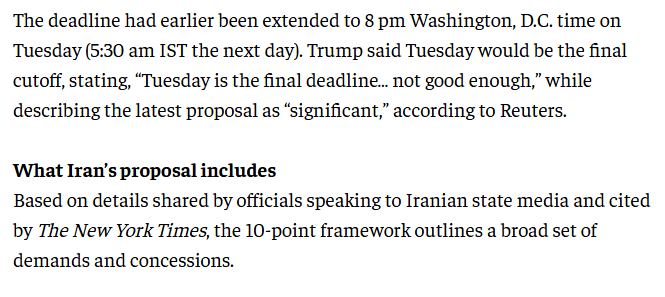
    Iran has reportedly presented a 10-point proposal aimed at ending its ongoing conflict with the United States and Israel, according to state media reports. The plan, conveyed via Pakistan, comes amid escalating tensions and a looming deadline set by former US President Donald Trump for Tehran to meet certain conditions. Trump described the proposal as “significant” but reiterated that Tuesday would be the “final deadline.”

    At the heart of the plan, Iran demands guarantees against future attacks and a permanent cessation of Israeli strikes against Hezbollah in Lebanon. It also calls for the lifting of all economic sanctions imposed on the country.

    In return, Iran would permit the reopening of the Strait of Hormuz, a strategic waterway vital for global oil and gas transport. Additionally, Tehran has proposed charging $2 million per ship passing through the strait while seeking assurances that it will be shielded from future military strikes.

    The framework signals Iran’s attempt to negotiate both security guarantees and economic concessions, linking control over a key maritime chokepoint with broader geopolitical demands.

    Disclaimer

    This content is for informational purposes only and does not constitute financial, investment, or legal advice. Cryptocurrency trading involves risk and may result in financial loss.

  • Bitcoin’s Quantum Risks Are ‘More Social Than Technical,’ Says Grayscale

    Bitcoin’s Quantum Risks Are ‘More Social Than Technical,’ Says Grayscale

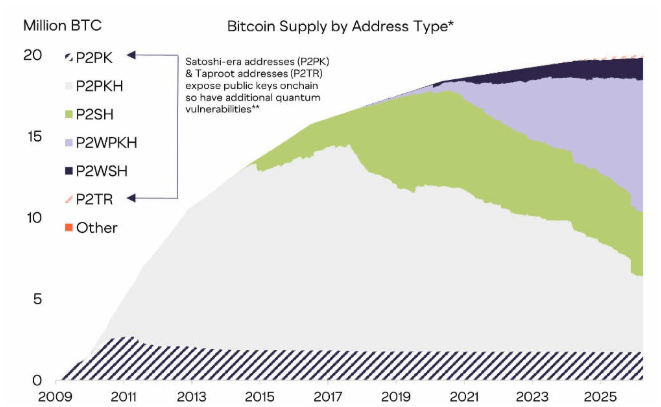
    The threat posed by quantum computers to Bitcoin may be more about social coordination than technical vulnerability, according to Zach Pandl. While Google’s March 30 report suggested that a quantum computer could potentially break Bitcoin’s cryptography with fewer resources than previously expected, Pandl emphasized that Bitcoin’s technical design reduces its risk. The UTXO model, proof-of-work consensus, absence of native smart contracts, and certain address types make it less exposed than other cryptocurrencies.

    Managing Dormant and Vulnerable Coins

    Approximately 1.7 million BTC, including an estimated 1 million held by Satoshi, are locked in early P2PK addresses. The Bitcoin community faces three options: burn these coins, slow their release, or take no action. Pandl noted that “all are conceptually doable,” but reaching consensus is difficult given Bitcoin’s history of contentious protocol debates, including the 2023 dispute over blockspace usage for Bitcoin Ordinals.

    About 1.7 million BTC is vulnerable to the quantum threat

    Preparing for a Post-Quantum Future

    Pandl stressed it is “time to get started” on adopting post-quantum cryptography, citing initiatives by Solana, the XRP Ledger, and the Ethereum Foundation. For now, he reassured investors that no immediate security threat exists, but preparation is crucial for the long-term security of Bitcoin and other blockchains.

    Disclaimer

    This content is for informational purposes only and does not constitute financial, investment, or legal advice. Cryptocurrency trading involves risk and may result in financial loss.
  • SEC Nears Release of “Reg Crypto” Proposal on Fundraising and Startup Exemptions

    SEC Nears Release of “Reg Crypto” Proposal on Fundraising and Startup Exemptions

    SEC Moves Closer to Publishing Crypto Fundraising Rules

    The US Securities and Exchange Commission is preparing to release a long-awaited “Reg Crypto” proposal that will clarify how crypto fundraising and startup exemptions are regulated. Chair Paul Atkins said the proposal is currently under review by the White House Office of Information and Regulatory Affairs, placing it one step away from public release.

    According to Atkins, the proposal focuses on the Securities Act of 1933 and aims to define which crypto transactions qualify as securities and which do not. It will specifically address fundraising structures and exemptions that allow startups to raise capital. He also confirmed that the SEC plans to introduce a separate innovation exemption designed to allow experimentation without disadvantaging established companies.

    US Senator Paul atkins: Blockchain Association

    Political Engagement and Congressional Influence Highlighted

    Speaking at an event hosted by Vanderbilt University and the Blockchain Association, Atkins emphasized the role of Congress in shaping the regulatory environment. He stated that while rulemaking is advancing, lawmakers could still influence its direction.

    Atkins encouraged industry participants to remain engaged in the upcoming midterm elections, citing Bernie Moreno as an example of supportive leadership. He warned that an unfriendly Congress could create obstacles, though he expressed confidence that regulatory progress would continue despite political uncertainty.

    Disclaimer

    This content is for informational purposes only and does not constitute financial, investment, or legal advice. Cryptocurrency trading involves risk and may result in financial loss.

  • JPMorgan CEO Jamie Dimon Warns of Rising Blockchain and Stablecoin Competition

    JPMorgan CEO Jamie Dimon Warns of Rising Blockchain and Stablecoin Competition

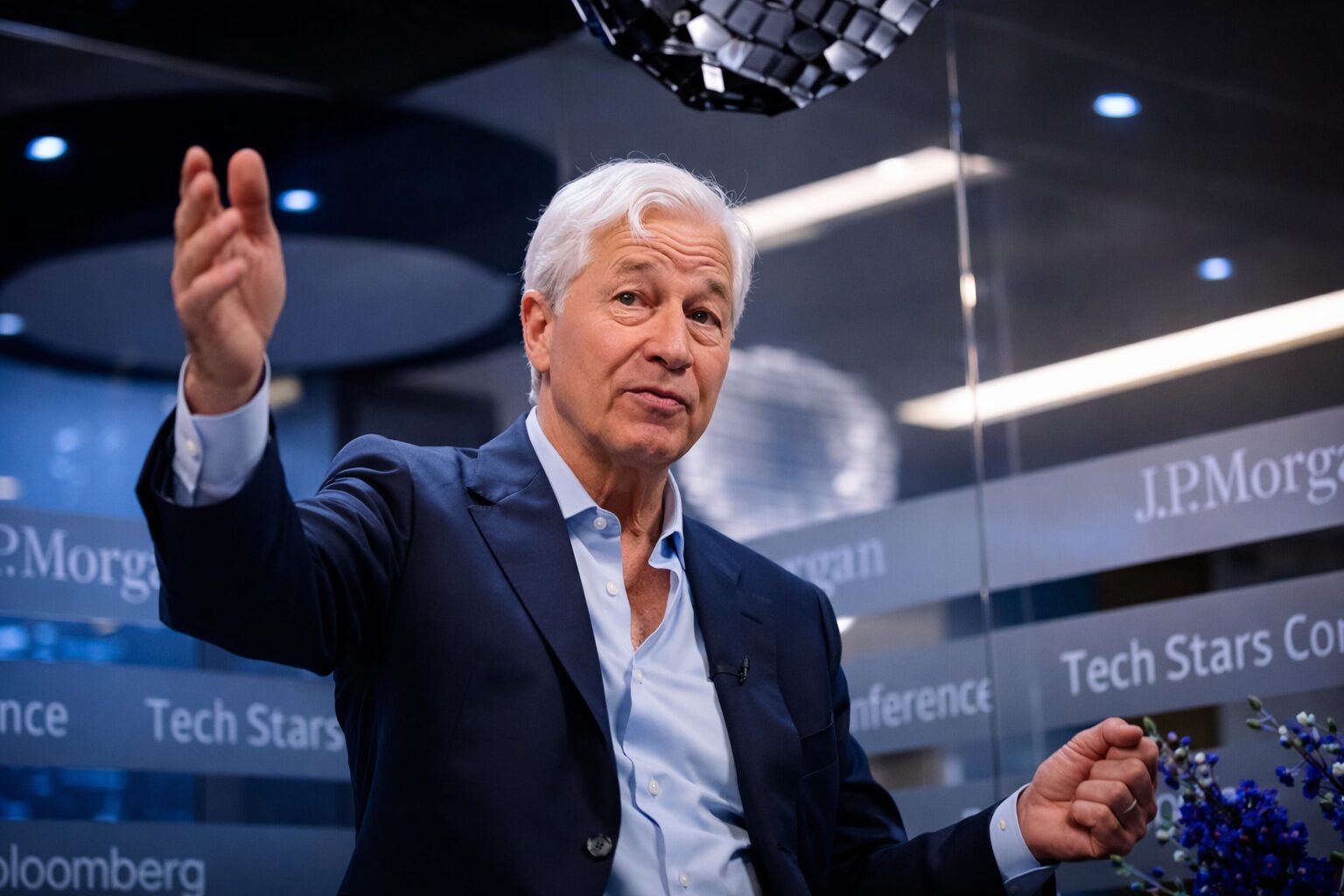
    Chief executive Jamie Dimon has warned that emerging technologies, including blockchain and stablecoins, are creating a new wave of competition for traditional financial institutions. In his annual shareholder letter, Dimon highlighted artificial intelligence, advanced data systems and automation as key forces shaping the future of banking.

    He noted that blockchain-based systems are introducing new competitors capable of offering financial services through stablecoins, smart contracts and tokenization. While these technologies were not the central theme of the letter, Dimon acknowledged that their growth represents a meaningful shift in how financial services may be delivered in the coming years.

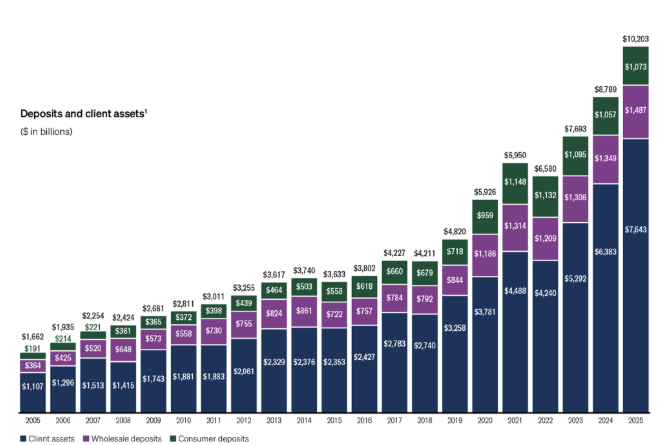
    Dimon’s shareholder letter highlighted the bank’s scale, including client assets, wholesale funding and consumer deposits: JPMorgan

    JPMorgan Expands Kinexys Blockchain Network

    JPMorgan Chase has continued investing in its internal blockchain infrastructure known as Kinexys, which supports near-instant transfers without relying on traditional intermediaries. The platform is targeting up to $10 billion in daily transaction volume.

    Major institutional participants, including Mitsubishi Corporation, Qatar National Bank, Siemens and BlackRock, have joined the network. JPMorgan is also positioning Kinexys to support tokenization use cases in markets such as private credit and real estate.

    Stablecoin Regulation Debate Intensifies in Washington

    Dimon’s remarks come amid ongoing regulatory debates in the United States following the passage of the GENIUS Act, which established a formal framework for stablecoin oversight. Analysts believe clearer regulations could accelerate institutional adoption.

    The stablecoin market topped $315 billion in the first quarter

    However, disagreements remain over yield-bearing stablecoins, which banking groups argue could pose financial stability risks if issuers offer interest-like returns without meeting banking-level regulations. Industry organizations such as the American Bankers Association have made opposition to yield-generating stablecoins a central policy priority as legislative discussions continue.

    Disclaimer

    This content is for informational purposes only and does not constitute financial, investment, or legal advice. Cryptocurrency trading involves risk and may result in financial loss.
  • Polymarket Replaces USDC.e With USDC-Backed Token in Exchange Upgrade

    Polymarket Replaces USDC.e With USDC-Backed Token in Exchange Upgrade

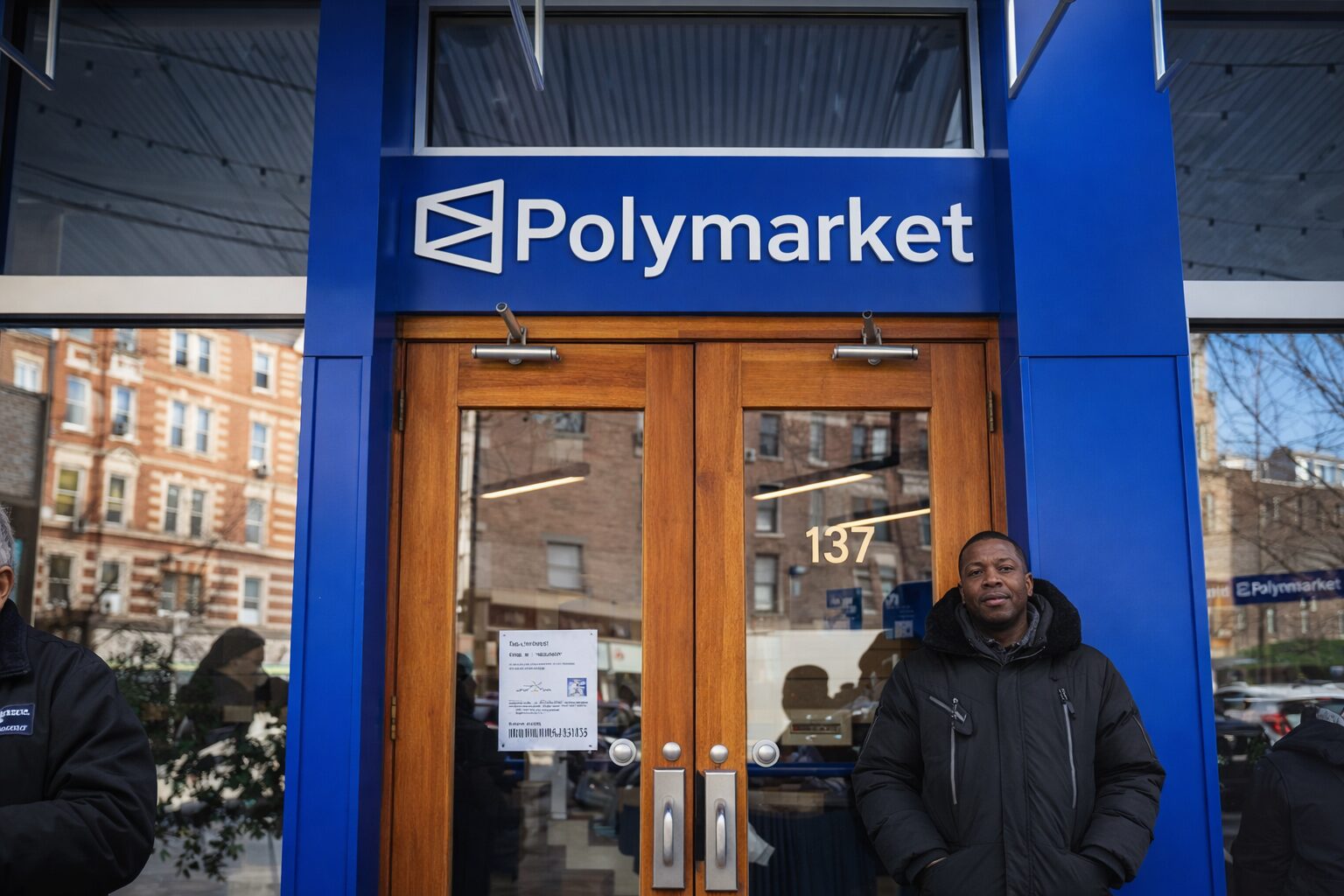
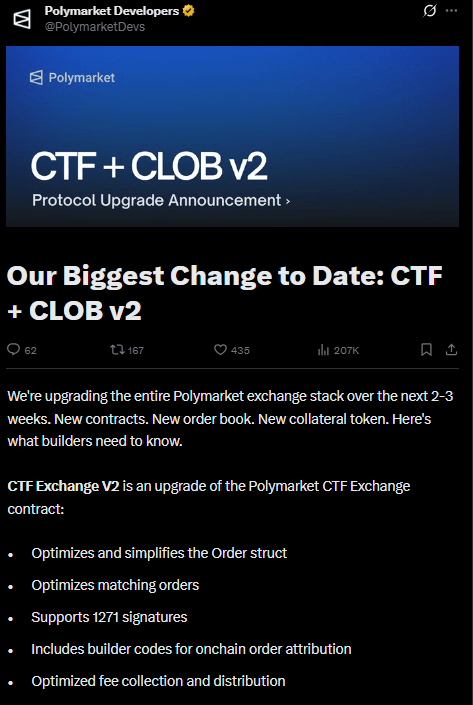
    Polymarket is preparing a major infrastructure overhaul that includes launching new exchange contracts and replacing its existing bridged stablecoin. The company announced plans to deploy version 2 exchange contracts designed to simplify order structure and improve how trades are matched.

    The upgraded system aims to increase trading efficiency and make it easier for developers to integrate trading bots and external applications. It will also support the EIP-1271 standard, allowing smart contract wallets such as multisignature systems to sign transactions, expanding compatibility beyond traditional wallets.

    A key part of the upgrade is the introduction of Polymarket USD, a new collateral token backed 1:1 by USD Coin. This token will replace USDC.e, the bridged version previously used on the platform. The change is expected to reduce reliance on bridged assets and provide Polymarket with greater control over settlement and risk management. For most users, the transition will occur automatically through the platform interface, requiring only a one-time approval.

    Regulatory Alignment and Growing Market Activity

    The overhaul reflects broader efforts by Polymarket to strengthen market integrity and align more closely with United States regulatory standards. In November, the company received approval from the Commodity Futures Trading Commission to operate an intermediated trading platform in the country, allowing it to return after previously exiting the US market.

    Following regulatory clearance, Polymarket outlined plans to onboard brokers and customers directly while facilitating trades through regulated venues. The platform has also introduced measures to reduce manipulation and insider-trading risks as interest in prediction markets continues to grow.

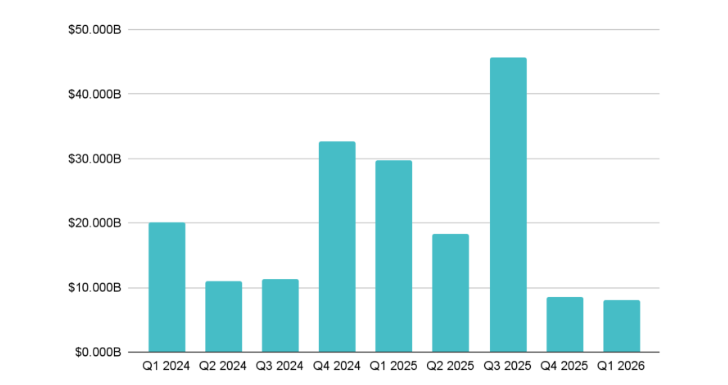
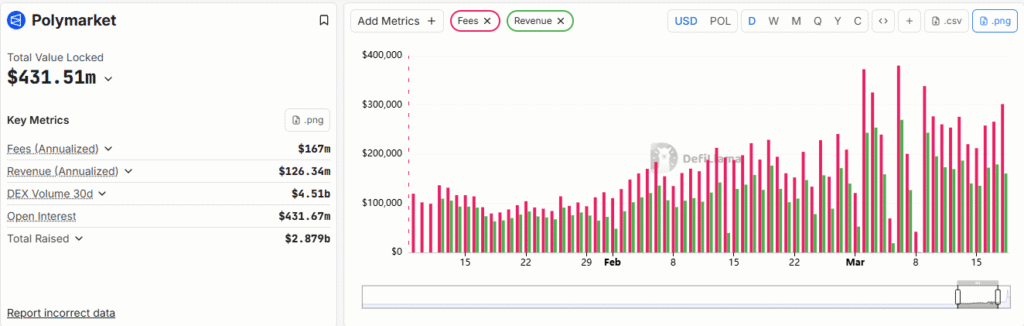
    Industry data indicates that Polymarket’s fee revenue has increased sharply in recent weeks, particularly after the platform expanded its trading fee structure, reflecting rising participation in markets tied to politics, financial events, and public policy outcomes.

    Polymarket’s fees and other revenue have climbed sharply since the end of March: DeFiLlama
    Disclaimer

    This content is for informational purposes only and does not constitute financial, investment, or legal advice. Cryptocurrency trading involves risk and may result in financial loss.

  • Chaos Labs Leaves Aave Risk Role Amid V4 Migration and Oracle Dispute

    Chaos Labs Leaves Aave Risk Role Amid V4 Migration and Oracle Dispute

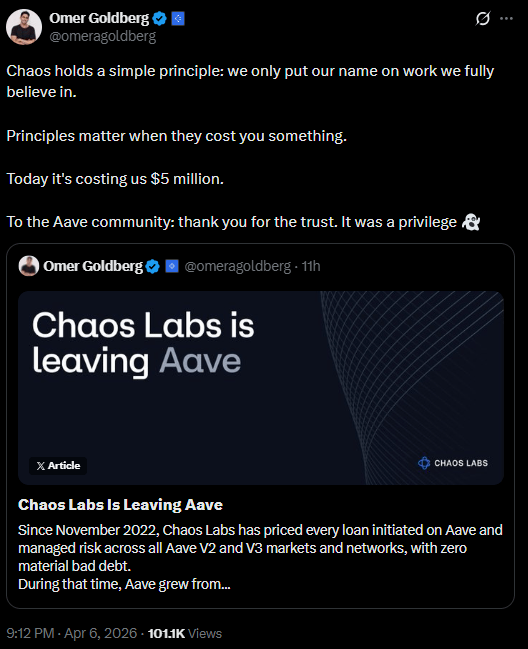
    Chaos Labs has stepped down as a primary risk service provider for Aave after three years, citing disagreements over risk management strategy and operational expectations. Founder Omer Goldberg said the decision “was not made in haste” and followed extended discussions with DAO contributors. He noted that Aave Labs supported raising Chaos Labs’ compensation to $5 million to retain its services.

    Goldberg warned that the planned migration to Aave V4 would significantly increase operational demands. He explained that until V4 fully absorbs V3 liquidity and markets, both systems must run simultaneously, doubling workloads rather than reducing them. He also stressed the absence of a clear regulatory framework defining responsibility if a protocol failure occurs, stating that risk managers face uncertainty if systems break.

    Aave Rejects Sole Risk Control and Oracle Changes

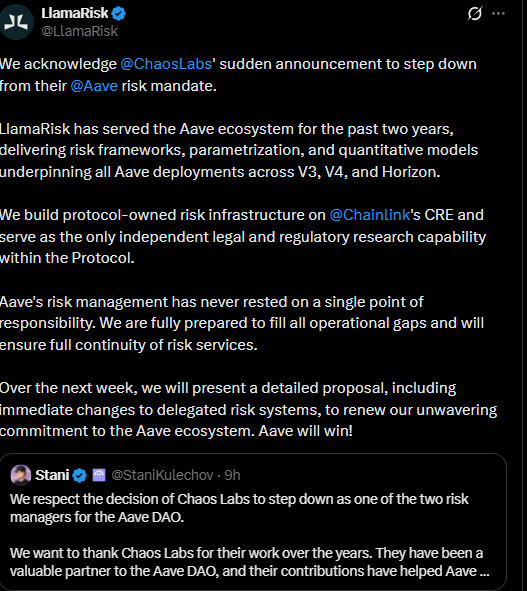
    Chief executive Stani Kulechov said Chaos Labs proposed becoming the sole risk provider, which would have forced the removal of LlamaRisk and replacement of price feeds from Chainlink. Aave declined the proposal to preserve its two-layer risk model.

    Risk concerns intensified after a user reportedly lost $50 million on March 12. Aave later introduced the “Aave Shield” feature, while confirming operations remain stable and collaboration with LlamaRisk will continue.

    LlamaRisk
    Disclaimer

    This content is for informational purposes only and does not constitute financial, investment, or legal advice. Cryptocurrency trading involves risk and may result in financial loss.

  • US Senate Targets April Timeline to Advance Crypto Market Structure Bill

    US Senate Targets April Timeline to Advance Crypto Market Structure Bill

    U.S. Senator Bill Hagerty confirmed that lawmakers expect progress on digital asset market structure legislation in April, renewing momentum after months of delays. Speaking at the Digital Assets and Emerging Tech Policy Summit at Vanderbilt University, Hagerty said Republican lawmakers plan to move the bill into the Senate Banking Committee starting next week. He noted that lawmakers are close to agreement but acknowledged that “there’s still a lot more work to do.”

    CLARITY Act Progress Faces Key Regulatory and Ethics Issues

    Originally introduced as the CLARITY Act when it passed the House of Representatives in July, the legislation is considered one of the most significant crypto bills under review. It is expected to create a comprehensive regulatory framework for digital assets and shift major oversight responsibilities from the Securities and Exchange Commission (SEC) to the Commodity Futures Trading Commission (CFTC).

    US Senator Bill Hagerty at the April 6 Digital Assets and Emerging Tech Policy Summit: Blockchain Association

    Because both agencies oversee different areas, the bill must also pass through the Senate Agriculture Committee, which advanced its version in a January markup. However, Banking Committee action has been delayed due to concerns involving tokenized equities, ethics rules, and stablecoin yield provisions.

    Midterm Elections Add Pressure to Complete Bill

    Hagerty emphasized the urgency of advancing the legislation before upcoming midterm elections, stating that completing committee work in April could allow lawmakers to finalize the bill ahead of the political cycle. Similar optimism was expressed by Coinbase chief legal officer Paul Grewal, who said lawmakers are “close to a deal” on unresolved issues. Meanwhile, the advocacy group Stand With Crypto noted that lawmakers’ votes on the legislation could influence voter sentiment during the 2026 midterms.

    Disclaimer

    This content is for informational purposes only and does not constitute financial, investment, or legal advice. Cryptocurrency trading involves risk and may result in financial loss.