Author: tristan

  • Telegram Founder Warns Push Notifications Pose Major Privacy Risk to Messaging Users

    Telegram Founder Warns Push Notifications Pose Major Privacy Risk to Messaging Users

    Pavel Durov, co-founder of the Telegram messaging platform, has warned that push notifications represent a persistent privacy vulnerability, even when messages are deleted or applications are removed from devices. His comments followed reports that investigators were able to retrieve deleted messages through device notification logs.

    Durov referenced a report indicating that the United States Federal Bureau of Investigation (FBI) accessed notification logs on an Apple iPhone to recover deleted Signal messages. He cautioned that disabling notification previews alone does not guarantee privacy, noting that message data may still be exposed if other users in a conversation keep notification features active.

    Metadata Access Raises Concerns Over End-to-End Encryption Limits

    Recent developments highlight how investigators can bypass end-to-end encryption by accessing metadata and system-level logs created by messaging applications. This capability has increased calls for decentralized messaging platforms that minimize or eliminate centralized data storage.
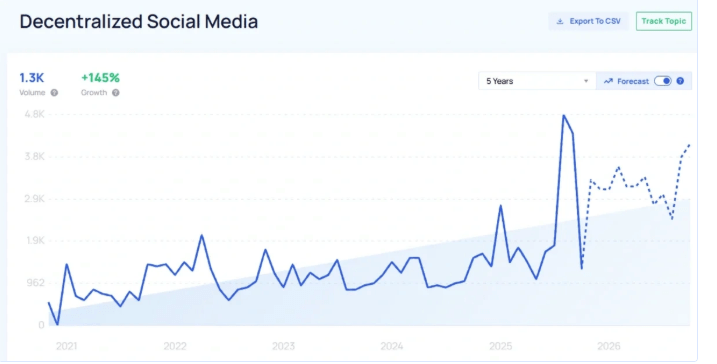
    Online search interest in decentralized social media platforms has spiked by 145% over the last five years: Exploding Topics

    Interest in alternative communication tools has surged since 2025, driven by geopolitical tensions and communication shutdowns. The decentralized messaging app Bitchat, which operates through Bluetooth mesh networks, recorded over 48,000 downloads in Nepal during a nationwide social media ban in September 2025.

    Durov also noted that attempts to ban messaging platforms often lead users to adopt virtual private networks (VPNs). Despite restrictions, more than 50 million users in Iran have reportedly downloaded Telegram, demonstrating how users bypass national bans through privacy tools.

    Disclaimer

    This content is for informational purposes only and does not constitute financial, investment, or legal advice. Cryptocurrency trading involves risk and may result in financial loss.

  • US–Iran Peace Talks Collapse After 21 Hours in Pakistan, Raising Risk of Naval Blockade

    US–Iran Peace Talks Collapse After 21 Hours in Pakistan, Raising Risk of Naval Blockade

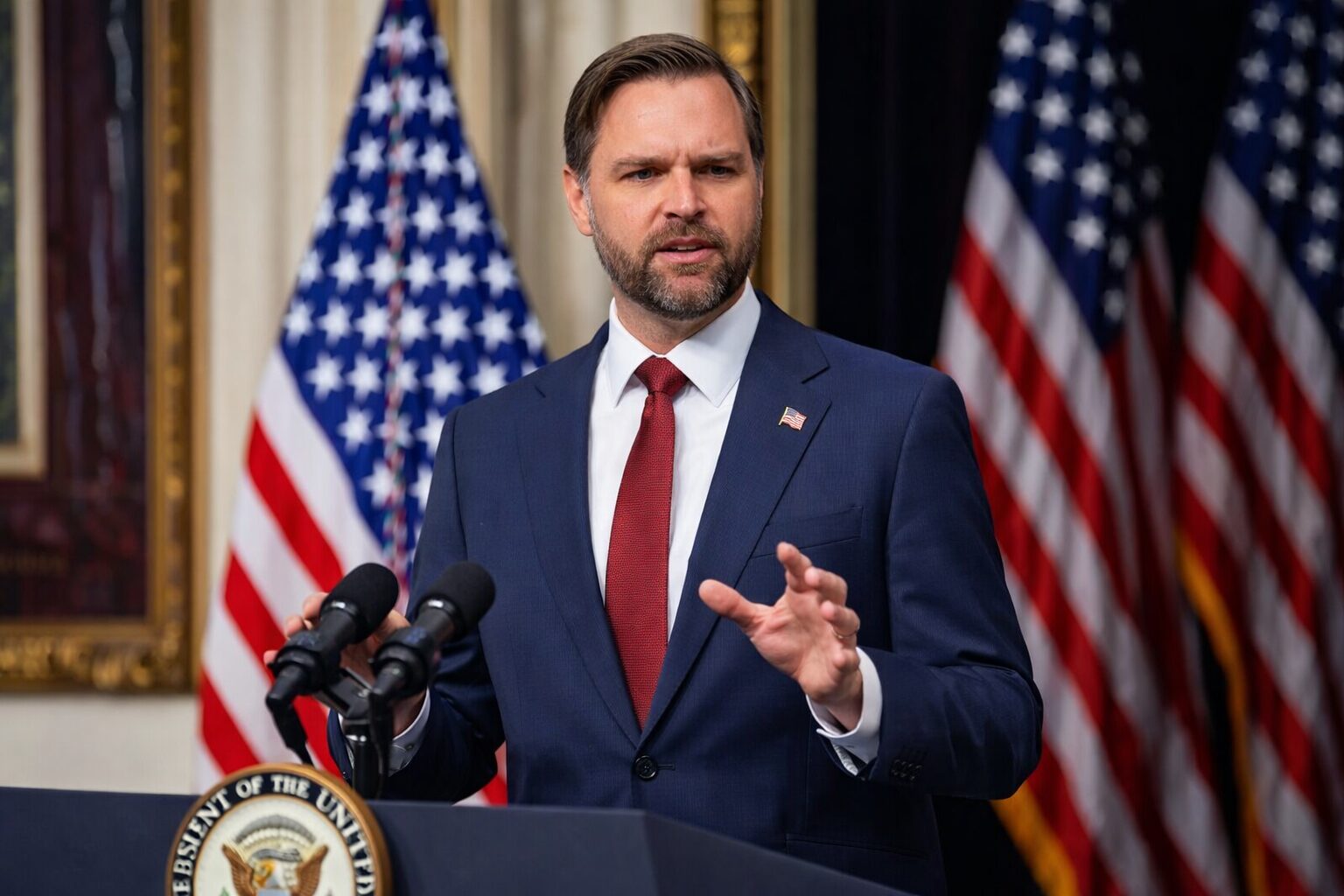
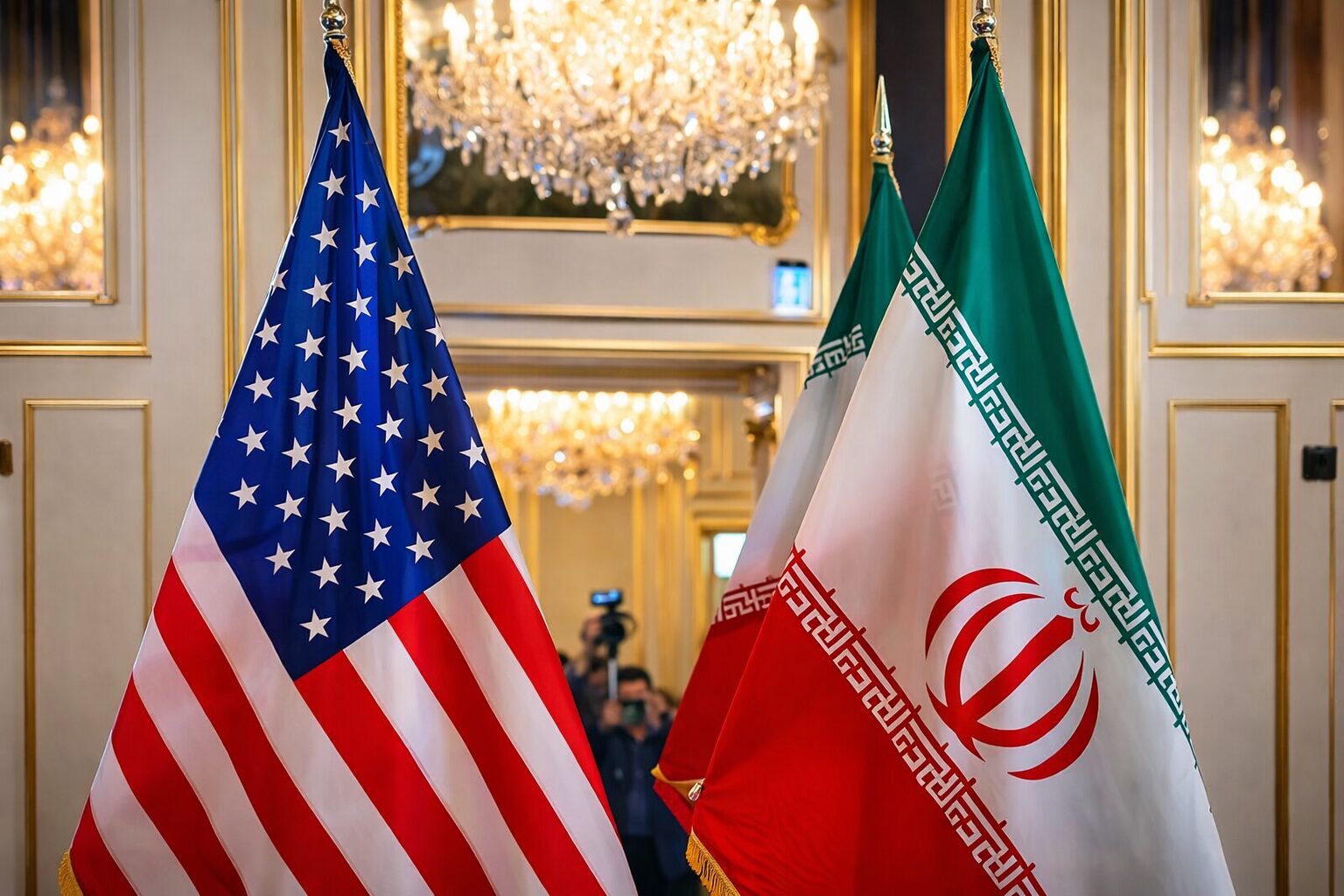
    Peace negotiations between the United States and Iran ended without agreement after more than 21 hours of talks held in Islamabad, Pakistan, according to U.S. Vice President JD Vance. The discussions were aimed at ending a six-week conflict and restoring stability in key regional routes, including the Strait of Hormuz.

    Speaking at a press conference on Sunday morning local time, Vance confirmed the outcome and signaled that the lack of progress could have greater consequences for Iran. He stated that failure to reach an agreement represented “bad news for Iran” and emphasized that U.S. negotiators had clearly outlined their demands during the extended session.

    Trump Signals Possible Naval Blockade Against Iran

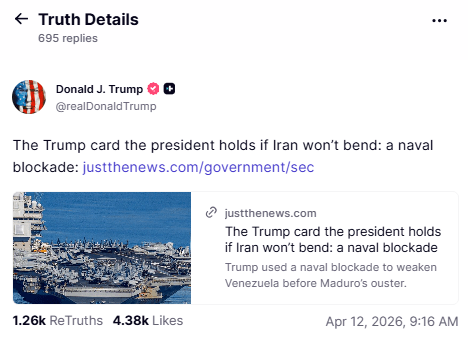
    U.S. President Donald Trump indicated that stronger measures remain under consideration following the failed negotiations. Shortly after the talks collapsed, Trump shared commentary highlighting a potential naval blockade against Iran, signaling that military or economic pressure options remain on the table.

    Earlier, Trump had stated that it “makes no difference” to him whether a deal was reached during the Islamabad discussions, while Iranian officials criticized what they described as “excessive” U.S. demands during negotiations.

    Iran Cites Key Disagreements and Mistrust

    Iranian officials acknowledged that some progress was made but said the talks ultimately failed due to disagreements over two major unresolved issues. A spokesperson from Iran’s foreign ministry described the negotiations as taking place in an “atmosphere of mistrust,” adding that expecting a full agreement in a single round was unrealistic.

    Both sides deployed large delegations and exchanged multiple draft proposals during the Islamabad meeting. However, officials confirmed that no immediate plans are currently in place to resume talks, leaving uncertainty around future diplomatic efforts and regional stability.

    Disclaimer

    This content is for informational purposes only and does not constitute financial, investment, or legal advice. Cryptocurrency trading involves risk and may result in financial loss.
  • Trump-Linked Crypto Tokens Crash to Record Lows, Triggering Political and Investor Backlash

    Trump-Linked Crypto Tokens Crash to Record Lows, Triggering Political and Investor Backlash

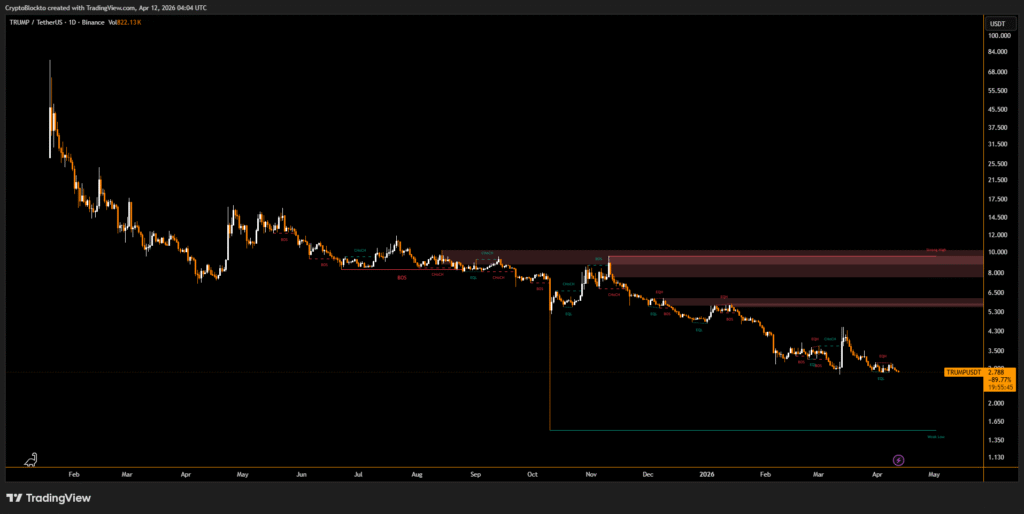
    Crypto tokens linked to U.S. President Donald Trump are facing renewed scrutiny after sharp price declines pushed several projects to record lows. The Official Trump (TRUMP) memecoin, launched in January 2025, dropped to an all-time low of about $2.73 in March 2026 and is currently trading near $2.86, according to market data.

    TRUMP memecoin has plummeted in price since launching in January 2025

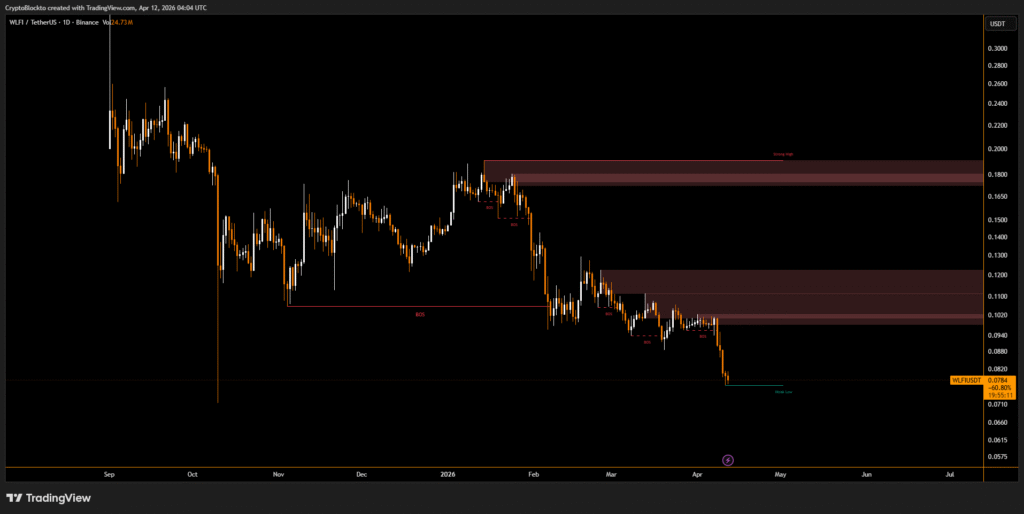
    The token has lost around 90% of its value from its January 2025 peak above $73, raising concerns among investors and political critics. Meanwhile, World Liberty Financial (WLFI), a decentralized finance platform co-founded by Trump’s sons, saw its governance token fall to $0.07, marking a new low. The WLFI token has declined nearly 75% from its September 2025 high of approximately $0.31.

    The WLFI token has crashed by nearly 75% since the all-time high reached in September 2025

    Lawmakers and Critics Raise Concerns Over Token Promotions

    Democratic lawmakers and crypto industry observers have intensified criticism, describing some Trump-linked crypto initiatives as politically controversial and financially risky. Professor Tonya Evans publicly criticized the projects, comparing their impact to earlier industry controversies involving figures such as Sam Bankman-Fried and Gary Gensler.

    Senators Question Access-Based Gala for Token Holders

    Senators Elizabeth Warren, Richard Blumenthal, and Adam Schiff recently sent a letter to Bill Zanker, who launched the TRUMP memecoin, requesting clarification about a planned April 25 gala for token holders. Lawmakers argued that requiring attendees to hold TRUMP tokens could create financial incentives tied to political access, increasing regulatory and ethical scrutiny.

    Disclaimer

    This content is for informational purposes only and does not constitute financial, investment, or legal advice. Cryptocurrency trading involves risk and may result in financial loss.
  • SpaceX Holds $603 Million in Bitcoin Despite $5 Billion Loss Linked to xAI Integration

    SpaceX Holds $603 Million in Bitcoin Despite $5 Billion Loss Linked to xAI Integration

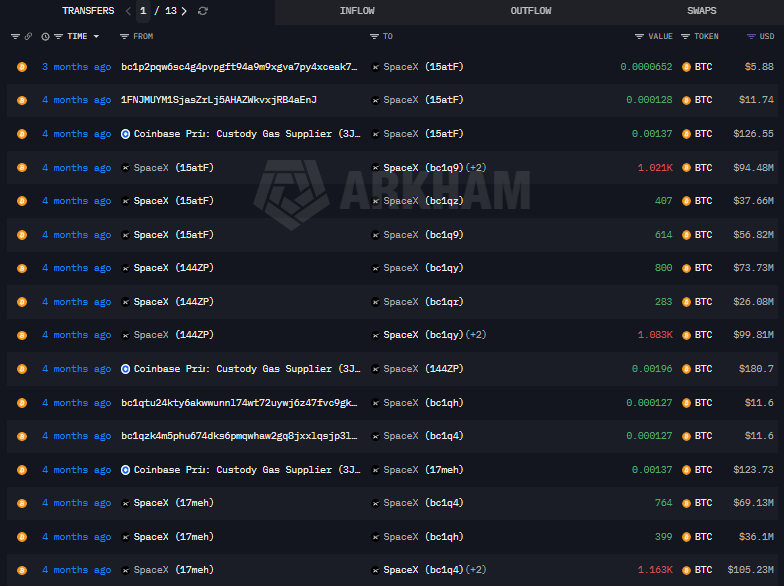
    SpaceX, led by Elon Musk, continues to hold 8,285 BTC valued at approximately $603 million in Coinbase Prime custody, even after reporting a nearly $5 billion loss for 2025. Blockchain analytics data shows the company has not reduced its bitcoin reserves, maintaining the same balance since mid-2024.

    The latest financial results mark a sharp reversal from the previous year, when SpaceX generated around $8 billion in profit on revenues estimated between $15 billion and $16 billion. Despite the downturn, 2025 revenue increased to $18.5 billion, indicating continued operational growth.

    xAI Integration Costs Drive Major Financial Reversa

    The primary factor behind the financial shift was the integration of Musk’s artificial intelligence venture, xAI, which SpaceX acquired in February 2025. Costs tied to combining operations pushed expenses beyond total revenue, leading to the company’s significant loss.

    Transfer records indicate the last notable bitcoin activity occurred about four months ago, when 614 BTC and 1,021 BTC were moved internally between SpaceX wallets. The company’s holdings previously peaked at over $1.6 billion in value during October 2025, when bitcoin reached an all-time high.

    SpaceX now ranks as the fourth largest known corporate bitcoin holder, behind Strategy, Marathon Digital, and Riot Platforms, reinforcing bitcoin’s role as a long-term treasury asset.

    Disclaimer

    This content is for informational purposes only and does not constitute financial, investment, or legal advice. Cryptocurrency trading involves risk and may result in financial loss

  • $1.6 Billion Ether Machine SPAC Deal Cancelled Amid Weak Market Conditions

    $1.6 Billion Ether Machine SPAC Deal Cancelled Amid Weak Market Conditions

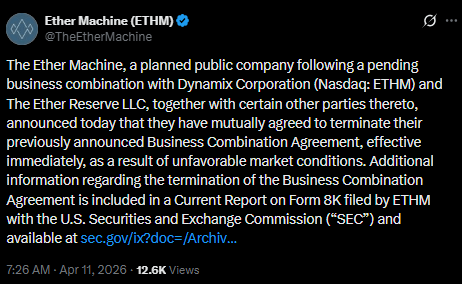
    The proposed $1.6 billion SPAC merger between Dynamix Corporation (DYNX) and The Ether Machine has been officially terminated after both parties cited unfavorable market conditions. The agreement, originally announced in July 2025, aimed to list The Ether Machine on the Nasdaq under the ticker ETHM, positioning it as a major Ethereum focused treasury company in public markets.

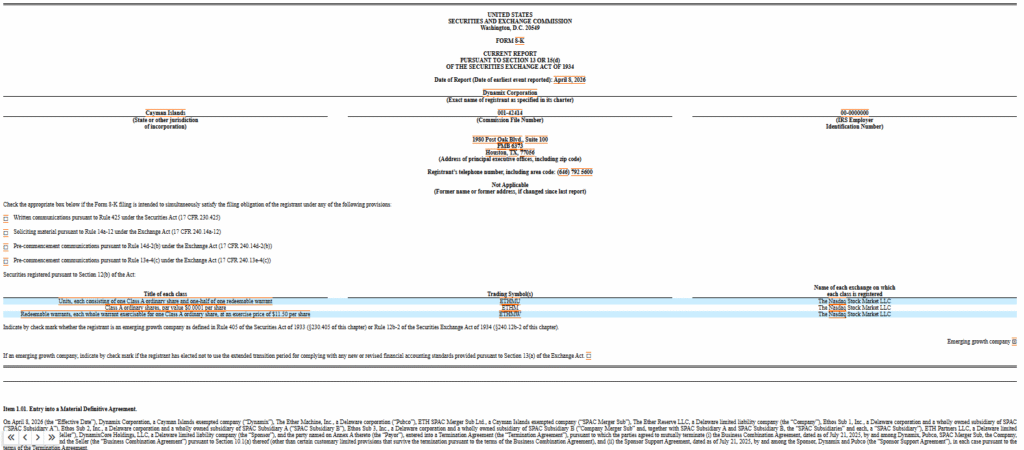
    According to regulatory filings submitted to the U.S. Securities and Exchange Commission (SEC), the companies mutually agreed to end the deal. As part of the termination terms, Dynamix Corporation will receive a $50 million payment within 15 days as the transaction unwinds.

    SEC

    Ethereum Treasury Holdings and Planned Deal Structure

    The Ether Machine is structured to function as an Ethereum treasury and yield vehicle, generating returns through staking and decentralized finance strategies while maintaining large ether reserves. The firm currently holds 496,712 ETH, valued at more than $1.1 billion, based on market pricing data.

    PIPE Financing and Co-Founder Contribution Details

    The original merger plan included a $1.5 billion fully committed PIPE financing, described as the largest all-common-stock raise of its kind since 2021, alongside roughly $170 million in Dynamix’s trust account. The combined company was expected to begin operations with over 400,000 ETH, supported in part by contributions from co-founder Andrew Keys.

    Disclaimer

    This content is for informational purposes only and does not constitute financial, investment, or legal advice. Cryptocurrency trading involves risk and may result in financial loss

  • Bitcoin and Major Cryptocurrencies Drop After U.S.–Iran Ceasefire Talks Fail

    Bitcoin and Major Cryptocurrencies Drop After U.S.–Iran Ceasefire Talks Fail

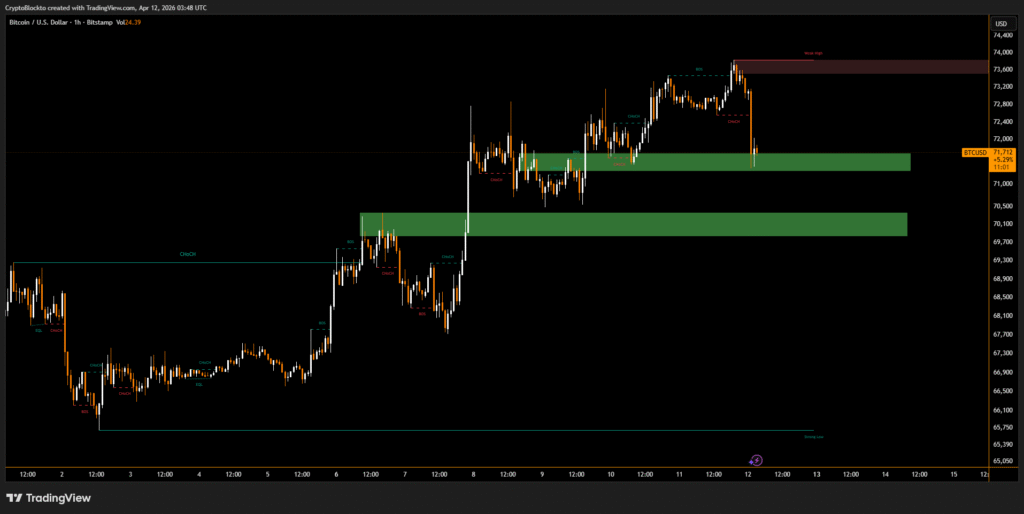
    Bitcoin and other major cryptocurrencies declined between 1.5% and 2% late Saturday after U.S. Vice President J.D. Vance confirmed that negotiations between the United States and Iran ended without reaching an extended ceasefire agreement. The talks took place in Pakistan after nearly six weeks of U.S. military operations against Iran, raising global market tensions.

    $BTC h1 price chart

    During a press conference following the daylong meeting, Vance stated that the two sides had “not reached an agreement,” emphasizing that the United States clearly outlined its red lines and areas where compromise was possible. A key sticking point involved Washington’s demand that Iran not pursue nuclear weapons or the tools needed to rapidly develop them.

    Ethereum, XRP and Crypto Market Index Also Decline

    Market reaction was immediate across digital assets. Bitcoin traded near $71,600, while Ether (ETH) dropped to about $2,200. XRP declined to roughly $1.33.

    Iran Response Highlights Ongoing Dispute Areas

    Esmaeil Baqaei, spokesperson for Iran’s Ministry of Foreign Affairs, stated that numerous messages and texts had been exchanged between both sides. He noted that discussions in the past 24 hours covered major issues including the Strait of Hormuz, nuclear concerns, war reparations, sanctions relief, and a complete end to hostilities in the region.

    Disclaimer

    This content is for informational purposes only and does not constitute financial, investment, or legal advice. Cryptocurrency trading involves risk and may result in financial loss

  • Bitcoin Holds Above $73.5K as U.S.–Iran Talks Begin and Strait of Hormuz Tensions Persist

    Bitcoin Holds Above $73.5K as U.S.–Iran Talks Begin and Strait of Hormuz Tensions Persist

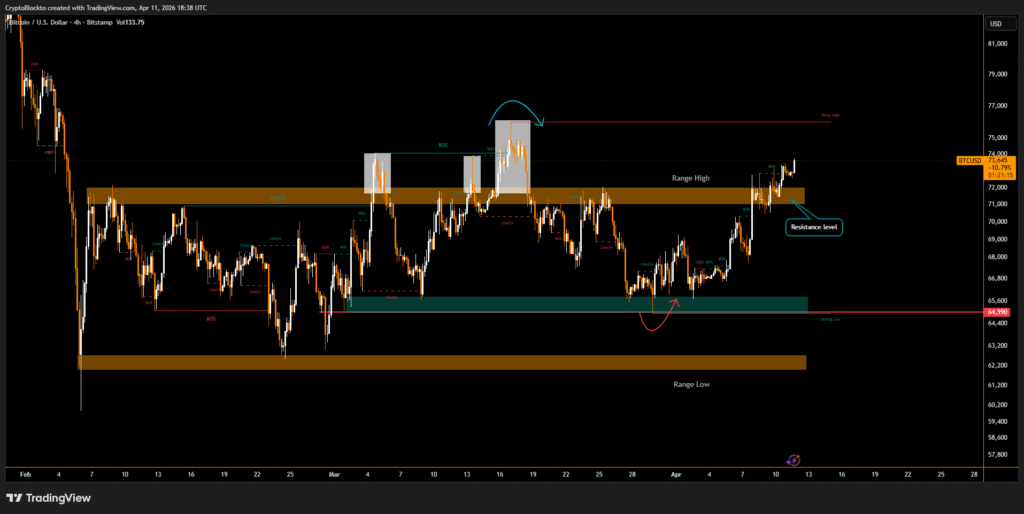
    Bitcoin traded slightly above the $73,600 level, showing limited movement in the past 24 hours as high-level negotiations between the United States and Iran began in Islamabad. The broader crypto market also remained largely flat, with minimal price changes across major assets.

    $BTC 4h price chart

    Market sentiment improved over the past week following a reported two week ceasefire, which triggered a sharp derivatives move. More than $430 million in bearish positions were liquidated in a short squeeze as prices rallied across digital assets.

    Crypto Market Stabilizes After Volatile Week

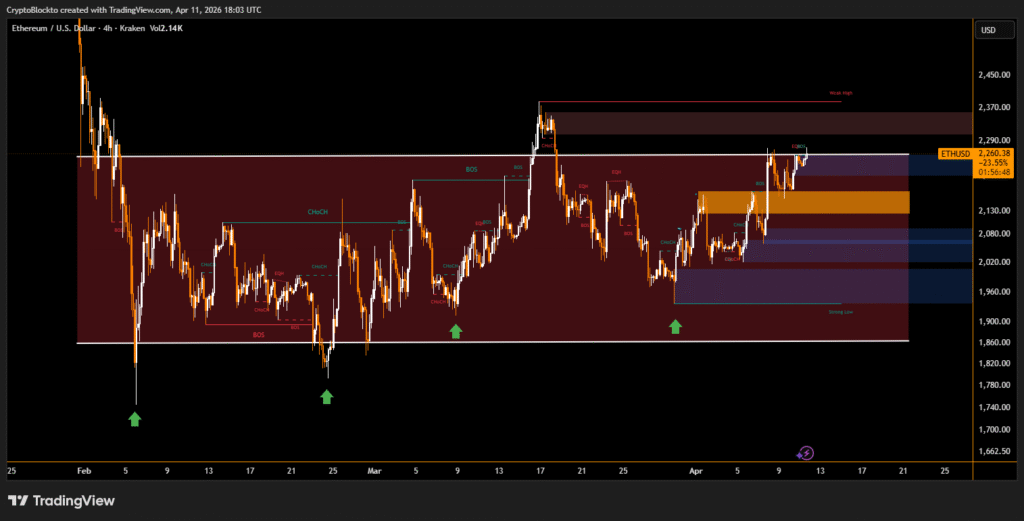
    Ethereum rose roughly 0.1%. Other major cryptocurrencies also recorded minor fluctuations, reflecting a period of consolidation after recent volatility.

    $ETH 4h price chart

    Despite the calm in prices, geopolitical risks remain elevated. Israel has continued airstrikes in Lebanon, while Iran has announced plans to impose transit tolls on vessels passing through the Strait of Hormuz, a move that has drawn criticism from former U.S. President Donald Trump.

    Diplomatic Efforts Expand With Mixed Leadership Teams

    According to multiple reports, the U.S. delegation includes Vice President JD Vance, special envoy Steve Witkoff, and Jared Kushner, while Iran is represented by Foreign Minister Abbas Araghchi and Parliament Speaker Mohammad Bagher Ghalibaf. Pakistan is acting as a neutral host and facilitator for the discussions.

    Despite earlier disruptions linked to regional tensions, some vessels have begun transiting the Strait of Hormuz again. However, shipping volumes remain below normal levels, highlighting the continued uncertainty surrounding one of the world’s most critical energy routes.

    Disclaimer

    This content is for informational purposes only and does not constitute financial, investment, or legal advice. Cryptocurrency trading involves risk and may result in financial loss.
  • U.S. Navy Launches Mine Clearance Mission in Strait of Hormuz as Iran Talks Reach Stalemate

    U.S. Navy Launches Mine Clearance Mission in Strait of Hormuz as Iran Talks Reach Stalemate

    U.S. Forces Begin Mine Clearance Operations in Strait of Hormuz

    U.S. Central Command (CENTCOM) has launched operations to clear sea mines in the Strait of Hormuz, a vital global shipping corridor. The mission began on April 11, with two U.S. Navy guided-missile destroyers USS Frank E. Peterson (DDG 121) and USS Michael Murphy (DDG 112) transiting the waterway and conducting security operations in the Arabian Gulf.

    The operation is focused on establishing a new safe maritime passage after mines were reportedly laid by Iran’s Islamic Revolutionary Guard Corps. Additional U.S. resources, including underwater drones, are expected to support the clearance mission in the coming days.

    Diplomatic Talks Continue Amid Stalemate

    At the same time, U.S. and Iranian delegations have begun direct negotiations in Islamabad, hosted by Shehbaz Sharif. Both sides met separately with Pakistani leadership before talks began. However, negotiators reported a stalemate over control and security arrangements for the Strait of Hormuz.

    U.S. Vice President JD Vance expressed cautious optimism about progress but warned Iranian negotiators against delaying tactics. Meanwhile, Iranian parliament speaker Mohammad Bagher Ghalibaf stated that Iran is willing to negotiate but remains distrustful of U.S. intentions.

    Regional Tensions and Broader Negotiations Intensify

    Military activity continues across the region, including Israeli air strikes in southern Lebanon. Lebanese Prime Minister Nawaf Salam postponed a planned visit to Washington, where he was expected to meet U.S. Secretary of State Marco Rubio ahead of talks between Israeli and Lebanese representatives.

    Iran has also insisted that any lasting ceasefire must include the unfreezing of sanctioned Iranian assets and an end to Israeli military operations against Hezbollah. However, U.S. officials have denied reports that Washington agreed to release Iranian funds, stating that negotiations were still in early stages.

    Disclaimer

    This content is for informational purposes only and does not constitute financial, investment, or legal advice. Cryptocurrency trading involves risk and may result in financial loss

  • Crypto Clarity Act Has 30% Chance of Passing in 2026 Amid Bank Opposition and Political Uncertainty

    Crypto Clarity Act Has 30% Chance of Passing in 2026 Amid Bank Opposition and Political Uncertainty

    The proposed Crypto Clarity Act, designed to establish clear market structure rules for digital assets in the United States, currently has about a 30% chance of passing in 2026, according to Ron Hammond, head of policy at Wintermute. Hammond noted that while legislative movement continues, persistent uncertainty and shifting timelines remain major obstacles.

    His estimate closely aligns with other industry indicators. A Punchbowl survey of lobbyists placed the probability at 26%, while prediction platform Kalshi has shown fluctuating odds, highlighting ongoing uncertainty surrounding the bill’s future. Lawmakers are attempting to advance the legislation through committee, with some aiming for a vote around April 20, although Hammond cautioned that deadlines have repeatedly shifted.

    Bank Opposition and Stablecoin Yield Debate Remain Key Hurdles

    The largest resistance to the legislation comes from traditional banking institutions, particularly regarding whether stablecoins should offer yield. Negotiations involving major stakeholders, including Coinbase, the White House, and bill drafters, have failed to produce consensus. A previously proposed “yield deal” collapsed after failing to satisfy both banking groups and crypto advocates, forcing renewed negotiations.

    Political Pressure and Institutional Stakes

    Political challenges are also shaping the bill’s outlook. Hammond highlighted concerns among Democratic lawmakers, especially those who previously received crypto industry funding, as they navigate regulatory debates involving decentralized finance and anti-money laundering compliance.

    Additional scrutiny surrounding Donald Trump’s crypto related activities could further complicate support if investigations intensify later in the year. Despite these challenges, Hammond believes incremental progress in committees may keep the legislation alive into midyear, offering a narrow but viable path forward.

    Disclaimer

    This content is for informational purposes only and does not constitute financial, investment, or legal advice. Cryptocurrency trading involves risk and may result in financial loss.

  • US Government Transfers Seized Bitcoin Linked to Glenn Olivio Steroid Distribution Case

    US Government Transfers Seized Bitcoin Linked to Glenn Olivio Steroid Distribution Case

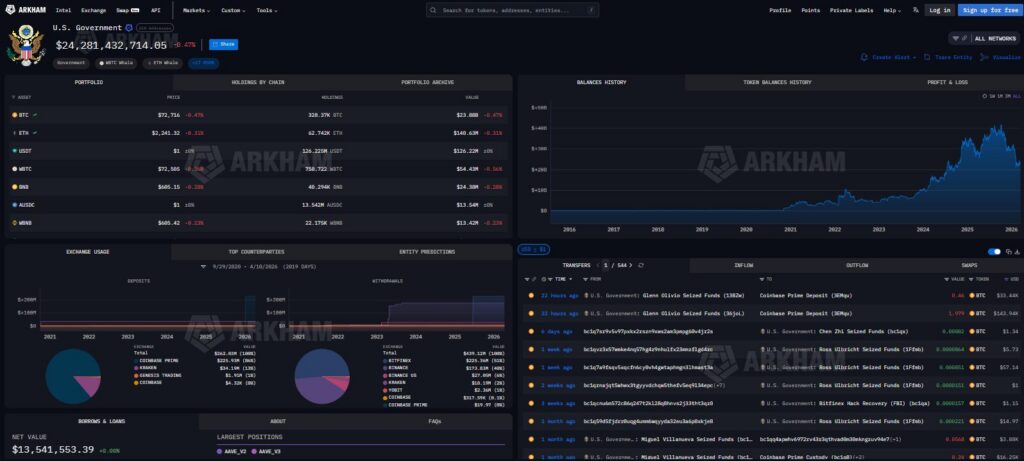
    The United States government transferred 2.438 Bitcoin (BTC), worth about $177,000, to a Coinbase Prime address in two separate transactions, according to blockchain data tracked by Arkham Intelligence. The funds originated from wallets labeled “U.S. Government: Glenn Olivio Seized Funds,” suggesting the assets were confiscated during a criminal investigation. Such transfers are commonly used to consolidate, secure, or manage cryptocurrency obtained through legal forfeiture actions.

    Similar government linked transactions have occurred recently. Authorities moved Bitcoin tied to Ross Ulbricht, the pardoned founder of the Silk Road marketplace, and Chen Zhi, a Cambodian national allegedly connected to a pig-butchering fraud scheme. Last month, officials also transferred about $23,000 in Bitcoin from a wallet associated with Miguel Villanueva.

    Strategic Bitcoin Reserve Policy Shapes Asset Management

    The transfer follows an executive order signed by President Donald Trump establishing a Strategic Bitcoin Reserve, requiring the retention of seized Bitcoin rather than selling it. In January, Treasury Secretary Scott Bessent confirmed that the administration halted sales of confiscated Bitcoin and began adding them to national reserves. The US government currently holds about 328,000 Bitcoin, valued at more than $22 billion.

    Glenn Olivio Steroid Conspiracy Details

    The Bitcoin is believed to be linked to Glenn Bradford Olivio, arrested in May 2025 with Dana Rene Light. Prosecutors alleged they conspired to distribute anabolic steroids including Trenbolone, Nandrolone, Mestanolone, Oxandrolone, Stanozolol, and Methandienone, alongside synthetic testosterone products.

    The defendants were indicted on five counts, including conspiracy to distribute controlled substances, conspiracy to launder monetary instruments, aggravated identity theft, and two drug possession charges. Court records show the indictment included a forfeiture notice, enabling authorities to seize cryptocurrency linked to alleged criminal proceeds.

    Disclaimer

    This content is for informational purposes only and does not constitute financial, investment, or legal advice. Cryptocurrency trading involves risk and may result in financial loss