Author: tristan

  • Bitcoin Holds Near $67K as Extreme Fear and Bearish Sentiment Deepen

    Bitcoin Holds Near $67K as Extreme Fear and Bearish Sentiment Deepen

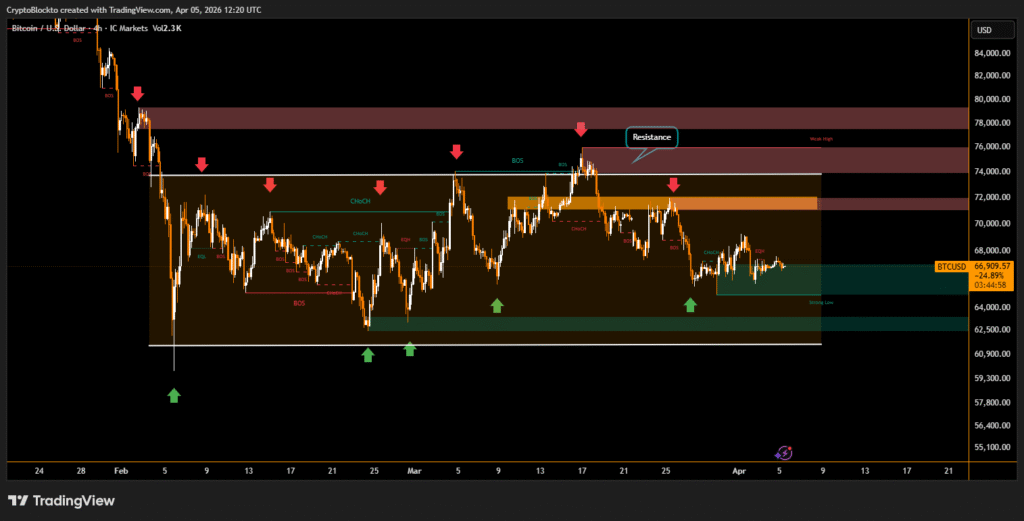
    Bitcoin is trading around $66,900, remaining within a $65,000 to $73,000 range despite the most negative market sentiment recorded since the Iran conflict began on February 28. Market mood has deteriorated sharply even as price action remains steady.
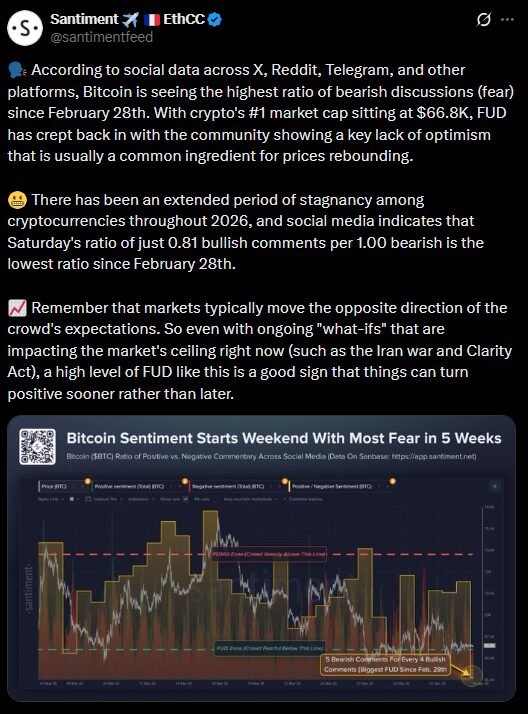
    Recent data shows social media sentiment turning heavily bearish, with roughly five bearish posts for every four bullish ones, marking the weakest outlook in about five weeks. The last time sentiment reached similar levels was during Operation Epic Fury, when bitcoin briefly fell below $65,000.
    Fear and Greed Index Signals Extreme Market Anxiety

    The Fear and Greed Index currently sits at 9, placing it deep in extreme fear territory where readings have ranged between 8 and 14 for more than a month. Historically, such levels appeared during major stress events like large-scale market sell-offs, yet bitcoin has continued to trade sideways instead of collapsing.

    Institutional demand appears to be holding the market floor. Approximately 50,000 BTC were absorbed by ETFs in March, the fastest monthly pace since October 2025. Additional accumulation included 44,000 BTC purchases, while approval of a 14-basis-point bitcoin ETF opened access to 16,000 advisors managing $6.2 trillion in assets.

    Institutional Flows Offset Weak On-Chain Demand

    Despite these supportive inflows, large holders continue distributing bitcoin, and 30-day apparent demand remains deeply negative. The market has also absorbed $403 million liquidation events, yet price movement remains limited. This disconnect between weakening sentiment and stable prices continues to raise questions about whether seasonal strength in April can overcome ongoing war headlines and persistent investor fear.

    Disclaimer

    This content is for informational purposes only and does not constitute financial, investment, or legal advice. Cryptocurrency trading involves risk and may result in financial loss.

  • AI Demand Drives Foxconn Revenue Spike Despite Profit Decline

    AI Demand Drives Foxconn Revenue Spike Despite Profit Decline

    AI Server Demand Drives Strong Revenue Growth

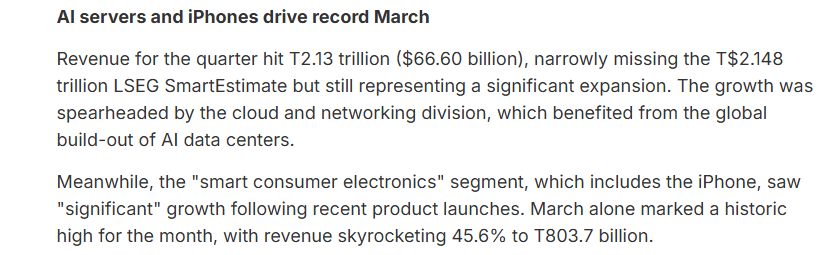
    Foxconn reported a sharp rise in first-quarter revenue, climbing 29.7% year-on-year to T2.13 trillion ($66.6 billion). The surge was powered by strong demand in its cloud and networking division, which supplies infrastructure to AI chipmakers such as Nvidia.

    Growth was also supported by the smart consumer electronics segment, including iPhone production, which expanded following recent product launches. March delivered the strongest monthly performance, with revenue jumping 45.6% year-on-year to T803.7 billion, reflecting accelerating demand for AI servers and consumer devices.

    Profit Decline Highlights Margin Pressure

    Despite strong revenue gains, net profit fell 2.4% year-on-year to $1.42 billion, weighed down by 5.88% gross margins and rising operating costs. This divergence between revenue growth and profit decline reflects mounting cost pressures across manufacturing and supply chains.

    Geopolitical Risks and 2026 Outlook

    Chairman Young Liu identified the Middle East war as the company’s top external risk, warning that logistics disruptions remain possible. Still, Foxconn forecasts “strong growth” in 2026, driven by continued expansion in AI infrastructure demand, despite the company’s stock declining 16% this year.

    Disclaimer

    This content is for informational purposes only and does not constitute financial, investment, or legal advice. Cryptocurrency trading involves risk and may result in financial loss.

  • Crypto Token Supply Surge Raises ‘Existential’ Concerns as Value Creation Lags

    Crypto Token Supply Surge Raises ‘Existential’ Concerns as Value Creation Lags

    A rapid expansion in crypto token supply is creating what some analysts describe as an “existential” problem for the digital asset industry. Michael Ippolito, co-founder of Blockworks, warned that the number of tokens entering the market is rising faster than the value they generate.

    In posts shared on X, Ippolito noted that while overall crypto market capitalization remains relatively steady, the average value per token shows weaker performance. He stated that the average coin is only slightly higher than its 2020 level and roughly 50% below 2021 levels, signaling widespread underperformance.

    Ippolito highlighted that median token returns have declined sharply, with most tokens down around 80% from their peak prices. This trend suggests gains have been concentrated among a limited number of large-cap assets, while smaller tokens struggle to retain value.

    He argued that the surge in new token creation has diluted returns, explaining that despite the creation of many new assets, total market capitalization has remained largely flat, spreading value across an expanding pool of tokens.

    Disconnect Between Fundamentals and Token Prices

    Ippolito also pointed to a growing disconnect between onchain revenue and token prices. In 2021, token prices closely followed protocol revenue growth, but recent data shows that prices have failed to reflect improving fundamentals.

    If market value continues concentrating around assets like Bitcoin and Ethereum, the broader ecosystem could lose relevance.

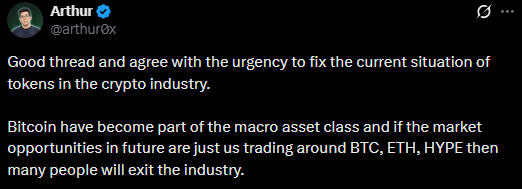
     Arthur Cheong, founder and CEO of DeFiance Capital, said;

    Capital Migration Toward Listed Crypto Firms

    Research from DWF Labs found that investor demand is shifting toward publicly listed crypto companies rather than newly issued tokens. The report showed that over 80% of projects trade below their token generation event (TGE) price, with typical losses ranging between 50% and 70% within about three months.

    According to Andrei Grachev, many tokens peak within their first month before declining due to continued selling pressure. Additional factors such as airdrops and early investor unlocks increase supply, reinforcing downward price trends even for projects with active products.

    Disclaimer

    This content is for informational purposes only and does not constitute financial, investment, or legal advice. Cryptocurrency trading involves risk and may result in financial loss.
  • Coinbase CEO Proposes Shenzhen-Style Crypto Zones to Boost U.S. Innovation

    Coinbase CEO Proposes Shenzhen-Style Crypto Zones to Boost U.S. Innovation

    Coinbase CEO Brian Armstrong has called for the creation of Shenzhen style special economic zones (SEZs) in the U.S. to accelerate crypto and technology innovation. In a recent interview, Armstrong said, “I hope we get to make like a crypto city or some special economic zones in the US. I think we want these sandboxes for innovation for a lot of things.”

    Coinbase CEO Brian Armstrong at Relentless

    Armstrong highlighted successful hubs such as Shenzhen, Hong Kong, Singapore, and Dubai, which fostered rapid technology growth under flexible regulations. He argued that similar zones could support sectors including crypto, biotech, and drones, allowing companies to test new technologies with fewer regulatory barriers.

    Coinbase’s Commitment to SEZ Models

    Coinbase has already invested in Prospera, a charter city project in Honduras designed as crypto-native, using digital assets for payments, governance, and economic activity. Armstrong previously proposed 10 dedicated U.S. zones in 2025, including one specifically for crypto.

    Potential Impact

    The proposed SEZs could repatriate crypto talent and capital, enhance on-chain economic activity, and position the U.S. as a leading global crypto hub. Armstrong envisions these zones as broader governance experiments aligned with Coinbase’s mission of greater economic freedom through blockchain technology.

    Disclaimer

    This content is for informational purposes only and does not constitute financial, investment, or legal advice. Cryptocurrency trading involves risk and may result in financial loss.

  • Bitcoin Traders Realize $337M Daily Losses in Q1 2026 Amid Growing Market Pressure

    Bitcoin Traders Realize $337M Daily Losses in Q1 2026 Amid Growing Market Pressure

    Q1 2026 Marks Heaviest Bitcoin Losses Since 2022

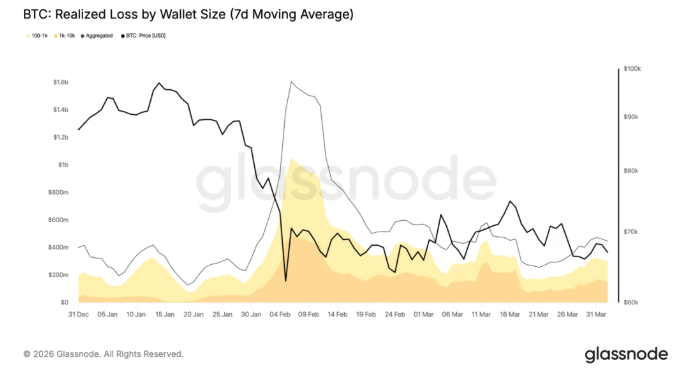
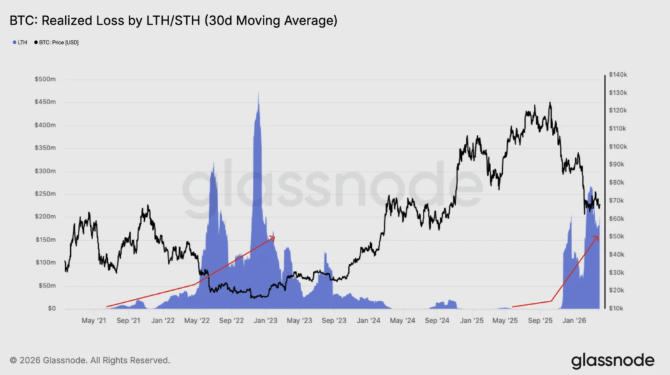
    Bitcoin traders holding 100–10,000 BTC experienced realized losses averaging $337 million per day in the first quarter of 2026, according to Glassnode data. This represents the worst quarter for BTC holders since 2022 and signals continued market stress for whales and mid-sized investors.

    Whales and Sharks Lock in $30.91 Billion Losses

    Large holders, categorized as sharks (100–1,000 BTC) and whales (1,000–10,000 BTC), accounted for the bulk of losses. Sharks realized $188.5 million daily, while whales added $147.5 million, bringing total Q1 losses to roughly $30.91 billion.

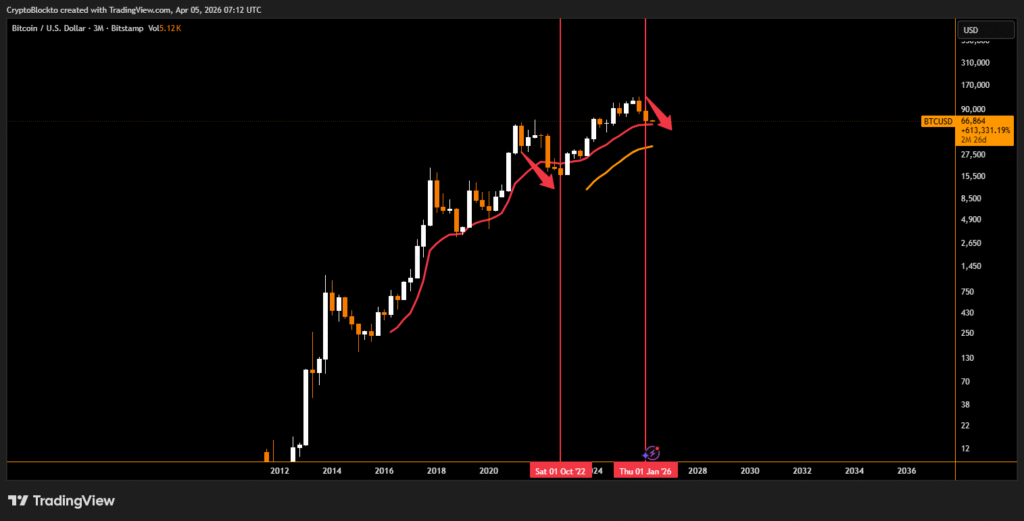
    This trend mirrors 2022’s significant sell-off, when BTC prices dropped over 50% in Q2, followed by an additional 20% decline by year-end. Past crises, including the Terra collapse, Celsius freeze, and Three Arrows liquidation, drove similar panic and liquidity challenges.

    $BTC 3 months price chart

    Long-Term Holders Also Selling at a Loss

    Losses among long term Bitcoin holders those who held coins for more than six months remain elevated at approximately $200 million per day, indicating ongoing capitulation. Analysts suggest that a meaningful cooldown below $25 million daily would signal exhaustion in selling pressure, a historical prerequisite for a sustained bull market.

    Pressure on Bitcoin stems from geopolitical tensions, Iran war driven inflation fears, quantum-security risks, and broader stress in AI-led risk trades. These headwinds have led some analysts to forecast further downside, with a potential bottom in the $40,000–$50,000 range, and a bear market potentially extending to Q4 2026.

    Disclaimer

    This content is for informational purposes only and does not constitute financial, investment, or legal advice. Cryptocurrency trading involves risk and may result in financial loss.

  • Germany Tightens Rules as Men Aged 17–45 Face New Travel Approval Requirement

    Germany Tightens Rules as Men Aged 17–45 Face New Travel Approval Requirement

    Military Service Modernisation Act Introduces New Travel Requirement

    Germany has introduced a new rule requiring men aged 17 to 45 to obtain approval from the Bundeswehr before traveling abroad for more than three months. The requirement comes under the Military Service Modernisation Act, which took effect on January 1, 2026, as part of efforts to strengthen the country’s military readiness and personnel planning.

    The change specifically revises paragraph 3 of the Conscription Act, which governs compulsory service obligations. Under the updated paragraph 2, male citizens aged 17 and above must seek authorization from a Bundeswehr careers center before extended stays outside Germany.

    Approval Still Granted While Service Remains Voluntary

    Officials clarified that, since military service remains voluntary, travel approvals are generally expected to be granted. However, administrative rules outlining detailed procedures are still being finalized. Authorities say the regulation ensures the government can track individuals who may be abroad during critical periods.

    Security Concerns Driving Policy Changes

    The law reflects heightened defense priorities following Russia’s invasion of Ukraine, which renewed focus on European security. Germany aims to increase military personnel from about 184,000 to between 255,000 and 270,000 troops by 2035.

    The Federal Ministry of Defence acknowledged the rule could significantly affect personal mobility. Young men planning long stays abroad such as semester programs or gap years may need formal approval, while further exemption guidelines are currently being developed.

    Disclaimer

    This content is for informational purposes only and does not constitute financial, investment, or legal advice. Cryptocurrency trading involves risk and may result in financial loss.

  • Bitcoin Developers Advance Quantum Proofing to Protect $1.3 Trillion Blockchain

    Bitcoin Developers Advance Quantum Proofing to Protect $1.3 Trillion Blockchain

    Quantum Threat to Bitcoin Raises Urgency

    Developers are actively exploring ways to quantum proof Bitcoin as the threat from quantum computing moves beyond the theoretical. Recent research from Google suggests that a sufficiently powerful quantum computer could break Bitcoin’s core cryptography in under nine minutes, potentially as soon as 2029. Approximately 1.7 million BTC, including coins belonging to Satoshi Nakamoto, are exposed to long-term quantum risk.

    Proposed Defenses and Security Measures

    Multiple initiatives aim to address these vulnerabilities:

    • BIP 360 removes public keys permanently embedded on chain by introducing Pay-to-Merkle-Root (P2MR) addresses, protecting future coins from quantum attacks.
    • SPHINCS+ / SLH-DSA, hash-based post-quantum signatures standardized by NIST, provide resistance against quantum attacks but increase signature size and transaction costs.
    • Commit/Reveal Scheme, proposed by Tadge Dryja, separates mempool transactions into commit and reveal phases, preventing short-window quantum attacks.
    • Hourglass V2, proposed by Hunter Beast, slows spending of roughly 1.7 million BTC in older exposed addresses, limiting withdrawals to prevent market collapse.

    Outlook for Bitcoin Security

    These proposals are not yet active, and adoption will be gradual due to Bitcoin’s decentralized governance structure involving developers, miners, and node operators. However, ongoing work demonstrates a proactive approach to safeguarding Bitcoin, ensuring the blockchain’s integrity, trust, and long-term viability against emerging quantum threats.

    Disclaimer

    This content is for informational purposes only and does not constitute financial, investment, or legal advice. Cryptocurrency trading involves risk and may result in financial loss.
  • Gold Investors Return to Bitcoin as Fund Flows Reverse: Fidelity Analysis

    Gold Investors Return to Bitcoin as Fund Flows Reverse: Fidelity Analysis

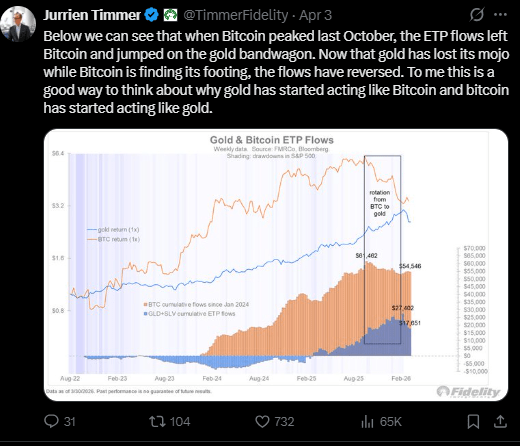
    Jurrien Timmer, director of global macro at Fidelity Investments, highlighted a significant shift in investor behavior, noting that gold investors are moving back into Bitcoin (BTC). In a post on X, Timmer stated that “investors who abandoned Bitcoin late last year are returning to crypto assets,” signaling renewed confidence in digital currencies.

    Reversal of 2025 Fund Flows

    Timmer explained, “Last year, investors pulled money out of crypto assets and moved into gold, but that flow is now reversing.” He emphasized that “as gold’s appeal fades and Bitcoin becomes more established, the direction of fund flows is changing.” This suggests a broader shift in investor priorities from traditional safe-haven assets toward cryptocurrencies.

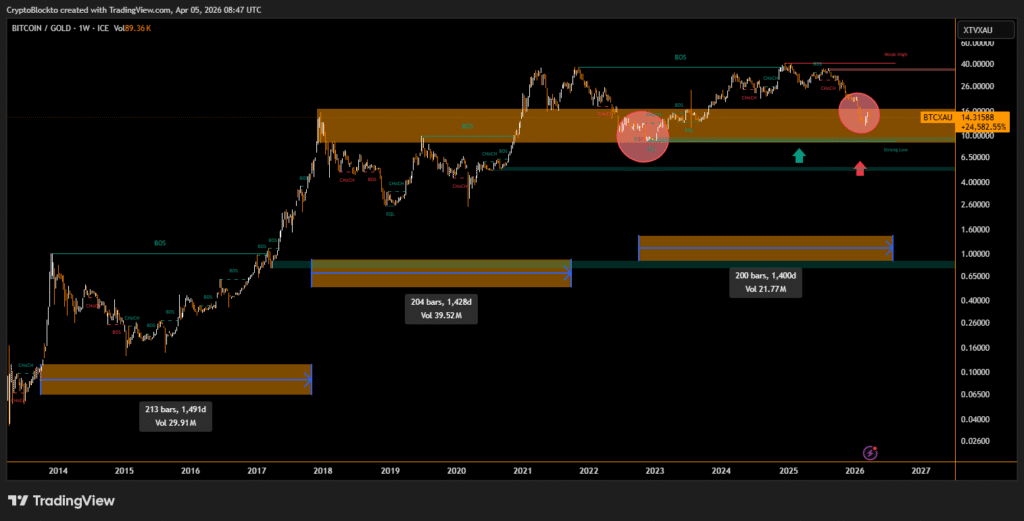
    Bitcoin vs Gold price Chart

    Bitcoin Support and Market Outlook

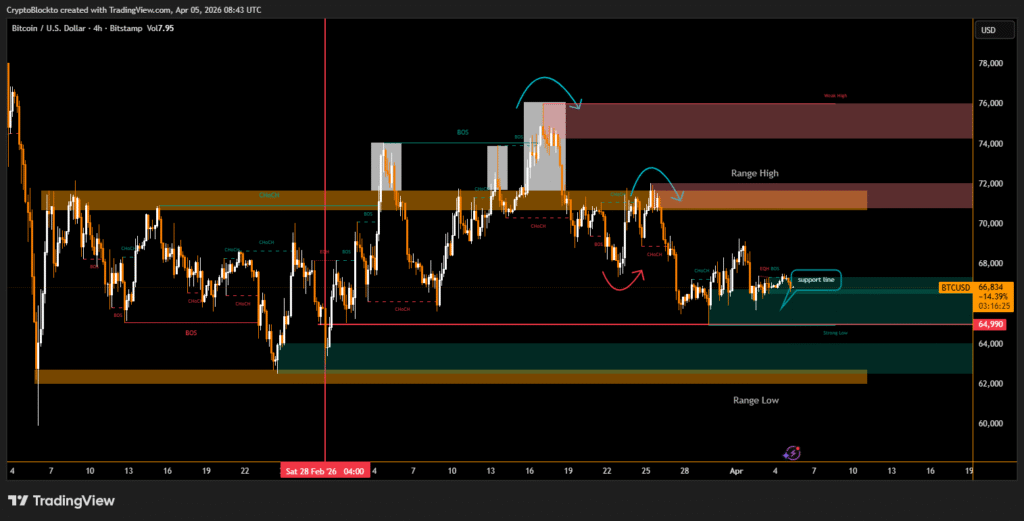
    The Fidelity executive noted that Bitcoin is currently forming support while trading sideways, appearing poised for the next leg higher. In comparison, gold has recently been relatively sluggish, reinforcing the reversal in capital allocation.

    Bitcoin was trading at $66,800 at the time of reporting, showing a decline of 5.63% over the past 30 days.

    $BTC 4h price chart

    Timmer added that these inter asset fund flows could affect price volatility in the near term, highlighting the importance of tracking short-term investment trends for both crypto and precious metals markets.

    Disclaimer

    This content is for informational purposes only and does not constitute financial, investment, or legal advice. Cryptocurrency trading involves risk and may result in financial loss.
  • Anthropic Launches PAC Amid Tensions With Trump Administration Over AI Policy

    Anthropic Launches PAC Amid Tensions With Trump Administration Over AI Policy

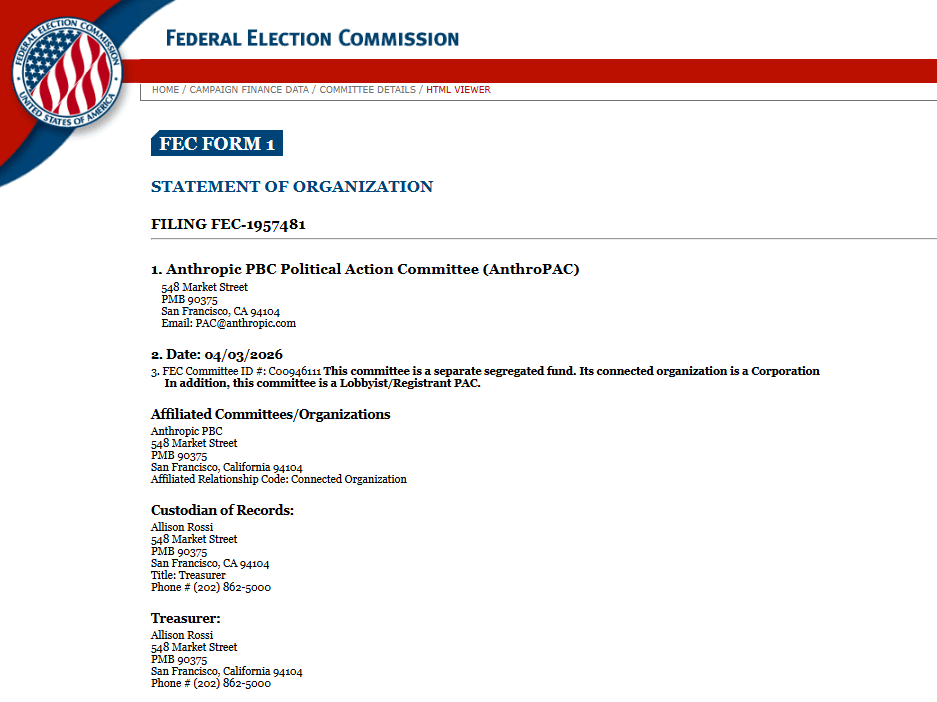
    Artificial intelligence firm Anthropic has launched an employee-funded political action committee (PAC) named AnthroPAC, entering election financing amid growing debates over AI policy in Washington. The company filed a statement of organization with the Federal Election Commission on Friday, listing Anthropic as the connected organization. Contributions are capped at $5,000 per candidate per election cycle and must be disclosed through public filings.

    Anthropic launches PAC

    Bipartisan Support and Funding Activity

    Anthropic said the PAC is expected to support candidates from both major parties, though some observers have questioned whether it will remain politically balanced. The company has already contributed $20 million to Public First Action, an organization focused on advancing AI safety initiatives.

    Clash With Pentagon Over AI Technology

    The move comes amid friction with the Pentagon, which designated Anthropic a supply chain risk in February after the company opposed the use of its AI in fully autonomous weapons and mass surveillance. Anthropic has challenged the designation in court, and a federal judge in California temporarily blocked the measure.

    Google Backing Texas Data Center

    In a related development, Google plans to support a multibillion-dollar Texas data center for Anthropic through Nexus Data Centers, with initial costs potentially exceeding $5 billion, reflecting increasing demand for AI infrastructure.

    Disclaimer

    This content is for informational purposes only and does not constitute financial, investment, or legal advice. Cryptocurrency trading involves risk and may result in financial loss.
  • Bitcoin Bearish Sentiment Climbs to Five-Week High as FUD Returns to Market

    Bitcoin Bearish Sentiment Climbs to Five-Week High as FUD Returns to Market

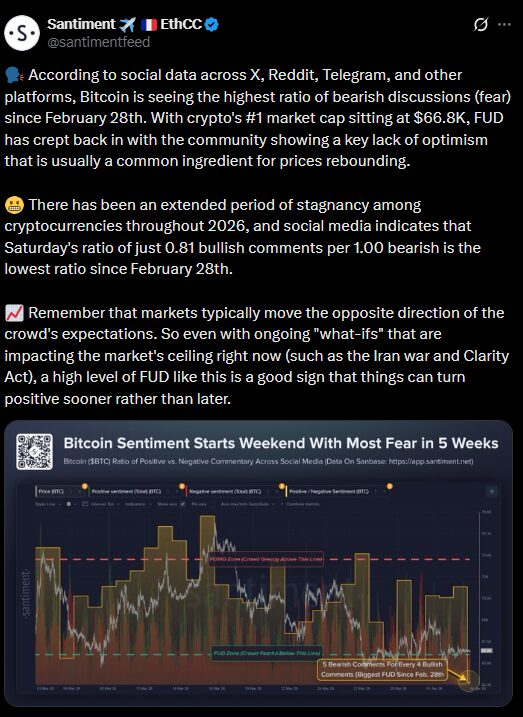
    Bearish sentiment surrounding Bitcoin has surged to its highest point in five weeks, reflecting growing fear among crypto market participants. Data from the crypto sentiment platform Santiment shows that negative commentary across social media platforms has increased significantly, signaling a lack of optimism within the community.

    According to Santiment, fear, uncertainty, and doubt (FUD) have reappeared in recent days. The firm analyzed a broad sample of crypto focused accounts on platforms such as X, Reddit, and other social channels to measure the ratio between bullish and bearish Bitcoin (BTC) comments.

    On Saturday, the ratio of bullish to bearish Bitcoin comments dropped to 0.81, the lowest level recorded since Feb. 28. This means there were roughly five bearish comments for every four bullish ones, highlighting a shift toward pessimism among traders.

    Markets Often Move Opposite to Crowd Sentiment

    Santiment noted that financial markets frequently move against prevailing expectations. The firm suggested that rising levels of FUD are often seen as a potential signal that prices could rebound sooner rather than later.

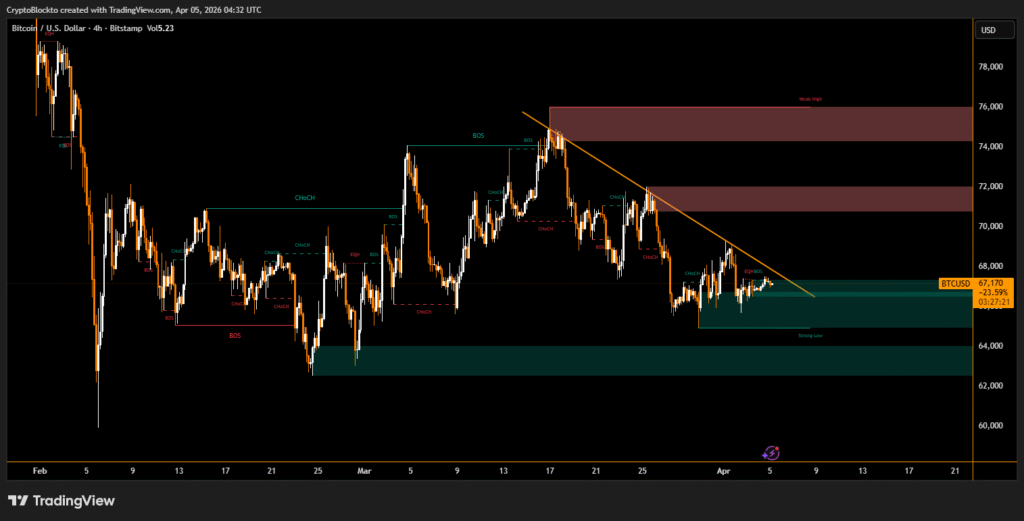
    Bitcoin was trading at $67,170 at the time of reporting, showing a decline of 5.53% over the past 30 days.

    $BTC 4h price chart

    US CLARITY Act and Extreme Fear Index Influence Market Outlook

    Santiment also identified the US CLARITY Act as a possible factor slowing price momentum, describing it as a key “what-if” catalyst being closely watched by the crypto industry.

    Separately, Coinbase chief legal officer Paul Grewal said the legislation is moving toward a markup hearing in the US Senate Banking Committee. He noted that the bill could proceed to a floor vote if senators resolve the ongoing dispute surrounding stablecoin yield and finalize the markup schedule.

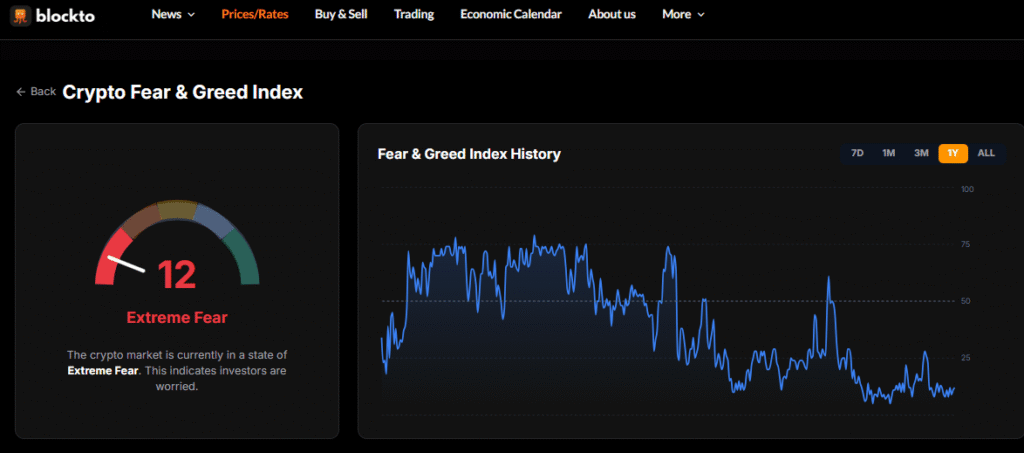
    Meanwhile, the Crypto Fear & Greed Index remained in “Extreme Fear” territory, recording a score of 12 on Sunday, signaling continued caution among investors.

    Disclaimer

    This content is for informational purposes only and does not constitute financial, investment, or legal advice. Cryptocurrency trading involves risk and may result in financial loss.