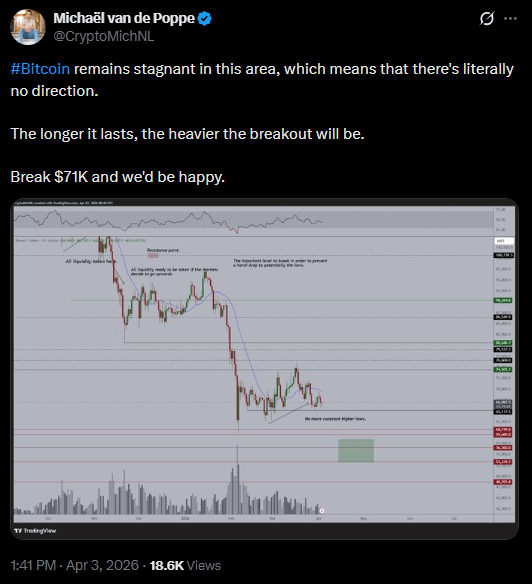
Bitcoin’s price action has remained largely flat below $70,000, a pattern some analysts suggest could precede a stronger rally. Michael van de Poppe, founder of MN Trading Capital, stated in an X post that “the longer it lasts, the heavier the breakout will be.” He noted that Bitcoin is “stagnant in this area,” pointing to $71,000 as a key level the asset has not reached since March 26.
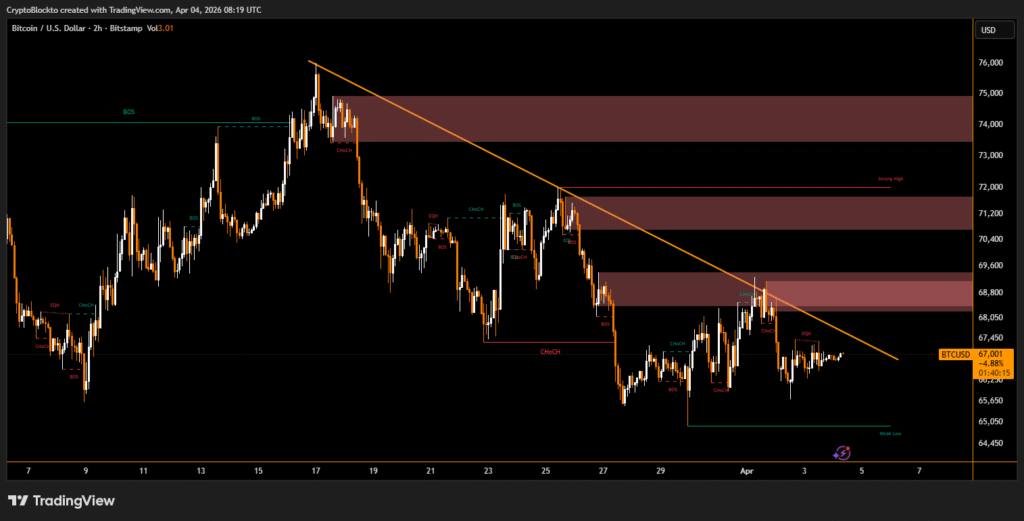
Since hitting a yearly low of $60,000 on February 6, Bitcoin has been trading within a narrow range of $60,000 to $74,000. At the time of reporting, Bitcoin is trading around $66,890, down 8.25% over the past 30 days according to CoinMarketCap data.
Bitcoin is down 7.63% over the past 30 days
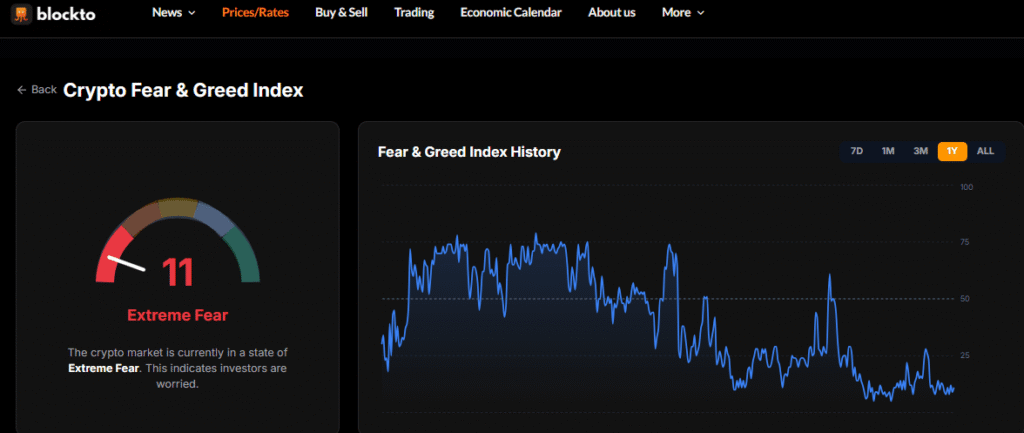
Market sentiment reflects ongoing caution, with the Crypto Fear & Greed Index remaining in “Extreme Fear” territory at a score of 11, highlighting uncertainty among investors.
Disclaimer
This content is for informational purposes only and does not constitute financial, investment, or legal advice. Cryptocurrency trading involves risk and may result in financial loss.
Solana Tests Quantum-Resistant Cryptography to Prepare for Future Threats
The Solana Foundation is working with cryptography firm Project Eleven to test quantum resistant security as concerns grow that future quantum computers could break current blockchain encryption. The effort reflects a wider industry push to prepare for a potential “Q-day,” the moment when quantum machines could solve mathematical problems that secure today’s digital assets.
Recent research from major technology and academic groups has intensified urgency, suggesting that powerful quantum systems could eventually crack widely used encryption methods much faster than traditional computers. While Bitcoin developers continue searching for solutions and Ethereum prepares long term strategies, Solana has moved toward live experimentation.
Project Eleven has deployed testing environments to model how the network performs when traditional cryptographic signatures are replaced with quantum-resistant alternatives. The goal is not only to prove security but to measure the impact on scalability and performance under real conditions.
Larger Signatures and Slower Speeds Present Major Tradeoffs
Early testing results show significant technical challenges. According to Project Eleven CEO Alex Pruden, quantum-safe signatures are approximately 20 to 40 times larger than current ones, placing heavy demands on network resources. In testing scenarios, a version of Solana using the new cryptography operated about 90% slower than its standard performance.
This slowdown directly challenges Solana’s reputation for high throughput and low latency. The network has built its identity around speed and efficiency, but stronger quantum protection introduces heavier data loads and computational demands.
Another concern involves structural design differences. Unlike Bitcoin and Ethereum, where wallet addresses are derived from hashed public keys, Solana exposes public keys directly. This makes the network potentially more vulnerable in a quantum scenario, as attackers could target any wallet and attempt to recover private keys.
Some developers are exploring alternatives such as Winternitz Vaults, which aim to protect individual wallets without requiring immediate system-wide upgrades. While challenges remain, early testing shows that active experimentation may help the ecosystem prepare before quantum threats become reality.
Disclaimer
This content is for informational purposes only and does not constitute financial, investment, or legal advice. Cryptocurrency trading involves risk and may result in financial loss.
Leap Wallet, a noncustodial crypto wallet originally designed for the Terra Luna ecosystem, is shutting down its software suite by May 28, the team announced on Friday. The closure affects the browser extension, iOS and Android mobile apps, the Leap WebApp, Swapfast exchange platform, and the Leap Cosmos Hub validator.
The Leap team urged users with ATOM delegated to their Cosmos Hub validator to redelegate to another validator promptly to continue earning staking rewards, accounting for network unbonding periods. Despite the shutdown, users can still access their assets through a recovery phrase or private key using another wallet, without needing to move funds to a new address.
Leap Wallet: Sunset Notice
After careful consideration, we've made the decision to sunset Leap Wallet and its associated products.
The products will be sunset on 28th May, 2026, and all users should complete their migration before then.
We started Leap in 2022 to redefine what…
— Leap Wallet | Sunset on 28th May (@leap_wallet) April 2, 2026
Leap Wallet’s Origins and Evolution
Leap was launched in late 2021 with a $50,000 grant from Terraform Labs, the R&D firm behind TerraUSD, and later raised a $3.2 million seed round co-led by CoinFund and Pantera Capital in early 2022. Initially positioned as a go-to wallet for Terra similar to MetaMask for Ethereum or Phantom for Solana Leap offered staking, trading via Terraswap, and integration with Terraform Labs’ Anchor and Mirror decentralized applications.
After Terra’s collapse in 2022, Leap pivoted to support the broader Cosmos ecosystem, leveraging Cosmos’ SDK to expand across multiple chains. The team emphasized their commitment to users and the interchain ecosystem, calling the decision to shut down a difficult but necessary step.
Disclaimer
This content is for informational purposes only and does not constitute financial, investment, or legal advice. Cryptocurrency trading involves risk and may result in financial loss.
Polymarket has removed a prediction market tied to the fate of a missing US service member after public backlash, stating that the listing violated its “integrity standards.” The market had asked users whether US authorities would confirm the rescue of a pilot reportedly shot down over Iran, with more than 60% of participants betting that the rescue would not be confirmed before Saturday.
US Representative Seth Moulton strongly criticized the listing, calling it “disgusting” and raising concerns about people speculating on the safety of a potentially injured service member. He noted that those involved could be “a neighbor, a friend, a family member,” emphasizing the ethical concerns surrounding such predictions.
If I was in that situation, I would want the information that a betting market provides. https://t.co/7reRNwWsPw
In response to the criticism, Polymarket said the market was removed immediately and acknowledged that it should not have been listed. The platform added that it is reviewing how the listing passed its internal safeguards but did not specify which rule had been violated.
Prediction Market Rules and Insider Trading Concerns Grow
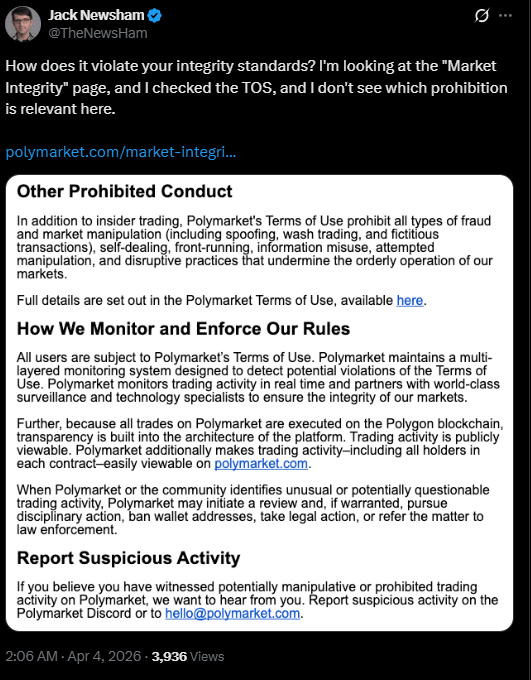
The removal has drawn scrutiny from users questioning how Polymarket applies its rules. Some users reviewed the platform’s Market Integrity guidelines and terms of service but said they could not identify the specific prohibition involved.
The controversy comes as prediction markets face growing concerns about insider trading. Recent reports indicated that a group of traders earned about $1 million by correctly betting on the timing of US strikes on Iran, placing trades shortly before the attacks.
Jack Newsham, a correspondent on Business Insider’s national desk, wrote on X;
At least 42 Democratic lawmakers have urged regulators, including the Commodity Futures Trading Commission and the Office of Government Ethics, to warn federal employees against using non-public information to trade on prediction markets.
Disclaimer
This content is for informational purposes only and does not constitute financial, investment, or legal advice. Cryptocurrency trading involves risk and may result in financial loss.
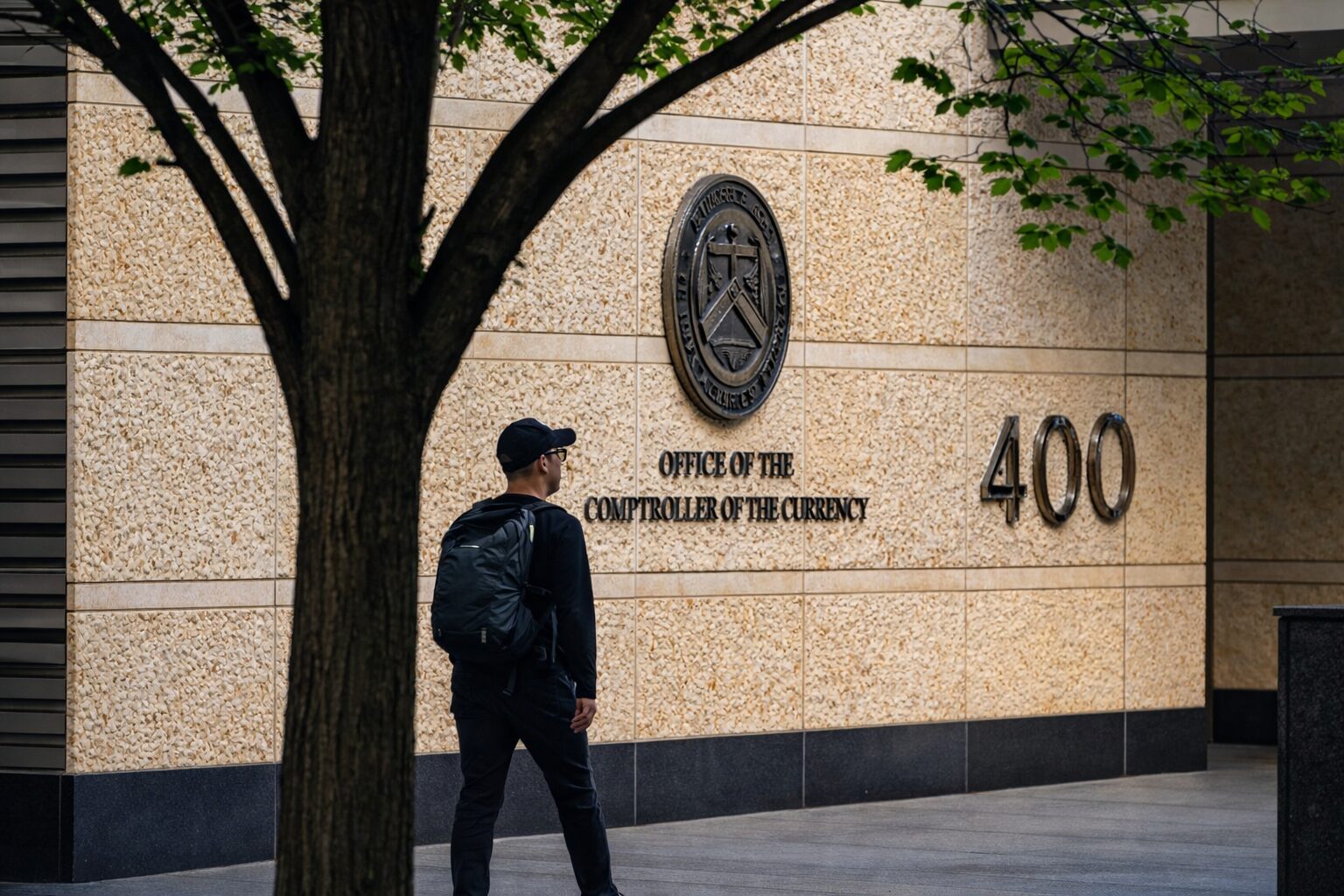
The Independent Community Bankers of America (ICBA) has voiced strong opposition to the Office of the Comptroller of the Currency’s (OCC) conditional approval of Coinbase’s national trust bank charter. The group warned that the application falls short of regulatory standards, citing deficiencies in risk controls, profitability, and resolution planning. ICBA also questioned the OCC’s authority to expand trust powers for crypto-related activities without enforcing the full set of banking regulations.
“The sudden influx of applications demonstrates nonbank entities are seeking the benefits of a US bank charter without satisfying the full scope of US bank regulations,” the ICBA said. Similarly, Americans for Financial Reform Education Fund criticized the approval, citing potential risks to the financial system from crypto market volatility, fraud, and money laundering.
Coinbase Responds and Industry Dispute Continues
Coinbase stated that the charter would place its custody and market infrastructure business under federal oversight, emphasizing it will not hold customer deposits or engage in fractional reserve lending. CEO Brian Armstrong noted that “the right path forward for crypto is through the system not around it.”
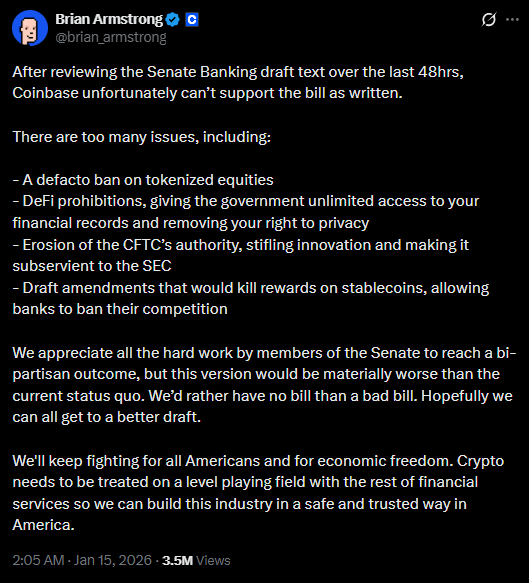
The approval comes amid a broader dispute over digital assets’ role in finance, particularly stablecoins and yield-bearing products. Bank of America CEO Brian Moynihan warned that allowing stablecoin issuers to offer interest could shift up to $6 trillion in deposits away from banks, affecting lending and borrowing costs. Legislative efforts, including the US Digital Asset Market Clarity Act, remain in progress, with stablecoin yield provisions a central sticking point delaying Senate consideration.
Disclaimer
This content is for informational purposes only and does not constitute financial, investment, or legal advice. Cryptocurrency trading involves risk and may result in financial loss.
A Nevada state judge has extended a temporary ban on Kalshi’s sports related prediction markets, citing concerns that the contracts are “indistinguishable” from traditional gambling. Judge Jason Woodbury of the First Judicial District Court approved the extension of a temporary restraining order originally issued on March 20 and granted the Nevada Gaming Control Board’s request for a preliminary injunction. The injunction prevents Kalshi from offering certain prediction market products until a broader legal case is resolved.
The judge specifically noted that buying a contract on a baseball game through Kalshi is equivalent to placing a bet on a state gaming platform. “I find based on the arguments that have been presented that it is a gaming activity that is prohibited for any non-licensee to engage in,” Woodbury said. The original restraining order also applied to entertainment and election-related contracts.
Federal vs State Regulatory Debate
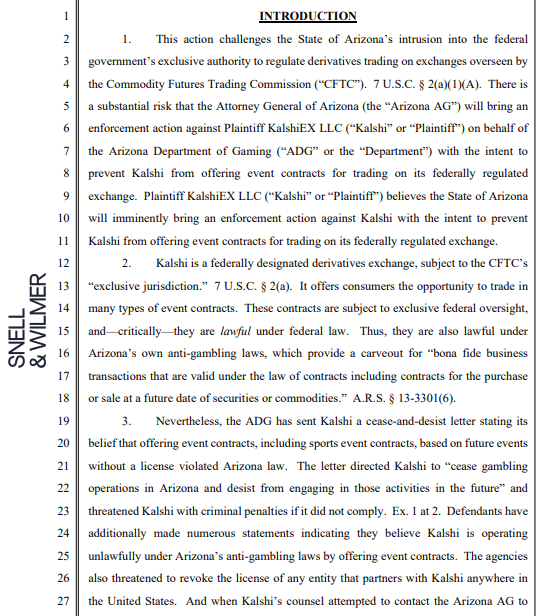
Kalshi argues that its markets are federally regulated designated contract markets offering swaps, a type of derivative, and thus fall under the jurisdiction of the Commodity Futures Trading Commission (CFTC). The CFTC, led by Chairman Mike Selig, has supported Kalshi and other prediction market providers, filing an amicus brief and lawsuits against Arizona, Illinois, and Connecticut alongside the Department of Justice to assert federal oversight.
The ruling comes amid ongoing nationwide legal disputes, with similar hearings taking place in Arizona, where Kalshi is challenging state attempts to block its products, including criminal allegations filed by Arizona Attorney General Kris Mayes.
Disclaimer
This content is for informational purposes only and does not constitute financial, investment, or legal advice. Cryptocurrency trading involves risk and may result in financial loss.
Kalshi announced that Stephanie Cutter, a former staffer for President Barack Obama, will join the company as a policy adviser. Cutter, who co founded communications firm Precision Strategies in 2013, is expected to help Kalshi “deepen its relationships in DC and across the country,” according to the company’s Thursday notice.
@kalshi is setting high standards for themselves and their competitors.
Kalshi co founder and CEO Tarek Mansour emphasized Cutter’s experience in government and politics, saying she can “get [the] message to the right people.” The platform already has staff with government connections, including Donald Trump Jr., who joined as a strategic adviser in January 2025, just before his father took office.
Legal Scrutiny and Regulatory Challenges
Kalshi has faced heightened regulatory scrutiny over the past year. Several US state authorities have filed lawsuits alleging that the company’s event contracts constitute illegal bets. Meanwhile, the US Commodity Futures Trading Commission (CFTC), under Trump nominee Michael Selig, has asserted “exclusive jurisdiction” over such markets and filed suits against state regulators.
Congressional Democrats have also called for closer oversight, citing “suspicious trades” related to geopolitical events, including the US invasion of Iran. In response, Kalshi and Polymarket have introduced guardrails to prevent the use of insider information. As of Friday, no federal legislation has been signed, and the outcome of ongoing state-level lawsuits remains uncertain.
Disclaimer
This content is for informational purposes only and does not constitute financial, investment, or legal advice. Cryptocurrency trading involves risk and may result in financial loss.
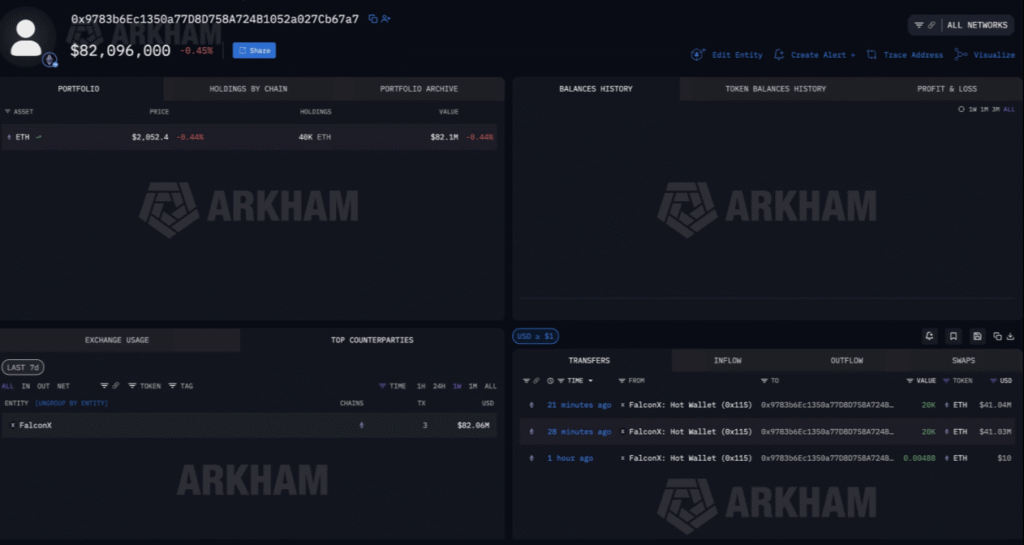
A fresh wallet has withdrawn $82.12 million worth of Ethereum (ETH) from FalconX in the past hour, according to blockchain intelligence data from Arkham . Analysts note that the purchase pattern matches previous transactions associated with Bitmine, the investment firm led by Tom Lee. The transaction involved approximately 40,000 ETH, marking another significant acquisition for the firm.
While the wallet’s behavior strongly aligns with Bitmine’s historical purchase activity, it is important to note that on chain data cannot definitively confirm ownership. Arkham Intelligence highlighted the similarities in timing, amount, and transaction patterns, suggesting this could be another major ETH accumulation by the firm.
Implications for Ethereum Market
Bitmine’s purchase adds to a series of large scale acquisitions that have been observed over recent months. Such high-volume buys by institutional investors are often interpreted as bullish signals for the cryptocurrency, reflecting confidence in Ethereum’s potential for growth.
The transaction highlights ongoing interest from major market participants and underscores the influence of institutional wallets on crypto price dynamics. While confirmation from Bitmine or Tom Lee is pending, the size and pattern of the purchase suggest strategic accumulation within the Ethereum market.
Disclaimer
This content is for informational purposes only and does not constitute financial, investment, or legal advice. Cryptocurrency trading involves risk and may result in financial loss.
Tether is reportedly pressing investors to commit to a major fundraising round at a $500 billion valuation within the next two weeks, warning that the effort could be delayed if demand falls short. The El Salvador based company has been seeking fresh capital since late last year, but some investors remain cautious about the high valuation target.
If achieved, the proposed valuation would position Tether among the world’s largest financial firms. The figure would place the company ahead of every United States bank except JPMorgan Chase, which has a market capitalization of about $794.55 billion, and above Bank of America, valued at roughly $352.86 billion.
Earlier discussions suggested Tether could raise between $15 billion and $20 billion through a private placement, offering about a 3% stake. Cantor Fitzgerald was identified as a lead adviser in those early planning stages.
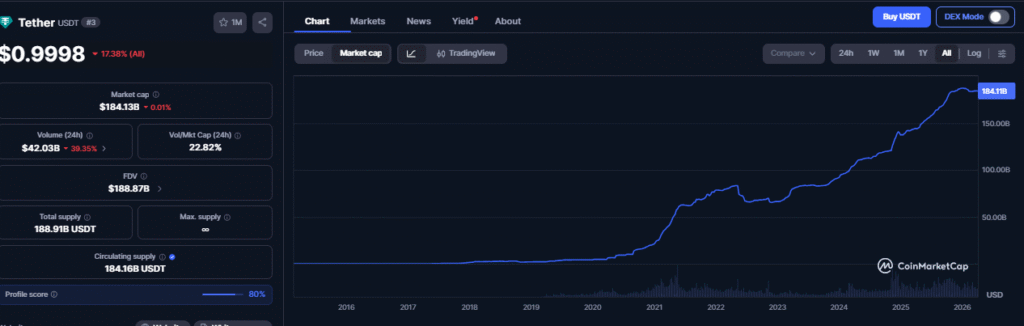
USDt market cap.
CEO Paolo Ardoino Defends Valuation and Expansion Strategy
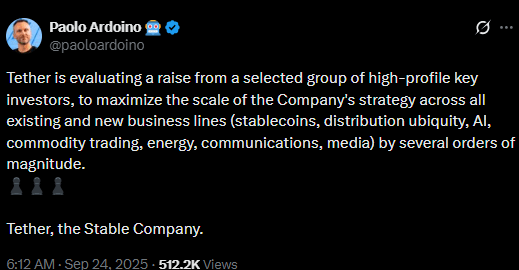
Chief Executive Officer Paolo Ardoino previously stated that the company was considering raising funds from a select group of investors to accelerate growth across both existing and new business lines. These areas include stablecoins, distribution networks, artificial intelligence, commodity trading, energy, communications, and media.
Although earlier estimates of a $15 billion to $20 billion raise were later described as hypothetical scenarios rather than a confirmed plan, Ardoino continued to defend the $500 billion valuation. He compared the company’s profitability potential to major artificial intelligence platforms.
USDt Market Cap and Audit Efforts Gain Attention
Tether’s USDt stablecoin remains the company’s largest product, with a market capitalization of approximately $184 billion. Other key offerings include Tether Gold (XAUt) and Tether EURt (EURt), which are pegged to gold and the euro respectively.
Separately, Tether has reportedly hired KPMG to conduct its first full audit of USDt financial statements, while PwC is assisting in preparing internal systems. The comprehensive audit is expected to examine assets, liabilities, and internal controls, going beyond the reserve attestations previously conducted by BDO Italia.
Disclaimer
This content is for informational purposes only and does not constitute financial, investment, or legal advice. Cryptocurrency trading involves risk and may result in financial loss.
Charles Schwab is preparing to launch spot crypto trading for Bitcoin and Ethereum in the first half of 2026, marking a major step in its expansion into digital assets.
The new service will be offered through Charles Schwab Premier Bank, SSB, allowing clients to buy and sell the two largest cryptocurrencies directly within their brokerage accounts. The firm has also opened a waitlist for early access to its upcoming Schwab Crypto account, designed to integrate crypto trading alongside traditional investments such as stocks and bonds.
Chief Executive Officer Rick Wurster previously indicated that growing client demand influenced the company’s decision to move into spot crypto trading. The initiative aims to create a unified investment experience where digital assets appear within the same portfolio view as conventional financial instruments.
Schwab’s Scale Positions It Against Crypto-Native Exchanges
With approximately $11.9 trillion in client assets reported in 2025, Schwab enters the crypto market with a substantial investor base. The company already supports cryptocurrency-linked exchange-traded funds and offers Bitcoin futures trading, along with the Schwab Crypto Thematic Index (STCE), which tracks companies tied to the digital asset sector.
Disclaimer
This content is for informational purposes only and does not constitute financial, investment, or legal advice. Cryptocurrency trading involves risk and may result in financial loss.