Author: tristan

  • Crypto Market Flows Drop to $11 Billion in Q1 2026, JPMorgan Reports

    Crypto Market Flows Drop to $11 Billion in Q1 2026, JPMorgan Reports

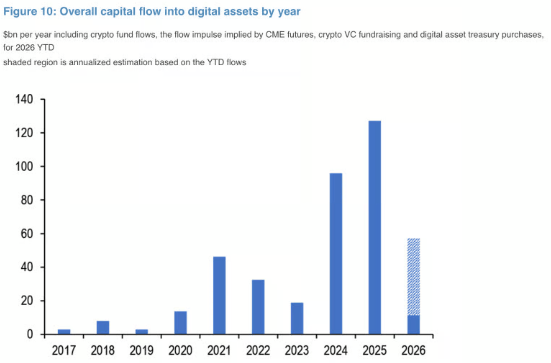
    Digital asset flows declined significantly in the first quarter of 2026, according to analysts at JPMorgan. Total crypto market inflows were estimated at $11 billion, roughly one third of the level recorded during the same quarter last year.

    The slowdown implies an annualized pace of around $44 billion, far below the record $130 billion inflows recorded in 2025. Analysts calculated total flows using combined data from crypto fund movements, futures activity, venture capital funding, and corporate treasury purchases.
    Corporate Bitcoin Buying Remains a Key Driver

    Much of the first quarter inflow was linked to corporate treasury purchases of Bitcoin, particularly from Strategy. The company continued acquiring Bitcoin using funds raised through equity issuance, while several smaller firms reduced holdings to support share buybacks.

    Institutional Demand Weakens as Miners Increase Selling

    Institutional positioning through futures on CME Group weakened during the quarter, signaling reduced demand. Spot Bitcoin and Ethereum exchange traded funds also recorded outflows, particularly in January, though Bitcoin ETFs saw modest inflows in March.

    At the same time, Bitcoin mining companies became net sellers, using assets as collateral or liquidating holdings to improve liquidity and fund operations, reflecting tighter financing conditions rather than widespread distress.

    Disclaimer

    This content is for informational purposes only and does not constitute financial, investment, or legal advice. Cryptocurrency trading involves risk and may result in financial loss.
  • Corporate Bitcoin Treasuries Diverge as BTC Drops Below $70K

    Corporate Bitcoin Treasuries Diverge as BTC Drops Below $70K

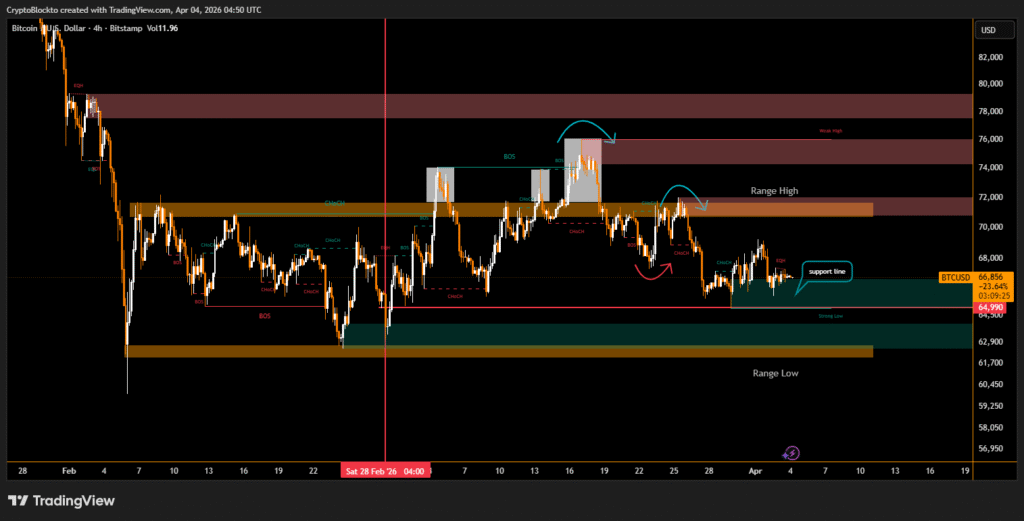
    Corporate holders of Bitcoin are beginning to take sharply different approaches as the asset remains under pressure, falling about 46% from its peak to below $70,000. Some firms continue treating Bitcoin as a long term reserve asset while others are reducing exposure to protect liquidity and balance sheets.

    $BTC 4h price chart

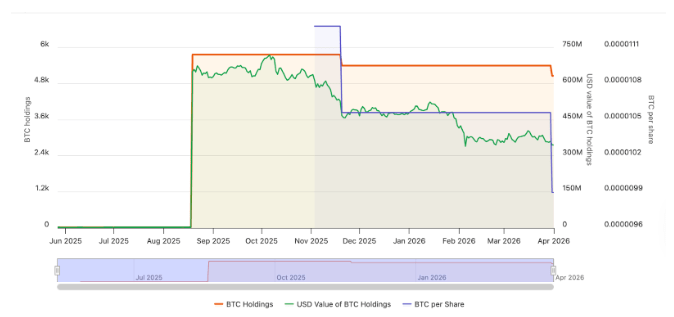
    Nakamoto Holdings moved to sell approximately 284 BTC in March at around $70,400 per coin, totaling roughly $20 million. The sale occurred below its average purchase price, converting unrealized losses into realized ones. The company reduced its holdings to just over 5,000 BTC, using proceeds for working capital and merger-related investments. It also sold millions of shares in Metaplanet at a loss, signaling broader balance-sheet restructuring.

    Nakamoto’s Bitcoin holdings last year: BitcoinTreasuries.NET

    Strategy Maintains Holdings While Pausing New Purchases

    Meanwhile, Strategy, led by Michael Saylor, paused new Bitcoin purchases after months of steady accumulation. Despite the halt, the company still holds roughly 762,000 BTC, maintaining its position as the largest corporate holder of the asset.

    Bitcoin-Backed Bonds and Market Expansion Efforts

    A proposed $100 million Bitcoin backed municipal bond in New Hampshire received a Ba2 speculative-grade rating from Moody’s, reflecting the risks tied to Bitcoin’s volatility. At the same time, digital asset manager CoinShares entered the Nasdaq following a merger with Vine Hill Capital, highlighting continued institutional expansion despite shifting market conditions.

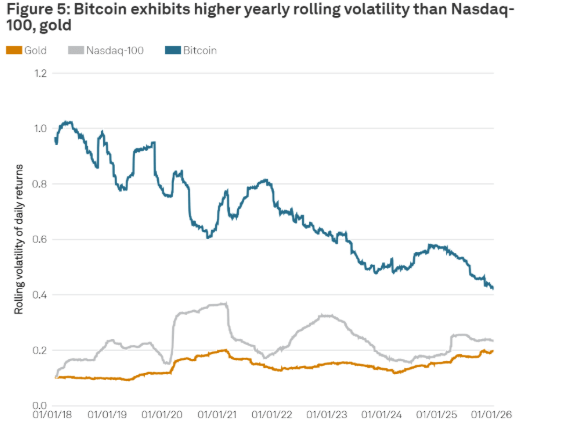
    Bitcoin volatility, cited as a key factor that speculative grade rating, remains elevated compared with traditional asset classes.: S&P Global

    Disclaimer

    This content is for informational purposes only and does not constitute financial, investment, or legal advice. Cryptocurrency trading involves risk and may result in financial loss.
  • Bitcoin’s Quantum Risk: How Exposed Public Keys Could Become Targets

    Bitcoin’s Quantum Risk: How Exposed Public Keys Could Become Targets

    Google Quantum Research Raises Security Questions for Bitcoin

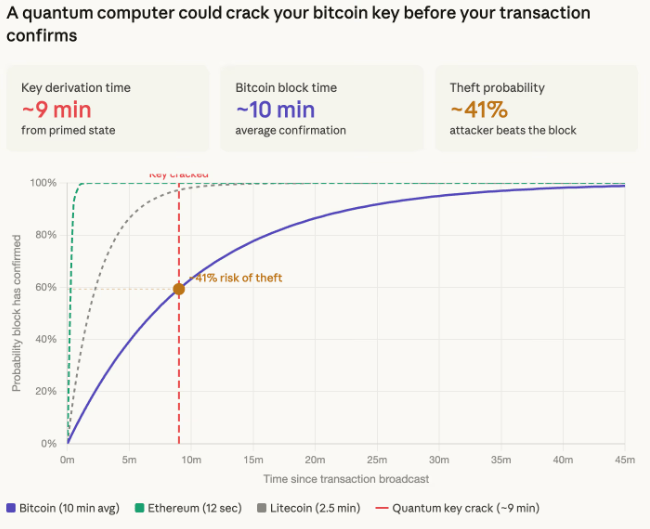
    New findings from Google’s Google Quantum AI team suggest that a future quantum computer could derive a Bitcoin private key from a public key in roughly nine minutes, potentially allowing attackers to hijack transactions before confirmation.

    Bitcoin transactions typically take about 10 minutes to confirm, creating a narrow window in which an attacker could attempt to extract a private key once the public key becomes visible in the mempool. Researchers explained that such attacks rely on solving the elliptic curve discrete logarithm problem using quantum algorithms such as Shor’s algorithm, which classical computers cannot efficiently execute.

    Up to 6.9 Million Bitcoin Could Face Greater Exposure

    The research highlights a broader concern involving approximately 6.9 million bitcoin, nearly one third of total supply, stored in addresses where public keys have already been exposed. These include early wallets using pay to public key formats and addresses that have been reused, allowing attackers to target them without time pressure.

    Post-Quantum Cryptography Seen as Long-Term Solution

    While Bitcoin mining would continue using the SHA-256 algorithm, experts warn that ownership guarantees could weaken if private keys become derivable. Developers are exploring post quantum cryptography as a potential safeguard, though migration efforts remain in early stages compared with other blockchain ecosystems.

    Disclaimer

    This content is for informational purposes only and does not constitute financial, investment, or legal advice. Cryptocurrency trading involves risk and may result in financial loss.
  • Iran Rejects U.S. 48-Hour Ceasefire Proposal Amid Rising Military Tensions

    Iran Rejects U.S. 48-Hour Ceasefire Proposal Amid Rising Military Tensions

    Iran has rejected a proposed 48-hour ceasefire reportedly offered by the United States through an intermediary on April 2, according to News Agency.

    Sources cited by the agency claimed that instead of accepting the temporary halt in hostilities, Tehran responded by increasing the intensity of its attacks. The reported ceasefire proposal allegedly followed operational challenges faced by U.S. armed forces, which were attributed to a miscalculation of Iran’s military capabilities.

    Conflicting Statements Highlight Ongoing Diplomatic Tensions

    Earlier, Donald Trump stated that Washington was negotiating with what he described as new Iranian authorities to bring an end to the armed conflict. However, officials from Iran’s foreign ministry have repeatedly rejected those claims.

    Iran Calls U.S. Proposals “Illogical” and “Excessively Harsh”

    Iranian authorities said they had received multiple settlement proposals from the United States through intermediary channels but described the terms as “illogical” and “excessively harsh.” The exchange highlights ongoing diplomatic strain and uncertainty surrounding potential ceasefire efforts between the two countries.

    Disclaimer

    This content is for informational purposes only and does not constitute financial, investment, or legal advice. Cryptocurrency trading involves risk and may result in financial loss.

  • XRP Price Stays Range-Bound Near $1.33 as Traders Await Breakout Signal

    XRP Price Stays Range-Bound Near $1.33 as Traders Await Breakout Signal

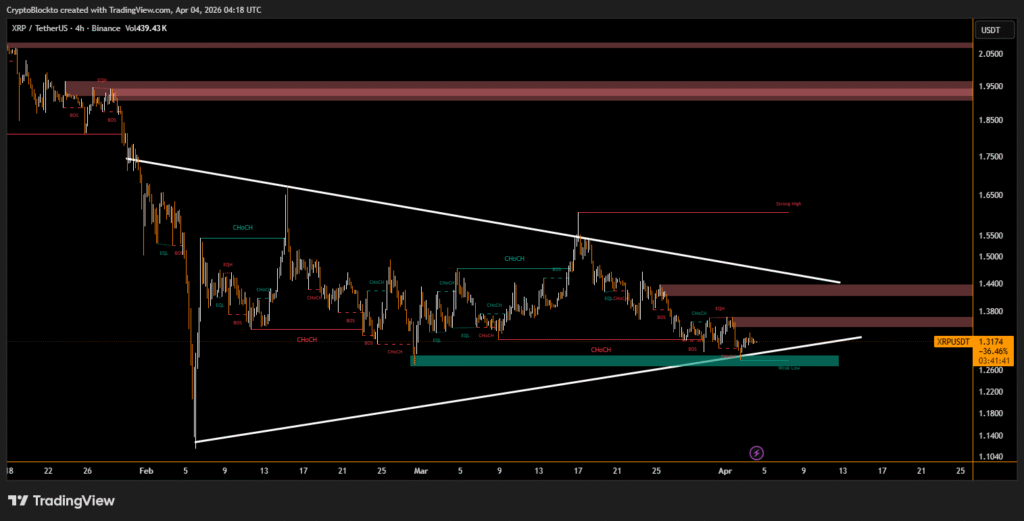
    XRP continued to trade around $1.33, holding within a narrow range as price action closely tracked the broader cryptoc market. The token gained just over 1%, while trading volume rose about 23% above its weekly average, indicating increased activity without a decisive directional move.

    $XRP 4h chart

    Despite higher participation, the lack of a breakout suggests traders are positioning rather than committing to strong bullish or bearish momentum. XRP’s price movement remained largely aligned with the wider market, with no major token-specific catalyst driving the session.

    Key Support and Resistance Levels Define Current Structure

    Price action showed buyers stepping in during dips, helping XRP maintain support near $1.30 while forming slightly higher lows. However, attempts to push toward the $1.33 to $1.34 region were repeatedly met with selling pressure, preventing sustained upward movement.

    Traders Watch for Breakout Above $1.35

    The immediate resistance zone remains between $1.34 and $1.35, where a breakout could trigger stronger momentum. Meanwhile, $1.30 continues to act as the structural floor. Until either level breaks decisively, XRP is expected to remain in a compression phase, reacting primarily to broader market trends rather than leading them.

    Disclaimer

    This content is for informational purposes only and does not constitute financial, investment, or legal advice. Cryptocurrency trading involves risk and may result in financial loss.
  • Dmail Network to Shut Down Services on May 15 After Funding and Cost Challenges

    Dmail Network to Shut Down Services on May 15 After Funding and Cost Challenges

    Dmail Network, a decentralized email and messaging platform, has announced it will cease all services starting May 15 after five years of operations. The platform urged users to export their data before the deadline, warning that once nodes shut down, emails and user accounts will become inaccessible.

    The project was known for offering wallet-based email, encrypted messaging, and onchain notifications, positioning itself as a Web3 communication solution. In January 2025, Dmail ranked second among AI-based decentralized applications, recording 4.9 million unique active wallets for the month.

    High Costs and Failed Fundraising Pressured Operations

    Dmail cited rising infrastructure expenses, including bandwidth, storage, and computing costs, as key reasons behind the shutdown. The company said multiple funding rounds failed and acquisition attempts did not materialize, leaving finances close to exhaustion.

    The project also acknowledged that its token failed to develop a clear large-scale use case, weakening long-term sustainability. Following the shutdown announcement, the token’s price dropped to $0.0002067, reaching an all-time low and reflecting declining market confidence.

    Disclaimer

    This content is for informational purposes only and does not constitute financial, investment, or legal advice. Cryptocurrency trading involves risk and may result in financial loss.

  • Cambodia Passes First Cybercrime Law Targeting Scam Compounds and Crypto Fraud

    Cambodia Passes First Cybercrime Law Targeting Scam Compounds and Crypto Fraud

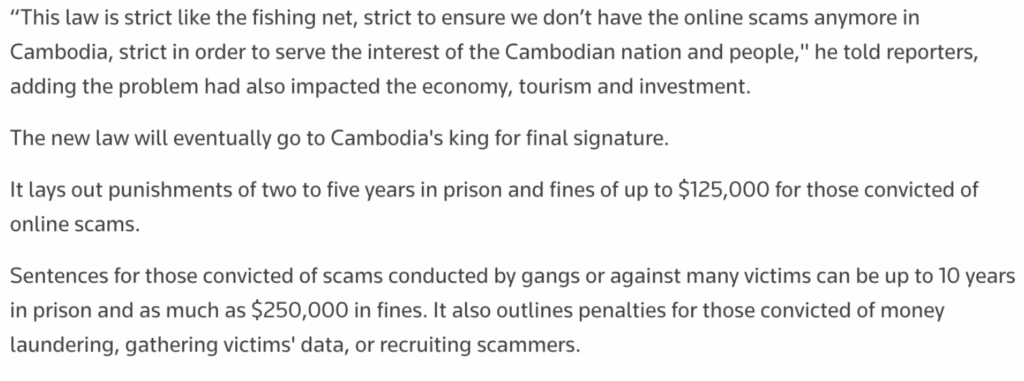
    Cambodia’s parliament has approved its first dedicated cybercrime law aimed at tackling scam compounds accused of defrauding international victims and laundering funds through digital channels, including cryptocurrency. The legislation introduces prison sentences of two to five years and fines of up to $125,000 for individuals convicted of standard online scam offenses.

    Justice Minister Keut Rith stated that the law is designed to strengthen ongoing enforcement actions and prevent scam operations from re emerging after crackdowns. He noted that online fraud activities have negatively affected Cambodia’s economy, tourism sector, and investment environment.

    first dedicated cybercrime law

    Tougher Punishments for Organized Fraud Networks

    Under the new law, harsher penalties apply to crimes carried out by organized groups or involving multiple victims. Offenders in such cases may face up to 10 years in prison and fines reaching $250,000. The legislation also includes provisions targeting money laundering, data collection of victims, and recruitment of scammers, addressing key components of large-scale fraud networks.

    The bill will now be submitted to Cambodia’s king for final approval. Once enacted, it will provide the country with its first comprehensive legal framework specifically designed to combat cross-border online scams and related financial crimes.

    Disclaimer

    This content is for informational purposes only and does not constitute financial, investment, or legal advice. Cryptocurrency trading involves risk and may result in financial loss.
  • ZachXBT Criticizes Circle Over Delayed USDC Freezes Linked to $420M Illicit Funds

    ZachXBT Criticizes Circle Over Delayed USDC Freezes Linked to $420M Illicit Funds

    Blockchain investigator ZachXBT has accused Circle of slow responses in freezing funds linked to illegal activity, citing 15 incidents involving more than $420 million in alleged illicit transactions.

    In a detailed thread, ZachXBT pointed to the recent Drift Protocol exploit, valued at over $280 million, as a key example. According to the report, attackers bridged approximately 232 million USDC from the Solana network to Ethereum through more than 100 transactions over six hours, yet no funds were frozen during that period.

    Blockchain analytics firm Elliptic stated that multiple indicators suggested links to the Democratic People’s Republic of Korea in connection with the attack.

    Earlier Incidents Raise Compliance Questions

    ZachXBT also referenced the Cetus Protocol exploit, valued at $223 million, where roughly 61 million USDC was bridged from the Sui network to Ethereum. In that case, the address was reportedly blacklisted one month later, after funds had already been converted to Ether.

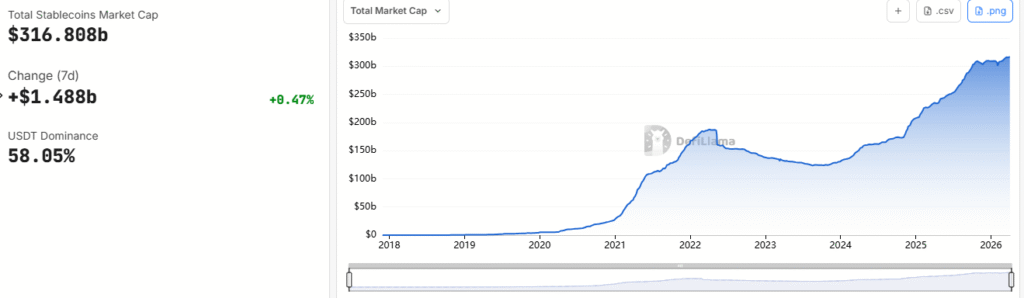
    Total Stablecoin Supply

    Circle responded that it freezes assets only when legally required and in line with privacy protections. With USDC circulation exceeding $77 billion, the criticism adds pressure on stablecoin issuers to improve coordination and response times across the digital asset ecosystem.

    Disclaimer

    This content is for informational purposes only and does not constitute financial, investment, or legal advice. Cryptocurrency trading involves risk and may result in financial loss.
  • Aave V3 Avoided Bad Debt but Shifted Risk to Borrowers, Bank of Canada Study Finds

    Aave V3 Avoided Bad Debt but Shifted Risk to Borrowers, Bank of Canada Study Finds

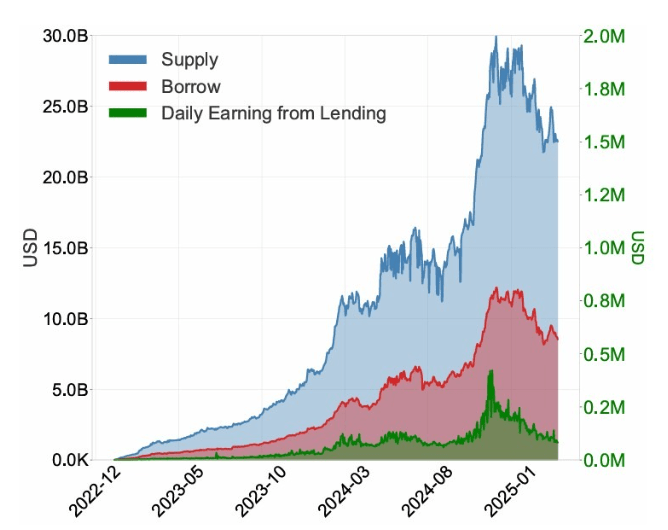
    A staff paper from the Bank of Canada found that Aave V3 reported zero non performing loans in 2024, largely due to its overcollateralization model and automated liquidation system. The study analyzed transaction-level data from Jan. 27, 2023, to May 6, 2025, showing that borrower positions were usually liquidated before collateral values dropped below outstanding debt.

    This structure protected lenders from unrecovered losses across the Ethereum lending market. However, the research noted that the system relies heavily on automated risk controls rather than traditional underwriting methods. Borrowers are required to deposit collateral exceeding the value of their loans, with liquidations triggered when risk thresholds are breached.

    Daily lending earnings, circulating supply, and borrowing volumes (USD) on Aave V3

    Recursive Leverage Increased Borrowing Exposure

    The study also found that recursive leverage played a major role in borrowing demand, accounting for over 20% of total borrowed volume and 8.2% of transactions. Liquidations often occurred in concentrated waves, with assets such as Wrapped Ether (WETH), wstETH, WBTC, and weETH representing 90% of total liquidated value.

    According to the findings, liquidation fees typically ranged between 5% and 10%, while missed recovery gains pushed total borrower losses to 10% to 30% in some cases when collateral prices fell sharply.

    Disclaimer

    This content is for informational purposes only and does not constitute financial, investment, or legal advice. Cryptocurrency trading involves risk and may result in financial loss.

  • Ethereum L2s Need Responsive Pricing to Scale, Says Offchain Labs

    Ethereum L2s Need Responsive Pricing to Scale, Says Offchain Labs

    Responsive Pricing Can Reduce Gas-Fee Swings

    Ethereum layer-2 networks require responsive pricing to scale to billions of users and reduce the fee volatility that still accompanies network congestion, according to Edward Felten, co founder of Offchain Labs. Speaking at EthCC 2026, Felten noted that although Ethereum’s EIP-1559 upgrade in August 2021 reformed the fee market and introduced fee burning, gas-price swings remain the primary mechanism to protect networks during high demand.

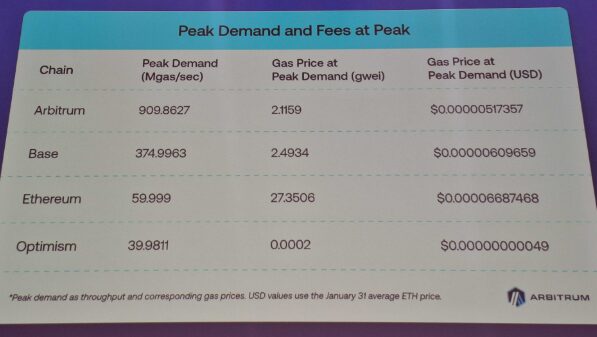
    Responsive pricing, peak demand and peak gas price comparison among leading L2 networks

    Responsive pricing allows networks to accommodate more transactions at lower gas fees without overloading infrastructure, making costs more predictable for mainstream-style apps. Felten cited Arbitrum One, the largest Ethereum L2 with $15.2 billion in total value locked (TVL), as the first network to adopt dynamic pricing. Arbitrum’s new model keeps fees lower during peak congestion than EIP-1559-style L2s such as Coinbase Base, which holds $10.9 billion TVL, demonstrating its scalability advantages.

    Tradeoffs Between Predictability and Efficiency

    While responsive pricing improves transparency and efficiency, it reduces predictability compared to EIP-1559. Julian Kors, founder of Pulsar Spaces, emphasized that the debate is whether L2s optimize for “predictability and mechanism design purity” or “efficiency and real-time cost alignment.” Similarly, Jerome de Tychey, president of Ethereum France and EthCC, and Cyprien Grau, project lead at Status Network, note that gas markets still exist, meaning users may face variable costs during congestion.

    Grau added that responsive pricing smooths fee declines but does not solve the structural problem: as L1 and L2 networks scale, gas fees trend toward zero. Future L2s will need models where users do not actively consider gas fees, and network economics no longer depend on charging for them.

    Disclaimer

    This content is for informational purposes only and does not constitute financial, investment, or legal advice. Cryptocurrency trading involves risk and may result in financial loss.