Author: tristan

  • Todd Blanche Named Interim U.S. Attorney General Amid Crypto Enforcement Controversy

    Todd Blanche Named Interim U.S. Attorney General Amid Crypto Enforcement Controversy

    President Donald Trump removed Attorney General Pam Bondi and appointed Todd Blanche as the interim Attorney General, placing the former deputy and Trump’s personal attorney in charge of the Department of Justice. Blanche previously represented Trump in his 2024 criminal case in New York and was named deputy attorney general after Trump retook office.

    Crypto Enforcement Memo and Controversy

    As deputy attorney general, Blanche dismantled the DOJ’s National Crypto Enforcement Team and issued a memo directing prosecutors not to pursue regulatory violation cases in the crypto sector. The memo influenced cases such as the Southern District of New York’s proceedings against Tornado Cash developer Roman Storm, resulting in the dismissal of certain charges.

    Blanche’s government ethics disclosure from July 2025 revealed he held between $159,000 and $485,000 in cryptocurrencies at the time, including Bitcoin, Ethereum, Solana, ADA, Polygon, DOT, and Quant, alongside Coinbase stock. This appeared to violate ethics rules and his prior pledge to divest before working on crypto-related matters.

    The appointment raises questions over crypto regulation and enforcement policy under the DOJ, particularly regarding the treatment of ongoing and future cases in the rapidly evolving digital asset space.

    Disclaimer

    This content is for informational purposes only and does not constitute financial, investment, or legal advice. Cryptocurrency trading involves risk and may result in financial loss.

  • Trump Threatens Iran Bridges and Power Plants Amid Ongoing Conflict

    Trump Threatens Iran Bridges and Power Plants Amid Ongoing Conflict

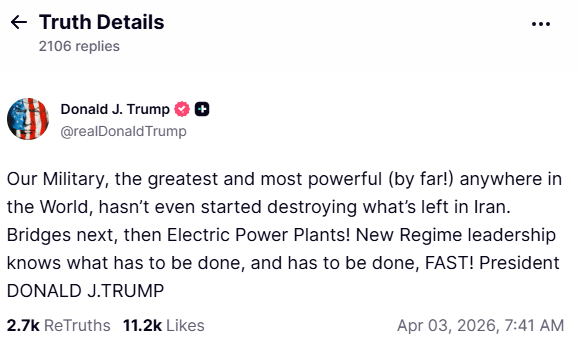
    U.S. President Donald Trump has issued new threats against Iran, warning that bridges and electric power plants will be the next targets in the ongoing conflict. On truthsocial , Trump stated, “The U.S. military hasn’t even started destroying what’s left in Iran. Bridges next, then Electric Power Plants.” He emphasized urgency, claiming Iran’s leadership “knows what has to be done, and has to be done, FAST!”

    War Timeline and Regional Impact

    Trump’s comments come as a 10-day pause on attacks against energy infrastructure concludes on April 6, coinciding with market reopenings. While Trump stated Washington is nearing its goals in Iran, he did not provide a clear timeline for ending the war.

    The war, which began on February 28 with U.S. and Israeli strikes, has killed thousands, displaced millions, and triggered retaliatory attacks by Tehran across the Gulf and on U.S. bases. The conflict has also pushed oil prices higher and created volatility in global markets. Analysts note that Trump’s shifting messages have so far failed to calm concerns over the largest U.S. military operations since 2003.

    Disclaimer

    This content is for informational purposes only and does not constitute financial, investment, or legal advice. Cryptocurrency trading involves risk and may result in financial loss.

  • X to Auto Lock First Time Crypto Mentions to Fight Phishing Scams

    X to Auto Lock First Time Crypto Mentions to Fight Phishing Scams

    X, owned by Elon Musk, is preparing to introduce a new security feature that will automatically lock accounts that mention crypto for the first time. The move is designed to reduce the growing wave of phishing attacks that rely on hijacked accounts to promote scam tokens and fraudulent offers.

    According to Nikita Bier, users whose accounts post about crypto for the first time will be required to complete additional verification before they can post again. The feature targets attackers who gain access to accounts and immediately use them to spread malicious links or fake promotions. Bier stated that the change could remove most of the incentive behind such scams.

    The update follows reports of phishing emails disguised as copyright violation notices. Victims are directed to realistic login pages that capture passwords and two-factor authentication codes, allowing attackers to take control of accounts.

    Platform Expands Anti-Scam Efforts Amid Rising Threats

    Crypto scams have long been a challenge on X, continuing trends from its earlier years as Twitter. Common schemes include fake “double your money” promotions, impersonation of public figures, and fraudulent token launches designed to trick users into sending cryptocurrency.

    One of the most notable incidents occurred during the 2020 Twitter Bitcoin Scam, when attackers gained control of prominent accounts and promoted fake Bitcoin giveaways, collecting over $100,000 before the posts were removed. That breach resulted from social engineering attacks targeting employees and later led to a prison sentence for the hacker.

    X has previously introduced bot purges, API restrictions, and behavioral detection tools to improve safety. Bier also criticized Google for allowing phishing emails to pass through Gmail, arguing stronger email-level protection is necessary to reduce crypto-related fraud.

    Disclaimer

    This content is for informational purposes only and does not constitute financial, investment, or legal advice. Cryptocurrency trading involves risk and may result in financial loss.

  • Iran Strikes Kuwait Refinery as U.S. and Israel Target Tehran Amid Escalating Conflict

    Iran Strikes Kuwait Refinery as U.S. and Israel Target Tehran Amid Escalating Conflict

    Iran launched drone strikes on Mina al Ahmadi oil refinery on Friday, igniting multiple fires at the facility. Kuwait Petroleum Corp. confirmed that firefighters were working to control the blazes, and no injuries were reported. The refinery has been repeatedly targeted during the ongoing war.

    Sirens were reported in Bahrain, while Saudi Arabia said it destroyed several Iranian drones. Defenses were activated in the United Arab Emirates, and Israel reported incoming missiles.

    https://cms.blockto.io/irgc-threatens-strikes-on-nvidia-apple-microsoft-and-tesla-sites-across-region/

    Airstrikes and Global Energy Impact

    Meanwhile, United States and Israel conducted airstrikes around Tehran and Isfahan. Iran’s attacks on Gulf energy infrastructure and its control over the Strait of Hormuz have sent Brent crude prices to roughly $109 per barrel, up more than 50% since late February.

    The conflict, now entering its fifth week, shows no signs of slowing, while the United Nations Security Council prepares to address Tehran’s tightening grip on regional shipping lanes critical to global energy supply.

    Disclaimer

    This content is for informational purposes only and does not constitute financial, investment, or legal advice. Cryptocurrency trading involves risk and may result in financial loss.
  • Bitcoin Price Risks New Lows Unless $76K Turns Into Strong Support

    Bitcoin Price Risks New Lows Unless $76K Turns Into Strong Support

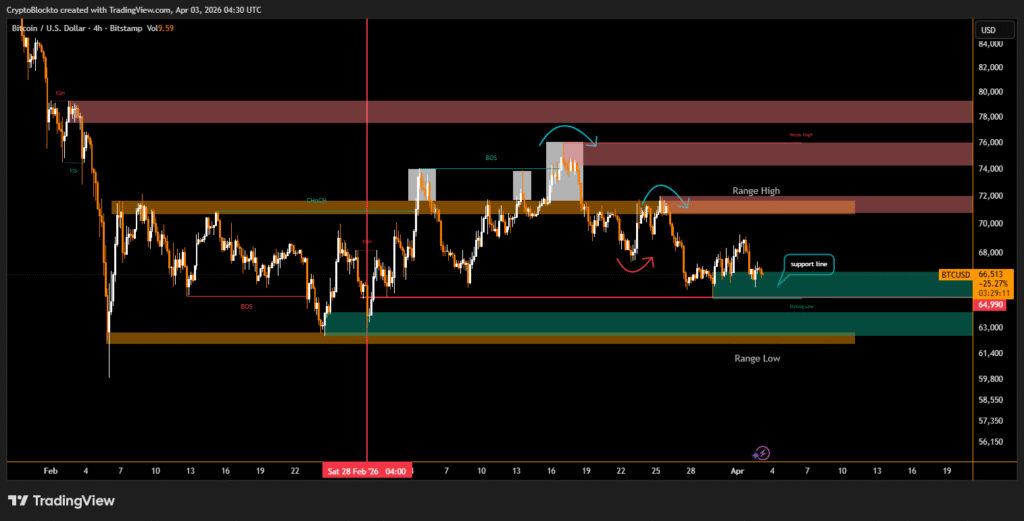
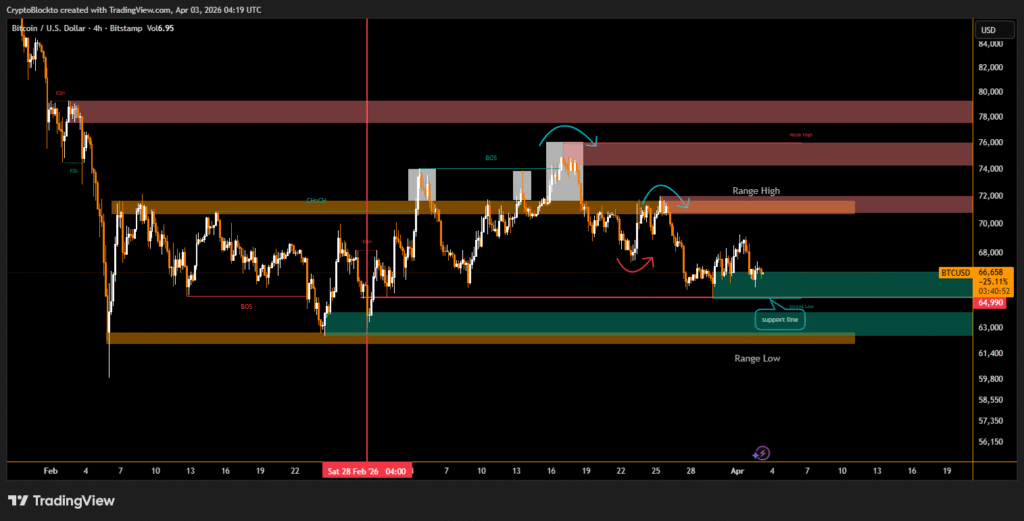
    Bitcoin continues trading within a tight $60,000 to $73,000 range, showing resilience despite challenging global conditions. Rising Brent crude oil prices to levels last seen in 2008, ongoing conflict involving the United States, Israel and Iran, and volatility in traditional markets including a 3.95% year-to-date decline in the S&P 500 have created a difficult backdrop.

    $BTC 4h price chart

    Buyers have repeatedly stepped in near the $60,000 level, keeping it intact as a key support zone. However, technical indicators show a bearish continuation structure forming on the daily chart. One bearish pattern was confirmed on Jan. 20, when Bitcoin corrected toward $60,014, and a second bear flag has developed since Feb. 8, rejecting multiple rally attempts at resistance.

    Analysts emphasize that a multi-day close above $76,000 is necessary to invalidate the bearish structure. Ideally, this would include two to three consecutive daily closes above that level, followed by a successful retest around $75,000, confirming a resistance to support flip.

    Key Support Levels and Liquidation Risks in Focus

    Market technician Aksel Kibar has warned that a breakdown below the lower boundary of the current pattern could push Bitcoin toward $52,500. Data tracking leveraged positions also highlights increased liquidation risk if Bitcoin falls into the $63,000 to $65,000 range, where a concentration of long positions is located.

    Market demand across spot and futures markets remains relatively flat, with aggregated open interest staying below $20 billion, a level last seen in early February when Bitcoin traded near $79,000. Below the current support range, a liquidity gap exists until roughly $57,500 to $56,000, where the next cluster of margin positions begins.

    Until a strong catalyst emerges, analysts expect Bitcoin to continue consolidating within its broad range, with $60,000 acting as critical support and $70,000 remaining a major resistance barrier.

    Disclaimer

    This content is for informational purposes only and does not constitute financial, investment, or legal advice. Cryptocurrency trading involves risk and may result in financial loss.
  • Stablecoin Supply Hits $315B in Q1 as USDC Growth Outpaces USDT Decline

    Stablecoin Supply Hits $315B in Q1 as USDC Growth Outpaces USDT Decline

    Stablecoins remained one of the strongest segments of the crypto market in the first quarter, with total supply rising by about $8 billion to reach a record $315 billion, according to data from.CEX.io Although this represented the slowest expansion since the fourth quarter of 2023, the increase came during a period when the broader digital asset market weakened.

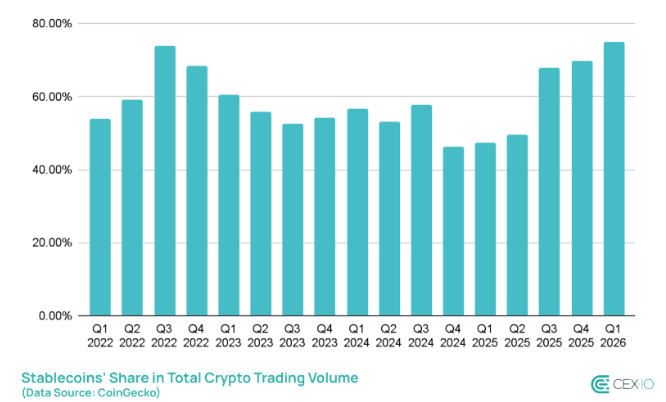
    Investor behavior showed a defensive shift toward stable assets. Stablecoins accounted for approximately 75% of total crypto trading volume in Q1, the highest level recorded so far. At the same time, overall stablecoin transaction volume exceeded $28 trillion, reinforcing their role as a major liquidity layer across digital asset markets.

    Stablecoins’ share of total digital asset trading volume exceeded its 2022 peak

    Despite the strong activity levels, retail participation showed signs of decline. Retail-sized transfers fell by 16%, marking the steepest quarterly drop on record. Meanwhile, automated systems dominated usage, with bots responsible for roughly 76% of all stablecoin transaction volume, suggesting increased reliance on algorithmic trading, arbitrage, and liquidity provisioning.

    Diverging Trends Between Major Stablecoin Issuers

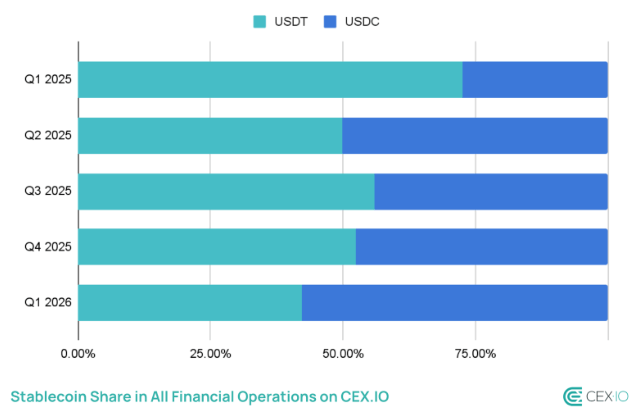
    Data from the quarter also highlighted a widening gap between leading stablecoin issuers. The supply of USDC, issued by Circle, increased by approximately $2 billion, while USDT, issued by Tether, declined by about $3 billion. This marked the first significant divergence between the two since the second quarter of 2022 during earlier bearish market conditions.

    Much of the broader growth in stablecoin issuance came from yield-bearing products, a segment now valued at around $3.7 billion, with daily trading volumes exceeding $100 million. These products have drawn regulatory attention in the United States, particularly as lawmakers debate crypto market structure rules and traditional banks raise concerns about stablecoins offering interest-like returns.

    Disclaimer

    This content is for informational purposes only and does not constitute financial, investment, or legal advice. Cryptocurrency trading involves risk and may result in financial loss.

  • Bitcoin Faces Holiday Weekend Risk as ETF and CME Demand Pauses

    Bitcoin Faces Holiday Weekend Risk as ETF and CME Demand Pauses

    Bitcoin traded near $66,700 heading into the Good Friday long weekend, with markets preparing for reduced liquidity as institutional trading channels temporarily shut down. Futures trading on the Chicago Mercantile Exchange will pause, and exchange-traded fund creation and redemption activity will also halt, removing a major source of buying support.

    The timing is critical as Bitcoin’s $65,000 support level appears increasingly fragile. Despite strong institutional accumulation in recent weeks, overall demand has turned negative, raising concerns about short-term price stability.

    Large Holder Selling Offsets Institutional Buying

    Recent market data showed ETF purchases reached about 50,000 BTC in the past 30 days, the highest level since October 2025. At the same time, Strategy accumulated roughly 44,000 BTC. However, overall demand remained weak, with 30-day apparent demand estimated at negative 63,000 BTC.

    Large holders controlling 1,000 to 10,000 BTC shifted into net selling, with their one-year balance change falling to negative 188,000 BTC from positive 200,000 BTC at the 2024 peak. Mid-sized holders also slowed accumulation, while a negative Coinbase Premium signaled weak U.S. spot demand.

    Inflation Data and Holiday Liquidity Could Shape Price Direction

    With institutional flows paused during the holiday, Bitcoin will rely mainly on spot markets. Analysts expect resistance between $71,500 and $81,000, while upcoming April 9 inflation data could further influence market direction if rate-cut expectations weaken.

    Disclaimer

    This content is for informational purposes only and does not constitute financial, investment, or legal advice. Cryptocurrency trading involves risk and may result in financial loss.
  • Big Tech Firms Support x402 Foundation to Drive Agentic AI Payment Standards

    Big Tech Firms Support x402 Foundation to Drive Agentic AI Payment Standards

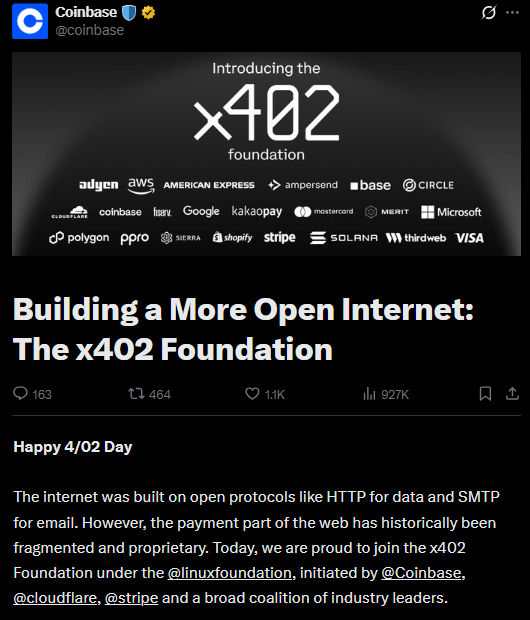
    Major technology companies including Google, Microsoft, and Amazon Web Services have joined as founding members of the newly created x402 Foundation, aimed at governing and standardizing the x402 protocol for agentic AI payments across crypto and fiat systems.

    The Linux Foundation officially launched the x402 Foundation on Thursday with support from Coinbase, which originally developed the x402 protocol. Other founding participants include American Express, Mastercard, Visa, Cloudflare, Shopify, Stripe, Circle, Polygon Labs, Solana Foundation, Thirdweb, and KakaoPay.

    Coinbase stated that placing the x402 protocol under the Linux Foundation gives it a neutral, nonprofit structure. This approach is expected to encourage wider adoption by developers and companies compared to launching it under a single corporate entity.

    Open Standards Aim to Enable Autonomous AI Transactions

    The x402 protocol is designed as an open payment standard that allows AI agents and web services to automatically pay for API access, digital data, and online services. Supporters believe agentic AI could soon become a dominant user of blockchain-based payment systems.

    Brian Armstrong previously stated that AI agents may soon outnumber human users in online transactions. Similar views were shared by Jeremy Allaire, who predicted billions of AI agents could transact onchain within three to five years. Changpeng Zhao also described cryptocurrency as a natural payment method for automated AI systems handling everyday purchases.

    x402 Transaction Activity Shows Sharp Rise and Decline

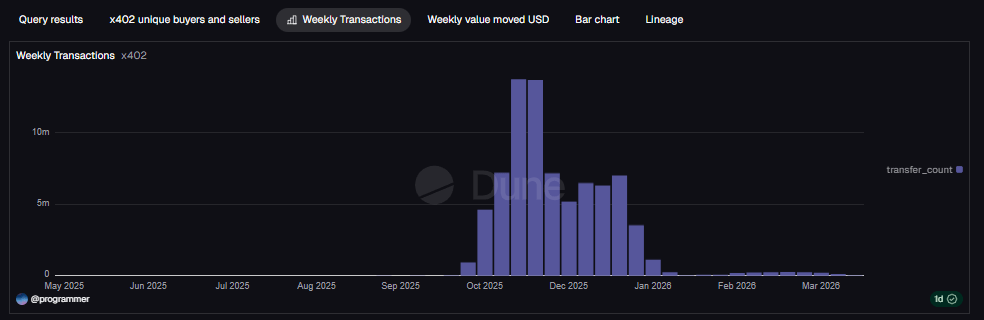
    Data from analytics platform Dune Analytics showed that x402 protocol usage surged in late 2025 before declining in early 2026. Weekly transaction volume peaked between Nov. 4 and Nov. 10, reaching approximately 13.7 million transactions, followed by another 13.66 million transactions the next week.

    Weekly transactions via the x402 protocol since May 2025: Dune Analytics

    However, transaction levels have since dropped significantly, with weekly volumes ranging between 29,000 and 1.1 million transactions during 2026, indicating a slowdown after the earlier surge in activity.

    Disclaimer

    This content is for informational purposes only and does not constitute financial, investment, or legal advice. Cryptocurrency trading involves risk and may result in financial loss.
  • Circle Plans cirBTC Launch to Compete With Coinbase and BitGo in Wrapped Bitcoin Market

    Circle Plans cirBTC Launch to Compete With Coinbase and BitGo in Wrapped Bitcoin Market

    Circle has announced plans to launch a new wrapped Bitcoin asset called cirBTC, marking its expansion into the Bitcoin ecosystem and positioning the company against established providers such as Coinbase and BitGo.

    The new token, cirBTC, is expected to launch on Ethereum, backed 1:1 by Bitcoin, and designed primarily for institutional participants such as over the counter trading desks, market makers, and lending protocols. The company stated that the asset aims to deliver a highly secure and neutral wrapped Bitcoin product suited for institutional-grade usage.

    Wrapped Bitcoin tokens allow Bitcoin holders to use their assets on other blockchain networks, enabling access to decentralized finance services. Financial institutions that have increased their exposure to Bitcoin are also exploring decentralized finance tools, driving demand for wrapped assets.

    Competition Intensifies in the Wrapped Bitcoin Sector

    Circle’s entry adds pressure to an already competitive market led by Wrapped Bitcoin (WBTC) and Coinbase Wrapped Bitcoin (cbBTC).

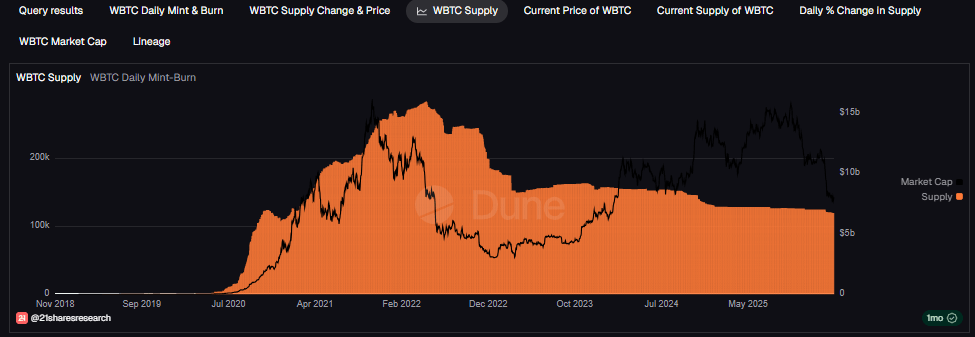
    Coinbase introduced cbBTC in September 2024, and it currently holds a market capitalization of about $5.9 billion, with roughly 88,800 tokens in circulation. Meanwhile, BitGo’s WBTC remains the dominant wrapped Bitcoin token, with a market capitalization near $8 billion and about 119,157 tokens circulating. However, this figure is roughly half of its November 2021 peak, when Bitcoin reached its cycle high.

    WBTC supply has declined over the past few years. : Dune

    Other crypto exchanges have also introduced alternative wrapped Bitcoin versions, including tokens from Kraken, Gate.io, Binance, Huobi, and OKX, though their market shares remain significantly smaller than the leading two providers.

    The combined supply of WBTC and cbBTC currently stands at approximately 208,000 Bitcoin, highlighting the scale of the growing wrapped Bitcoin market.

    Disclaimer

    This content is for informational purposes only and does not constitute financial, investment, or legal advice. Cryptocurrency trading involves risk and may result in financial loss.

  • Bitcoin Miner Riot Sells 3,778 BTC in Q1 as Profitability Pressures Mount

    Bitcoin Miner Riot Sells 3,778 BTC in Q1 as Profitability Pressures Mount

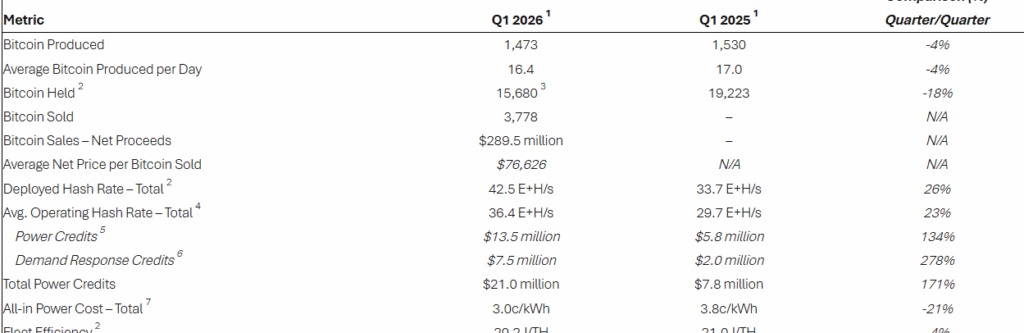
    Riot Platforms sold 3,778 Bitcoin during the first quarter as mining profitability faced pressure from rising operating costs and market volatility. The company reported that the Bitcoin was sold at an average price of $76,626, generating about $289.5 million in total proceeds.

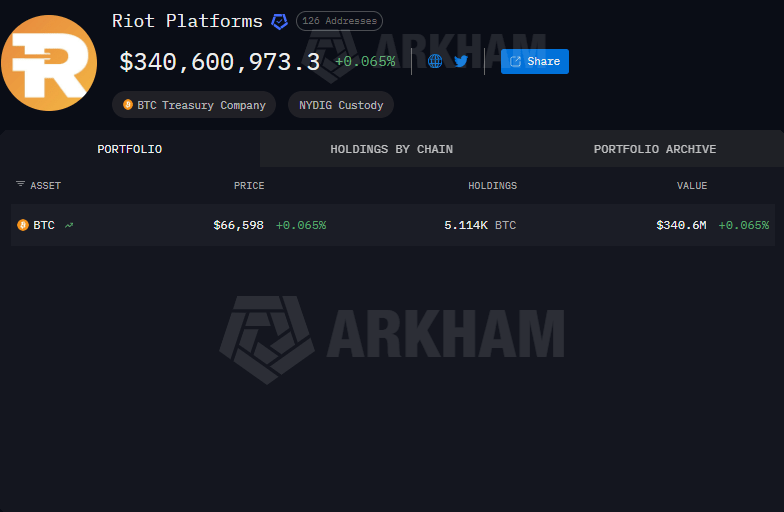
    During the same period, Riot produced 1,473 Bitcoin and held 15,680 Bitcoin on its balance sheet at the end of Q1. Blockchain intelligence platform Arkham also flagged a 500 Bitcoin outflow from a wallet linked to Riot on Thursday, indicating continued movement of funds. Bitcoin traded near $66,867 on Friday, below the average level at which Riot sold its holdings.

    Mining Firms Increase Bitcoin Sales as Energy Costs Rise

    Riot’s sales add to a broader wave of selling across the mining sector. In the past week, MARA Holdings, Genius Group, and Nakamoto Holdings reported combined Bitcoin sales totaling 15,501 BTC, with most of the volume coming from MARA.

    Bitcoin miner Riot Platforms sold 3,778 Bitcoin in the first quarter but still has 15,680 on its books: Riot Platforms

    Industry participants attribute the trend to rising energy costs linked to higher oil prices following escalating conflict in the Middle East, forcing miners to sell Bitcoin to cover operational expenses.

    Disclaimer

    This content is for informational purposes only and does not constitute financial, investment, or legal advice. Cryptocurrency trading involves risk and may result in financial loss.