Category: News

  • Coinbase CEO Brian Armstrong Backs Clarity Act as US Pushes for Crypto Market Rules

    Coinbase CEO Brian Armstrong Backs Clarity Act as US Pushes for Crypto Market Rules

    Brian Armstrong has publicly backed the passage of the Clarity Act, signaling a shift in stance from earlier hesitation by Coinbase. His comments came after Scott Bessent urged lawmakers to move forward with the bill, emphasizing the need for clear digital asset regulations in the United States.

    Armstrong responded publicly, agreeing with Bessent’s call and expressing appreciation for bipartisan efforts among senators and staff who have worked on refining the legislation over recent months.

    Stablecoin Provisions Previously Delayed Support

    Coinbase had previously withheld support for earlier versions of the Clarity Act due to unresolved concerns surrounding stablecoin provisions, particularly those related to yield generation. The legislation aims to establish a comprehensive framework governing cryptocurrency markets, including operational rules for stablecoin issuers.

    Recent statements from Paul Grewal suggested negotiations are nearing agreement, describing the bill as “very close” to resolving outstanding issues.

    Policy Debate Continues Amid Regulatory Pressure

    Treasury officials are also advancing proposals addressing anti money laundering and sanctions risks linked to stablecoins, while policymakers continue discussions on how digital assets should integrate with traditional banking systems.

    Despite growing momentum, analysts have warned that political divisions in Washington could still complicate the passage of the Clarity Act, leaving the timeline for final approval uncertain.

    Disclaimer

    This content is for informational purposes only and does not constitute financial, investment, or legal advice. Cryptocurrency trading involves risk and may result in financial loss.

  • Bitcoin Rises Slightly After Core CPI Misses Forecast as Energy Costs Drive Headline Inflation

    Bitcoin Rises Slightly After Core CPI Misses Forecast as Energy Costs Drive Headline Inflation

    Bitcoin posted modest gains after fresh U.S. inflation data showed core prices rising less than expected in March. Core Consumer Price Index (CPI), which excludes food and energy, increased by 0.2% month over month, below the 0.3% forecast and matching February’s reading. On a yearly basis, core CPI rose 2.6%, slightly under expectations of 2.7% and up from 2.5% previously.

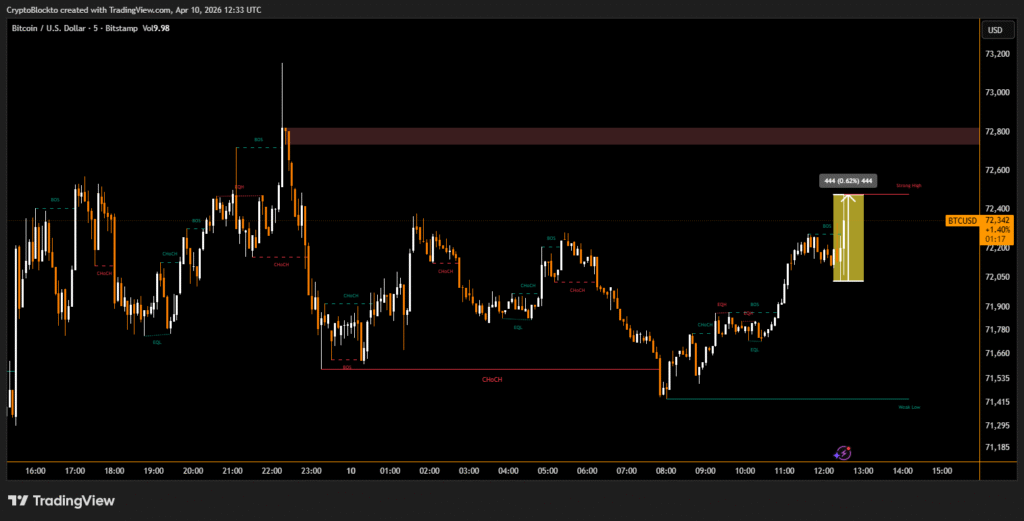
    Bitcoin had been trading near $72,000 ahead of the report but climbed to around $72,400 shortly after the data release, reflecting cautious optimism among traders.

    $BTC M5 price chart on CPI

    Headline Inflation Driven by Energy Costs and Iran Conflict

    Headline CPI increased 0.9% in March, in line with forecasts but significantly higher than February’s 0.3% rise. On a year-over-year basis, inflation reached 3.3%, matching expectations and rising from the prior 2.4%. Analysts attributed much of the increase to surging energy prices linked to geopolitical tensions involving Iran, which pushed oil costs higher and influenced broader market sentiment.

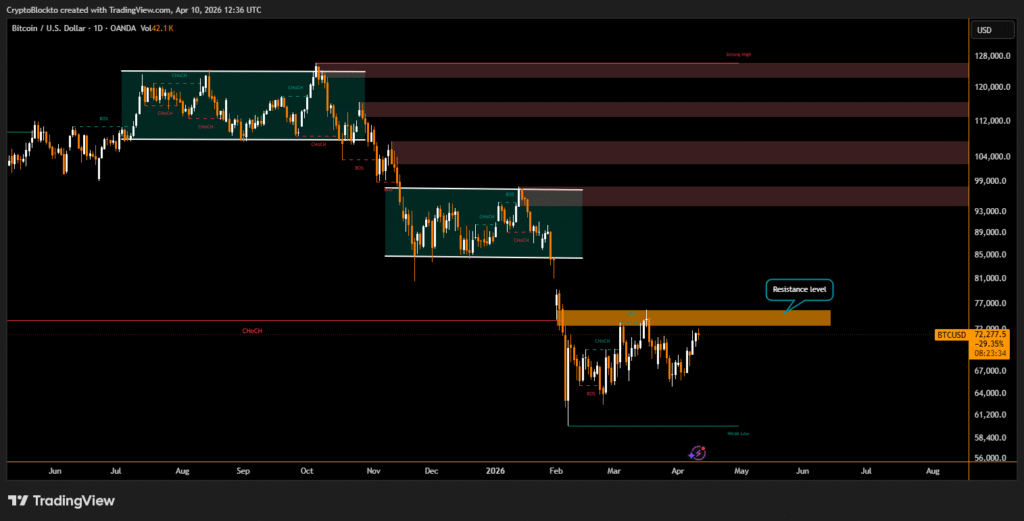
    $BTC dailyprice chart

    Federal Reserve Rate Expectations Remain Steady

    Market expectations suggest the Federal Reserve will maintain current interest rates in the near term. According to data from the CME FedWatch Tool, traders priced in roughly a 99% probability of no rate change at the late April meeting and a 97% chance of unchanged policy in mid-June.

    Recent shifts in inflation expectations have led markets to move away from earlier predictions of multiple rate cuts, reinforcing uncertainty about the timing of future monetary policy adjustments.

    Disclaimer

    This content is for informational purposes only and does not constitute financial, investment, or legal advice. Cryptocurrency trading involves risk and may result in financial loss.
  • x402 Protocol Adds Usage-Based Pricing for AI Compute Requests

    x402 Protocol Adds Usage-Based Pricing for AI Compute Requests

    The x402 protocol has launched a major upgrade enabling usage based pricing for AI compute requests, replacing its earlier fixed-fee system. The update was announced by Coinbase via its Developer Platform and introduces a new scheme called “Upto”, designed for variable-cost services such as large language model inference, compute workloads, and data queries.

    Previously, x402 only supported exact fixed pricing, which worked for deterministic APIs but failed for services where costs vary based on token usage, compute time, or query complexity. The new model allows sellers to set a maximum price while buyers authorize spending up to that limit, with final costs based on actual resource usage.

    EVM-Based System Enables Flexible AI Payments

    The system runs on the Ethereum Virtual Machine and supports all ERC-20 tokens, along with gasless payments through Coinbase’s facilitator infrastructure. This structure is designed to improve efficiency in AI-driven transactions and prevent users from overpaying for lighter compute tasks.

    Push Toward Agentic AI Economy

    The upgrade targets the emerging agentic AI economy, where autonomous systems handle payments and compute tasks at scale. The protocol was developed by Coinbase but has been transferred to the Linux Foundation, with participation from Google, Microsoft, and Amazon Web Services through the x402 Foundation.

    Despite early adoption, x402 activity has dropped sharply in 2026. Data shows peak usage reached 13.7 million transactions in November, fell below 1 million weekly in January, and declined further to about 112,708 weekly transactions by March, signaling reduced network activity even as development continues.

    Disclaimer

    This content is for informational purposes only and does not constitute financial, investment, or legal advice. Cryptocurrency trading involves risk and may result in financial loss.

  • Crypto Won’t Be a Topic in 5 Years, It Will Be Infrastructure: CZ

    Crypto Won’t Be a Topic in 5 Years, It Will Be Infrastructure: CZ

    Binance co founder Changpeng “CZ” Zhao has said he hopes cryptocurrencies and blockchain will no longer be discussed as separate technologies within the next five years, but instead become an invisible part of everyday systems. Speaking on the Wolf of All Streets podcast, Zhao compared crypto’s future role to the internet’s underlying protocols, which users rely on without actively thinking about TCP/IP or HTML.

    He said that while innovation will continue, the focus should shift away from the technology itself and toward real-world usage. According to CZ, blockchain should function in the background of financial systems, data storage, and digital infrastructure rather than as a standalone concept people constantly reference.

    Mainstream adoption outlook and industry forecasts

    Zhao’s comments align with broader industry expectations that crypto adoption will keep expanding. Estimates suggest around 559 million people globally use crypto in 2026. Other projections cited by industry participants suggest the sector could reach full-scale mainstream adoption within a single market cycle.

    Some forecasts are even more aggressive, with ARK Invest projecting a potential $28 trillion digital asset market by 2030. Additional research from firms like Chainalysis and Citi highlights rapid growth in stablecoin usage and tokenized financial systems over the next decade.

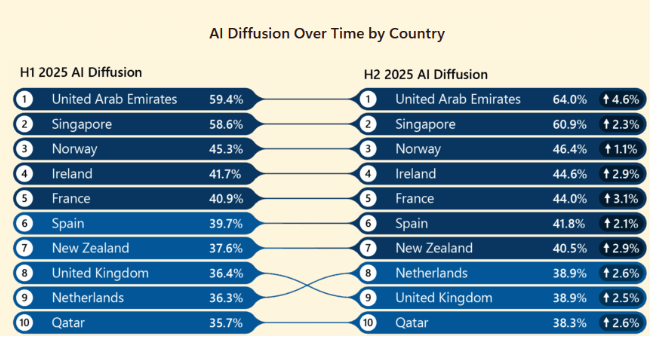
    The United Arab Emirates is the global leader in AI adoption and usage: Microsoft

    CZ also emphasized that artificial intelligence could significantly speed up blockchain development and adoption, particularly as AI agents increasingly interact with crypto systems. He added that countries failing to adopt both AI and blockchain risk falling behind economically, as he sees the internet, AI, and blockchain as the three defining industries of the modern era.

    Disclaimer

    This content is for informational purposes only and does not constitute financial, investment, or legal advice. Cryptocurrency trading involves risk and may result in financial loss.

  • Hong Kong Issues First Stablecoin Licences to Anchorpoint Financial and HSBC Under New Regulatory Framework

    Hong Kong Issues First Stablecoin Licences to Anchorpoint Financial and HSBC Under New Regulatory Framework

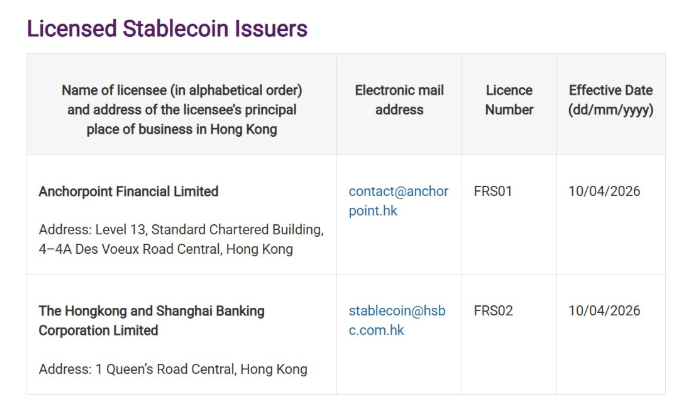
    Hong Kong has officially granted its first stablecoin issuer licences under a new regulatory regime overseen by the Hong Kong Monetary Authority. The initial approvals were awarded to Anchorpoint Financial and The Hongkong and Shanghai Banking Corporation Limited, marking a key milestone in the region’s digital asset oversight strategy.

    Anchorpoint Financial is a joint venture formed by Standard Chartered Bank (Hong Kong), Animoca Brands, and Hong Kong Telecommunications. The HSBC linked entity is also one of the city’s three traditional note-issuing banks.

    Name of licensees in the public register

    Stablecoin Compliance Rules and Regulatory Oversight

    The stablecoin licensing regime took effect in August 2025 and requires issuers of fiat-referenced stablecoins to meet strict standards. These include maintaining full reserve backing, ensuring redemption rights for users, establishing a local presence, and complying with anti-money laundering controls. The regulator also has authority to investigate violations and impose enforcement actions such as fines, licence suspensions, or revocations.

    Delays and Limited First Batch Approvals

    The announcement follows earlier delays after authorities missed an expected March timeline for the first approvals. Officials had previously indicated that only a very small number of issuers would be selected in the initial round. The new licences confirm a cautious rollout approach as Hong Kong positions itself as a regulated hub for stablecoin innovation and broader digital finance development.

    Disclaimer

    This content is for informational purposes only and does not constitute financial, investment, or legal advice. Cryptocurrency trading involves risk and may result in financial loss.

  • Nakamoto Seeks Reverse Stock Split to Avoid Nasdaq Delisting After 99% Share Price Collapse

    Nakamoto Seeks Reverse Stock Split to Avoid Nasdaq Delisting After 99% Share Price Collapse

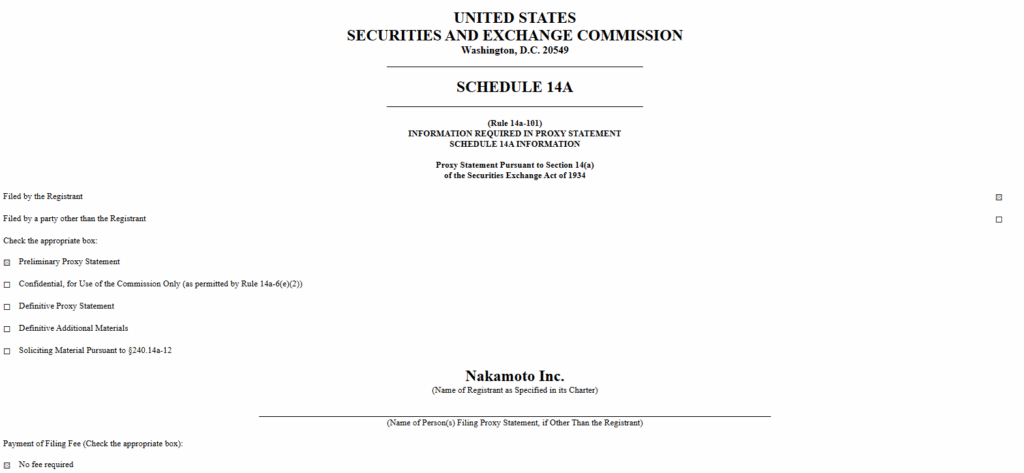
    Bitcoin treasury firm Nakamoto is seeking shareholder approval for a reverse stock split to maintain its listing on the Nasdaq after its share price dropped to about $0.22, down roughly 99% from its May 2025 peak. According to a preliminary Schedule 14A filing, the company proposed a reverse split ratio between 1-for-20 and 1-for-50. This process would reduce the number of outstanding shares while proportionally increasing the share price, helping the company meet Nasdaq’s minimum $1 bid requirement and avoid delisting.

    Share Registration and Future Securities Issuance Plans

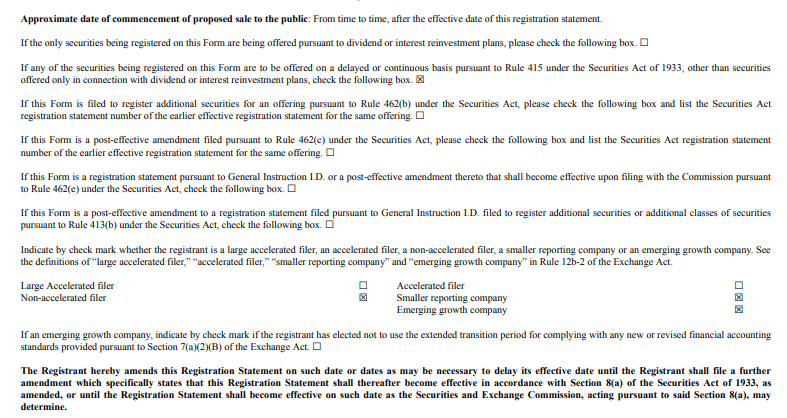
    In a separate Form S-3 filing, Nakamoto registered more than 400 million shares for potential resale by existing investors. While this does not immediately raise new capital, it creates a potential stock overhang that could pressure share prices. The company also disclosed a shelf registration allowing up to roughly $7 billion in future securities issuance. This includes an at-the-market (ATM) program worth up to approximately $5 billion, enabling the firm to sell newly issued shares gradually into the market.

    Form S-3 filing

    Bitcoin Holdings and Industry Market Pressure

    Nakamoto recently sold about 5% of its Bitcoin reserves, leaving it with 5,058 BTC, signaling liquidity management efforts. The company’s share decline mirrors broader pressure across bitcoin treasury firms, as falling Bitcoin prices from above $126,000 in October to near $70,000 have weighed heavily on related stocks.

    Disclaimer

    This content is for informational purposes only and does not constitute financial, investment, or legal advice. Cryptocurrency trading involves risk and may result in financial loss.

  • Japan Reclassifies Crypto as Financial Instruments Under New Regulatory Amendment

    Japan Reclassifies Crypto as Financial Instruments Under New Regulatory Amendment

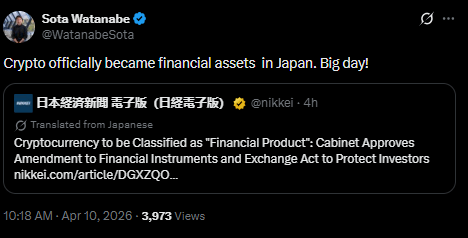
    Japan has officially amended its Financial Instruments and Exchange Act to classify cryptocurrencies as financial instruments, marking a major shift in how digital assets are regulated in the country. The decision moves crypto beyond its previous classification under the Payment and Settlement Act and places it closer to traditional financial markets such as equities and securities.

    Insider Trading Ban and Market Transparency Rules

    Under the updated framework, insider trading involving cryptocurrencies is now explicitly prohibited. This includes buying or selling digital assets based on undisclosed or material non-public information. The law aims to improve market fairness and reduce risks linked to information asymmetry in crypto trading.

    The amendment also introduces stricter disclosure obligations for cryptocurrency issuers. Companies involved in issuing digital assets will now be required to provide annual transparency reports, increasing regulatory oversight and investor protection standards. Authorities have also strengthened penalties for unregistered exchanges operating in the market.

    Japan’s Shift Toward Institutional Crypto Integration

    Japan’s Financial Services Agency previously regulated crypto mainly as a payment tool, but rising institutional participation has driven this reclassification. Officials have stated that the goal is to align crypto markets with traditional financial systems while maintaining transparency and investor safeguards. The country is also exploring crypto exchange-traded funds, signaling continued integration into mainstream financial infrastructure.

    Disclaimer

    This content is for informational purposes only and does not constitute financial, investment, or legal advice. Cryptocurrency trading involves risk and may result in financial loss.
  • xAI Sues Colorado Over AI Speech Rules in Senate Bill 24-205 Targeting Grok

    xAI Sues Colorado Over AI Speech Rules in Senate Bill 24-205 Targeting Grok

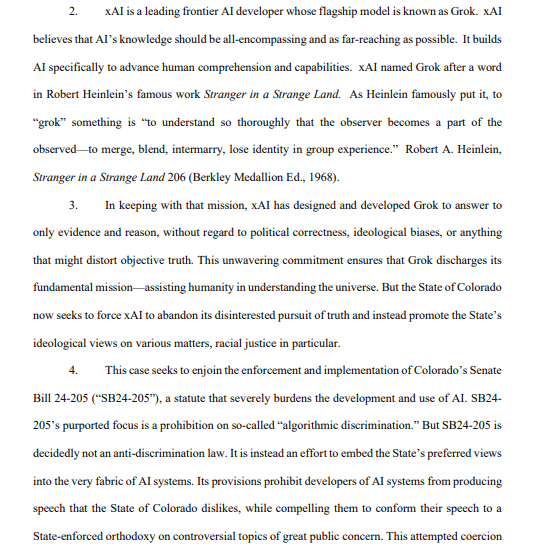
    Elon Musk’s xAI has filed a lawsuit in a US district court in Colorado seeking to block Senate Bill 24-205, a regulation designed to prevent algorithmic discrimination in employment, housing, and financial services. xAI argues the law could force its chatbot Grok to modify responses based on state-defined standards of fairness and equity, effectively compelling speech. The company claims this violates First Amendment free speech protections and Fifth Amendment rights by requiring disclosure of training data and trade secrets.

    xAI’s Core Arguments on Grok and “Truth-Seeking AI”

    In its filing, xAI states that Colorado cannot alter its message or require Grok to reflect politically influenced viewpoints. It argues such rules interfere with its goal of building “maximally truth-seeking” AI systems and could distort neutral outputs through regulatory pressure.

    Wider US AI Regulation Conflict

    xAI also references its earlier lawsuit against California’s Generative AI Training Data Transparency Act, which raised similar concerns about compelled speech and proprietary data exposure. White House AI adviser David Sacks has warned that inconsistent state laws create a fragmented regulatory system and has pushed for a unified federal AI standard instead of multiple state rules.

    Disclaimer

    This content is for informational purposes only and does not constitute financial, investment, or legal advice. Cryptocurrency trading involves risk and may result in financial loss.

  • Covenant AI exits Bittensor after governance dispute; SN3, SN81, SN39 cited, TAO falls 15%

    Covenant AI exits Bittensor after governance dispute; SN3, SN81, SN39 cited, TAO falls 15%

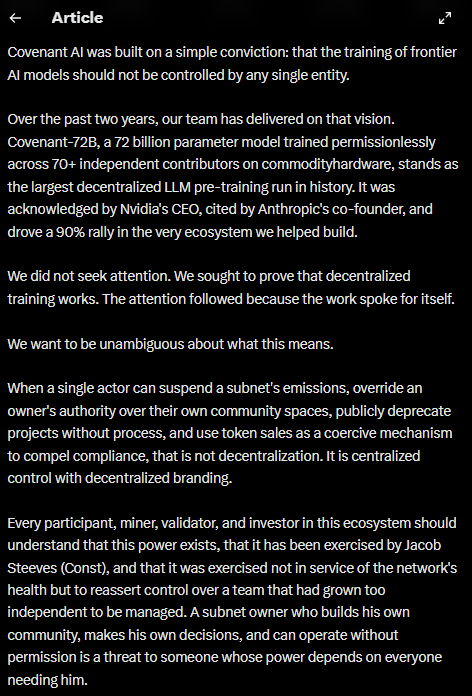
    Covenant AI, the owner of subnets SN3, SN81, and SN39, has announced it is leaving the Bittensor ecosystem. The decision marks a significant shift within the AI-focused decentralized network, where Covenant had been one of the most prominent subnet operators.

    Allegations of centralized control within “decentralized” network

    In a public statement on X, Covenant AI founder Sam Dare said the departure stems from governance conflicts with Bittensor co-founder Jacob Steeves, also known as “Const.” Dare argued that the network’s decentralization promise is misleading, calling it “decentralization theatre” and claiming that no single entity was supposed to control the system.

    Dare further alleged that Steeves maintains effective authority through a “triumvirate structure” managing multisig upgrades. According to Covenant, actions taken against its subnets included suspension of emissions, removal of moderation privileges, and deprecation of subnet infrastructure. The founder also accused Steeves of applying economic pressure through token sales during periods of operational conflict.

    Market impact

    Covenant stated it had developed Covenant-72B, described as a major decentralized large language model pre-training effort within Bittensor. Despite this, the team said it will continue building decentralized AI systems outside the network.

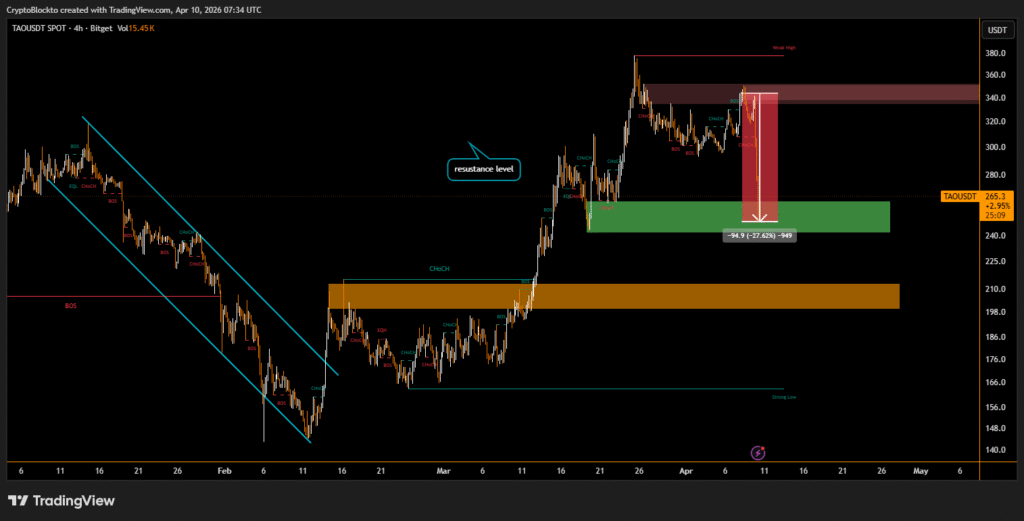
    Following the announcement, TAO dropped about 20%, falling from $338 to $250 before partially recovering near $294. The community reaction on X was divided, with criticism over the abrupt exit. Steeves responded indirectly, suggesting future subnets may operate as “true commodities” independently.

    $Tao 4h price chart

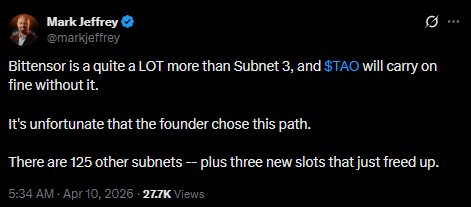
    Mark Jefferey, partner at Bittensor Fund, commented that;

    Disclaimer

    This content is for informational purposes only and does not constitute financial, investment, or legal advice. Cryptocurrency trading involves risk and may result in financial loss.
  • Galaxy Stock Rallies 11% Despite $241 Million Net Loss as Core Business Turns Profitable

    Galaxy Stock Rallies 11% Despite $241 Million Net Loss as Core Business Turns Profitable

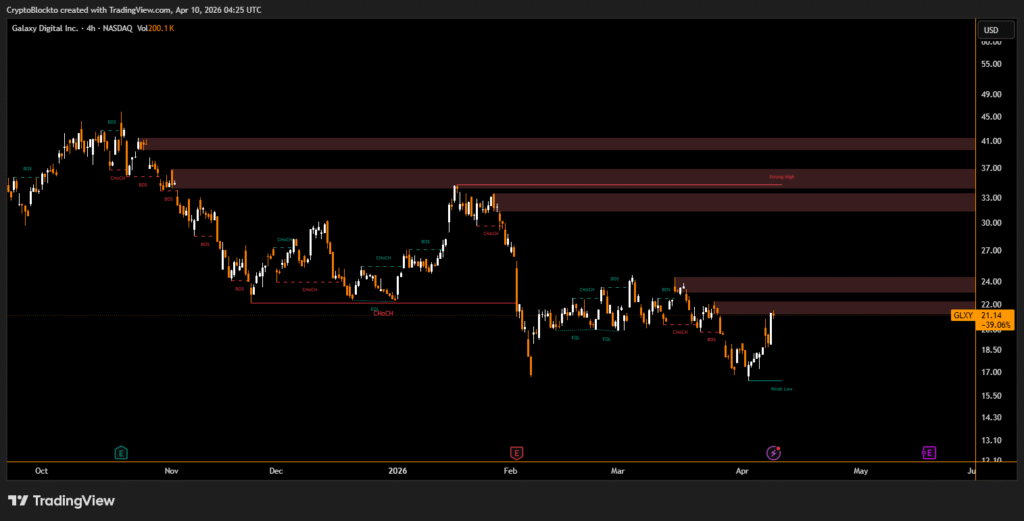
    Shares of Galaxy Digital climbed more than 11% after the company released its annual report, even though it posted a $241 million net loss for full-year 2025. The stock, trading under GLXY, closed at $21.15, ranking as the second-best performing crypto-related stock tracked on industry equity listings that day.

    Galaxy Digital stocks up 11.3%

    The company reported that its core operating business remained profitable on an adjusted, non-GAAP basis. Galaxy recorded an adjusted annual gross loss of $86 million and adjusted EBITDA of $216 million, largely due to unrealized losses on digital asset holdings and investment positions.

    CEO Highlights Infrastructure and Long-Term Strategy

    Chief Executive Officer Mike Novogratz said the company is positioned to benefit from rising demand for blockchain infrastructure. He pointed to the Helios Data Center, which received approval from Electric Reliability Council of Texas to expand to 1.6 gigawatts capacity.

    Cloud firm CoreWeave has signed a long-term agreement to utilize 800 megawatts from Helios, providing stable infrastructure revenue. Galaxy’s Digital Assets segment including trading, lending, asset management and staking generated $505 million in adjusted gross profit, reinforcing Novogratz’s view that the industry is shifting from narrative-driven growth to infrastructure-based development.

    Disclaimer

    This content is for informational purposes only and does not constitute financial, investment, or legal advice. Cryptocurrency trading involves risk and may result in financial loss.