Category: News

  • Anthropic Loses Initial Court Battle Over Pentagon Supply Chain Risk Designation

    Anthropic Loses Initial Court Battle Over Pentagon Supply Chain Risk Designation

    The U.S. Court of Appeals for the District of Columbia Circuit has rejected Anthropic’s emergency request to pause the Pentagon’s designation of its technology as a national security supply chain risk. The three-judge panel ruled that government interests in controlling the use of AI during active military conflict outweighed potential financial and reputational harm to the company.

    In its decision, the court stated that “the equitable balance here cuts in favor of the government,” emphasizing that the risk to national security took priority over the business impact on a single private firm. The designation remains active and prevents contractors working with the Defense Department from using Anthropic’s AI products, marking the first time such a label has been applied to an American technology company.
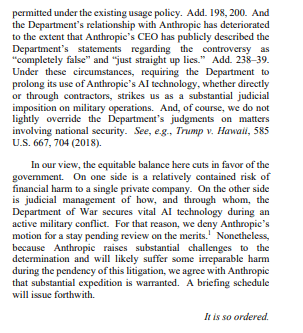
    US Court of Appeals order, case No. 26-01049

    Dispute Originates From Failed AI Contract Negotiations

    The legal dispute began after a July 2025 agreement intended to make Anthropic’s Claude model the first large language model approved for classified government networks. Negotiations collapsed in February when officials demanded unrestricted military access, including potential use in lethal autonomous weapons and domestic surveillance programs, which Anthropic opposed.

    President Donald Trump later directed federal agencies to halt the use of Anthropic products. The company responded with lawsuits in multiple courts, including a California ruling that temporarily blocked parts of the directive, while the broader legal challenge continues.

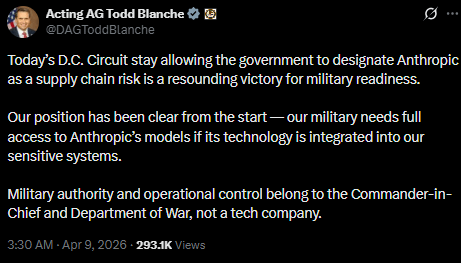
    Acting US Attorney General Todd Blanche said on X that ;
    Disclaimer

    This content is for informational purposes only and does not constitute financial, investment, or legal advice. Cryptocurrency trading involves risk and may result in financial loss.

  • European Union Rejects Iran’s Strait of Hormuz Toll Proposal, Calls for Free Navigation

    European Union Rejects Iran’s Strait of Hormuz Toll Proposal, Calls for Free Navigation

    The European Union on Thursday firmly rejected Iran’s proposal to impose tolls on shipping through the Strait of Hormuz, emphasizing that freedom of navigation in the vital Gulf waterway must be ensured without any payments. The statement came as diplomatic efforts continue following a two-week ceasefire between Iran and the United States after over a month of hostilities.

    EU and International Law Position

    European Commission spokesman Anouar El Anouni clarified that “international law provides for the freedom of navigation, which means… basically no payment or toll whatsoever.” He added that freedom of passage is a public good that must be maintained, highlighting the strategic and economic importance of the strait for global trade.

    Iran and U.S. Responses

    While Iran agreed to reopen the strait during the ceasefire, it has suggested a toll system as a potential source of revenue for reconstruction efforts. U.S. President Donald Trump floated the idea of a “joint venture” to operate such a system with Iran. However, the White House reiterated that the waterway should be reopened immediately and without restrictions.

    Despite the ceasefire, traffic through the Strait of Hormuz remains extremely limited, underscoring the challenges in balancing security, economic interests, and international law in the region.

    Disclaimer

    This content is for informational purposes only and does not constitute financial, investment, or legal advice. Cryptocurrency trading involves risk and may result in financial loss.
  • US Q1 GDP Misses Forecast at 0.5% and PCE index remain same , Boosting Gold as Dollar Weakens

    US Q1 GDP Misses Forecast at 0.5% and PCE index remain same , Boosting Gold as Dollar Weakens

    The latest Core PCE Price Index for March rose 0.4% month-over-month, matching both the forecast and February’s reading. The steady inflation metric suggests consumer prices are rising at a moderate pace, providing signals for the Federal Reserve’s future policy decisions.

    Final GDP Growth Slows

    US GDP growth for Q1 2026 came in at 0.5% quarter-over-quarter, below the 0.7% forecast and prior quarter. The slowdown indicates softer economic momentum, placing pressure on the US dollar.

    A weaker than expected GDP combined with stable inflation tends to boost safe haven demand. Gold prices often rise when the dollar loses momentum, as investors seek alternatives amid slower economic growth. Analysts note that continued economic softness could sustain support for gold in the near term.

    Disclaimer

    This content is for informational purposes only and does not constitute financial, investment, or legal advice. Cryptocurrency trading involves risk and may result in financial loss.
  • Canary Capital Files Application for Spot PEPE ETF in the United States

    Canary Capital Files Application for Spot PEPE ETF in the United States

    Canary Capital has submitted a Form S-1 application to the U.S. Securities and Exchange Commission seeking approval to launch a spot exchange-traded fund tied to the PEPE memecoin. The proposed product, named the CANARY PEPE ETF, is designed to track the price performance of the Pepe token by holding the asset directly through a designated custodian.

    According to the filing, the ETF trust may allocate up to 5% of its assets to Ether in order to cover transaction fees associated with activity on the Ethereum blockchain. The move highlights the operational requirements of maintaining blockchain-based assets within a regulated investment structure.

    Canary Capital already offers several cryptocurrency-related ETF products linked to assets such as XRP, Solana, Hedera, and Sei. In November 2025, the firm also submitted an application for an ETF tracking Mog Coin, a smaller memecoin ranked significantly below PEPE by market capitalization.

    Market Risks and Concentration Raise Investor Concerns

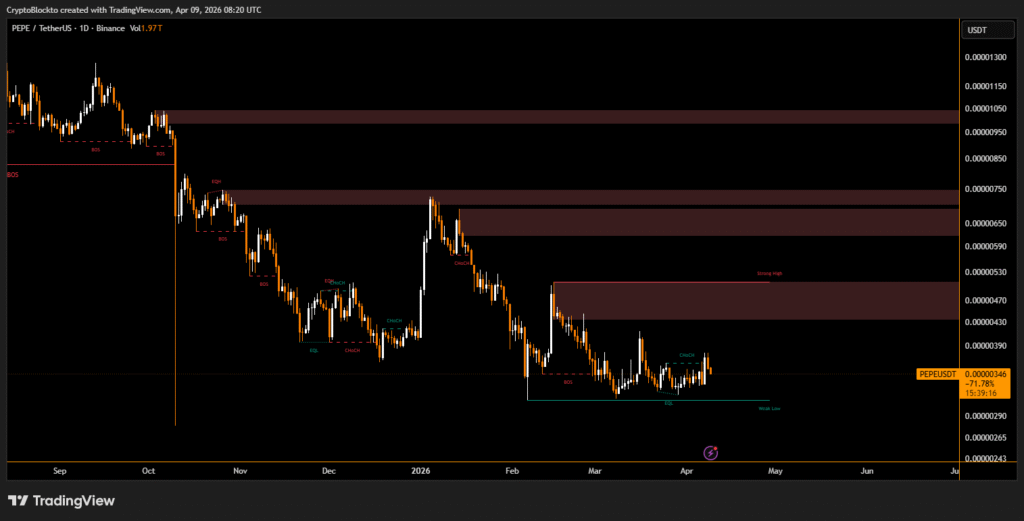
    The proposed ETF arrives at a time when PEPE remains significantly below its previous peak. The token is currently down nearly 85% from its December 2024 all-time high of $0.00002368. Despite the decline, the token continues to maintain a large user base, with approximately 513,392 holders recorded on blockchain data platforms.

    Pepe is up 6.06% over the past 30 days

    The filing also highlighted ownership concentration risks, noting that as of January 2026, the ten largest PEPE wallet addresses controlled about 41% of the circulating supply. Such concentration could increase price volatility and impact investor confidence.

    Regulatory developments remain a key factor in determining the pace of new ETF launches. Canary Capital noted in its filing that rules governing the use of the Pepe token and Ethereum network in the United States continue to evolve, which could influence both adoption and long-term demand for the asset.

    Disclaimer

    This content is for informational purposes only and does not constitute financial, investment, or legal advice. Cryptocurrency trading involves risk and may result in financial loss.
  • Treasury Secretary Bessent Urges Congress to Pass CLARITY Act for Crypto Regulation

    Treasury Secretary Bessent Urges Congress to Pass CLARITY Act for Crypto Regulation

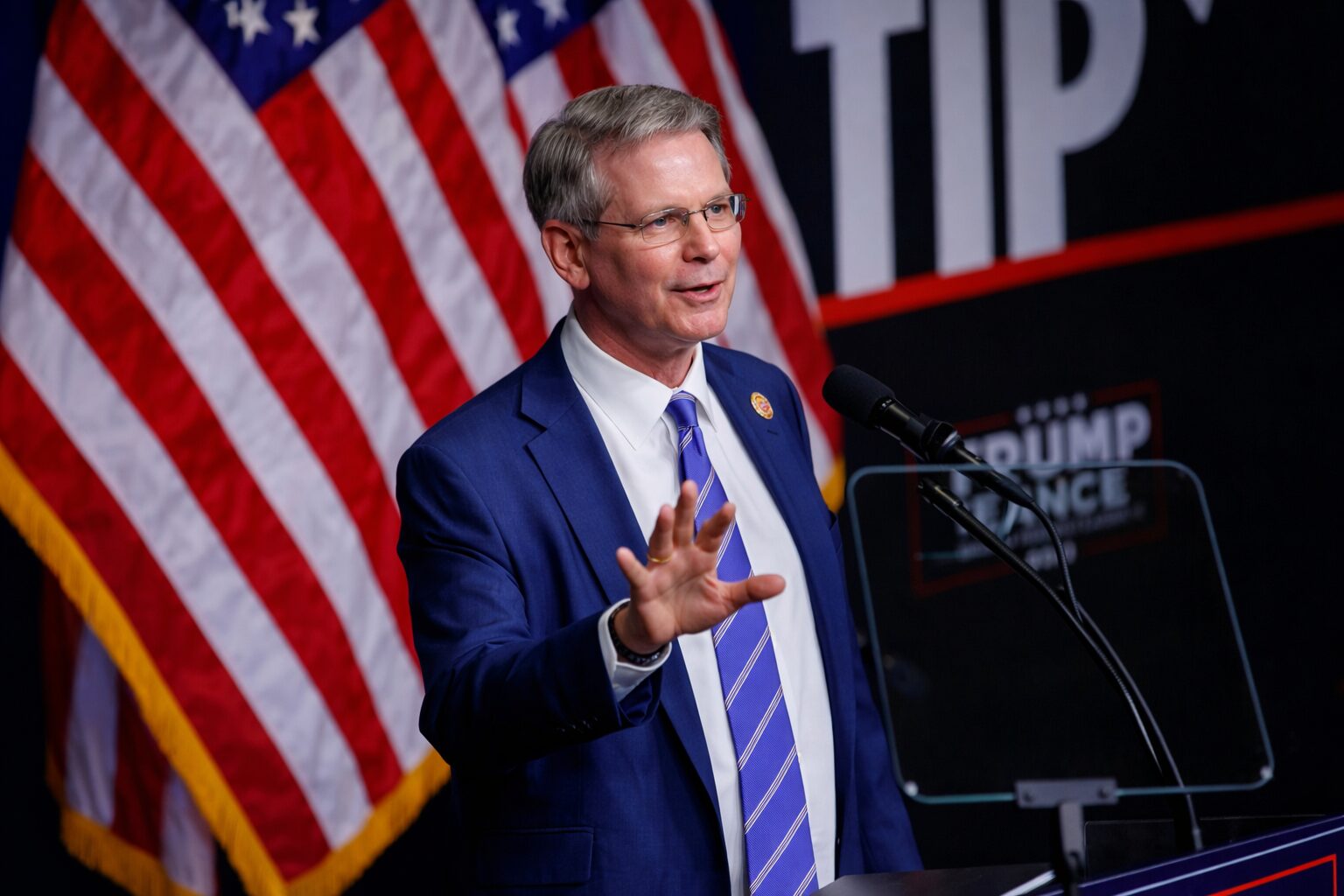
    U.S. Treasury Secretary Scott Bessent has intensified pressure on Congress to pass the Digital Asset Market CLARITY Act, emphasizing that clear rules for cryptocurrencies, tokenized assets, and decentralized exchanges are critical for maintaining U.S. leadership in financial innovation. In a recent op-ed, Bessent noted the global crypto market has reached $3 trillion, with nearly one in six Americans holding digital assets.

    House Approval and Senate Delays

    The CLARITY Act passed the U.S. House of Representatives in July 2025 but has faced repeated delays in the Senate, largely over how stablecoin yields should be treated. Traditional banks argue that yield payments could reduce lending, while industry advocates claim they are essential for innovation and competitiveness.

    White House Report and President Trump’s Position

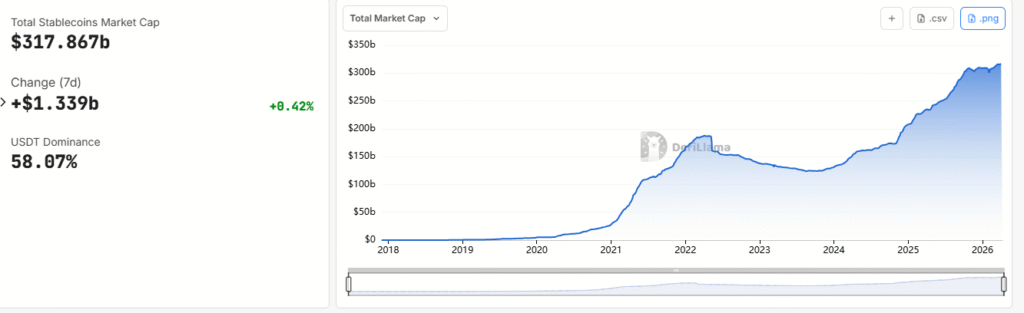
    White House economists found that banning stablecoin yields would only increase bank lending by $2.1 billion, a negligible 0.02% of the $12 trillion market, while causing an $800 million annual welfare loss to users. President Donald Trump criticized banks for obstructing the legislation.

    Stablecoin market cap.: DefiLlama

    Stricter Compliance Rules for Stablecoins

    Separately, the Treasury proposed GENIUS Act rules requiring stablecoin issuers to implement Anti-Money Laundering and Counter-Terrorism Financing programs. Experts warn this could make issuers “bank-like gatekeepers,” enabling wallet freezes, transaction blocking, and asset seizures at scale.

    Disclaimer

    This content is for informational purposes only and does not constitute financial, investment, or legal advice. Cryptocurrency trading involves risk and may result in financial loss.
  • Bhutan Transfers $23 Million in Bitcoin as Holdings Drop 70% from Peak

    Bhutan Transfers $23 Million in Bitcoin as Holdings Drop 70% from Peak

    The Royal Government of Bhutan recently moved approximately 319.7 BTC, valued at $22.68 million, across two wallets on Thursday, according to on-chain data. One recipient wallet reportedly routed funds for sales via Galaxy Digital and OKX, while the second was a new, unmarked address.

    Year-to-Date Bitcoin Transfers

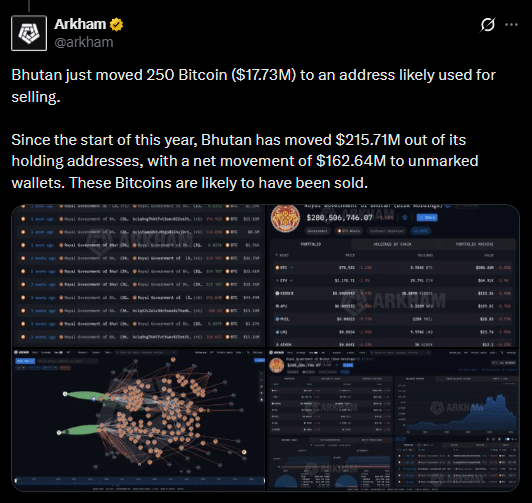
    Arkham data shows Bhutan has transferred around $215.7 million worth of bitcoin from its holding addresses so far in 2026, with $162.6 million directed to unlabeled wallets. These transactions follow a broader trend, leaving Bhutan with 3,954 BTC, worth roughly $280.6 million. At its peak in October 2024, the country held nearly 13,000 BTC. Druk Holding and Investments Ltd., Bhutan’s sovereign wealth fund, manages these assets.

    Mining and Market Context

    Historically, Bhutan’s bitcoin accumulation came from hydropower-backed mining operations. However, reports suggest mining may have slowed or paused, as the last inflow exceeding $100,000 was over a year ago. Bitcoin prices fell 1.3% in the past 24 hours to $70,859, down from an all-time high of around $124,900 in October 2025.

    The exact purpose of the recent transfers remains unclear, though such activity is often linked to potential asset sales or portfolio adjustments by the sovereign fund.

    Disclaimer

    This content is for informational purposes only and does not constitute financial, investment, or legal advice. Cryptocurrency trading involves risk and may result in financial loss.

  • Bithumb Launches Legal Action to Recover 7 Bitcoin Remaining From February Payout Error

    Bithumb Launches Legal Action to Recover 7 Bitcoin Remaining From February Payout Error

    South Korean crypto exchange Bithumb has begun legal proceedings to recover 7 Bitcoin that remain unreturned following a major payout error during a promotional event earlier this year. The exchange filed for a provisional attachment, a court approved measure designed to freeze assets before a civil lawsuit, targeting users who have not yet returned the mistakenly distributed funds.

    The error occurred on Feb. 6 when Bithumb intended to distribute 620,000 Korean won (about $420) to 249 winners of an event. Due to an input mistake, the system accidentally sent 620,000 Bitcoin instead of the intended fiat amount. At the time, the mistaken transfer briefly carried an estimated value of about 62 trillion Korean won, or nearly $42 billion. Although the exchange reversed transactions within minutes, some funds had already been moved by recipients.

    Regulatory Response and Recovery Efforts Continue

    Bithumb reported that it recovered 99.7% of the funds on the same day, while the remaining 0.3%, totaling 1,788 Bitcoin that had already been sold, was covered using company reserves. Since then, most recipients have returned their assets, but a small number have refused. Under South Korean law, mistakenly received assets are considered unjust enrichment and must be returned.

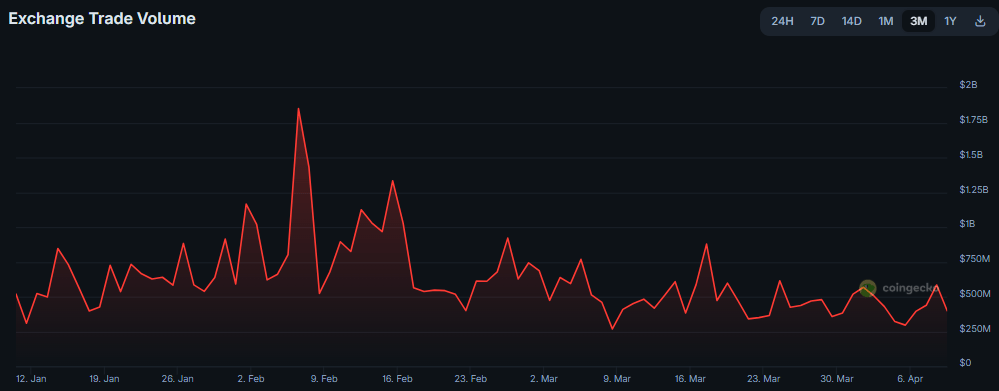
    Bithumb trading volume in 3 months

    Following the incident, South Korea’s Financial Services Commission ordered all crypto exchanges to reconcile internal ledgers with actual asset balances every five minutes to prevent similar operational failures in the future.

    Disclaimer

    This content is for informational purposes only and does not constitute financial, investment, or legal advice. Cryptocurrency trading involves risk and may result in financial loss.
  • Dubai Issues New Guidance on Token Launches for Stablecoins and RWAs

    Dubai Issues New Guidance on Token Launches for Stablecoins and RWAs

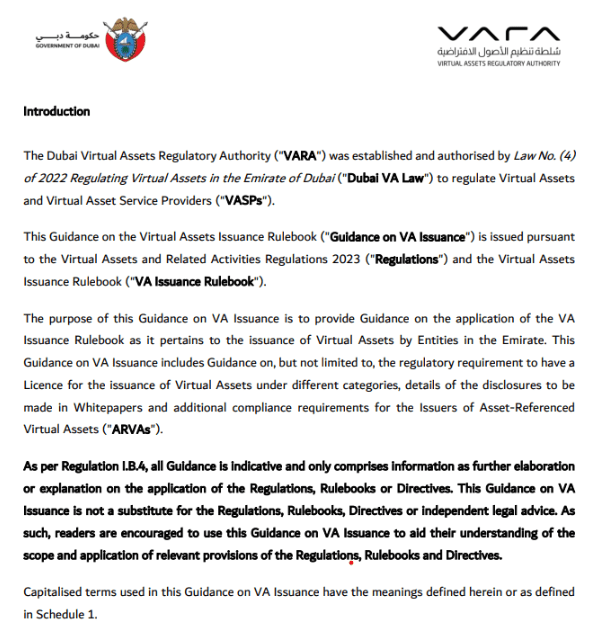
    Dubai’s Virtual Assets Regulatory Authority (VARA) released detailed guidance on token issuance, specifying how stablecoins, real-world asset (RWA) tokens, and other digital assets should be structured, disclosed, and distributed. The guidance interprets VARA’s existing Virtual Asset Issuance Rulebook, establishing three distinct issuance categories rather than creating new law.

    Three Issuance Pathways

    Category 1 covers fiat- and asset referenced tokens, Category 2 requires distribution through VARA-licensed intermediaries, and exempt virtual assets with limited functionality fall under Category 3. Licensed distributors in Category 2 are responsible for due diligence and ongoing compliance validation.

    VARA Guidance on VA Issuance.: VARA

    Enhanced Transparency and Governance

    Ruben Bombardi, VARA general counsel, emphasized that the bespoke framework offers clearer regulatory guidance compared with traditional securities or payments law. The guidance mandates detailed disclosures, including whitepapers and separate risk statements, to support informed decision-making for investors and users.

    VARA’s framework focuses on clarity for market participants in Dubai, while incorporating expectations for reserve assets, redemption rights, and legal structuring for asset-referenced tokens. Bombardi noted the approach may also attract interest from foreign regulators and standard setters, highlighting Dubai’s goal of establishing a specialized, globally recognized virtual asset issuance regime.

    Disclaimer

    This content is for informational purposes only and does not constitute financial, investment, or legal advice. Cryptocurrency trading involves risk and may result in financial loss.
  • Bitcoin Developers Test Prototype for Quantum-Safe Wallet Recovery

    Bitcoin Developers Test Prototype for Quantum-Safe Wallet Recovery

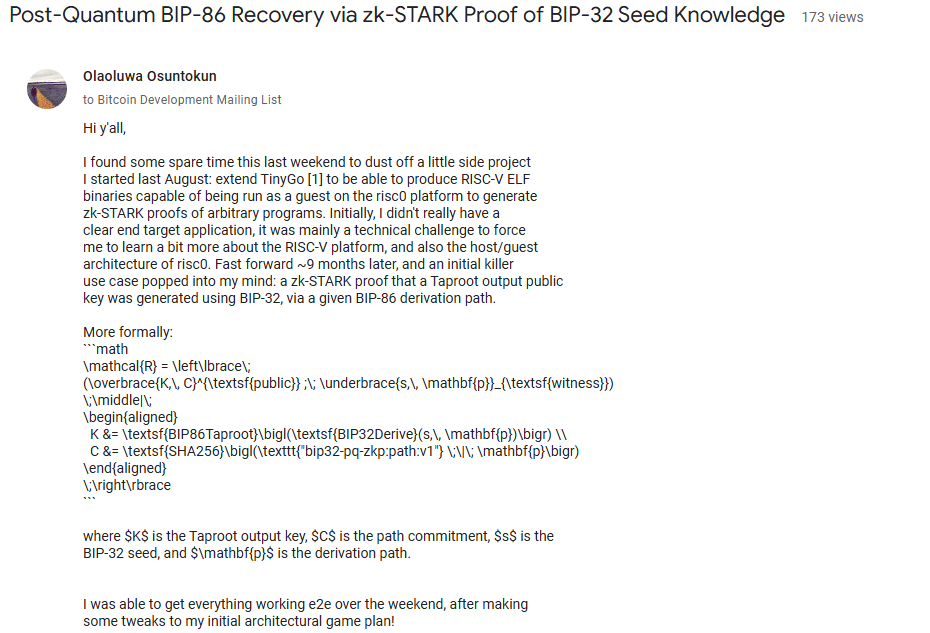
    Lightning Labs CTO Olaoluwa “Roasbeef” Osuntokun has unveiled a working prototype designed to protect Bitcoin wallets from potential quantum attacks. The tool enables users of vulnerable Taproot and other modern wallets to prove wallet ownership using their secret seed without revealing it, providing a backup method if the network disables traditional digital signatures.

    Bitcoin currently relies on cryptographic signatures, which a sufficiently powerful quantum computer could forge. To counter this, developers have proposed BIP-360, a quantum resistant wallet migration plan, and an “emergency brake” upgrade that would shut off Bitcoin’s signature system. While the emergency brake could prevent theft, it risks locking millions of users out of wallets dependent solely on Taproot signatures.

    Osuntokun’s prototype acts as an escape hatch. It allows users to mathematically prove they created a wallet, securing funds even if signatures are disabled. Proof generation on a high-end MacBook takes about 55 seconds, verification under two seconds, and the resulting file is roughly 1.7 MB.

    Currently, there is no formal adoption path, and developers remain divided on the urgency of quantum threats. Analysts note that while large-scale quantum attacks remain theoretical, exposed wallets are at risk. The prototype offers a practical solution to prevent collateral loss without compromising other wallets, addressing a long-standing gap in Bitcoin’s quantum contingency planning.

    Disclaimer

    This content is for informational purposes only and does not constitute financial, investment, or legal advice. Cryptocurrency trading involves risk and may result in financial loss.
  • Yuga Labs Settles Lawsuit With Artists Over Lookalike NFTs

    Yuga Labs Settles Lawsuit With Artists Over Lookalike NFTs

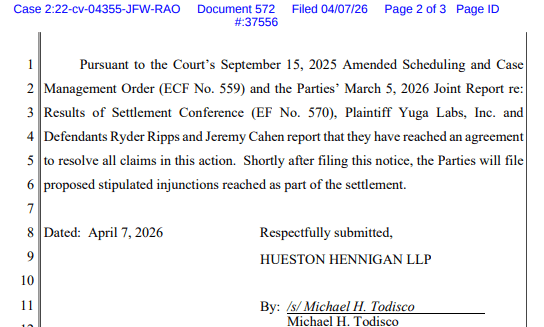
    Yuga Labs, creator of the Bored Ape Yacht Club (BAYC), has reached a settlement with artists Ryder Ripps and Jeremy Cahen, who were accused of producing and selling NFTs that closely resembled BAYC’s iconic cartoon ape collection. Court documents filed in the U.S. District Court for the Central District of California confirm that the parties have agreed to resolve the dispute.

    As part of the settlement, Ripps and Cahen are permanently prohibited from using Yuga Labs’ imagery and trademarks. They are required to transfer control of smart contracts, domains, and any remaining NFTs linked to their RR/BAYC project to Yuga Labs within 10 days. The court also barred the artists from selling, concealing, or otherwise disposing of any assets related to the case to avoid compliance.

    Background of the Legal Dispute

    Yuga Labs initially filed the lawsuit in June 2022, alleging that the RR/BAYC NFTs, minted in May 2022, copied its copyrighted ape designs and caused user confusion, generating millions in profits for Ripps and Cahen. The artists defended their work as satire and parody, citing free speech protections.

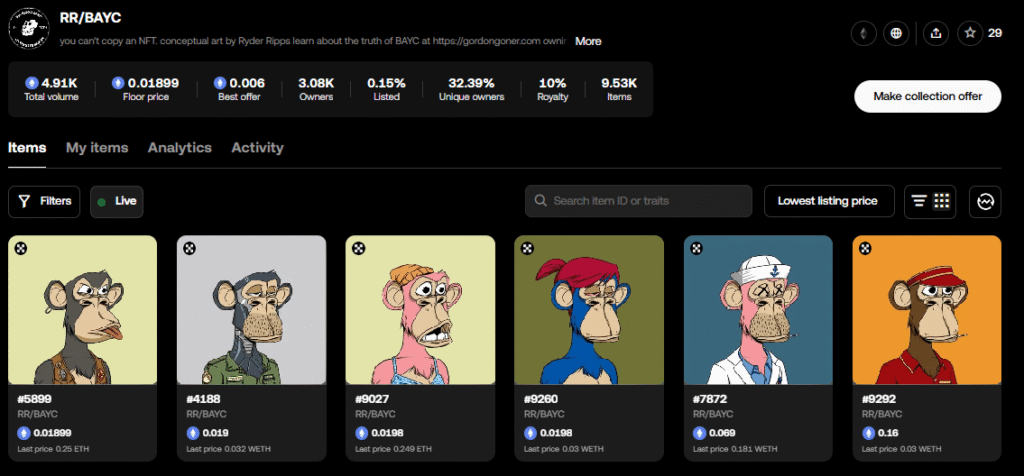
    The RR/BAYC NFTs are still live on OKX Wallet

    A 2023 court ruling favored Yuga Labs, ordering the artists to pay $1.37 million plus $200,000 in additional damages, which later grew to $9 million after a counterclaim in 2024. The appeals process in 2025 overturned part of the ruling and mandated a jury trial to evaluate the trademark infringement claims.

    With the settlement now finalized, Yuga Labs regains control over the disputed assets, bringing an end to a nearly four-year legal saga in the NFT space.

    Disclaimer

    This content is for informational purposes only and does not constitute financial, investment, or legal advice. Cryptocurrency trading involves risk and may result in financial loss.