Category: News

  • Bitcoin Bear Market Could Require More Months of Consolidation

    Bitcoin Bear Market Could Require More Months of Consolidation

    Bitcoin is trading below $66,000, down over 3% in the past 24 hours and roughly 45% below its October all-time high, marking nearly six months of a bear market. Investors are increasingly focused on two key questions: how much lower can bitcoin fall, and how long will this bear market continue.
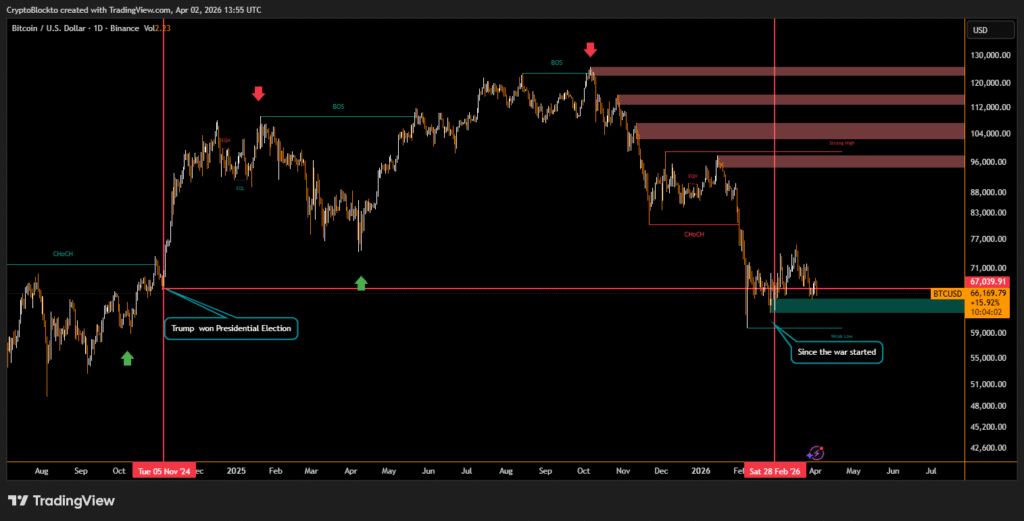
    $BTC daily price chart

    Price Pain vs. Time Pain

    Market challenges are not only about sharp drawdowns, known as price pain, but also slow-moving, range-bound trading, referred to as time pain. Price pain forces participants out of positions during sudden volatility, while time pain tests investor endurance as markets remain directionless for extended periods.

    Long-Term Holder Dynamics

    Realized Cap HODL Waves data groups bitcoin supply based on the last time coins moved and weights them by realized price. Currently, long-term holders those holding bitcoin for six months or more control around 80% of the total supply. Historical patterns indicate bear market bottoms coincide with long-term holders controlling about 85% of supply. This suggests that although the price floor may be forming, several months of sideways trading could still be ahead.
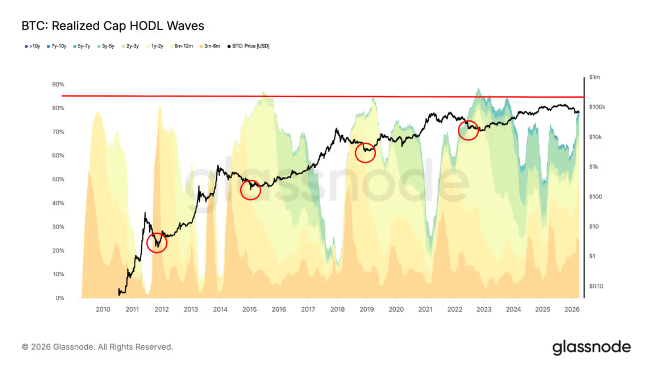
    Implications for Investors

    Long-term holders appear to be accumulating at depressed prices, which historically signals stabilization. However, past cycles show that while price bottoms may form first, it often takes months for long-term holder supply to reach peak levels. This indicates that investors should expect continued consolidation before a sustained recovery begins.

    Disclaimer

    This content is for informational purposes only and does not constitute financial, investment, or legal advice. Cryptocurrency trading involves risk and may result in financial loss.

  • SoFi Launches 24/7 Business Banking Platform Combining Cash and Stablecoins

    SoFi Launches 24/7 Business Banking Platform Combining Cash and Stablecoins

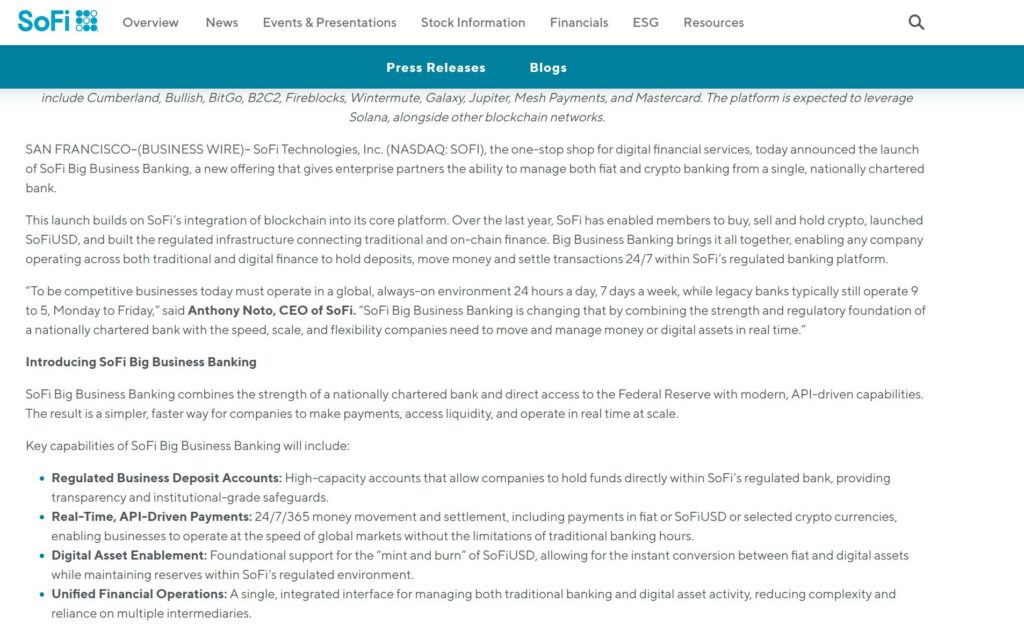
    SoFi has introduced SoFi Big Business Banking, a new platform designed to let companies manage both U.S. dollars and digital assets within a regulated banking environment. The service enables firms to hold dollars, convert funds into stablecoins such as SoFiUSD, and transfer money at any time without relying on traditional banking hours.

    The platform addresses a long standing challenge in crypto finance, where companies typically depend on separate providers for banking, stablecoin issuance and custody. These fragmented systems often slow payments and settlements, sometimes taking hours or days to complete.

    Stablecoin Conversion and Blockchain Settlement Tools

    Under the system, businesses can deposit U.S. dollars, convert them into SoFiUSD and move funds instantly across blockchain networks, including Solana. The stablecoin is issued and redeemed directly within SoFi’s regulated balance sheet, with reserves held internally.

    Industry Partners Signal Growing Adoption

    Early partners include Cumberland, Wintermute, Galaxy, BitGo and Bullish. SoFi CEO Anthony Noto stated that modern businesses require financial systems operating around the clock. The launch highlights a wider trend of merging traditional banking infrastructure with blockchain technology to simplify global money movement and reduce reliance on multiple intermediaries.

    Disclaimer

    This content is for informational purposes only and does not constitute financial, investment, or legal advice. Cryptocurrency trading involves risk and may result in financial loss.
  • BitGo Launches Institutional Stablecoin Minting and Redemption Service

    BitGo Launches Institutional Stablecoin Minting and Redemption Service

    Crypto infrastructure firm BitGo has introduced a new service designed to allow institutional clients to mint, redeem, and manage stablecoins and other digital assets within a single operational framework. The service, called BitGo Mint, aims to simplify workflows for institutions seeking efficient and scalable digital asset infrastructure.

    The platform initially supports minting and redemption for World Liberty’s USD1, a Trump-backed stablecoin, and SoFiUSD, issued by SoFi Bank, an OCC-regulated and FDIC-insured depository institution. BitGo previously launched infrastructure support for both USD1 and SoFiUSD at the end of last year, strengthening its role in stablecoin operations.

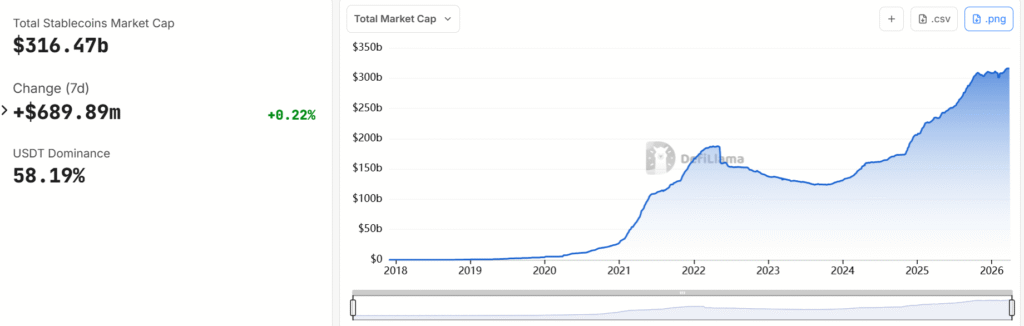
    total stablecoin supply

    Institutional Demand Drives Stablecoin Infrastructure Growth

    BitGo stated that the service targets market makers, liquidity providers, banks, exchanges, asset managers, and fintech firms interested in issuing or managing stablecoins. The goal is to reduce operational complexity by integrating minting and redemption into existing digital asset workflows used by institutional clients.

    The launch comes as the global stablecoin sector continues expanding, with major financial and payments companies increasing their involvement in tokenized dollar systems. Institutions including PayPal, Barclays, and Western Union have either introduced stablecoin initiatives or invested in related infrastructure.

    Market Performance and Industry Positioning

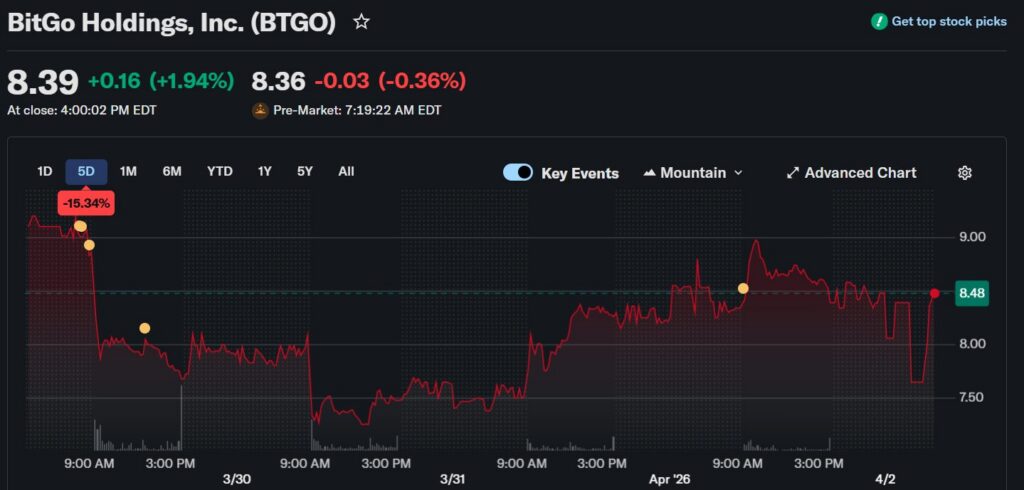
    Analysts at Mizuho described BitGo as a “military-grade custodian,” citing its strong security record and focus on institutional services as competitive advantages. Following the announcement period, BitGo shares closed up 1.94% at $8.49 on Thursday, though the stock remains down more than 50% since its January initial public offering.

    BitGo’s shares price
    Disclaimer

    This content is for informational purposes only and does not constitute financial, investment, or legal advice. Cryptocurrency trading involves risk and may result in financial loss.
  • Iran Demands Crypto or Yuan Payments for Ships Crossing Strait of Hormuz

    Iran Demands Crypto or Yuan Payments for Ships Crossing Strait of Hormuz

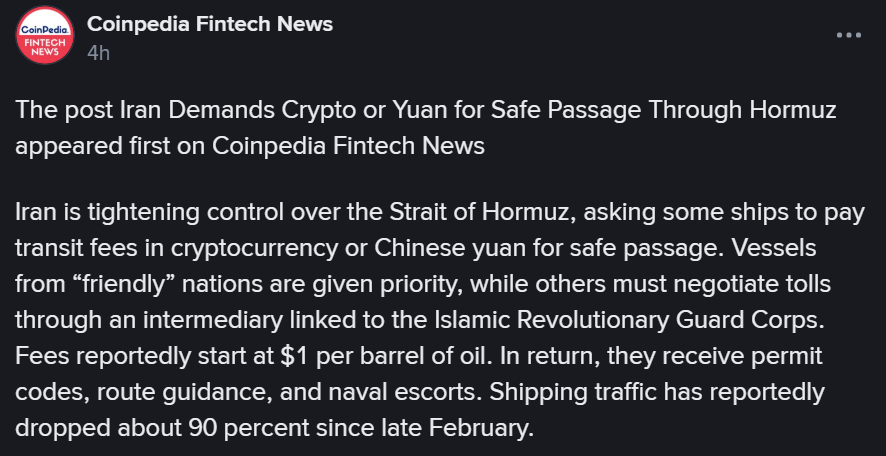
    Iran has introduced a new transit payment system requiring ships to pay in cryptocurrencies or Chinese yuan to cross the Strait of Hormuz, transforming the strategic waterway into a tightly controlled passage managed by the Islamic Revolutionary Guard Corps (IRGC). Under the new process, vessels seeking entry must submit detailed operational data, including ownership, cargo details, flag, crew information, destination, and real-time tracking data before receiving approval.

    The policy applies primarily to vessels from nations considered “friendly,” while ships heading to the United States or Israel are reportedly restricted from passage. Approved vessels receive clearance codes and are guided through designated IRGC-monitored corridors, sometimes accompanied by armed escorts to ensure safe transit.

    Impact on Global Oil Trade and Dollar-Dominated Settlements

    The Strait of Hormuz carries an estimated 20% to 25% of global oil supply, making the new toll structure highly significant for international energy markets. Payments reportedly start at about $1 per barrel of oil, meaning total transit costs for large shipments can reach millions of dollars depending on cargo volume and risk levels.

    With roughly 80% to 85% of global oil trades traditionally settled in US dollars, the introduction of yuan and crypto payment options signals a potential shift in settlement practices. Countries heavily dependent on the strait, including Japan and Singapore, rely on it for a majority of their oil imports, leaving them limited alternatives.

    Strait of Hormuz Management Plan and Shipping Disruptions

    The payment framework forms part of Iran’s Strait of Hormuz Management Plan, which establishes security procedures, environmental controls, coordination measures with Oman, and structured toll rules. The plan also restricts access for certain allied nations and introduces stricter operational oversight.

    Shipping activity through the strait has reportedly declined sharply following the rollout of the system, highlighting the growing geopolitical and economic pressure surrounding one of the world’s most critical energy corridors.

    Disclaimer

    This content is for informational purposes only and does not constitute financial, investment, or legal advice. Cryptocurrency trading involves risk and may result in financial loss.
  • Drift $280M Exploit Linked to Admin Takeover as Criticism Targets USDC Handling

    Drift $280M Exploit Linked to Admin Takeover as Criticism Targets USDC Handling

    Drift revealed that the $280 million exploit on its Solana based trading platform was caused by a highly sophisticated administrative takeover involving weeks of preparation. The platform said a malicious actor gained unauthorized access using durable nonce accounts, allowing pre-signed transactions to be executed later.

    According to Drift, the attacker secured multisig transaction approvals in advance, likely through social engineering or misrepresentation of transactions. This enabled the takeover of Security Council administrative powers, allowing the attacker to introduce a malicious asset and remove withdrawal limits. Drift confirmed the incident was not caused by a smart contract flaw or seed phrase compromise.

    All deposits across borrow-lend, vault, and trading systems were affected. Stolen tokens included JLP, SOL, USDC, cbBTC, and wBTC. As a precaution, all remaining protocol functions were frozen, and the compromised wallet was removed from the multisig. Drift also stated it is working with exchanges, bridges, and law enforcement to trace and freeze the stolen funds.

    ZachXBT Criticism of Circle USDC Response

    Onchain investigator ZachXBT criticized Circle over its handling of USDC tied to the exploit. He claimed more than $230 million in USDC linked to the attack was transferred from Solana to Ethereum through the Cross-Chain Transfer Protocol without being frozen.

    ZachXBT stated Circle had roughly six hours to act but did not freeze the funds. He also referenced an earlier incident in which Circle froze 16 USDC wallets tied to separate businesses without issuing an official explanation, raising concerns among community members about centralized control over stablecoin operations.

    Disclaimer

    This content is for informational purposes only and does not constitute financial, investment, or legal advice. Cryptocurrency trading involves risk and may result in financial loss.

  • Former FTX Head of Engineering Nishad Singh Fined $3.7 Million

    Former FTX Head of Engineering Nishad Singh Fined $3.7 Million

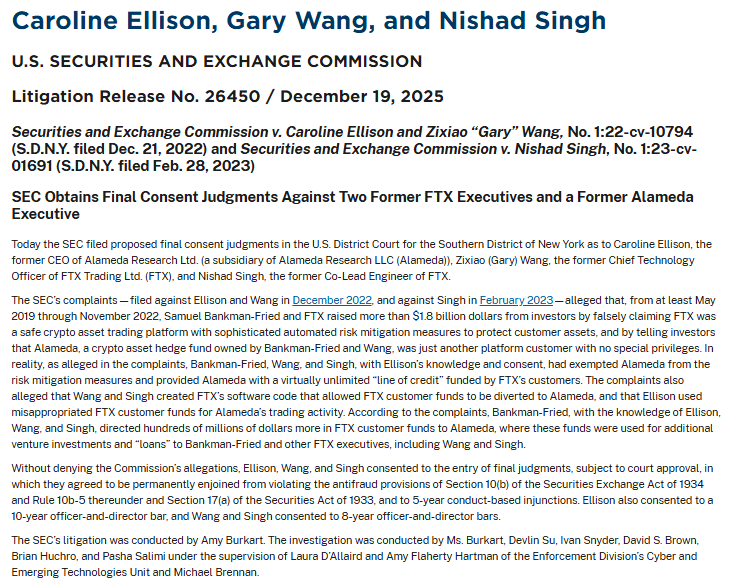
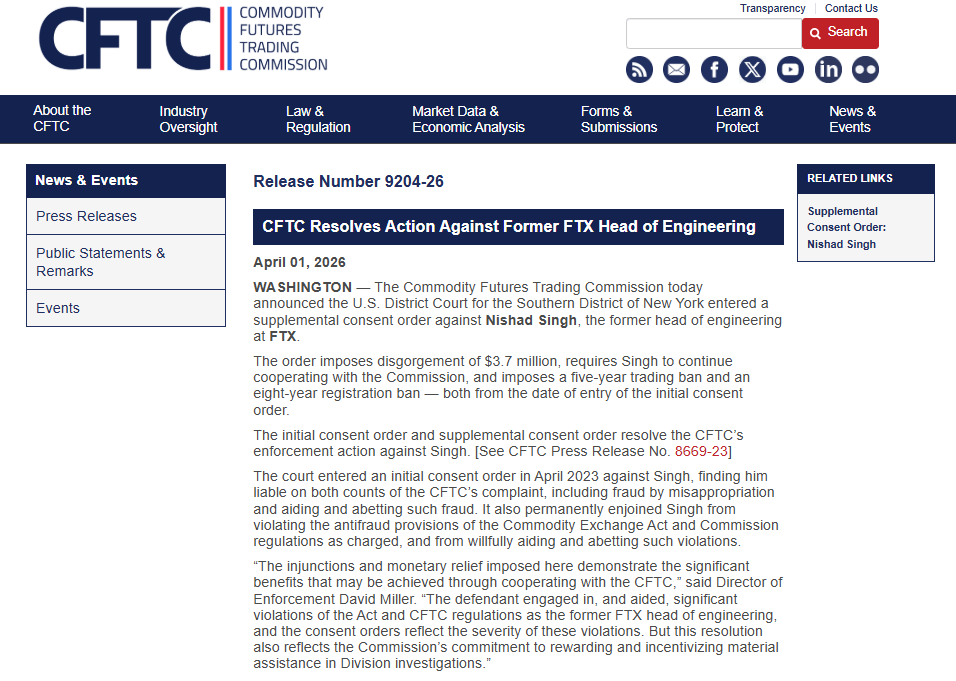
    Nishad Singh, the former head of engineering at FTX, has agreed to pay $3.7 million to resolve a lawsuit filed by the US Commodity Futures Trading Commission (CFTC) over his alleged role in the crypto exchange’s collapse and the misappropriation of user funds.

    CFTC Orders Disgorgement and Trading Bans

    Under the supplemental consent order, Singh will pay $3.7 million in disgorgement and faces a five-year ban on trading in markets along with an eight-year registration ban, preventing him from obtaining a license to operate in the sector. The CFTC stated that the order resolves its enforcement action against Singh and reflects both the seriousness of his violations and his cooperation with investigators.

    US Commodity Futures Trading Commission

    FTX’s bankruptcy in November 2022 caused massive disruptions in the crypto industry, erasing billions in market liquidity and prompting multiple regulatory actions. Singh was charged by the CFTC in February 2023 with fraud by misappropriation and aiding and abetting fraud committed by former CEO Sam Bankman-Fried.

    Singh’s Cooperation and Legal Outcomes

    Singh also faced related cases from the Securities and Exchange Commission and US prosecutors. He received time served and three years of supervised release after cooperating with authorities and testifying against Bankman-Fried. His attorneys highlighted Singh’s limited role and extensive cooperation in these matters.

    Securities and Exchange Commission
    Disclaimer

    This content is for informational purposes only and does not constitute financial, investment, or legal advice. Cryptocurrency trading involves risk and may result in financial loss.
  • Alabama Grants DAOs Legal Status Under DUNA Act

    Alabama Grants DAOs Legal Status Under DUNA Act

    Alabama has become the second US state, after Wyoming, to grant decentralized autonomous organizations (DAOs) legal recognition under the Decentralized Unincorporated Nonprofit Association (DUNA) Act. Senate Bill 277, introduced by Republican Senator Lance Bell in February, passed the House 82-7 with 16 abstentions on March 17 and was signed into law by Governor Kay Ivey.

    Legal Protections and Governance for DAOs

    The DUNA Act provides DAOs with legal status and limited liability protections, allowing decentralized communities to build, govern, contract, and scale in the real world. DAOs qualifying under the law must have at least 100 members united for a common nonprofit purpose, such as managing a blockchain network or smart contract system. Governance can operate entirely through blockchain technology, including on-chain voting, proposals, and consensus mechanisms.

    DAOs recognized under the law gain full legal entity status, enabling them to own property, enter contracts, and sue or be sued. Individual members and administrators are shielded from personal liability, providing certainty and protection for participants in decentralized communities.

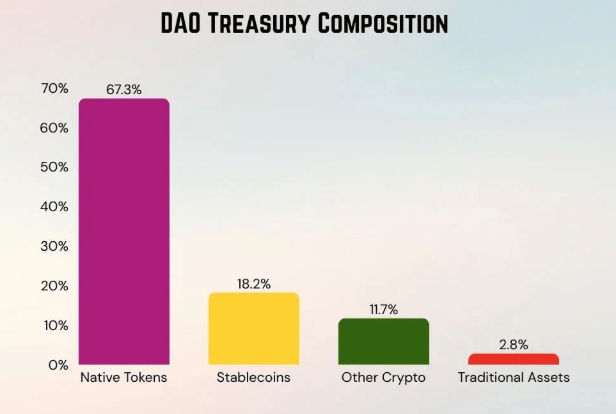
    DAO treasury composition

    Expanding DAO Legislation Across the US

    Wyoming was the first state to pass DUNA legislation, with its governor signing the law in March 2024. West Virginia has a similar bill awaiting approval. Globally, over 13,000 DAOs exist with collective treasuries exceeding $24.5 billion, with Ethereum and its layer-2 networks hosting over 85% of these organizations.

    Disclaimer

    This content is for informational purposes only and does not constitute financial, investment, or legal advice. Cryptocurrency trading involves risk and may result in financial loss.

  • Genius Group Sells Entire Bitcoin Treasury to Pay $8.5M Debt

    Genius Group Sells Entire Bitcoin Treasury to Pay $8.5M Debt

    AI and crypto company Genius Group has sold its remaining Bitcoin holdings in Q1 2026 to pay off $8.5 million of debt, marking a significant shift from its previous “Bitcoin first” strategy. The company stated it plans to rebuild its Bitcoin treasury when market conditions improve.

    Shift from “Bitcoin First” Strategy

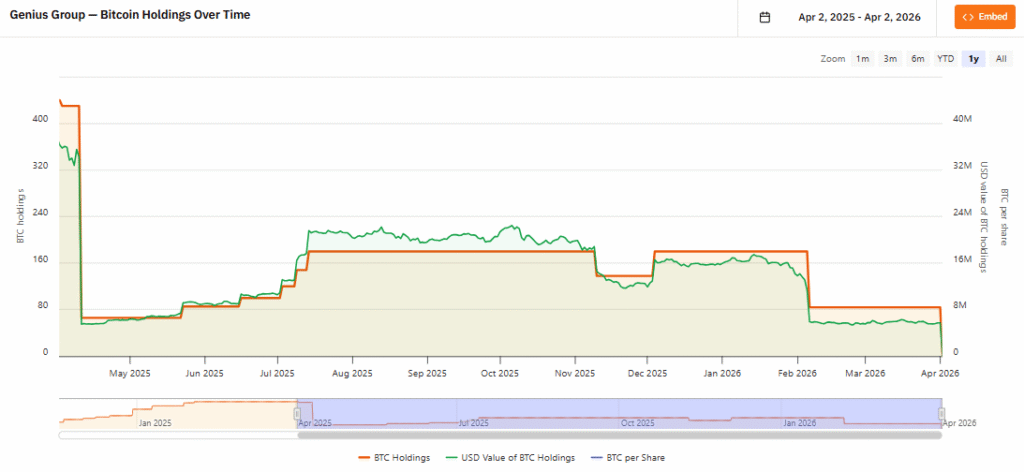
    In November 2024, Genius Group had pledged to hold 90% or more of its reserves in Bitcoin. At the start of 2026, the company held 84 BTC valued at approximately $5.7 million, but these holdings have gradually declined since April 2025, when a US court temporarily barred it from expanding its Bitcoin treasury. Purchases resumed in June 2025 before the full liquidation.

    Genius Group BTC holdings have now fallen to zero: Bitcoin Treasuries

    Genius Group reported strong Q1 results, with revenue rising 171% year-on-year to $3.3 million and gross profit up 228% to $2 million. The company swung from a $500,000 operating loss in Q1 2025 to a $2.7 million net profit in Q1 2026.

    Bitcoin Treasury Liquidations in 2026

    Genius Group is part of a broader trend of corporate Bitcoin sell-offs this year. MARA Holdings sold 15,133 BTC for $1.1 billion in March, Bitdeer liquidated 943 BTC, and other companies like Cango Inc. and GD Culture Group have also reduced holdings.

    In contrast, Michael Saylor’s Strategy continues to increase its Bitcoin treasury, adding 1,031 BTC on March 23 and now holding 89,581 BTC worth $6.1 billion, dominating corporate Bitcoin purchases in 2026.

    https://cms.blockto.io/strategy-expands-bitcoin-holdings-as-michael-saylor-signals-potential-new-purchase/
    Disclaimer

    This content is for informational purposes only and does not constitute financial, investment, or legal advice. Cryptocurrency trading involves risk and may result in financial loss.

  • Metaplanet Acquires 5,075 BTC to Become Third Largest Bitcoin Treasury Company

    Metaplanet Acquires 5,075 BTC to Become Third Largest Bitcoin Treasury Company

    Japan based Metaplanet has strengthened its Bitcoin accumulation strategy by acquiring 5,075 BTC during the first quarter of 2026 for approximately $398 million. The purchase reflects an average acquisition price of about $78,000 per Bitcoin and highlights the company’s continued focus on expanding its digital asset reserves.

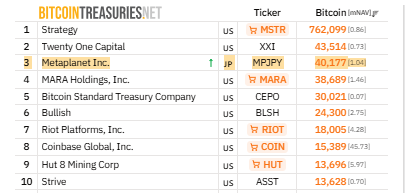
    As of March 31, 2026, Metaplanet holds a total of 40,177 BTC, acquired for roughly $3.9 billion at an average cost basis of approximately $97,000 per Bitcoin. The company also reported generating a Bitcoin yield of 2.8% year-to-date, indicating steady performance from its treasury strategy.

    Metaplanet Surpasses MARA Holdings in Global Bitcoin Treasury Rankings

    With its latest acquisitions, Metaplanet has overtaken MARA Holdings to become the third largest corporate Bitcoin holder worldwide. The shift occurred after MARA Holdings significantly reduced its Bitcoin stack in recent months.

    Twenty One Capital holds the second position globally with 43,514 BTC, while Strategy remains the largest corporate Bitcoin holder by a wide margin, maintaining more than 762,000 BTC. These rankings highlight the growing competition among corporations accumulating Bitcoin as a treasury asset.

    Following the announcement of its expanded holdings, shares of Metaplanet declined by 2%, trading at 302 yen, equivalent to approximately $1.89. The price movement reflects typical market adjustments despite the company’s continued growth in Bitcoin reserves.

    Disclaimer

    This content is for informational purposes only and does not constitute financial, investment, or legal advice. Cryptocurrency trading involves risk and may result in financial loss.
  • Bitcoin and Risk Assets React to Trump’s Iran Rhetoric, But Real Signals Lie Elsewhere

    Bitcoin and Risk Assets React to Trump’s Iran Rhetoric, But Real Signals Lie Elsewhere

    Bitcoin and other risk assets have been volatile amid Donald Trump’s shifting rhetoric on Iran. Traders react to each statement peace comments lift markets while hawkish remarks push them down—but political noise is masking real-world fundamentals.

    Strategic Petroleum Reserves Near Depletion

    The International Energy Agency coordinated a historic release of 426 million barrels from strategic petroleum reserves to offset a 4.5–5 million barrel per day shortfall caused by near-total disruption of the Strait of Hormuz. Analysts warn these reserves may be exhausted within weeks, potentially doubling the supply deficit to 10–11 million barrels per day. The Saudi Arabia called this “a shock of unprecedented scale with no obvious buffer left to absorb it.”

    Shipping and Insurance Signals

    Insurance premiums for tanker passage through Hormuz have surged from under 1% of ship value to as high as 7.5%, meaning a $100 million ship now pays $2–3 million per trip. Normalized premiums below 2% would indicate safer passage. Meanwhile, tanker traffic remains critically low, with only 21 transits since the conflict began compared to over 100 daily before the war.

    Traders relying on political statements may be misled. Sustainable rallies in Bitcoin Bitcoin and other risk assets depend on actual oil market conditions, insurance premiums, and shipping traffic returning to normal. Until then, geopolitical headlines will likely continue driving short-term volatility.

    Disclaimer

    This content is for informational purposes only and does not constitute financial, investment, or legal advice. Cryptocurrency trading involves risk and may result in financial loss.