Category: News

  • Trump Threatens Iran Bridges and Power Plants Amid Ongoing Conflict

    Trump Threatens Iran Bridges and Power Plants Amid Ongoing Conflict

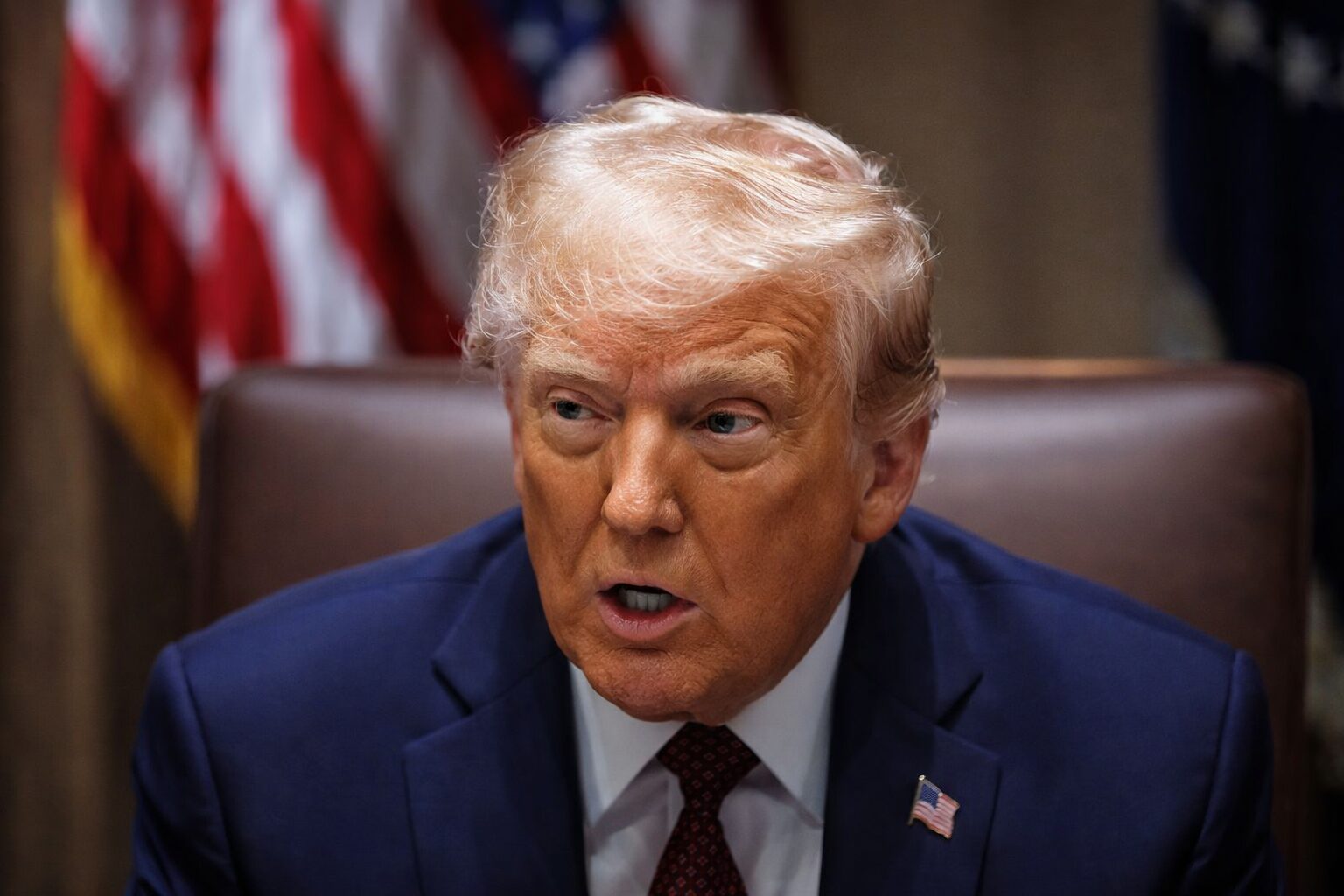
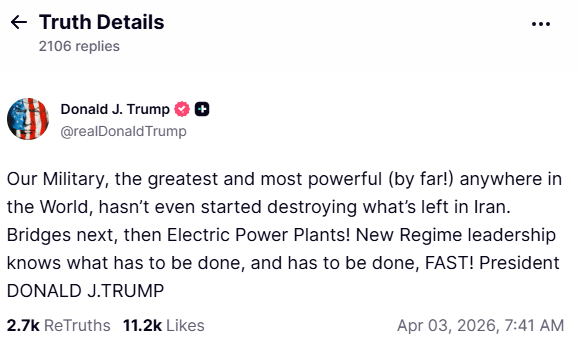
    U.S. President Donald Trump has issued new threats against Iran, warning that bridges and electric power plants will be the next targets in the ongoing conflict. On truthsocial , Trump stated, “The U.S. military hasn’t even started destroying what’s left in Iran. Bridges next, then Electric Power Plants.” He emphasized urgency, claiming Iran’s leadership “knows what has to be done, and has to be done, FAST!”
    War Timeline and Regional Impact

    Trump’s comments come as a 10-day pause on attacks against energy infrastructure concludes on April 6, coinciding with market reopenings. While Trump stated Washington is nearing its goals in Iran, he did not provide a clear timeline for ending the war.

    The war, which began on February 28 with U.S. and Israeli strikes, has killed thousands, displaced millions, and triggered retaliatory attacks by Tehran across the Gulf and on U.S. bases. The conflict has also pushed oil prices higher and created volatility in global markets. Analysts note that Trump’s shifting messages have so far failed to calm concerns over the largest U.S. military operations since 2003.

    Disclaimer

    This content is for informational purposes only and does not constitute financial, investment, or legal advice. Cryptocurrency trading involves risk and may result in financial loss.


  • X to Auto Lock First Time Crypto Mentions to Fight Phishing Scams

    X to Auto Lock First Time Crypto Mentions to Fight Phishing Scams

    X, owned by Elon Musk, is preparing to introduce a new security feature that will automatically lock accounts that mention crypto for the first time. The move is designed to reduce the growing wave of phishing attacks that rely on hijacked accounts to promote scam tokens and fraudulent offers.

    According to Nikita Bier, users whose accounts post about crypto for the first time will be required to complete additional verification before they can post again. The feature targets attackers who gain access to accounts and immediately use them to spread malicious links or fake promotions. Bier stated that the change could remove most of the incentive behind such scams.

    The update follows reports of phishing emails disguised as copyright violation notices. Victims are directed to realistic login pages that capture passwords and two-factor authentication codes, allowing attackers to take control of accounts.

    Platform Expands Anti-Scam Efforts Amid Rising Threats

    Crypto scams have long been a challenge on X, continuing trends from its earlier years as Twitter. Common schemes include fake “double your money” promotions, impersonation of public figures, and fraudulent token launches designed to trick users into sending cryptocurrency.

    One of the most notable incidents occurred during the 2020 Twitter Bitcoin Scam, when attackers gained control of prominent accounts and promoted fake Bitcoin giveaways, collecting over $100,000 before the posts were removed. That breach resulted from social engineering attacks targeting employees and later led to a prison sentence for the hacker.

    X has previously introduced bot purges, API restrictions, and behavioral detection tools to improve safety. Bier also criticized Google for allowing phishing emails to pass through Gmail, arguing stronger email-level protection is necessary to reduce crypto-related fraud.

    Disclaimer

    This content is for informational purposes only and does not constitute financial, investment, or legal advice. Cryptocurrency trading involves risk and may result in financial loss.

  • Iran Strikes Kuwait Refinery as U.S. and Israel Target Tehran Amid Escalating Conflict

    Iran Strikes Kuwait Refinery as U.S. and Israel Target Tehran Amid Escalating Conflict

    Iran launched drone strikes on Mina al Ahmadi oil refinery on Friday, igniting multiple fires at the facility. Kuwait Petroleum Corp. confirmed that firefighters were working to control the blazes, and no injuries were reported. The refinery has been repeatedly targeted during the ongoing war.

    Sirens were reported in Bahrain, while Saudi Arabia said it destroyed several Iranian drones. Defenses were activated in the United Arab Emirates, and Israel reported incoming missiles.

    https://cms.blockto.io/irgc-threatens-strikes-on-nvidia-apple-microsoft-and-tesla-sites-across-region/

    Airstrikes and Global Energy Impact

    Meanwhile, United States and Israel conducted airstrikes around Tehran and Isfahan. Iran’s attacks on Gulf energy infrastructure and its control over the Strait of Hormuz have sent Brent crude prices to roughly $109 per barrel, up more than 50% since late February.

    The conflict, now entering its fifth week, shows no signs of slowing, while the United Nations Security Council prepares to address Tehran’s tightening grip on regional shipping lanes critical to global energy supply.

    Disclaimer

    This content is for informational purposes only and does not constitute financial, investment, or legal advice. Cryptocurrency trading involves risk and may result in financial loss.
  • Stablecoin Supply Hits $315B in Q1 as USDC Growth Outpaces USDT Decline

    Stablecoin Supply Hits $315B in Q1 as USDC Growth Outpaces USDT Decline

    Stablecoins remained one of the strongest segments of the crypto market in the first quarter, with total supply rising by about $8 billion to reach a record $315 billion, according to data from.CEX.io Although this represented the slowest expansion since the fourth quarter of 2023, the increase came during a period when the broader digital asset market weakened.

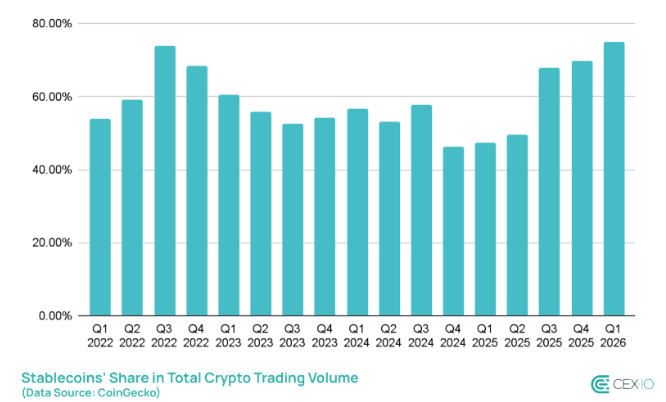
    Investor behavior showed a defensive shift toward stable assets. Stablecoins accounted for approximately 75% of total crypto trading volume in Q1, the highest level recorded so far. At the same time, overall stablecoin transaction volume exceeded $28 trillion, reinforcing their role as a major liquidity layer across digital asset markets.

    Stablecoins’ share of total digital asset trading volume exceeded its 2022 peak

    Despite the strong activity levels, retail participation showed signs of decline. Retail-sized transfers fell by 16%, marking the steepest quarterly drop on record. Meanwhile, automated systems dominated usage, with bots responsible for roughly 76% of all stablecoin transaction volume, suggesting increased reliance on algorithmic trading, arbitrage, and liquidity provisioning.

    Diverging Trends Between Major Stablecoin Issuers

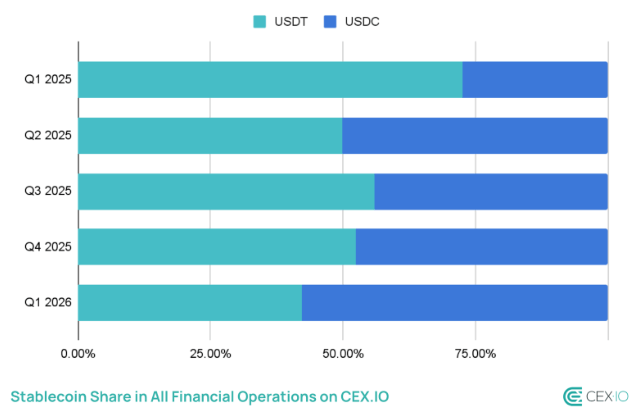
    Data from the quarter also highlighted a widening gap between leading stablecoin issuers. The supply of USDC, issued by Circle, increased by approximately $2 billion, while USDT, issued by Tether, declined by about $3 billion. This marked the first significant divergence between the two since the second quarter of 2022 during earlier bearish market conditions.

    Much of the broader growth in stablecoin issuance came from yield-bearing products, a segment now valued at around $3.7 billion, with daily trading volumes exceeding $100 million. These products have drawn regulatory attention in the United States, particularly as lawmakers debate crypto market structure rules and traditional banks raise concerns about stablecoins offering interest-like returns.

    Disclaimer

    This content is for informational purposes only and does not constitute financial, investment, or legal advice. Cryptocurrency trading involves risk and may result in financial loss.
  • Big Tech Firms Support x402 Foundation to Drive Agentic AI Payment Standards

    Big Tech Firms Support x402 Foundation to Drive Agentic AI Payment Standards

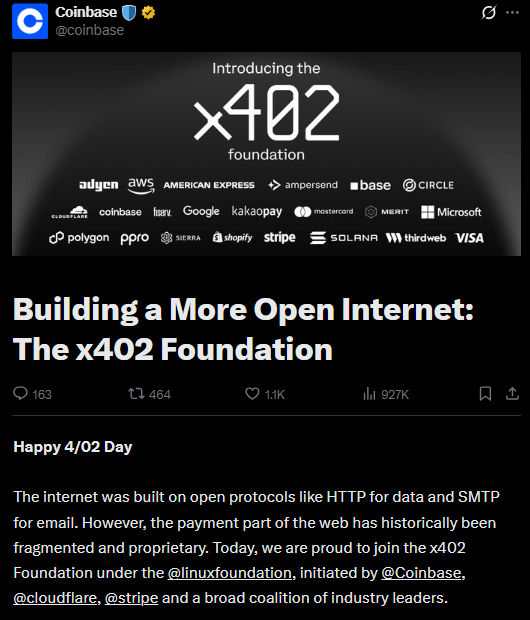
    Major technology companies including Google, Microsoft, and Amazon Web Services have joined as founding members of the newly created x402 Foundation, aimed at governing and standardizing the x402 protocol for agentic AI payments across crypto and fiat systems.

    The Linux Foundation officially launched the x402 Foundation on Thursday with support from Coinbase, which originally developed the x402 protocol. Other founding participants include American Express, Mastercard, Visa, Cloudflare, Shopify, Stripe, Circle, Polygon Labs, Solana Foundation, Thirdweb, and KakaoPay.

    Coinbase stated that placing the x402 protocol under the Linux Foundation gives it a neutral, nonprofit structure. This approach is expected to encourage wider adoption by developers and companies compared to launching it under a single corporate entity.

    Open Standards Aim to Enable Autonomous AI Transactions

    The x402 protocol is designed as an open payment standard that allows AI agents and web services to automatically pay for API access, digital data, and online services. Supporters believe agentic AI could soon become a dominant user of blockchain-based payment systems.

    Brian Armstrong previously stated that AI agents may soon outnumber human users in online transactions. Similar views were shared by Jeremy Allaire, who predicted billions of AI agents could transact onchain within three to five years. Changpeng Zhao also described cryptocurrency as a natural payment method for automated AI systems handling everyday purchases.

    x402 Transaction Activity Shows Sharp Rise and Decline

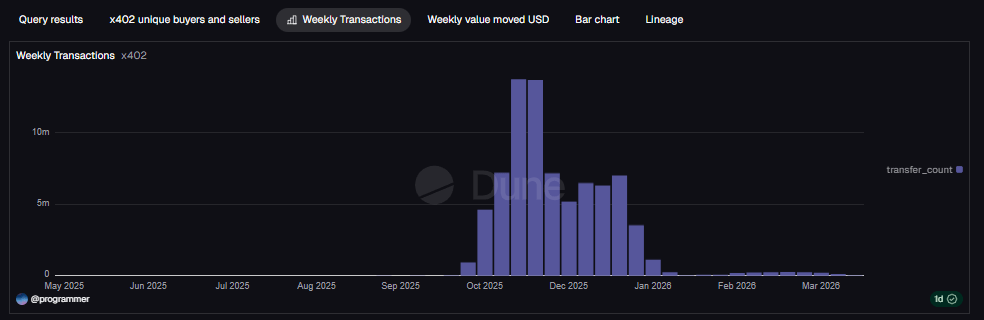
    Data from analytics platform Dune Analytics showed that x402 protocol usage surged in late 2025 before declining in early 2026. Weekly transaction volume peaked between Nov. 4 and Nov. 10, reaching approximately 13.7 million transactions, followed by another 13.66 million transactions the next week.

    Weekly transactions via the x402 protocol since May 2025: Dune Analytics

    However, transaction levels have since dropped significantly, with weekly volumes ranging between 29,000 and 1.1 million transactions during 2026, indicating a slowdown after the earlier surge in activity.

    Disclaimer

    This content is for informational purposes only and does not constitute financial, investment, or legal advice. Cryptocurrency trading involves risk and may result in financial loss.

  • Circle Plans cirBTC Launch to Compete With Coinbase and BitGo in Wrapped Bitcoin Market

    Circle Plans cirBTC Launch to Compete With Coinbase and BitGo in Wrapped Bitcoin Market

    Circle has announced plans to launch a new wrapped Bitcoin asset called cirBTC, marking its expansion into the Bitcoin ecosystem and positioning the company against established providers such as Coinbase and BitGo.

    The new token, cirBTC, is expected to launch on Ethereum, backed 1:1 by Bitcoin, and designed primarily for institutional participants such as over the counter trading desks, market makers, and lending protocols. The company stated that the asset aims to deliver a highly secure and neutral wrapped Bitcoin product suited for institutional-grade usage.

    Wrapped Bitcoin tokens allow Bitcoin holders to use their assets on other blockchain networks, enabling access to decentralized finance services. Financial institutions that have increased their exposure to Bitcoin are also exploring decentralized finance tools, driving demand for wrapped assets.

    Competition Intensifies in the Wrapped Bitcoin Sector

    Circle’s entry adds pressure to an already competitive market led by Wrapped Bitcoin (WBTC) and Coinbase Wrapped Bitcoin (cbBTC).

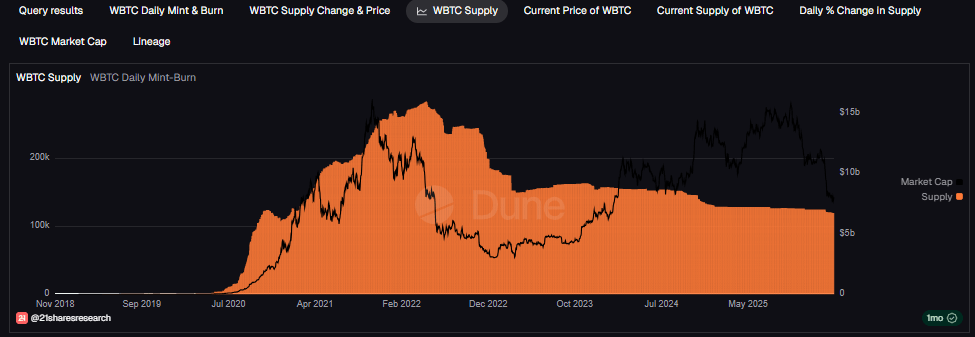
    Coinbase introduced cbBTC in September 2024, and it currently holds a market capitalization of about $5.9 billion, with roughly 88,800 tokens in circulation. Meanwhile, BitGo’s WBTC remains the dominant wrapped Bitcoin token, with a market capitalization near $8 billion and about 119,157 tokens circulating. However, this figure is roughly half of its November 2021 peak, when Bitcoin reached its cycle high.

    WBTC supply has declined over the past few years. : Dune

    Other crypto exchanges have also introduced alternative wrapped Bitcoin versions, including tokens from Kraken, Gate.io, Binance, Huobi, and OKX, though their market shares remain significantly smaller than the leading two providers.

    The combined supply of WBTC and cbBTC currently stands at approximately 208,000 Bitcoin, highlighting the scale of the growing wrapped Bitcoin market.

    Disclaimer

    This content is for informational purposes only and does not constitute financial, investment, or legal advice. Cryptocurrency trading involves risk and may result in financial loss.
  • CFTC Sues Illinois Over Cease-and-Desist Orders Targeting Prediction Markets

    CFTC Sues Illinois Over Cease-and-Desist Orders Targeting Prediction Markets

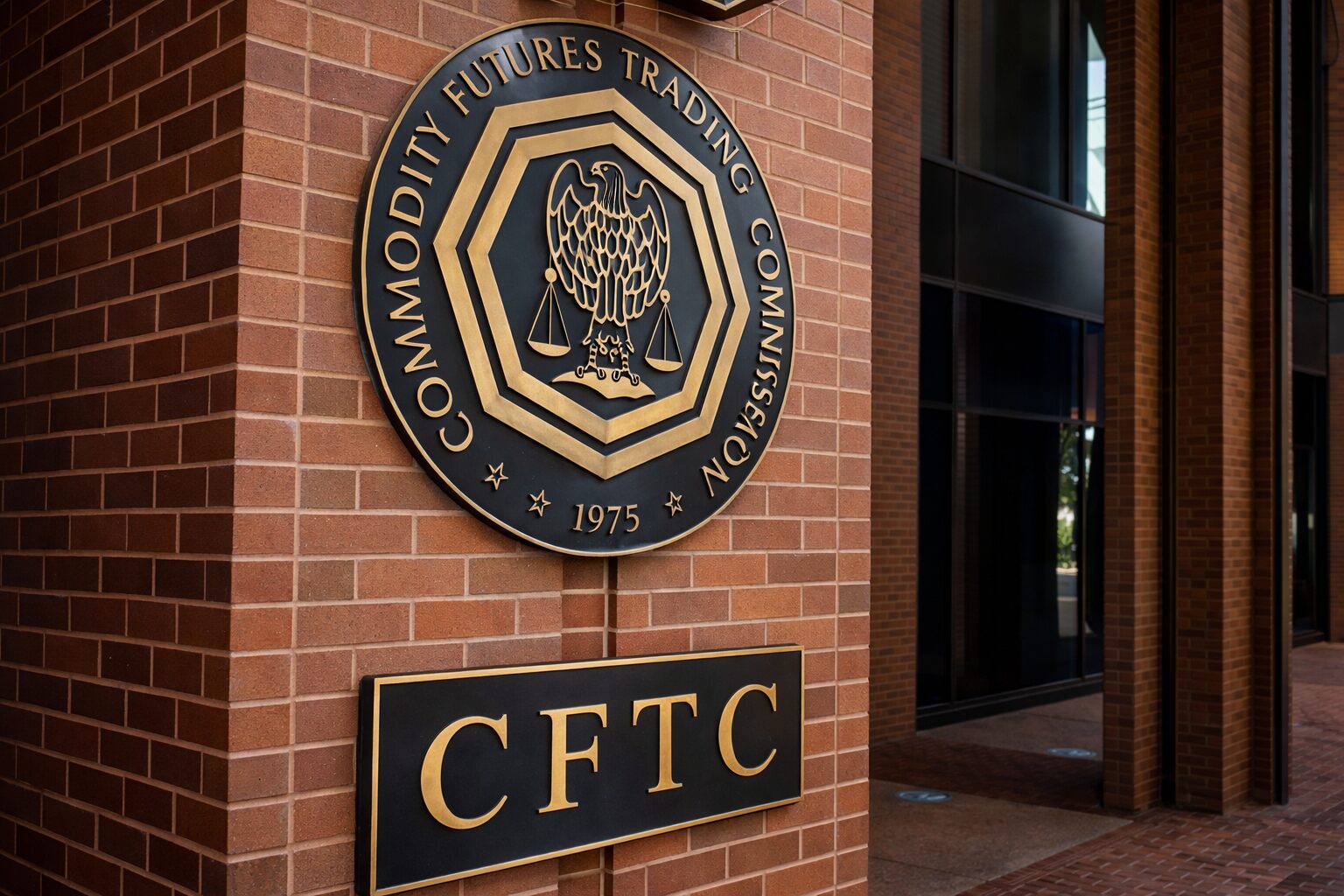
    The U.S. Commodity Futures Trading Commission (CFTC) and the Department of Justice have filed a lawsuit against the state of Illinois and several state officials after Illinois issued cease-and-desist letters aimed at shutting down sports related prediction market products.

    Illinois authorities argued that certain prediction market providers were offering products similar to sports gambling and should therefore be regulated under state gambling laws. However, the CFTC countered that these offerings are not traditional wagers but financial instruments classified as swaps.

    In its filing, the CFTC stated that the Commodity Exchange Act grants the agency “exclusive jurisdiction” over swaps markets. The lawsuit argues that Illinois’ enforcement actions intrude on federal authority and that federal law preempts state-level regulation in this area.

    States Push Back as Prediction Markets Expand Into Sports

    Federal regulators described event contracts as derivative instruments that allow participants to trade based on predictions about future outcomes. These events can include sports results, economic indicators, elections, climate developments, or other occurrences with financial or commercial consequences.

    Under CFTC Chairman Mike Selig, the agency has consistently maintained that prediction markets fall under federal oversight. At the same time, state regulators across political lines have pushed back, claiming that sports-linked contracts function similarly to gambling products.

    Nevada’s Gaming Control Board recently secured a temporary restraining order against Kalshi, with a related hearing scheduled soon. In addition, the CFTC is set to participate in an appeals court hearing before the Ninth Circuit, involving cases connected to the North American Derivatives Exchange, Kalshi, and Robinhood, highlighting the growing legal battle over the regulation of sports-related prediction markets.

    Disclaimer

    This content is for informational purposes only and does not constitute financial, investment, or legal advice. Cryptocurrency trading involves risk and may result in financial loss.
  • Polymarket Fee Expansion Drives Revenue Growth as Global Regulatory Pressure Intensifies

    Polymarket Fee Expansion Drives Revenue Growth as Global Regulatory Pressure Intensifies

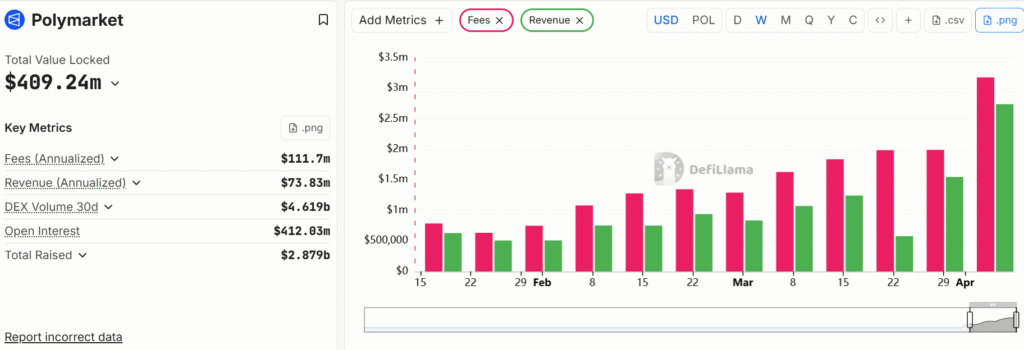
    Prediction market platform Polymarket recorded a sharp rise in daily fees and revenue following its March 30 fee model overhaul. Data from DefiLlama showed daily fees increasing from about $363,000 on Monday to more than $1 million on both Wednesday and Thursday. Revenue, representing the portion retained after incentives, reached approximately $995,000 on Wednesday before easing to around $899,000 on Thursday.

    The increase followed the expansion of taker fees beyond crypto and sports markets to include finance, politics, economics, culture, weather, and technology categories. Geopolitical and world events remained fee-free under the updated structure. The move reflects Polymarket’s efforts to strengthen monetization and maintain investor interest as regulatory scrutiny continues to grow globally.

    Polymarket fees and revenue data since feb

    Prediction Market Regulation Expands Across Multiple Jurisdictions

    Prediction markets, including Polymarket, face mounting regulatory pressure across several regions. In Europe, Hungary and Portugal moved to block or restrict access in January, citing concerns about unlicensed gambling and political betting risks.

    On March 17, a court in Argentina ordered a nationwide ban on Polymarket, stating the platform allowed betting without adequate identity and age verification, enabling minors to participate. Polymarket reports being blocked in 33 countries, while Kalshi faces restrictions in 52 jurisdictions.

    Funding Activity and Market Integrity Measures

    In the United States, at least 11 states have taken legal action against platforms such as Polymarket and Kalshi, issuing cease-and-desist orders or reviewing new regulations. Despite restrictions, both platforms are exploring funding rounds that could value each at approximately $20 billion.

    On March 24, Polymarket and Kalshi introduced new trading restrictions designed to reduce insider trading risks following criticism over unusually timed bets and concerns about overall market integrity.

    Disclaimer

    This content is for informational purposes only and does not constitute financial, investment, or legal advice. Cryptocurrency trading involves risk and may result in financial loss.
  • Coinbase Receives Conditional OCC Approval for National Trust Charter

    Coinbase Receives Conditional OCC Approval for National Trust Charter

    Coinbase has received conditional approval from the U.S. Office of the Comptroller of the Currency (OCC) for a national trust company charter, marking a major step toward operating as a federally regulated crypto custodian. The approval remains preliminary and requires the company to complete several regulatory steps before receiving a full charter.

    Compliance Requirements Before Final Charter Approval

    The conditional green light requires Coinbase to build comprehensive compliance systems, hire key personnel and undergo regulatory reviews. Regulators also expect the company to demonstrate strong risk management practices, protect client assets and meet anti-money-laundering standards. Only after satisfying these requirements can the OCC grant full approval.

    In a X post, Coinbase chief legal officer Paul Grewal said ;

    Coinbase first applied for the charter in October, alongside firms such as Ripple. More recently, Citadel-backed exchange EDX Markets also filed for a similar structure, highlighting growing demand for regulated custody services.

    Custody Services Support Institutional Crypto Adoption

    If finalized, the charter would allow Coinbase to operate a non-insured national trust company focused on digital asset custody, meaning it can hold client assets but cannot take deposits or issue loans. The move supports Coinbase’s strategy to expand institutional services and generate steadier revenue beyond trading fees, especially as it already serves as custodian for several U.S. spot bitcoin exchange-traded funds.

    Disclaimer

    This content is for informational purposes only and does not constitute financial, investment, or legal advice. Cryptocurrency trading involves risk and may result in financial loss.
  • Bitcoin and Stocks Recover as Iran Signals Cooperation on Strait of Hormuz

    Bitcoin and Stocks Recover as Iran Signals Cooperation on Strait of Hormuz

    Bitcoin trimmed earlier losses while major stock markets recovered after reports that Iran is working with Oman on a protocol to manage traffic through the Strait of Hormuz. The development eased fears of disruptions to one of the world’s most important oil shipping routes, helping risk markets stabilize.

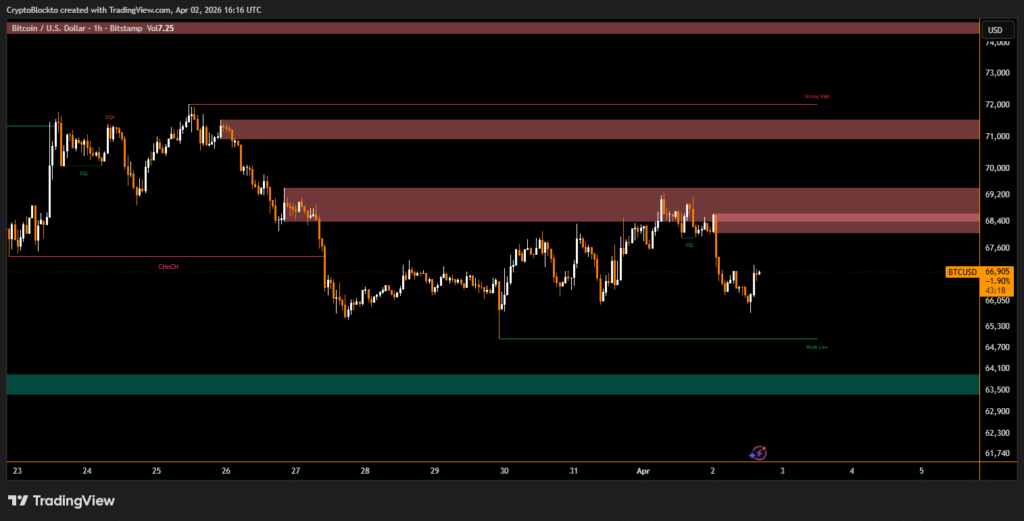
    Bitcoin traded near $66,900, down about 3%, with ether near $2,060, also lower by roughly 3% over the past 24 hours.

    $BTC h1 price chart

    Iran-Oman Protocol Eases Shipping Route Concerns

    Iranian officials said the proposed measures are intended to coordinate ship movement and ensure safe passage rather than restrict traffic. Deputy Foreign Minister for legal and international affairs Kazem Gharibabadi explained that even under normal conditions, vessel traffic should be monitored and coordinated with coastal states such as Iran and Oman to improve safety and services.

    The update followed earlier remarks from President Donald Trump, who pledged overnight to continue the war against Iran and warned that the Strait of Hormuz would “open naturally” once the conflict ends.

    Oil, Crypto, and Stocks React to Geopolitical Signals

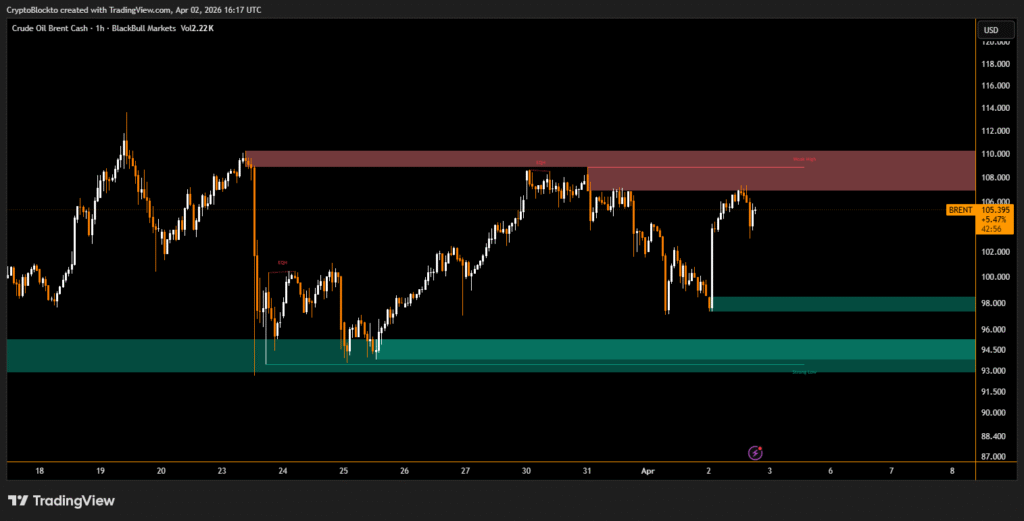
    WTI crude oil, which had surged to nearly $106 per barrel, dropped about $5 to $6 per barrel after the shipping coordination news.

    Brent crude h1 price chart
    Disclaimer

    This content is for informational purposes only and does not constitute financial, investment, or legal advice. Cryptocurrency trading involves risk and may result in financial loss.