Category: News

  • Polymarket Removes Missing US Pilot Market Following Backlash

    Polymarket Removes Missing US Pilot Market Following Backlash

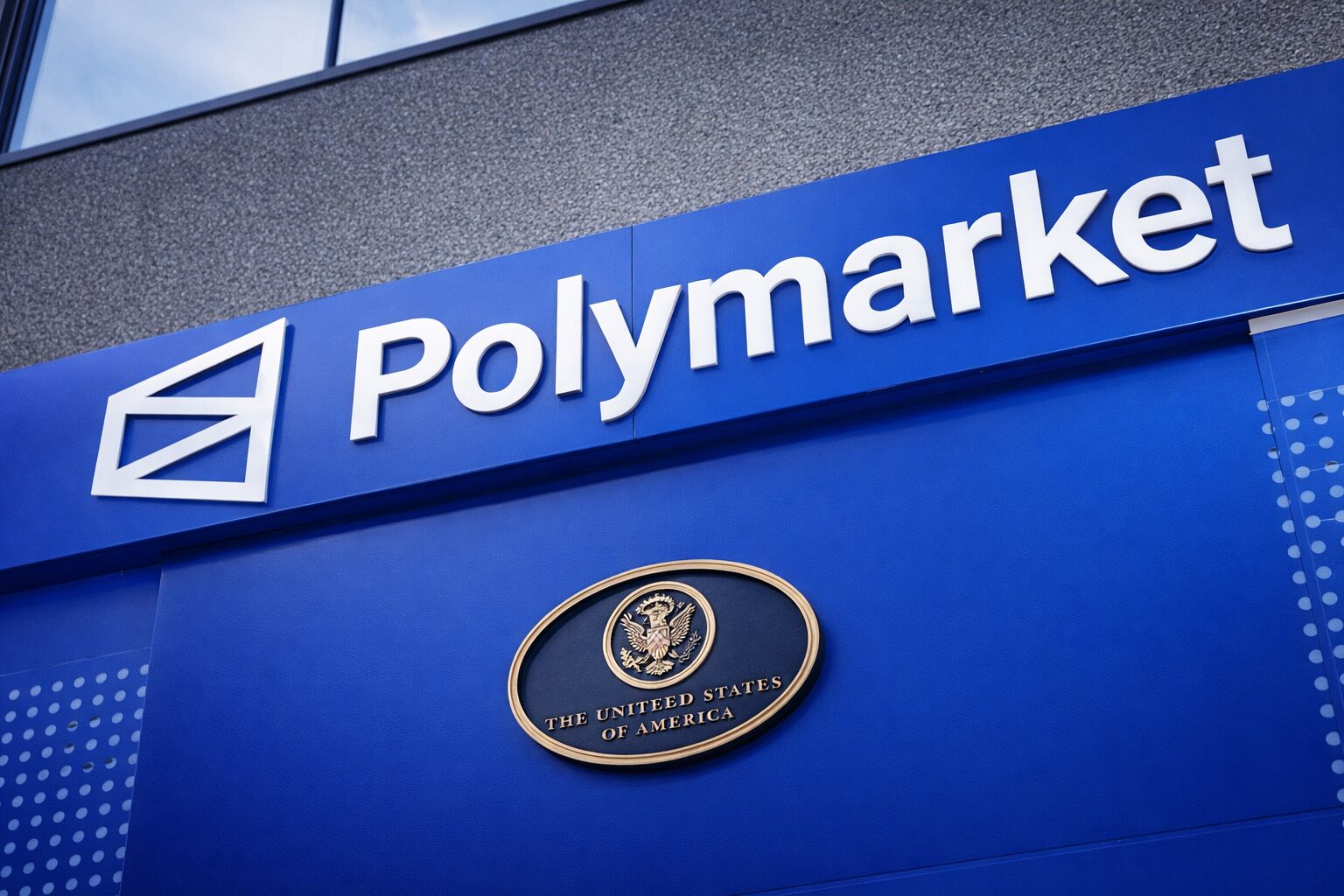
    Polymarket has removed a prediction market tied to the fate of a missing US service member after public backlash, stating that the listing violated its “integrity standards.” The market had asked users whether US authorities would confirm the rescue of a pilot reportedly shot down over Iran, with more than 60% of participants betting that the rescue would not be confirmed before Saturday.

    US Representative Seth Moulton strongly criticized the listing, calling it “disgusting” and raising concerns about people speculating on the safety of a potentially injured service member. He noted that those involved could be “a neighbor, a friend, a family member,” emphasizing the ethical concerns surrounding such predictions.

    In response to the criticism, Polymarket said the market was removed immediately and acknowledged that it should not have been listed. The platform added that it is reviewing how the listing passed its internal safeguards but did not specify which rule had been violated.

    Prediction Market Rules and Insider Trading Concerns Grow

    The removal has drawn scrutiny from users questioning how Polymarket applies its rules. Some users reviewed the platform’s Market Integrity guidelines and terms of service but said they could not identify the specific prohibition involved.

    The controversy comes as prediction markets face growing concerns about insider trading. Recent reports indicated that a group of traders earned about $1 million by correctly betting on the timing of US strikes on Iran, placing trades shortly before the attacks.

    Jack Newsham, a correspondent on Business Insider’s national desk, wrote on X;
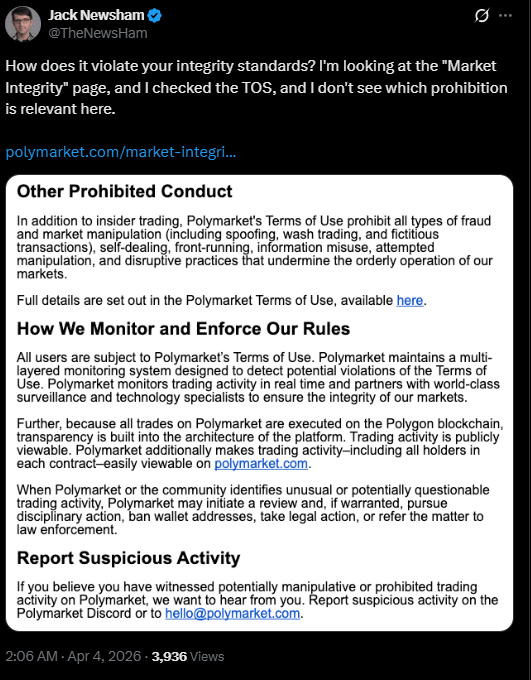
    At least 42 Democratic lawmakers have urged regulators, including the Commodity Futures Trading Commission and the Office of Government Ethics, to warn federal employees against using non-public information to trade on prediction markets.

    Disclaimer

    This content is for informational purposes only and does not constitute financial, investment, or legal advice. Cryptocurrency trading involves risk and may result in financial loss.
  • US Community Banks Challenge OCC Approval of Coinbase Trust Charter

    US Community Banks Challenge OCC Approval of Coinbase Trust Charter

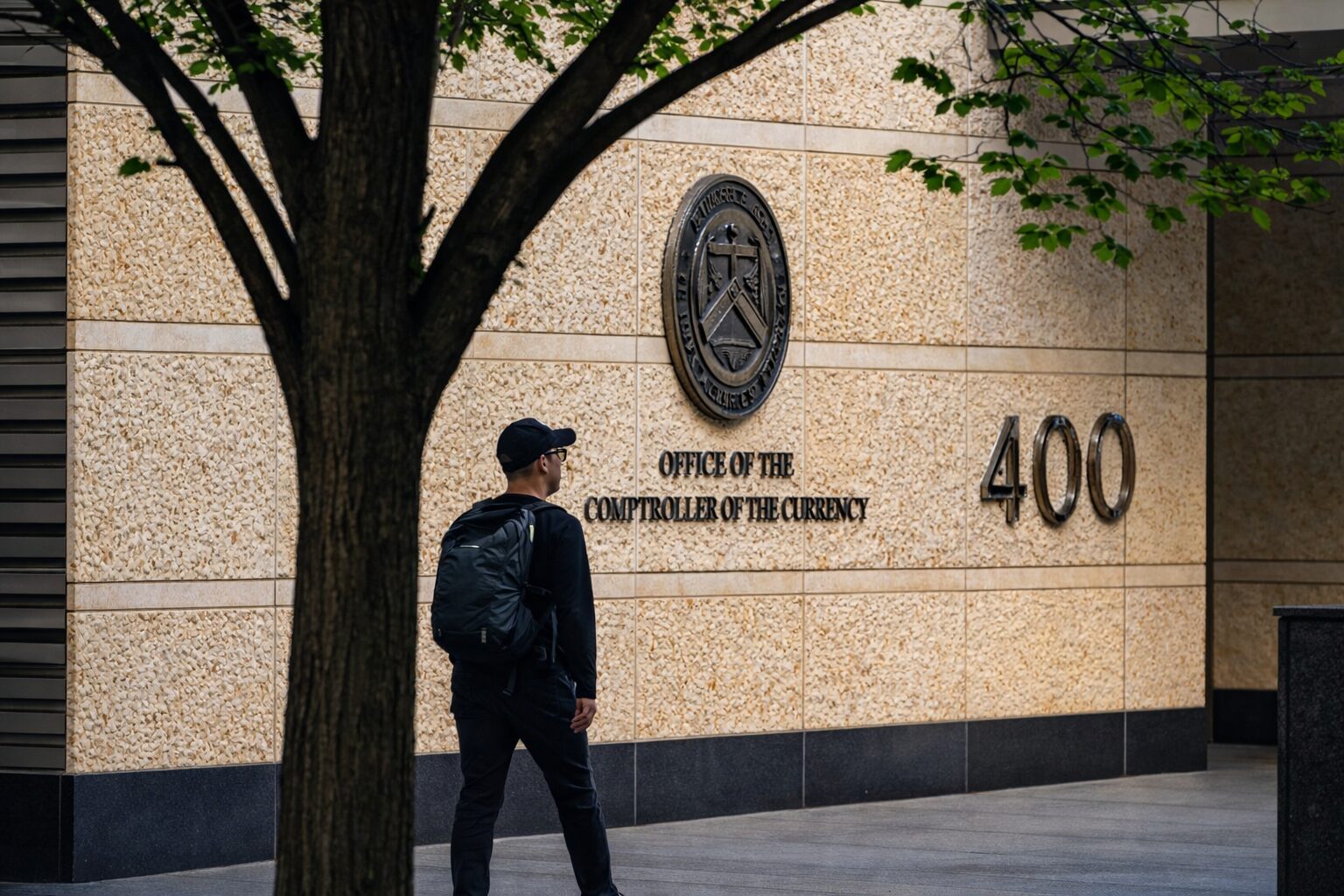
    The Independent Community Bankers of America (ICBA) has voiced strong opposition to the Office of the Comptroller of the Currency’s (OCC) conditional approval of Coinbase’s national trust bank charter. The group warned that the application falls short of regulatory standards, citing deficiencies in risk controls, profitability, and resolution planning. ICBA also questioned the OCC’s authority to expand trust powers for crypto-related activities without enforcing the full set of banking regulations.

    “The sudden influx of applications demonstrates nonbank entities are seeking the benefits of a US bank charter without satisfying the full scope of US bank regulations,” the ICBA said. Similarly, Americans for Financial Reform Education Fund criticized the approval, citing potential risks to the financial system from crypto market volatility, fraud, and money laundering.

    Coinbase Responds and Industry Dispute Continues

    Coinbase stated that the charter would place its custody and market infrastructure business under federal oversight, emphasizing it will not hold customer deposits or engage in fractional reserve lending. CEO Brian Armstrong noted that “the right path forward for crypto is through the system not around it.”

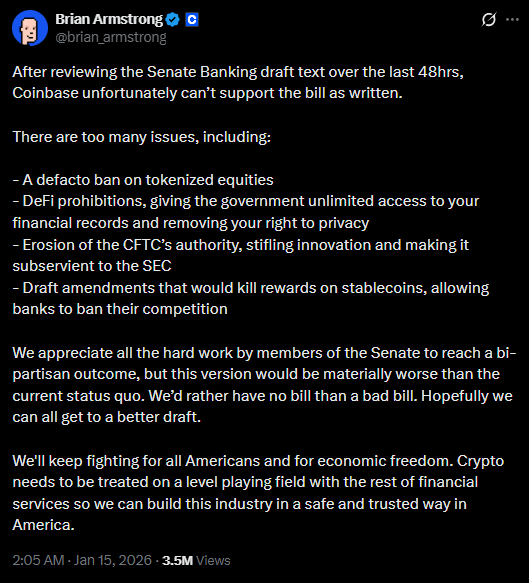
    The approval comes amid a broader dispute over digital assets’ role in finance, particularly stablecoins and yield-bearing products. Bank of America CEO Brian Moynihan warned that allowing stablecoin issuers to offer interest could shift up to $6 trillion in deposits away from banks, affecting lending and borrowing costs. Legislative efforts, including the US Digital Asset Market Clarity Act, remain in progress, with stablecoin yield provisions a central sticking point delaying Senate consideration.

    Disclaimer

    This content is for informational purposes only and does not constitute financial, investment, or legal advice. Cryptocurrency trading involves risk and may result in financial loss.

  • Nevada Judge Extends Ban on Kalshi Sports Prediction Markets

    Nevada Judge Extends Ban on Kalshi Sports Prediction Markets

    A Nevada state judge has extended a temporary ban on Kalshi’s sports related prediction markets, citing concerns that the contracts are “indistinguishable” from traditional gambling. Judge Jason Woodbury of the First Judicial District Court approved the extension of a temporary restraining order originally issued on March 20 and granted the Nevada Gaming Control Board’s request for a preliminary injunction. The injunction prevents Kalshi from offering certain prediction market products until a broader legal case is resolved.

    The judge specifically noted that buying a contract on a baseball game through Kalshi is equivalent to placing a bet on a state gaming platform. “I find based on the arguments that have been presented that it is a gaming activity that is prohibited for any non-licensee to engage in,” Woodbury said. The original restraining order also applied to entertainment and election-related contracts.

    Federal vs State Regulatory Debate

    Kalshi argues that its markets are federally regulated designated contract markets offering swaps, a type of derivative, and thus fall under the jurisdiction of the Commodity Futures Trading Commission (CFTC). The CFTC, led by Chairman Mike Selig, has supported Kalshi and other prediction market providers, filing an amicus brief and lawsuits against Arizona, Illinois, and Connecticut alongside the Department of Justice to assert federal oversight.

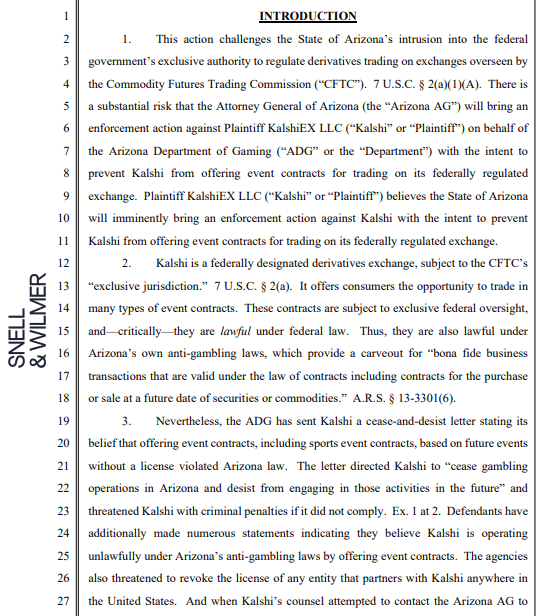
    The ruling comes amid ongoing nationwide legal disputes, with similar hearings taking place in Arizona, where Kalshi is challenging state attempts to block its products, including criminal allegations filed by Arizona Attorney General Kris Mayes.

    Disclaimer

    This content is for informational purposes only and does not constitute financial, investment, or legal advice. Cryptocurrency trading involves risk and may result in financial loss.
  • Kalshi Hires Former Democratic Strategist Stephanie Cutter Amid Legal Challenges

    Kalshi Hires Former Democratic Strategist Stephanie Cutter Amid Legal Challenges

    Kalshi announced that Stephanie Cutter, a former staffer for President Barack Obama, will join the company as a policy adviser. Cutter, who co founded communications firm Precision Strategies in 2013, is expected to help Kalshi “deepen its relationships in DC and across the country,” according to the company’s Thursday notice.

    Kalshi co founder and CEO Tarek Mansour emphasized Cutter’s experience in government and politics, saying she can “get [the] message to the right people.” The platform already has staff with government connections, including Donald Trump Jr., who joined as a strategic adviser in January 2025, just before his father took office.

    Legal Scrutiny and Regulatory Challenges

    Kalshi has faced heightened regulatory scrutiny over the past year. Several US state authorities have filed lawsuits alleging that the company’s event contracts constitute illegal bets. Meanwhile, the US Commodity Futures Trading Commission (CFTC), under Trump nominee Michael Selig, has asserted “exclusive jurisdiction” over such markets and filed suits against state regulators.

    Congressional Democrats have also called for closer oversight, citing “suspicious trades” related to geopolitical events, including the US invasion of Iran. In response, Kalshi and Polymarket have introduced guardrails to prevent the use of insider information. As of Friday, no federal legislation has been signed, and the outcome of ongoing state-level lawsuits remains uncertain.

    Disclaimer

    This content is for informational purposes only and does not constitute financial, investment, or legal advice. Cryptocurrency trading involves risk and may result in financial loss.

  • Tether May Delay Fundraising if $500 Billion Valuation Fails to Attract Investor Demand

    Tether May Delay Fundraising if $500 Billion Valuation Fails to Attract Investor Demand

    Tether is reportedly pressing investors to commit to a major fundraising round at a $500 billion valuation within the next two weeks, warning that the effort could be delayed if demand falls short. The El Salvador based company has been seeking fresh capital since late last year, but some investors remain cautious about the high valuation target.

    If achieved, the proposed valuation would position Tether among the world’s largest financial firms. The figure would place the company ahead of every United States bank except JPMorgan Chase, which has a market capitalization of about $794.55 billion, and above Bank of America, valued at roughly $352.86 billion.

    Earlier discussions suggested Tether could raise between $15 billion and $20 billion through a private placement, offering about a 3% stake. Cantor Fitzgerald was identified as a lead adviser in those early planning stages.

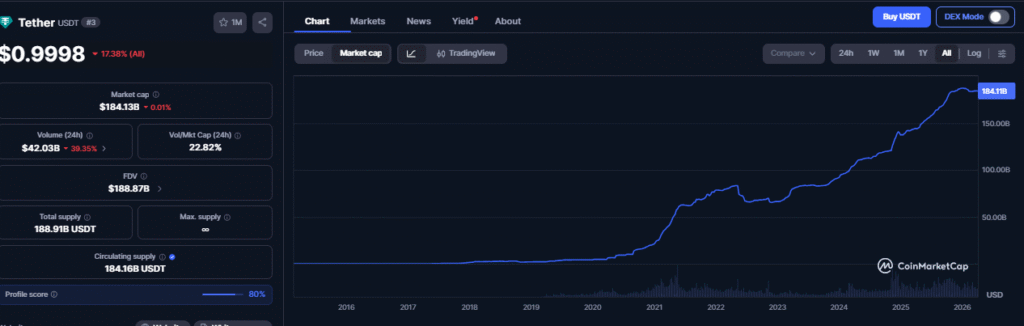
    USDt market cap.

    CEO Paolo Ardoino Defends Valuation and Expansion Strategy

    Chief Executive Officer Paolo Ardoino previously stated that the company was considering raising funds from a select group of investors to accelerate growth across both existing and new business lines. These areas include stablecoins, distribution networks, artificial intelligence, commodity trading, energy, communications, and media.

    Although earlier estimates of a $15 billion to $20 billion raise were later described as hypothetical scenarios rather than a confirmed plan, Ardoino continued to defend the $500 billion valuation. He compared the company’s profitability potential to major artificial intelligence platforms.

    USDt Market Cap and Audit Efforts Gain Attention

    Tether’s USDt stablecoin remains the company’s largest product, with a market capitalization of approximately $184 billion. Other key offerings include Tether Gold (XAUt) and Tether EURt (EURt), which are pegged to gold and the euro respectively.

    Separately, Tether has reportedly hired KPMG to conduct its first full audit of USDt financial statements, while PwC is assisting in preparing internal systems. The comprehensive audit is expected to examine assets, liabilities, and internal controls, going beyond the reserve attestations previously conducted by BDO Italia.

    Disclaimer

    This content is for informational purposes only and does not constitute financial, investment, or legal advice. Cryptocurrency trading involves risk and may result in financial loss.

  • Charles Schwab Plans Spot Bitcoin and Ether Trading Launch in First Half of 2026

    Charles Schwab Plans Spot Bitcoin and Ether Trading Launch in First Half of 2026

    Charles Schwab is preparing to launch spot crypto trading for Bitcoin and Ethereum in the first half of 2026, marking a major step in its expansion into digital assets.

    The new service will be offered through Charles Schwab Premier Bank, SSB, allowing clients to buy and sell the two largest cryptocurrencies directly within their brokerage accounts. The firm has also opened a waitlist for early access to its upcoming Schwab Crypto account, designed to integrate crypto trading alongside traditional investments such as stocks and bonds.

    Client Demand Drives Unified Investment Platform Strategy

    Chief Executive Officer Rick Wurster previously indicated that growing client demand influenced the company’s decision to move into spot crypto trading. The initiative aims to create a unified investment experience where digital assets appear within the same portfolio view as conventional financial instruments.

    Schwab’s Scale Positions It Against Crypto-Native Exchanges

    With approximately $11.9 trillion in client assets reported in 2025, Schwab enters the crypto market with a substantial investor base. The company already supports cryptocurrency-linked exchange-traded funds and offers Bitcoin futures trading, along with the Schwab Crypto Thematic Index (STCE), which tracks companies tied to the digital asset sector.

    Disclaimer

    This content is for informational purposes only and does not constitute financial, investment, or legal advice. Cryptocurrency trading involves risk and may result in financial loss.
  • Crypto Market Flows Drop to $11 Billion in Q1 2026, JPMorgan Reports

    Crypto Market Flows Drop to $11 Billion in Q1 2026, JPMorgan Reports

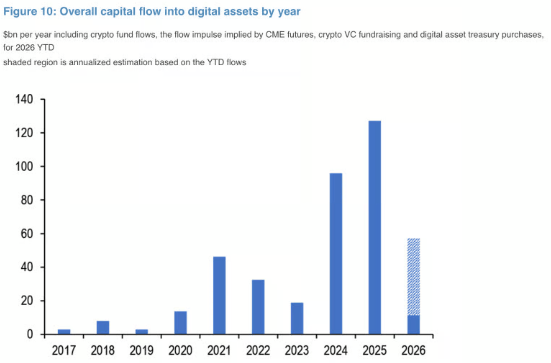
    Digital asset flows declined significantly in the first quarter of 2026, according to analysts at JPMorgan. Total crypto market inflows were estimated at $11 billion, roughly one third of the level recorded during the same quarter last year.

    The slowdown implies an annualized pace of around $44 billion, far below the record $130 billion inflows recorded in 2025. Analysts calculated total flows using combined data from crypto fund movements, futures activity, venture capital funding, and corporate treasury purchases.

    Corporate Bitcoin Buying Remains a Key Driver

    Much of the first quarter inflow was linked to corporate treasury purchases of Bitcoin, particularly from Strategy. The company continued acquiring Bitcoin using funds raised through equity issuance, while several smaller firms reduced holdings to support share buybacks.

    Institutional Demand Weakens as Miners Increase Selling

    Institutional positioning through futures on CME Group weakened during the quarter, signaling reduced demand. Spot Bitcoin and Ethereum exchange traded funds also recorded outflows, particularly in January, though Bitcoin ETFs saw modest inflows in March.

    At the same time, Bitcoin mining companies became net sellers, using assets as collateral or liquidating holdings to improve liquidity and fund operations, reflecting tighter financing conditions rather than widespread distress.

    Disclaimer

    This content is for informational purposes only and does not constitute financial, investment, or legal advice. Cryptocurrency trading involves risk and may result in financial loss.

  • Bitcoin’s Quantum Risk: How Exposed Public Keys Could Become Targets

    Bitcoin’s Quantum Risk: How Exposed Public Keys Could Become Targets

    Google Quantum Research Raises Security Questions for Bitcoin

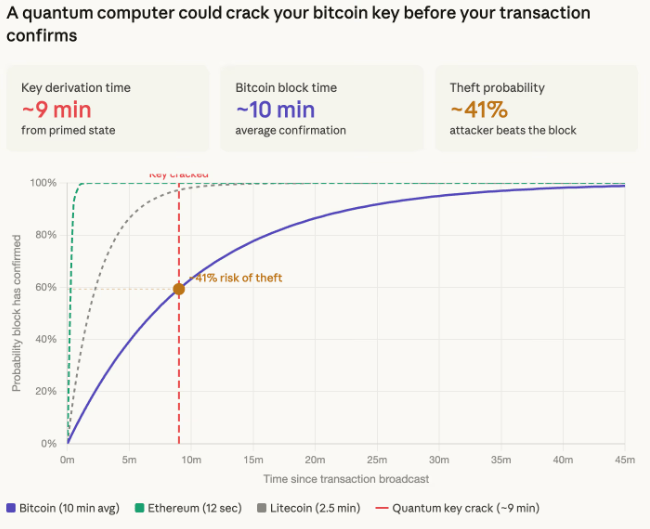
    New findings from Google’s Google Quantum AI team suggest that a future quantum computer could derive a Bitcoin private key from a public key in roughly nine minutes, potentially allowing attackers to hijack transactions before confirmation.

    Bitcoin transactions typically take about 10 minutes to confirm, creating a narrow window in which an attacker could attempt to extract a private key once the public key becomes visible in the mempool. Researchers explained that such attacks rely on solving the elliptic curve discrete logarithm problem using quantum algorithms such as Shor’s algorithm, which classical computers cannot efficiently execute.

    Up to 6.9 Million Bitcoin Could Face Greater Exposure

    The research highlights a broader concern involving approximately 6.9 million bitcoin, nearly one third of total supply, stored in addresses where public keys have already been exposed. These include early wallets using pay to public key formats and addresses that have been reused, allowing attackers to target them without time pressure.

    Post-Quantum Cryptography Seen as Long-Term Solution

    While Bitcoin mining would continue using the SHA-256 algorithm, experts warn that ownership guarantees could weaken if private keys become derivable. Developers are exploring post quantum cryptography as a potential safeguard, though migration efforts remain in early stages compared with other blockchain ecosystems.

    Disclaimer

    This content is for informational purposes only and does not constitute financial, investment, or legal advice. Cryptocurrency trading involves risk and may result in financial loss.

  • Iran Rejects U.S. 48-Hour Ceasefire Proposal Amid Rising Military Tensions

    Iran Rejects U.S. 48-Hour Ceasefire Proposal Amid Rising Military Tensions

    Iran has rejected a proposed 48-hour ceasefire reportedly offered by the United States through an intermediary on April 2, according to News Agency.

    Sources cited by the agency claimed that instead of accepting the temporary halt in hostilities, Tehran responded by increasing the intensity of its attacks. The reported ceasefire proposal allegedly followed operational challenges faced by U.S. armed forces, which were attributed to a miscalculation of Iran’s military capabilities.

    Conflicting Statements Highlight Ongoing Diplomatic Tensions

    Earlier, Donald Trump stated that Washington was negotiating with what he described as new Iranian authorities to bring an end to the armed conflict. However, officials from Iran’s foreign ministry have repeatedly rejected those claims.

    Iran Calls U.S. Proposals “Illogical” and “Excessively Harsh”

    Iranian authorities said they had received multiple settlement proposals from the United States through intermediary channels but described the terms as “illogical” and “excessively harsh.” The exchange highlights ongoing diplomatic strain and uncertainty surrounding potential ceasefire efforts between the two countries.

    Disclaimer

    This content is for informational purposes only and does not constitute financial, investment, or legal advice. Cryptocurrency trading involves risk and may result in financial loss.

  • Dmail Network to Shut Down Services on May 15 After Funding and Cost Challenges

    Dmail Network to Shut Down Services on May 15 After Funding and Cost Challenges

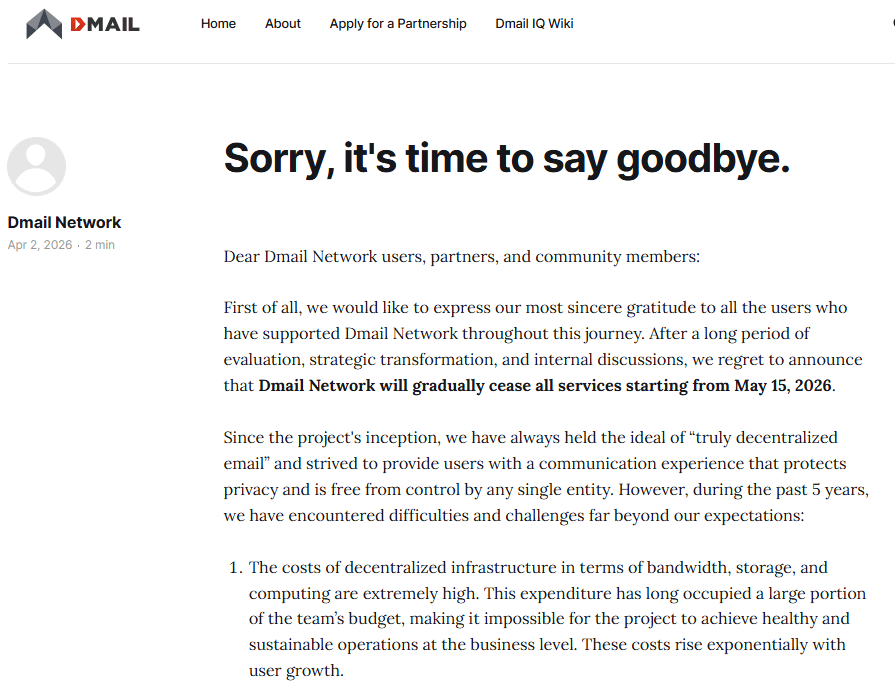
    Dmail Network, a decentralized email and messaging platform, has announced it will cease all services starting May 15 after five years of operations. The platform urged users to export their data before the deadline, warning that once nodes shut down, emails and user accounts will become inaccessible.

    The project was known for offering wallet-based email, encrypted messaging, and onchain notifications, positioning itself as a Web3 communication solution. In January 2025, Dmail ranked second among AI-based decentralized applications, recording 4.9 million unique active wallets for the month.

    High Costs and Failed Fundraising Pressured Operations

    Dmail cited rising infrastructure expenses, including bandwidth, storage, and computing costs, as key reasons behind the shutdown. The company said multiple funding rounds failed and acquisition attempts did not materialize, leaving finances close to exhaustion.

    The project also acknowledged that its token failed to develop a clear large-scale use case, weakening long-term sustainability. Following the shutdown announcement, the token’s price dropped to $0.0002067, reaching an all-time low and reflecting declining market confidence.

    Disclaimer

    This content is for informational purposes only and does not constitute financial, investment, or legal advice. Cryptocurrency trading involves risk and may result in financial loss.