Category: News

  • Cambodia Passes First Cybercrime Law Targeting Scam Compounds and Crypto Fraud

    Cambodia Passes First Cybercrime Law Targeting Scam Compounds and Crypto Fraud

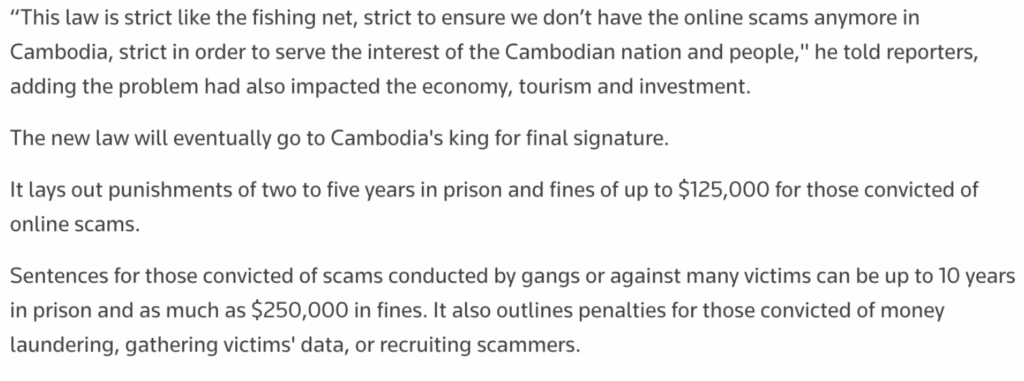
    Cambodia’s parliament has approved its first dedicated cybercrime law aimed at tackling scam compounds accused of defrauding international victims and laundering funds through digital channels, including cryptocurrency. The legislation introduces prison sentences of two to five years and fines of up to $125,000 for individuals convicted of standard online scam offenses.

    Justice Minister Keut Rith stated that the law is designed to strengthen ongoing enforcement actions and prevent scam operations from re emerging after crackdowns. He noted that online fraud activities have negatively affected Cambodia’s economy, tourism sector, and investment environment.
    first dedicated cybercrime law

    Tougher Punishments for Organized Fraud Networks

    Under the new law, harsher penalties apply to crimes carried out by organized groups or involving multiple victims. Offenders in such cases may face up to 10 years in prison and fines reaching $250,000. The legislation also includes provisions targeting money laundering, data collection of victims, and recruitment of scammers, addressing key components of large-scale fraud networks.

    The bill will now be submitted to Cambodia’s king for final approval. Once enacted, it will provide the country with its first comprehensive legal framework specifically designed to combat cross-border online scams and related financial crimes.

    Disclaimer

    This content is for informational purposes only and does not constitute financial, investment, or legal advice. Cryptocurrency trading involves risk and may result in financial loss.

  • ZachXBT Criticizes Circle Over Delayed USDC Freezes Linked to $420M Illicit Funds

    ZachXBT Criticizes Circle Over Delayed USDC Freezes Linked to $420M Illicit Funds

    Blockchain investigator ZachXBT has accused Circle of slow responses in freezing funds linked to illegal activity, citing 15 incidents involving more than $420 million in alleged illicit transactions.

    In a detailed thread, ZachXBT pointed to the recent Drift Protocol exploit, valued at over $280 million, as a key example. According to the report, attackers bridged approximately 232 million USDC from the Solana network to Ethereum through more than 100 transactions over six hours, yet no funds were frozen during that period.

    Blockchain analytics firm Elliptic stated that multiple indicators suggested links to the Democratic People’s Republic of Korea in connection with the attack.

    Earlier Incidents Raise Compliance Questions

    ZachXBT also referenced the Cetus Protocol exploit, valued at $223 million, where roughly 61 million USDC was bridged from the Sui network to Ethereum. In that case, the address was reportedly blacklisted one month later, after funds had already been converted to Ether.

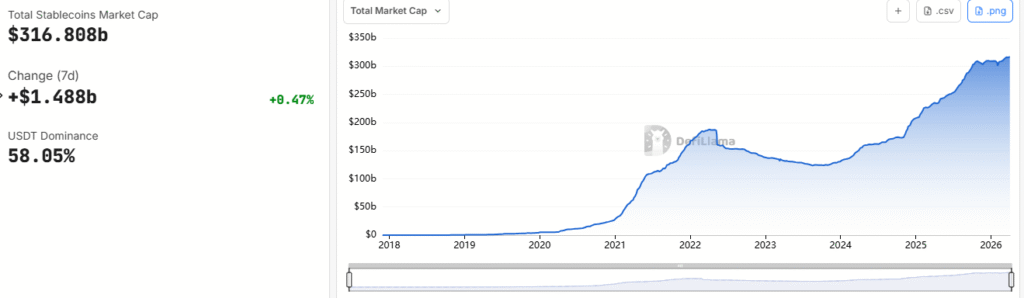
    Total Stablecoin Supply

    Circle responded that it freezes assets only when legally required and in line with privacy protections. With USDC circulation exceeding $77 billion, the criticism adds pressure on stablecoin issuers to improve coordination and response times across the digital asset ecosystem.

    Disclaimer

    This content is for informational purposes only and does not constitute financial, investment, or legal advice. Cryptocurrency trading involves risk and may result in financial loss.

  • Aave V3 Avoided Bad Debt but Shifted Risk to Borrowers, Bank of Canada Study Finds

    Aave V3 Avoided Bad Debt but Shifted Risk to Borrowers, Bank of Canada Study Finds

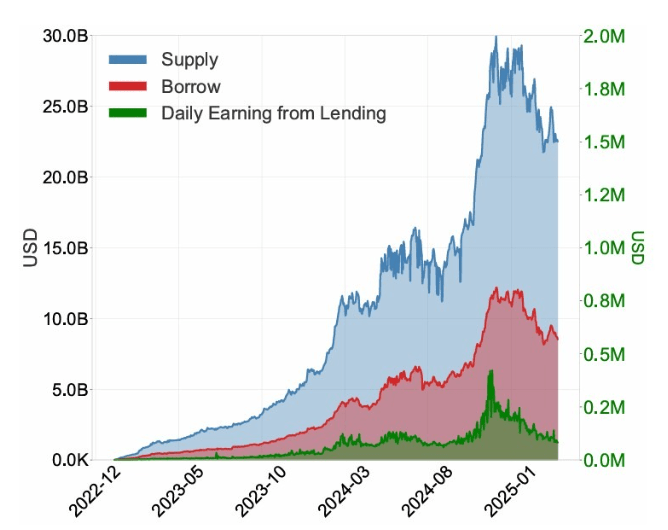
    A staff paper from the Bank of Canada found that Aave V3 reported zero non performing loans in 2024, largely due to its overcollateralization model and automated liquidation system. The study analyzed transaction-level data from Jan. 27, 2023, to May 6, 2025, showing that borrower positions were usually liquidated before collateral values dropped below outstanding debt.

    This structure protected lenders from unrecovered losses across the Ethereum lending market. However, the research noted that the system relies heavily on automated risk controls rather than traditional underwriting methods. Borrowers are required to deposit collateral exceeding the value of their loans, with liquidations triggered when risk thresholds are breached.

    Daily lending earnings, circulating supply, and borrowing volumes (USD) on Aave V3

    Recursive Leverage Increased Borrowing Exposure

    The study also found that recursive leverage played a major role in borrowing demand, accounting for over 20% of total borrowed volume and 8.2% of transactions. Liquidations often occurred in concentrated waves, with assets such as Wrapped Ether (WETH), wstETH, WBTC, and weETH representing 90% of total liquidated value.

    According to the findings, liquidation fees typically ranged between 5% and 10%, while missed recovery gains pushed total borrower losses to 10% to 30% in some cases when collateral prices fell sharply.

    Disclaimer

    This content is for informational purposes only and does not constitute financial, investment, or legal advice. Cryptocurrency trading involves risk and may result in financial loss.
  • Solo Bitcoin Miner Scores $210K Block Reward Amid Rising Difficulty

    Solo Bitcoin Miner Scores $210K Block Reward Amid Rising Difficulty

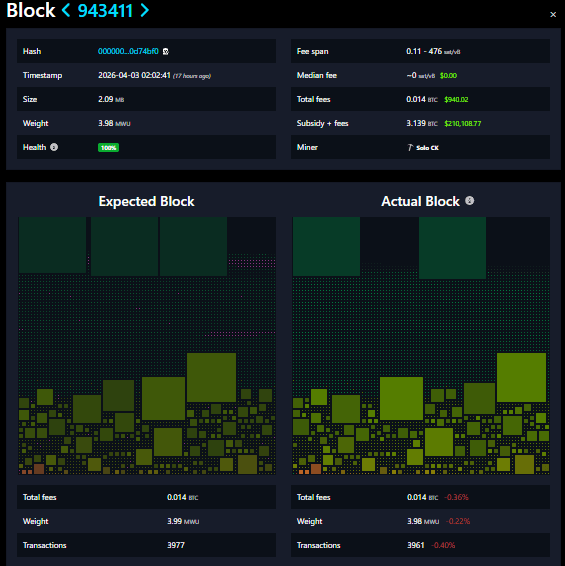
    Solo Bitcoin miner connected to CKPool secured a $210,000 block reward by successfully mining block 943,411, earning 3.139 BTC in subsidy and transaction fees. The win underscores that solo mining, though increasingly rare, can still pay off despite the dominance of industrial mining operations.

    Over the past year, only 20 Bitcoin blocks have been mined by solo operators, totaling 62.96 BTC, with an average interval of 18.7 days between wins. The longest gap reached 58 days, highlighting the highly competitive nature of mining today.

    Bitcoin Mining Difficulty Remains High

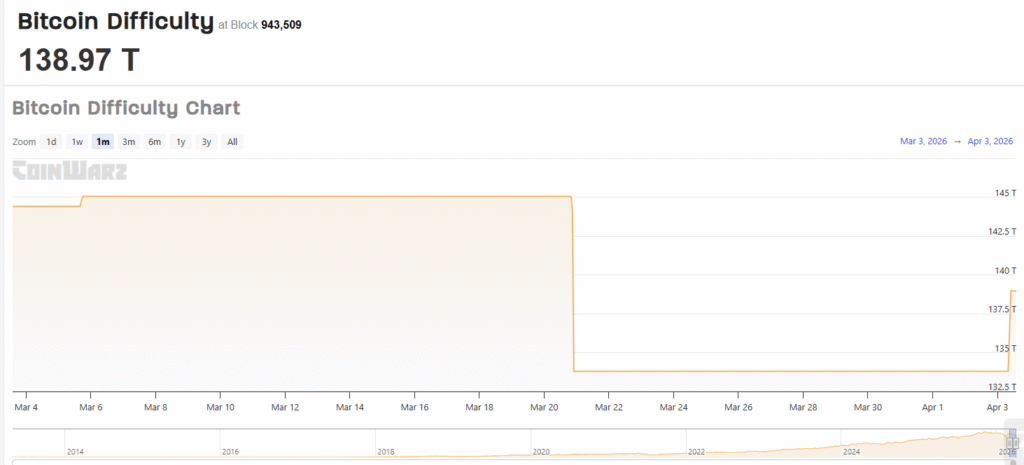
    Network difficulty, a measure of how hard it is to mine a block, recently recorded its steepest adjustment since February, dropping 7.7% before rebounding 3.87% within 24 hours. Despite this temporary relief, difficulty levels remain near historic highs, making solo block discovery increasingly unlikely.

    Bitcoin difficulty over time

    Institutional Miners Adjust Strategies

    Rising operational costs have prompted major miners to adapt. Companies including Riot Platforms, MARA Holdings, Genius Group, and Nakamoto Holdings sold Bitcoin during the first quarter of 2026. The CKPool win serves as a rare reminder that individual miners can still succeed against the odds.

    Disclaimer

    This content is for informational purposes only and does not constitute financial, investment, or legal advice. Cryptocurrency trading involves risk and may result in financial loss.

  • Malta and ESMA Clash Over Centralized Crypto Supervision Under MiCA

    Malta and ESMA Clash Over Centralized Crypto Supervision Under MiCA

    European Union policymakers are considering a proposal to shift supervision of major crypto asset service providers (CASPs) to the European Securities and Markets Authority (ESMA) in Paris. The plan would move key oversight powers away from national regulators, marking a significant shift in how Europe manages its digital asset industry.

    France, Austria, and Italy have supported the proposal, arguing that centralized supervision would address differences in national approval processes and reduce regulatory shopping across member states. The issue is particularly important under the Markets in Crypto Assets Regulation (MiCA), which allows firms authorized in one country to operate across the entire European Union.

    Malta Warns Against Premature Structural Changes

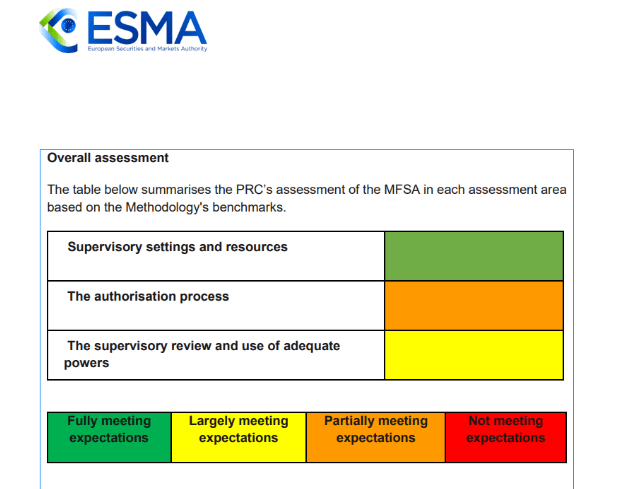
    Malta’s Financial Services Authority (MFSA) has expressed concerns, stating that MiCA has only recently been implemented and its full market impact is still being assessed. Officials warned that introducing centralized supervision too quickly could disrupt existing regulatory frameworks.

    ESMA peer review of a Malta CASP approval.: ESMA

    Industry Voices Raise Structural Concerns

    Supporters of centralization believe a single supervisor would strengthen investor protection and improve consistency. However, critics argue that splitting oversight between ESMA, national authorities, and other bodies could fragment accountability during crises and weaken local regulatory expertise.

    Disclaimer

    This content is for informational purposes only and does not constitute financial, investment, or legal advice. Cryptocurrency trading involves risk and may result in financial loss.
  • Korea Investment & Securities Considers Coinone Stake Amid South Korea Crypto Ownership Reform

    Korea Investment & Securities Considers Coinone Stake Amid South Korea Crypto Ownership Reform

    Korea Investment & Securities (KIS) is reportedly reviewing a potential investment in crypto exchange Coinone, according to local media reports. Sources familiar with the matter said KIS has begun engaging with regulators and policymakers as part of early discussions tied to a possible stake purchase.

    Coinone confirmed that no final agreement has been reached, indicating that negotiations remain at a preliminary stage. The reported talks reflect growing interest from major financial institutions seeking exposure to the digital asset market.

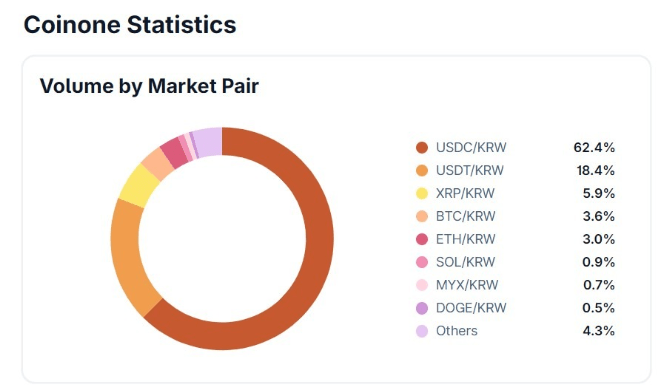
    Coinone volume by market pair.: CoinGecko

    Proposed Ownership Cap Could Drive Stake Sales

    The potential investment comes as South Korea considers introducing a 20% ownership cap for major shareholders in domestic cryptocurrency exchanges. If approved, the rule would require significant restructuring across the industry.

    Coinone Chairman Cha Myung-hoon, who controls about 53.44% of the exchange, may need to reduce his holdings to comply with the proposed law. Exchanges would reportedly have three years to adjust ownership structures after enforcement.

    Growing Competition Among Financial Institutions

    KIS, which recorded over 2 trillion won ($1.3 billion) in net profit in 2025, would join competitors expanding into crypto services. Rival Mirae Asset Group previously agreed to acquire a controlling stake in exchange Korbit, highlighting increasing institutional participation in South Korea’s evolving crypto market.

    Disclaimer

    This content is for informational purposes only and does not constitute financial, investment, or legal advice. Cryptocurrency trading involves risk and may result in financial loss.
  • Drift Protocol Sends Onchain Message to Wallets Linked to $280M Crypto Exploit

    Drift Protocol Sends Onchain Message to Wallets Linked to $280M Crypto Exploit

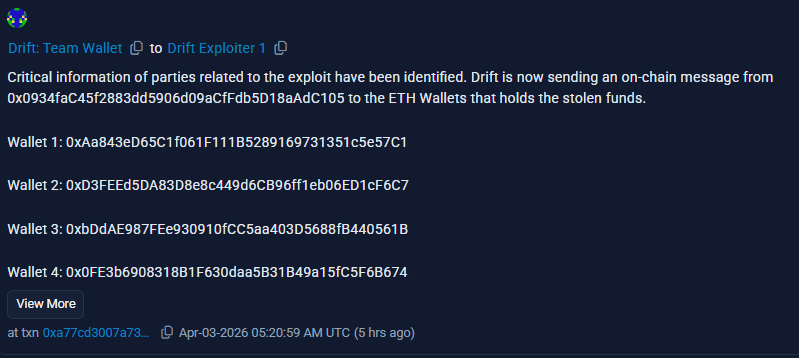
    Drift Protocol, a Solana based decentralized exchange, has initiated onchain communication with wallets tied to a major exploit estimated between $280 million and $286 million. The protocol confirmed that messages were sent from its Ethereum address to four wallets believed to hold stolen Ether, urging the attacker to establish contact through Blockscan chat.

    Onchain messaging has become a widely used tactic during exploit responses, allowing protocols to communicate anonymously with attackers. Similar outreach methods have been used in past incidents to negotiate potential fund recovery.

    Drift’s onchain message to the Drift Exploiter on Friday: Etherscan

    Anonymous Sender Adds Pressure on Attacker

    Drift’s outreach followed separate messages sent by an unknown sender using the readnow.eth name. The sender claimed to know the identities behind the exploit and demanded 1,000 ETH in exchange for withholding information. These claims remain unverified and may represent attempts to pressure or mislead the wallet holder.

    Expanding Impact Across Solana Ecosystem

    The fallout from the exploit continues to spread across the Solana ecosystem. Reports indicate that at least 20 protocols have been affected, including the DeFi platform Gauntlet, which suffered estimated losses of $6.4 million. Security analysts believe the attack was likely staged over several weeks, involving pre-signed transactions prepared before execution.

    Disclaimer

    This content is for informational purposes only and does not constitute financial, investment, or legal advice. Cryptocurrency trading involves risk and may result in financial loss.

  • Stablecoin Transaction Volume Surpasses ACH in February

    Stablecoin Transaction Volume Surpasses ACH in February

    Stablecoin transaction volumes reached $7.2 trillion in February, surpassing the $6.8 trillion processed by the US Automated Clearing House (ACH) network, marking a significant milestone for the asset class. Data from blockchain analytics platform Artemis shows this 30-day adjusted rolling volume excludes MEV activity and intra exchange transfers, highlighting the increasing use of stablecoins in global payments.

    Analyst Alex Obchakevich noted that stablecoins are emerging as “foundational infrastructure for global payments,” offering borderless, 24/7 transaction capabilities compared to traditional banking systems. The ACH network processes roughly 93% of US salary payments, underscoring the significance of stablecoins surpassing it in transaction volume.

    Market Growth and Institutional Adoption

    Stablecoin supply continued to rise in Q1 2026, reaching $315 billion, up $8 billion from the previous year, with stablecoins accounting for 75% of total crypto trading volume. Analysts predict the market cap could hit $2 trillion by 2028, fueled by institutional adoption and regulatory clarity. Industry observers emphasize that traditional banks and fintech firms risk losing relevance if they fail to integrate stablecoin infrastructure, highlighting the growing influence of digital assets in global finance.

    Disclaimer

    This content is for informational purposes only and does not constitute financial, investment, or legal advice. Cryptocurrency trading involves risk and may result in financial loss.
  • Crypto Hackers Steal $169M from 34 DeFi Protocols in Q1 2026

    Crypto Hackers Steal $169M from 34 DeFi Protocols in Q1 2026

    Crypto hackers stole over $168.6 million from 34 decentralized finance (DeFi) protocols in the first quarter of 2026, according to data from DefiLlama. The largest incident was the $40 million private key compromise of Step Finance in January, followed by a $26.4 million smart contract exploit of Truebit on January 8. Another significant attack targeted stablecoin issuer Resolv Labs on March 21.

    Although these losses are substantial, they are markedly lower than the $1.58 billion stolen in Q1 2025, which included the $1.4 billion Bybit exploit. Experts caution that crypto hacks are not tied to specific calendar periods.

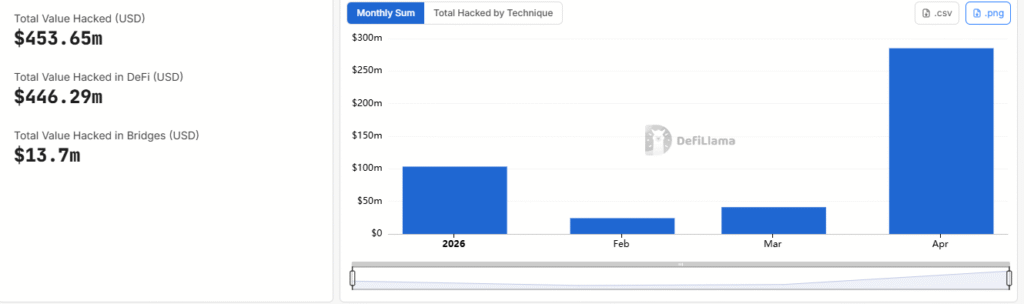
    The first months of 2026 saw less stolen compared to the prior year period.: DefiLlama

    Evolving Threats in the Crypto Space

    Nick Percoco, Chief Security Officer at Kraken, noted that attackers are drawn to areas with concentrated liquidity, such as bull markets, major product launches, and fast-growth phases. Threat actors range from highly coordinated groups to opportunistic hackers exploiting vulnerabilities in smart contracts and client-facing systems. North Korea linked actors continue to target Web3 infrastructure, including recent attacks on Drift Protocol.

    Percoco emphasized that crypto security must be continuous, as attackers deliberately assess infrastructure, code, and operational gaps. Transparency in blockchain makes high-value, technically complex targets particularly attractive.

    Disclaimer

    This content is for informational purposes only and does not constitute financial, investment, or legal advice. Cryptocurrency trading involves risk and may result in financial loss.

  • Todd Blanche Named Interim U.S. Attorney General Amid Crypto Enforcement Controversy

    Todd Blanche Named Interim U.S. Attorney General Amid Crypto Enforcement Controversy

    President Donald Trump removed Attorney General Pam Bondi and appointed Todd Blanche as the interim Attorney General, placing the former deputy and Trump’s personal attorney in charge of the Department of Justice. Blanche previously represented Trump in his 2024 criminal case in New York and was named deputy attorney general after Trump retook office.

    Crypto Enforcement Memo and Controversy

    As deputy attorney general, Blanche dismantled the DOJ’s National Crypto Enforcement Team and issued a memo directing prosecutors not to pursue regulatory violation cases in the crypto sector. The memo influenced cases such as the Southern District of New York’s proceedings against Tornado Cash developer Roman Storm, resulting in the dismissal of certain charges.

    Blanche’s government ethics disclosure from July 2025 revealed he held between $159,000 and $485,000 in cryptocurrencies at the time, including Bitcoin, Ethereum, Solana, ADA, Polygon, DOT, and Quant, alongside Coinbase stock. This appeared to violate ethics rules and his prior pledge to divest before working on crypto-related matters.

    The appointment raises questions over crypto regulation and enforcement policy under the DOJ, particularly regarding the treatment of ongoing and future cases in the rapidly evolving digital asset space.

    Disclaimer

    This content is for informational purposes only and does not constitute financial, investment, or legal advice. Cryptocurrency trading involves risk and may result in financial loss.