Category: Bitcoin news

  • Bitcoin Traders Realize $337M Daily Losses in Q1 2026 Amid Growing Market Pressure

    Bitcoin Traders Realize $337M Daily Losses in Q1 2026 Amid Growing Market Pressure

    Q1 2026 Marks Heaviest Bitcoin Losses Since 2022

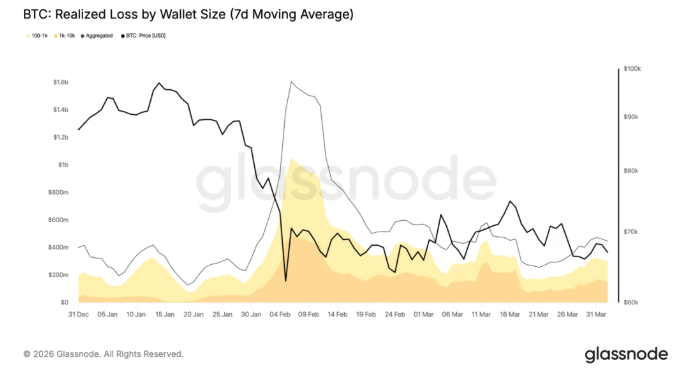
    Bitcoin traders holding 100–10,000 BTC experienced realized losses averaging $337 million per day in the first quarter of 2026, according to Glassnode data. This represents the worst quarter for BTC holders since 2022 and signals continued market stress for whales and mid-sized investors.
    Whales and Sharks Lock in $30.91 Billion Losses

    Large holders, categorized as sharks (100–1,000 BTC) and whales (1,000–10,000 BTC), accounted for the bulk of losses. Sharks realized $188.5 million daily, while whales added $147.5 million, bringing total Q1 losses to roughly $30.91 billion.

    This trend mirrors 2022’s significant sell-off, when BTC prices dropped over 50% in Q2, followed by an additional 20% decline by year-end. Past crises, including the Terra collapse, Celsius freeze, and Three Arrows liquidation, drove similar panic and liquidity challenges.
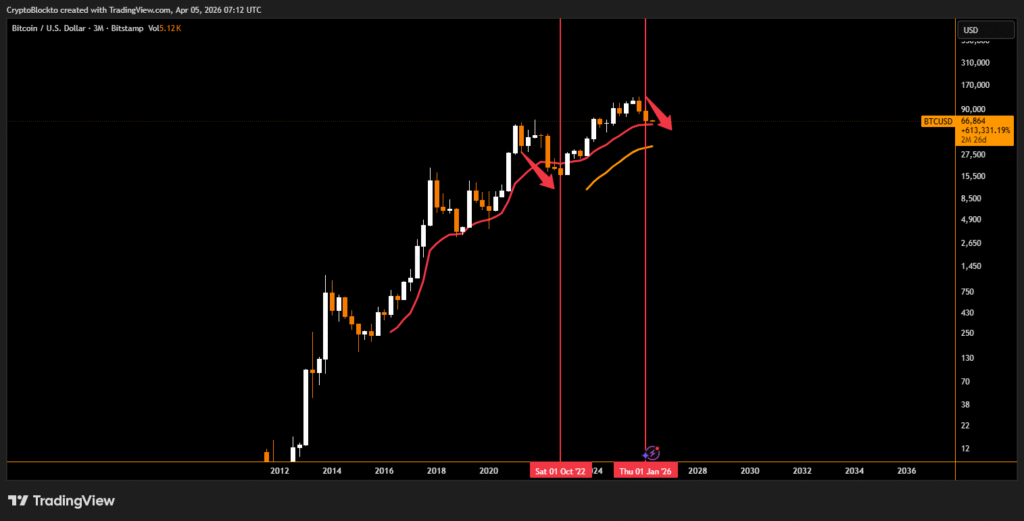
    $BTC 3 months price chart

    Long-Term Holders Also Selling at a Loss

    Losses among long term Bitcoin holders those who held coins for more than six months remain elevated at approximately $200 million per day, indicating ongoing capitulation. Analysts suggest that a meaningful cooldown below $25 million daily would signal exhaustion in selling pressure, a historical prerequisite for a sustained bull market.
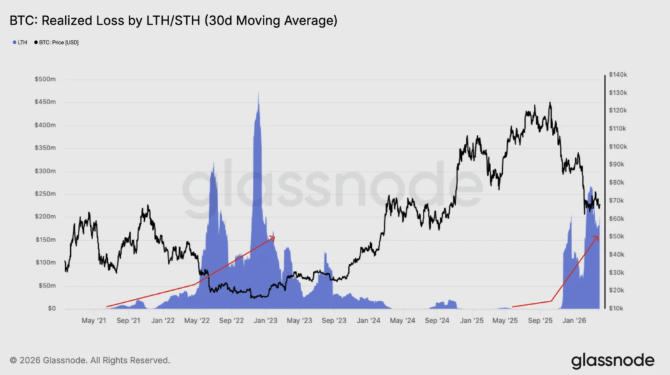
    Pressure on Bitcoin stems from geopolitical tensions, Iran war driven inflation fears, quantum-security risks, and broader stress in AI-led risk trades. These headwinds have led some analysts to forecast further downside, with a potential bottom in the $40,000–$50,000 range, and a bear market potentially extending to Q4 2026.

    Disclaimer

    This content is for informational purposes only and does not constitute financial, investment, or legal advice. Cryptocurrency trading involves risk and may result in financial loss.

  • Gold Investors Return to Bitcoin as Fund Flows Reverse: Fidelity Analysis

    Gold Investors Return to Bitcoin as Fund Flows Reverse: Fidelity Analysis

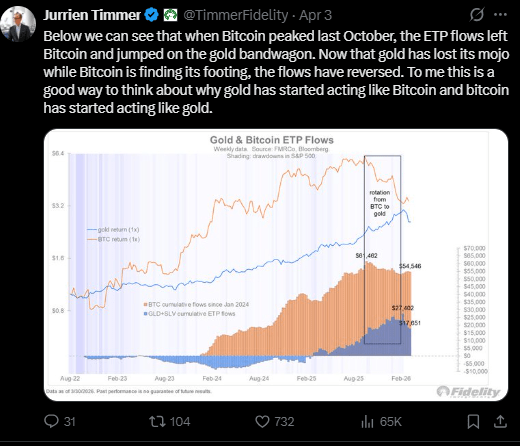
    Jurrien Timmer, director of global macro at Fidelity Investments, highlighted a significant shift in investor behavior, noting that gold investors are moving back into Bitcoin (BTC). In a post on X, Timmer stated that “investors who abandoned Bitcoin late last year are returning to crypto assets,” signaling renewed confidence in digital currencies.

    Reversal of 2025 Fund Flows

    Timmer explained, “Last year, investors pulled money out of crypto assets and moved into gold, but that flow is now reversing.” He emphasized that “as gold’s appeal fades and Bitcoin becomes more established, the direction of fund flows is changing.” This suggests a broader shift in investor priorities from traditional safe-haven assets toward cryptocurrencies.

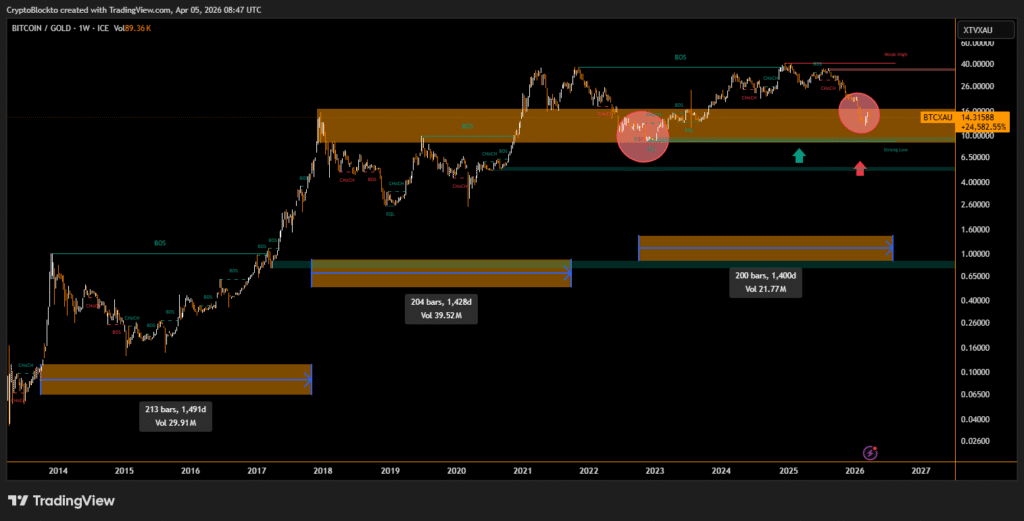
    Bitcoin vs Gold price Chart

    Bitcoin Support and Market Outlook

    The Fidelity executive noted that Bitcoin is currently forming support while trading sideways, appearing poised for the next leg higher. In comparison, gold has recently been relatively sluggish, reinforcing the reversal in capital allocation.

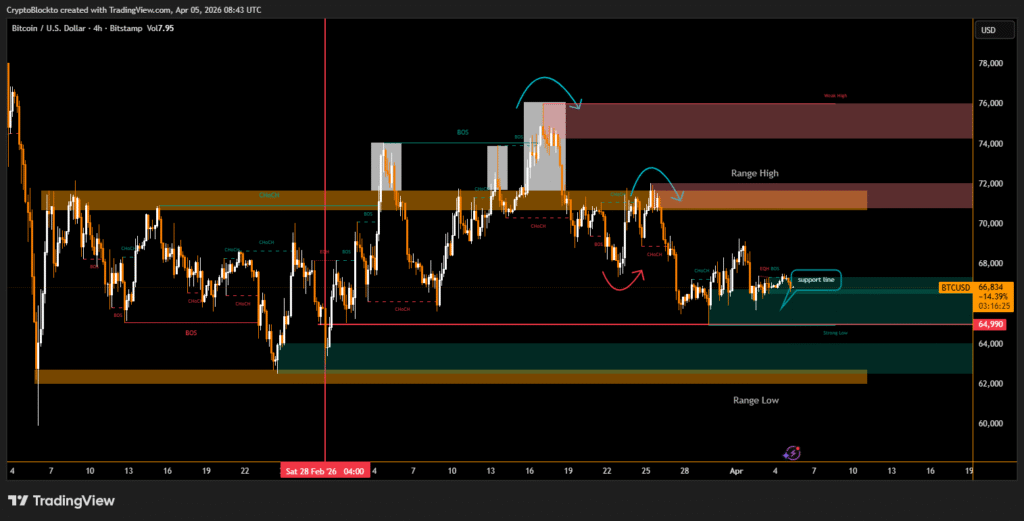
    Bitcoin was trading at $66,800 at the time of reporting, showing a decline of 5.63% over the past 30 days.

    $BTC 4h price chart

    Timmer added that these inter asset fund flows could affect price volatility in the near term, highlighting the importance of tracking short-term investment trends for both crypto and precious metals markets.

    Disclaimer

    This content is for informational purposes only and does not constitute financial, investment, or legal advice. Cryptocurrency trading involves risk and may result in financial loss.
  • Bitcoin Bearish Sentiment Climbs to Five-Week High as FUD Returns to Market

    Bitcoin Bearish Sentiment Climbs to Five-Week High as FUD Returns to Market

    Bearish sentiment surrounding Bitcoin has surged to its highest point in five weeks, reflecting growing fear among crypto market participants. Data from the crypto sentiment platform Santiment shows that negative commentary across social media platforms has increased significantly, signaling a lack of optimism within the community.

    According to Santiment, fear, uncertainty, and doubt (FUD) have reappeared in recent days. The firm analyzed a broad sample of crypto focused accounts on platforms such as X, Reddit, and other social channels to measure the ratio between bullish and bearish Bitcoin (BTC) comments.

    On Saturday, the ratio of bullish to bearish Bitcoin comments dropped to 0.81, the lowest level recorded since Feb. 28. This means there were roughly five bearish comments for every four bullish ones, highlighting a shift toward pessimism among traders.

    Markets Often Move Opposite to Crowd Sentiment

    Santiment noted that financial markets frequently move against prevailing expectations. The firm suggested that rising levels of FUD are often seen as a potential signal that prices could rebound sooner rather than later.

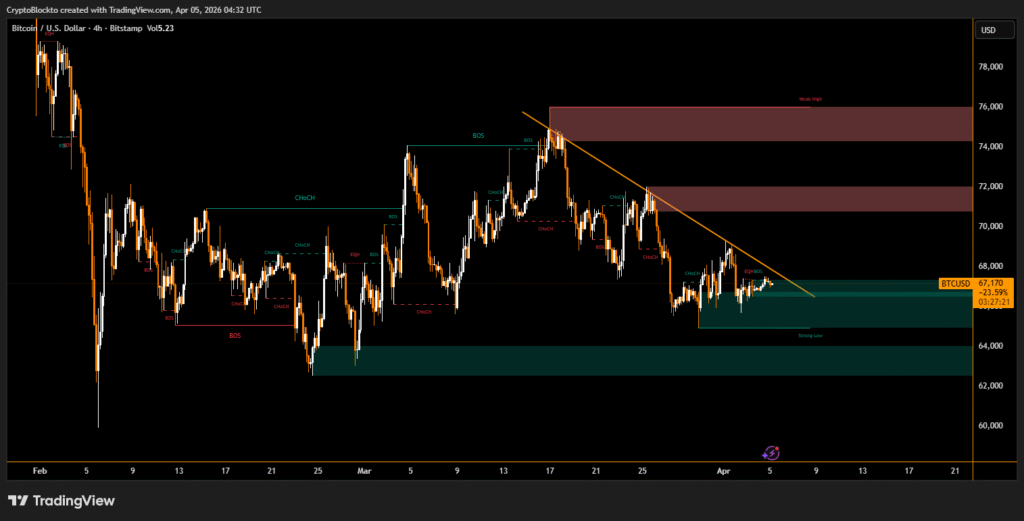
    Bitcoin was trading at $67,170 at the time of reporting, showing a decline of 5.53% over the past 30 days.

    $BTC 4h price chart

    US CLARITY Act and Extreme Fear Index Influence Market Outlook

    Santiment also identified the US CLARITY Act as a possible factor slowing price momentum, describing it as a key “what-if” catalyst being closely watched by the crypto industry.

    Separately, Coinbase chief legal officer Paul Grewal said the legislation is moving toward a markup hearing in the US Senate Banking Committee. He noted that the bill could proceed to a floor vote if senators resolve the ongoing dispute surrounding stablecoin yield and finalize the markup schedule.

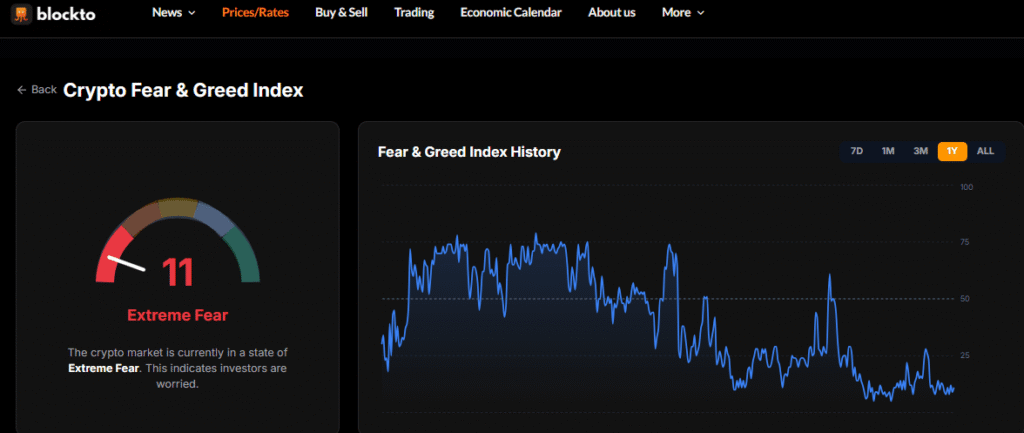
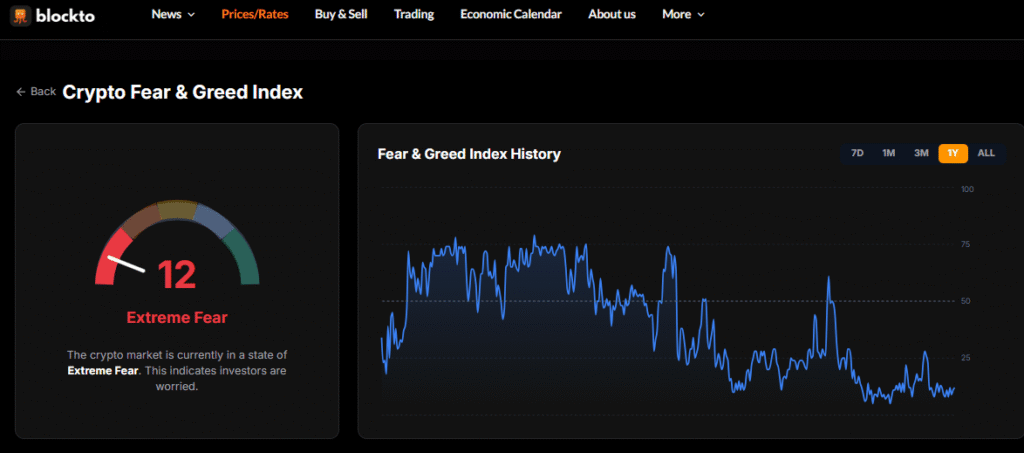
    Meanwhile, the Crypto Fear & Greed Index remained in “Extreme Fear” territory, recording a score of 12 on Sunday, signaling continued caution among investors.

    Disclaimer

    This content is for informational purposes only and does not constitute financial, investment, or legal advice. Cryptocurrency trading involves risk and may result in financial loss.
  • Jimmy Song: Bitcoin Needs a “Conservative” Node Client to Protect Decentralization

    Jimmy Song: Bitcoin Needs a “Conservative” Node Client to Protect Decentralization

    Bitcoin advocate Jimmy Song argued that the Bitcoin ecosystem requires a more “conservative” node client to preserve its monetary integrity and maintain decentralization.

    Song is co founder of ProductionReady, a nonprofit initiative focused on funding open-source Bitcoin node software and educational efforts. He emphasized that their development philosophy favors minimal code changes unless there is overwhelming community agreement.

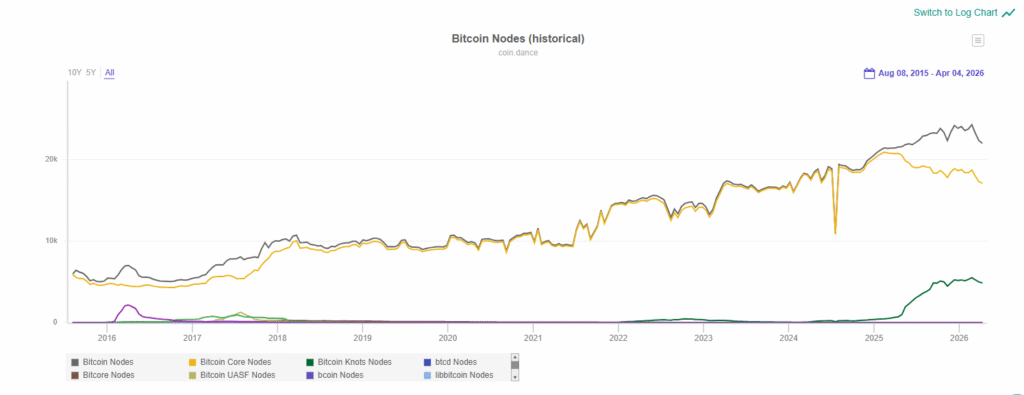
    The number of Bitcoin nodes, broken down by software implementation, between 2016 and 2026: Coin Dance

    His core principle is simple: if developers are uncertain whether a modification improves Bitcoin as money, it should not be implemented. This cautious stance aims to prevent unintended technical changes that could weaken Bitcoin’s reliability as a decentralized financial system.

    Restoring OP_Return Limits to Reduce Network Costs

    One of ProductionReady’s goals is to restore the 83-byte limit on OP_Return, which controls how much arbitrary data can be included in transactions.

    Song warned that increasing this limit significantly raises storage and bandwidth demands on node operators. If running a node becomes expensive, fewer individuals will operate them, increasing the risk of centralization.

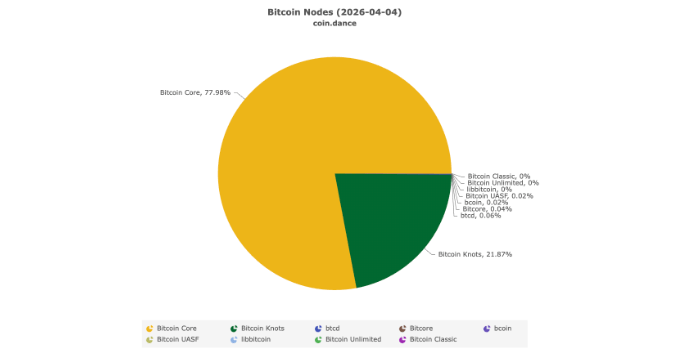
    Bitcoin Core continues to be the software of choice for node runners, with 77.8% of the network :Coin Dance

    Lower operating costs allow more users to run nodes independently, strengthening network security and reducing the chances of transaction fraud or collusion among large operators.

    Bitcoin Core Changes Spark Community Backlash

    The controversy began after the release of Bitcoin Core 30, which increased the OP_Return data limit from 83 bytes to 100,000 bytes. The update received strong criticism from many community members, with the proposal receiving roughly four times more downvotes than upvotes on its GitHub page.

    Following the update, many users migrated to alternative software such as Bitcoin Knots. Adoption of Bitcoin Knots surged dramatically, reaching 4,746 nodes—over 21.7% of the network—compared to roughly 1% usage in 2024.

    Decentralization Remains the Core Goal

    Song stressed that maximizing the number of independent node operators is essential for keeping Bitcoin decentralized and resistant to manipulation. A conservative development model, he argued, ensures that technical upgrades do not unintentionally undermine Bitcoin’s long-term monetary strength or accessibility for everyday users.

    Disclaimer

    This content is for informational purposes only and does not constitute financial, investment, or legal advice. Cryptocurrency trading involves risk and may result in financial loss.

  • Bitcoin Shorts Face $2.5 Billion Liquidation Risk if BTC Reaches $72K

    Bitcoin Shorts Face $2.5 Billion Liquidation Risk if BTC Reaches $72K

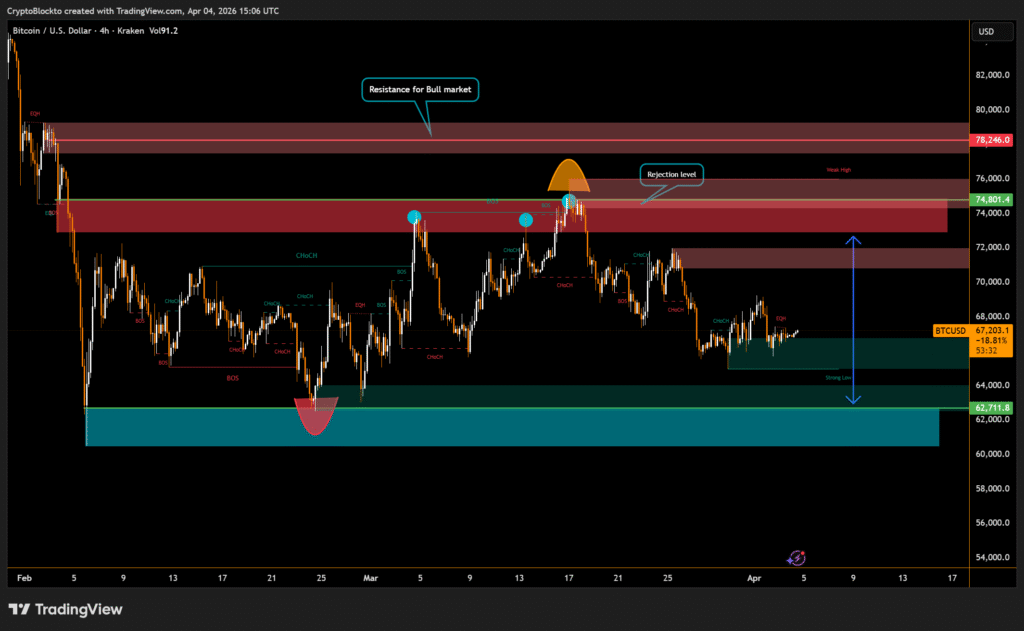
    Bitcoin could be nearing a critical turning point, with roughly $2.5 billion in short positions at risk of liquidation if the price climbs to $72,000. Current estimates show Bitcoin trading near $67,200, meaning a move of about 7.5% could trigger a wave of forced buying that may squeeze bearish traders.

    $BTC 4h price chart

    Bitcoin has struggled to reclaim the $75,000 level since March 17, while bearish futures bets have increased following geopolitical tensions linked to the war involving Iran. Oil prices have surged more than 70% since late February, raising logistics costs and reducing consumer spending, which has added pressure to risk assets like Bitcoin.

    Additional bearish pressure came after MARA Holdings announced it sold 15,133 BTC on March 26, shifting focus toward artificial intelligence computing and reducing Bitcoin reserves to pay down debt.

    ETF Demand and Ceasefire Could Reverse Market Sentiment

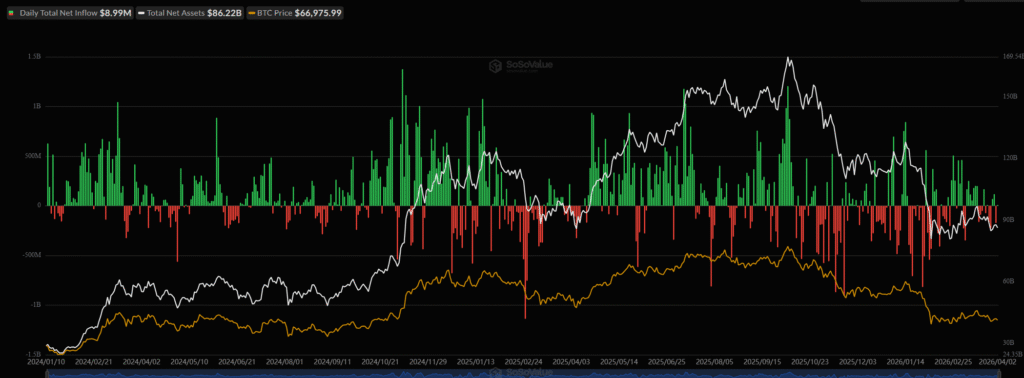
    Despite bearish sentiment, several factors could spark a reversal. Bitcoin previously jumped from $69,150 to $74,900 during a five day period ending March 16, supported by $1.5 billion in net inflows into US-listed Bitcoin exchange-traded funds.

    Market data also shows negative funding rates in perpetual futures, signaling increased confidence among bearish traders and limited demand for leveraged bullish positions.

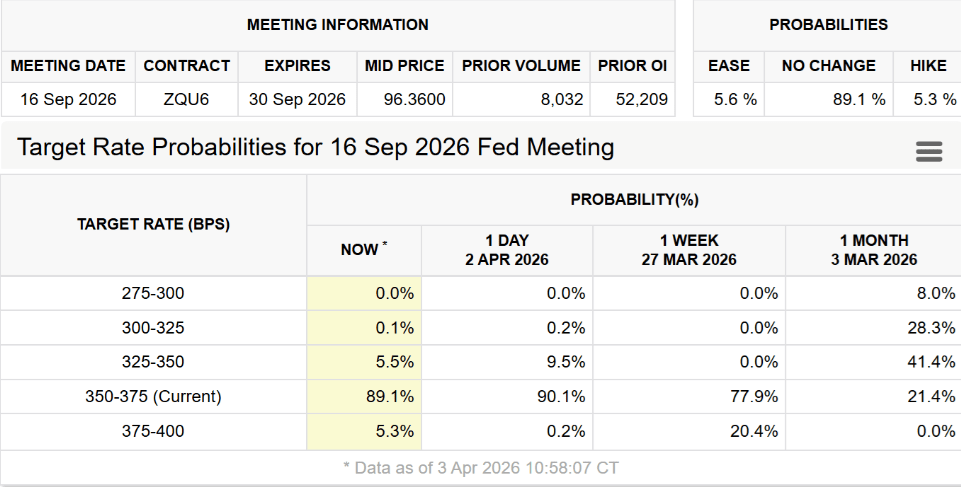
    Interest rate expectations remain steady, with traders pricing an 89% chance that the Federal Reserve will hold rates unchanged through September and only a 5% chance of a hike to 4%.

    Interest rate target odds for the Sept. FOMC meeting.: CME FedWatch Tool

    A potential ceasefire related to the Iran conflict or renewed ETF inflows could rapidly lift Bitcoin toward $72,000, potentially triggering large-scale liquidations and strengthening bullish momentum.

    US-listed Bitcoin ETF daily net flows,
    Disclaimer

    This content is for informational purposes only and does not constitute financial, investment, or legal advice. Cryptocurrency trading involves risk and may result in financial loss.

  • Bitcoin ETFs Expected to Surpass Gold ETFs in Assets, Analyst Says

    Bitcoin ETFs Expected to Surpass Gold ETFs in Assets, Analyst Says

    Spot BTC ETFs could eventually surpass gold ETFs in total assets under management (AUM) as investor interest grows beyond the “digital gold” narrative, according to ETF analyst James Seyffart. Speaking on the podcast, Seyffart highlighted Bitcoin’s multiple roles, including as digital gold, a store of value, a portfolio diversifier, and a form of digital capital and property. He added that the market also views Bitcoin as a “growth risk asset.”

    Bloomberg ETF analyst James Seyffart spoke to Natalie Brunell on podcast.

    Seyffart noted, “There are just more use cases of why somebody would put a Bitcoin ETF in a portfolio,” contrasting this with gold, which primarily serves one purpose.

    ETF Flows Reflect Shifting Investor Preferences

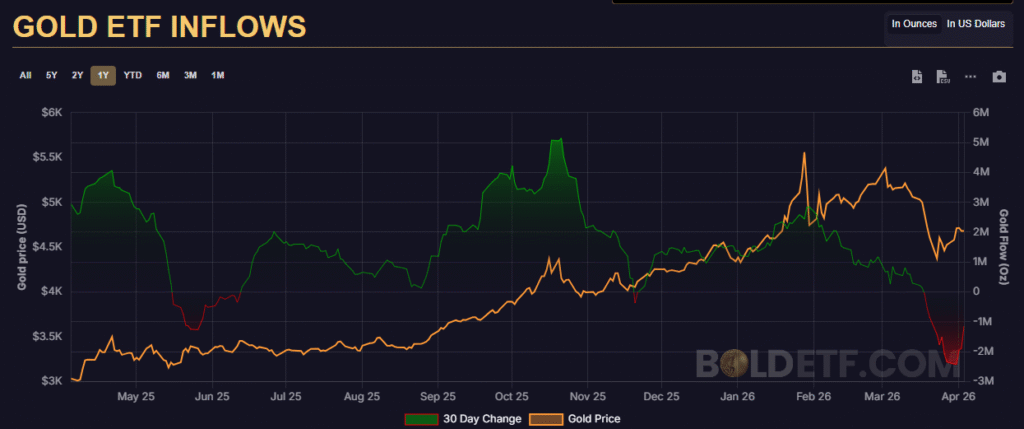
    US based gold ETFs recorded net outflows of $2.92 billion in March, while US spot Bitcoin ETFs saw $1.32 billion in net inflows over the same period. The largest US gold backed ETF, GLD, experienced a $3 billion outflow on March 4, the largest daily withdrawal in over two years.

    Gold ETF Inflows

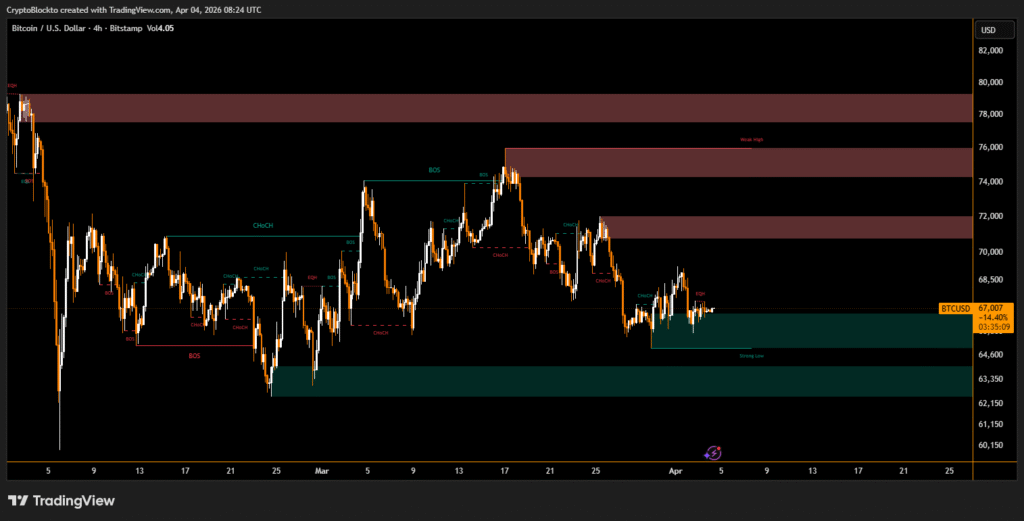
    Despite recent divergences, both Bitcoin and gold have broadly moved in tandem over the past 30 days. Bitcoin is trading around $66,818, down 8%.

    $BTC 4h price chart

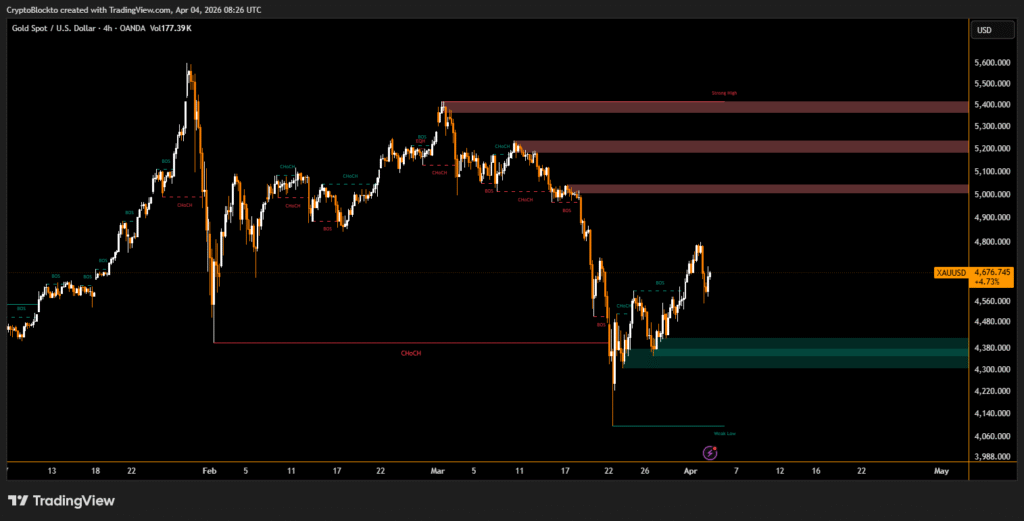
    While gold trades near $4,676, down 8%.

    Gold 4h price chart
    Disclaimer

    This content is for informational purposes only and does not constitute financial, investment, or legal advice. Cryptocurrency trading involves risk and may result in financial loss.
  • Bitcoin Consolidation Could Signal Stronger Breakout, Analysts Say

    Bitcoin Consolidation Could Signal Stronger Breakout, Analysts Say

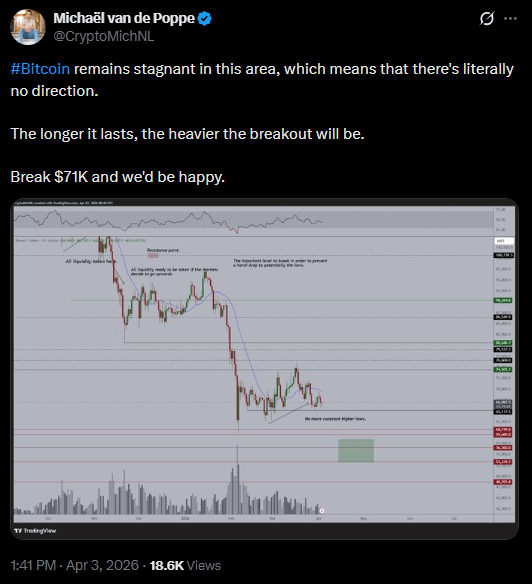
    Bitcoin’s price action has remained largely flat below $70,000, a pattern some analysts suggest could precede a stronger rally. Michael van de Poppe, founder of MN Trading Capital, stated in an X post that “the longer it lasts, the heavier the breakout will be.” He noted that Bitcoin is “stagnant in this area,” pointing to $71,000 as a key level the asset has not reached since March 26.

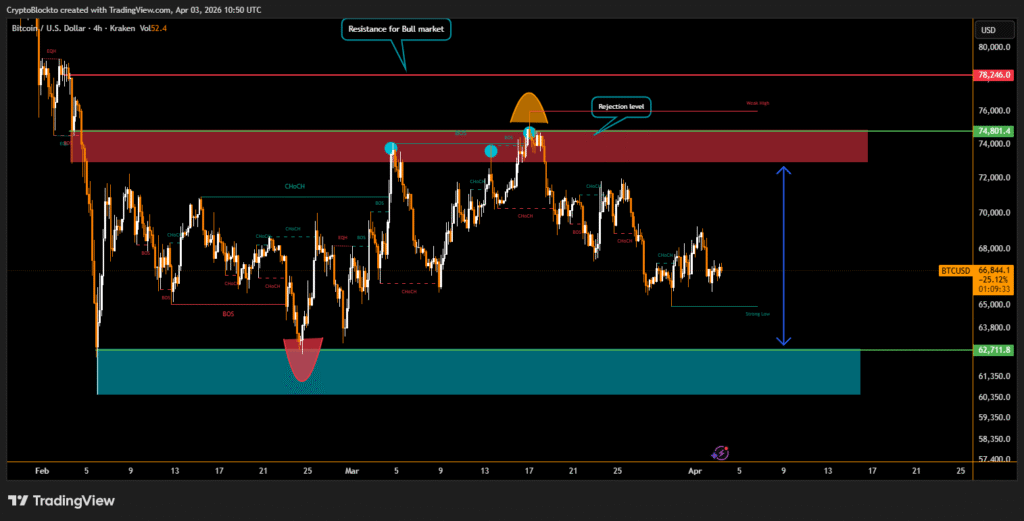
    Since hitting a yearly low of $60,000 on February 6, Bitcoin has been trading within a narrow range of $60,000 to $74,000. At the time of reporting, Bitcoin is trading around $66,890, down 8.25% over the past 30 days according to CoinMarketCap data.

    Bitcoin is down 7.63% over the past 30 days

    Market sentiment reflects ongoing caution, with the Crypto Fear & Greed Index remaining in “Extreme Fear” territory at a score of 11, highlighting uncertainty among investors.

    Disclaimer

    This content is for informational purposes only and does not constitute financial, investment, or legal advice. Cryptocurrency trading involves risk and may result in financial loss.
  • Corporate Bitcoin Treasuries Diverge as BTC Drops Below $70K

    Corporate Bitcoin Treasuries Diverge as BTC Drops Below $70K

    Corporate holders of Bitcoin are beginning to take sharply different approaches as the asset remains under pressure, falling about 46% from its peak to below $70,000. Some firms continue treating Bitcoin as a long term reserve asset while others are reducing exposure to protect liquidity and balance sheets.

    $BTC 4h price chart

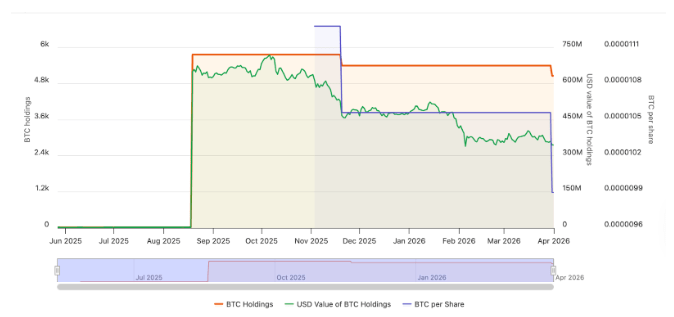
    Nakamoto Holdings moved to sell approximately 284 BTC in March at around $70,400 per coin, totaling roughly $20 million. The sale occurred below its average purchase price, converting unrealized losses into realized ones. The company reduced its holdings to just over 5,000 BTC, using proceeds for working capital and merger-related investments. It also sold millions of shares in Metaplanet at a loss, signaling broader balance-sheet restructuring.

    Nakamoto’s Bitcoin holdings last year: BitcoinTreasuries.NET

    Strategy Maintains Holdings While Pausing New Purchases

    Meanwhile, Strategy, led by Michael Saylor, paused new Bitcoin purchases after months of steady accumulation. Despite the halt, the company still holds roughly 762,000 BTC, maintaining its position as the largest corporate holder of the asset.

    Bitcoin-Backed Bonds and Market Expansion Efforts

    A proposed $100 million Bitcoin backed municipal bond in New Hampshire received a Ba2 speculative-grade rating from Moody’s, reflecting the risks tied to Bitcoin’s volatility. At the same time, digital asset manager CoinShares entered the Nasdaq following a merger with Vine Hill Capital, highlighting continued institutional expansion despite shifting market conditions.

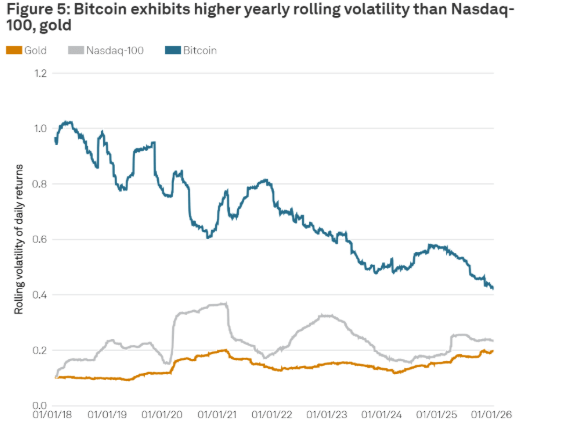
    Bitcoin volatility, cited as a key factor that speculative grade rating, remains elevated compared with traditional asset classes.: S&P Global

    Disclaimer

    This content is for informational purposes only and does not constitute financial, investment, or legal advice. Cryptocurrency trading involves risk and may result in financial loss.

  • Bitcoin Supply in Profit Approaches ‘True Bear Market’ Levels

    Bitcoin Supply in Profit Approaches ‘True Bear Market’ Levels

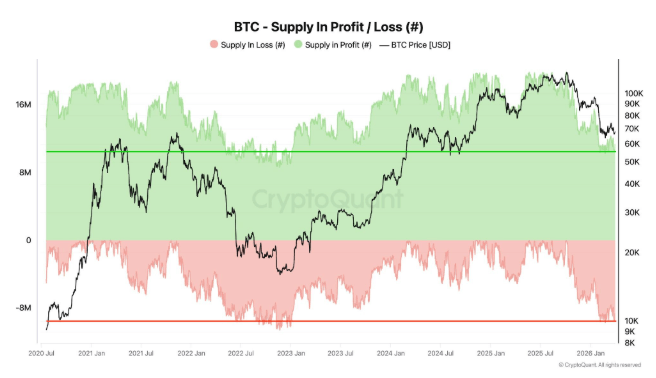
    CryptoQuant data shows that Bitcoin’s supply in profit and loss is approaching levels typical of a bear market. Currently, around 11.2 million BTC are in profit, while 8.2 million BTC are at a loss. The last bear market saw a low of 9 million BTC in profit and 10.6 million BTC at a loss, indicating that current metrics are nearing previous cycle lows.

    Bitcoin in profit and loss at bear market lows

    Analysts Debate Market Implications

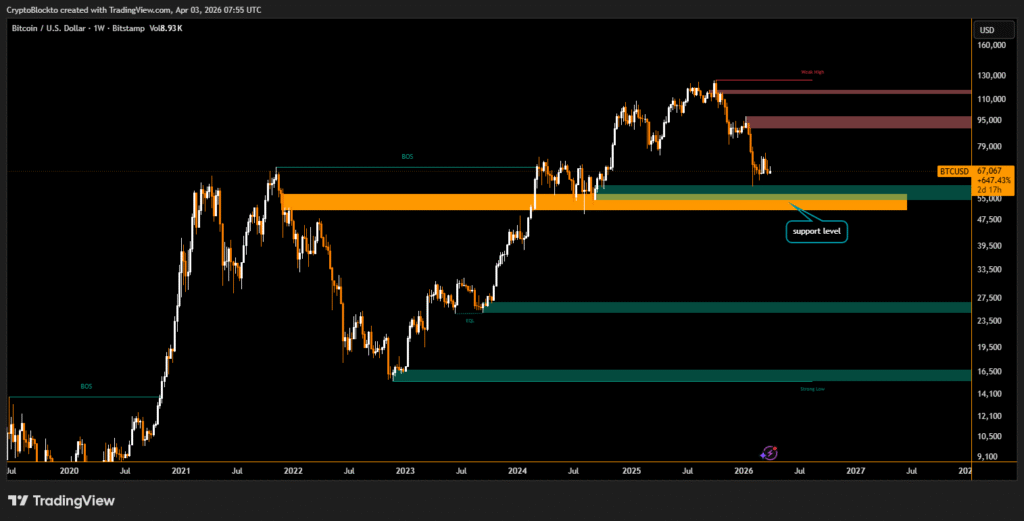
    Andri Fauzan Adziima, research lead at Bitrue exchange, cautioned that these figures indicate increasing market stress rather than immediate undervaluation. He highlighted that true capitulation bottoms involve more extreme metrics, including net unrealized profit/loss (NUPL) and market value to realized value ratio (MVRV), suggesting potential structural support near $55,000 but further downside or consolidation is likely.

    Macro Factors Impacting Recovery

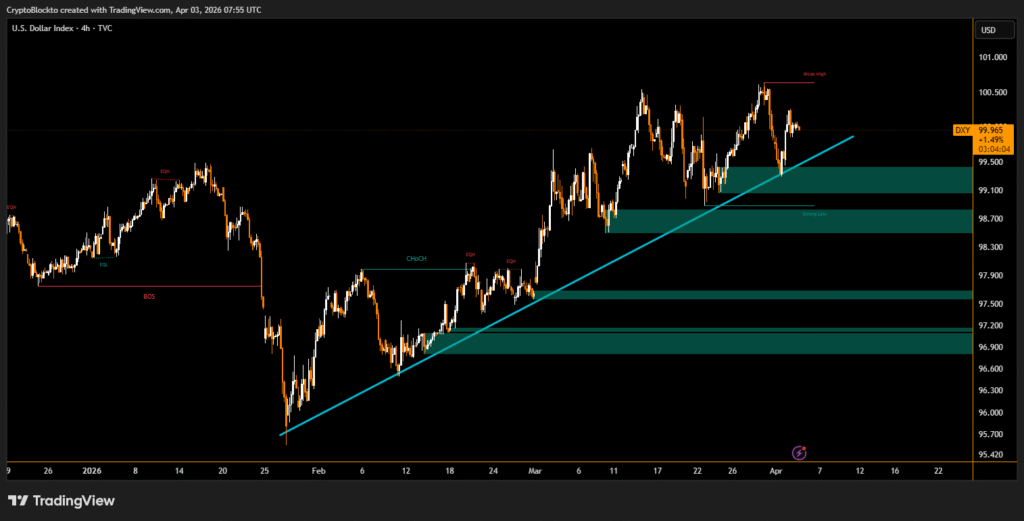
    Bitcoin’s recovery is also hampered by a strong US dollar. Timothy Peterson observed that higher dollar yields and cautious investor sentiment, particularly as the Chinese yuan weakens, limit capital inflows into crypto. The US Dollar Index (DXY) has risen about 5% over the past two months, reducing global liquidity and delaying a potential Bitcoin rebound until late 2026 or 2027.

    Disclaimer

    This content is for informational purposes only and does not constitute financial, investment, or legal advice. Cryptocurrency trading involves risk and may result in financial loss.
  • Crypto Market Consolidates as Bitcoin Holds $67K and Bearish Signals Grow

    Crypto Market Consolidates as Bitcoin Holds $67K and Bearish Signals Grow

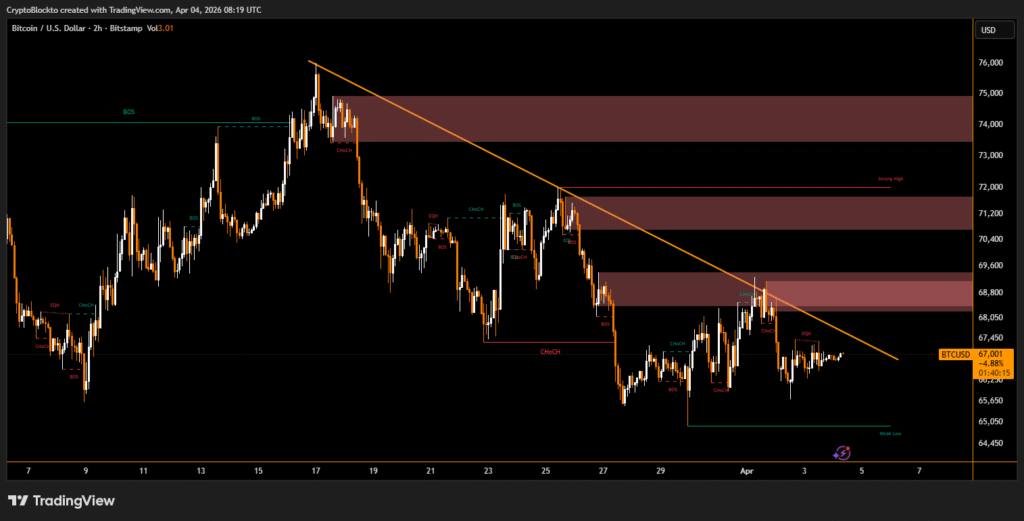
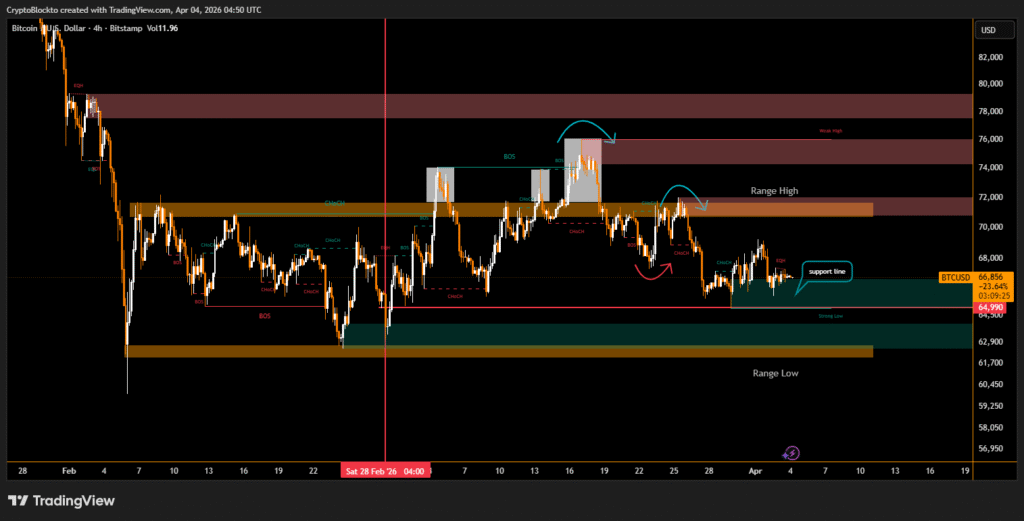
    Bitcoin continued to trade near $67,000, remaining locked within a narrow range that has persisted since early February. The broader trend still reflects a macro downtrend that began in October, marked by repeated lower highs and lower lows.

    $BTC 4h price chart

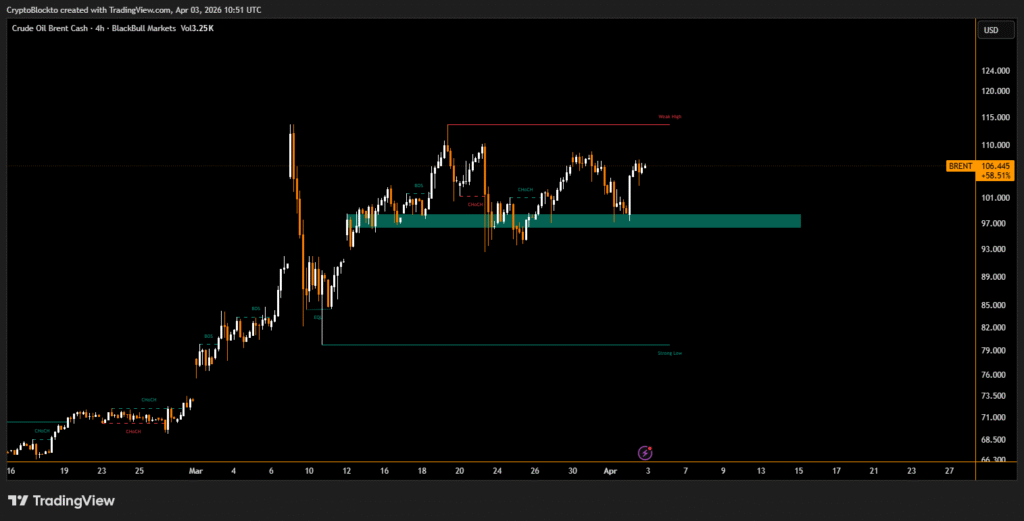
    Market volatility has cooled, while futures activity remained subdued, partly due to thin trading volumes during an extended holiday period. U.S. equities traded mostly flat, reflecting reduced risk appetite across financial markets. Meanwhile, Brent crude oil remained near $107 per barrel, signaling continued uncertainty surrounding global tensions.

    Brent crude oil 4h price chart

    Altcoins Outperform in Low-Liquidity Trading

    Despite Bitcoin’s limited movement, several altcoins recorded gains during lower liquidity trading hours, particularly in Asia. Tokens linked to DeFi and AI sectors showed relative strength, with assets such as ALGO and RENDER posting double-digit gains over the past 24 hours.

    Bearish Derivatives Positioning Raises Caution

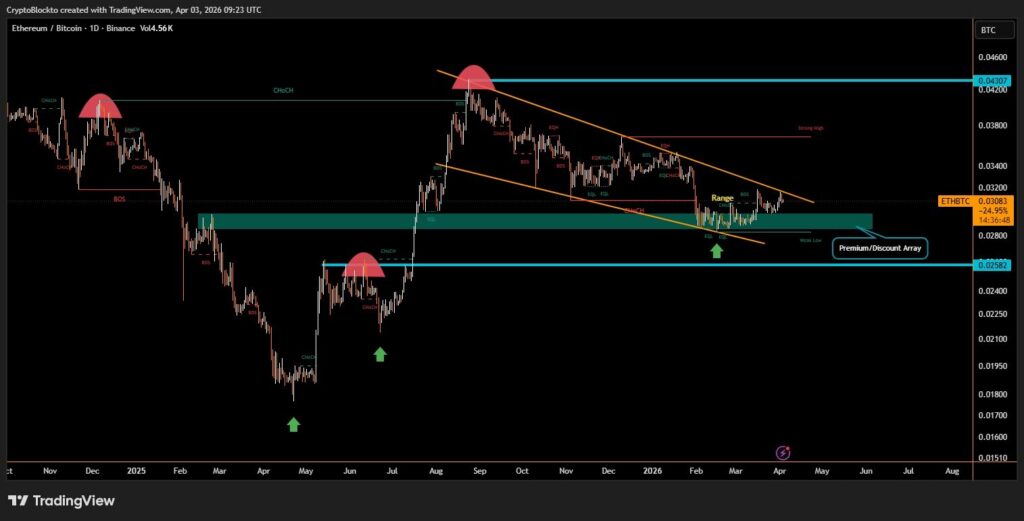
    Derivatives data showed signs of growing bearish sentiment, including negative funding rates and stable open interest levels in Bitcoin and Ethereum futures. Market observers note that altcoin outperformance during consolidation phases often fades once Bitcoin breaks decisively in either direction.

    ETH vs BTC daily price chart
    Disclaimer

    This content is for informational purposes only and does not constitute financial, investment, or legal advice. Cryptocurrency trading involves risk and may result in financial loss.